Humanities

Why Logical People Always Fail in Relationships: Escaping Winning Addiction with a 3-Step Solution

Why Logical People Always Fail in Relationships: Escaping Winning Addiction with a 3-Step Solution

19 min read
Turning Emotions into Strategy: Mastering the 5-Step Law of Conflict Resolution

Turning Emotions into Strategy: Mastering the 5-Step Law of Conflict Resolution

10 min read
It's Not Always Best to Endure: 5 Rational Languages to Master the Situation

It's Not Always Best to Endure: 5 Rational Languages to Master the Situation

10 min read
10 Years of Friendship Ends in an Instant? The 'Invisible Wall' Ruining Your Relationships and 2 Psychological Prescriptions

10 Years of Friendship Ends in an Instant? The 'Invisible Wall' Ruining Your Relationships and 2 Psychological Prescriptions

9 min read

광고

Workplace Conflict: Trying to Win with Logic Leads to Ruin - Crucial Skills for Saving Relationships

Workplace Conflict: Trying to Win with Logic Leads to Ruin - Crucial Skills for Saving Relationships

10 min read
Deceive Your Pretending Brain: Stephen Covey's 5 Steps of Listening and the Psychology of Empathy

Deceive Your Pretending Brain: Stephen Covey's 5 Steps of Listening and the Psychology of Empathy

12 min read
You, the One Carrying the Burden, and Them, the One Evading: Psychological Techniques to Escape the Responsibility Trap

You, the One Carrying the Burden, and Them, the One Evading: Psychological Techniques to Escape the Responsibility Trap

9 min read
How to Turn Conflict into an 'Opportunity': Win-Win Through 5-Step Root Cause Analysis

How to Turn Conflict into an 'Opportunity': Win-Win Through 5-Step Root Cause Analysis

24 min read

광고

Emotion, Reason, Intuition: Decide Like the 'Miracle on the Hudson' with the E-R-I Model

Emotion, Reason, Intuition: Decide Like the 'Miracle on the Hudson' with the E-R-I Model

16 min read
Why Do We Rationally 'Fail'? Understanding Reason with the E-R-I Model

Why Do We Rationally 'Fail'? Understanding Reason with the E-R-I Model

13 min read
Neuroscience to Change Your 'Angry' Self: The Space Between Stimulus and Response

Neuroscience to Change Your 'Angry' Self: The Space Between Stimulus and Response

13 min read
The E-R-I Model: How to Decode Conflict with Emotion, Reason, and Intuition

The E-R-I Model: How to Decode Conflict with Emotion, Reason, and Intuition

11 min read

광고

NASA's $160 Billion Mistake: The Essence of 'Error' Behind It

NASA's $160 Billion Mistake: The Essence of 'Error' Behind It

22 min read
'Yes, but' to 'Yes, and' — Practical methods to build psychological safety

'Yes, but' to 'Yes, and' — Practical methods to build psychological safety

20 min read
"I knew it" — the delusion: how to escape the trap of hindsight bias

"I knew it" — the delusion: how to escape the trap of hindsight bias

18 min read
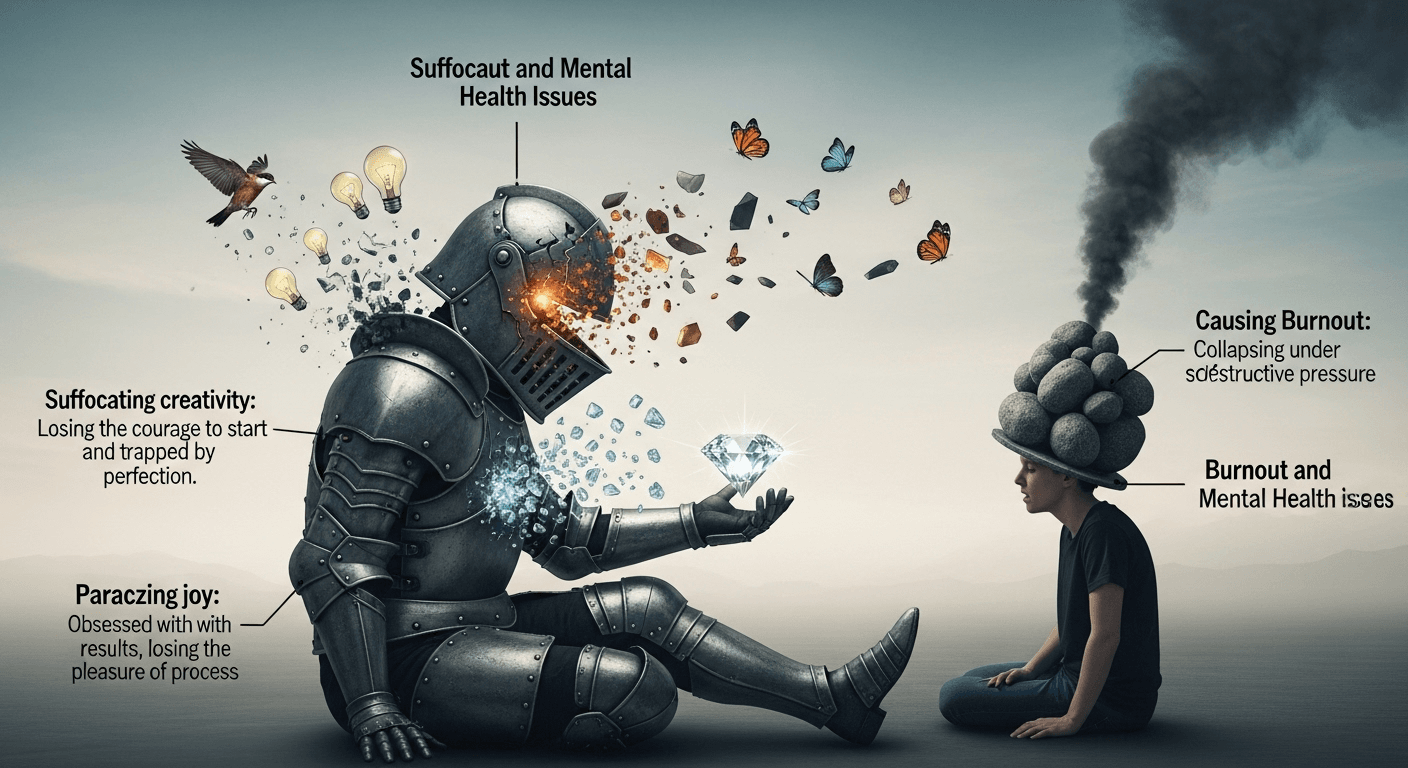
The Prison of Perfectionism: How to Escape the Inner Tyrant That Strangles You

The Prison of Perfectionism: How to Escape the Inner Tyrant That Strangles You

15 min read

광고

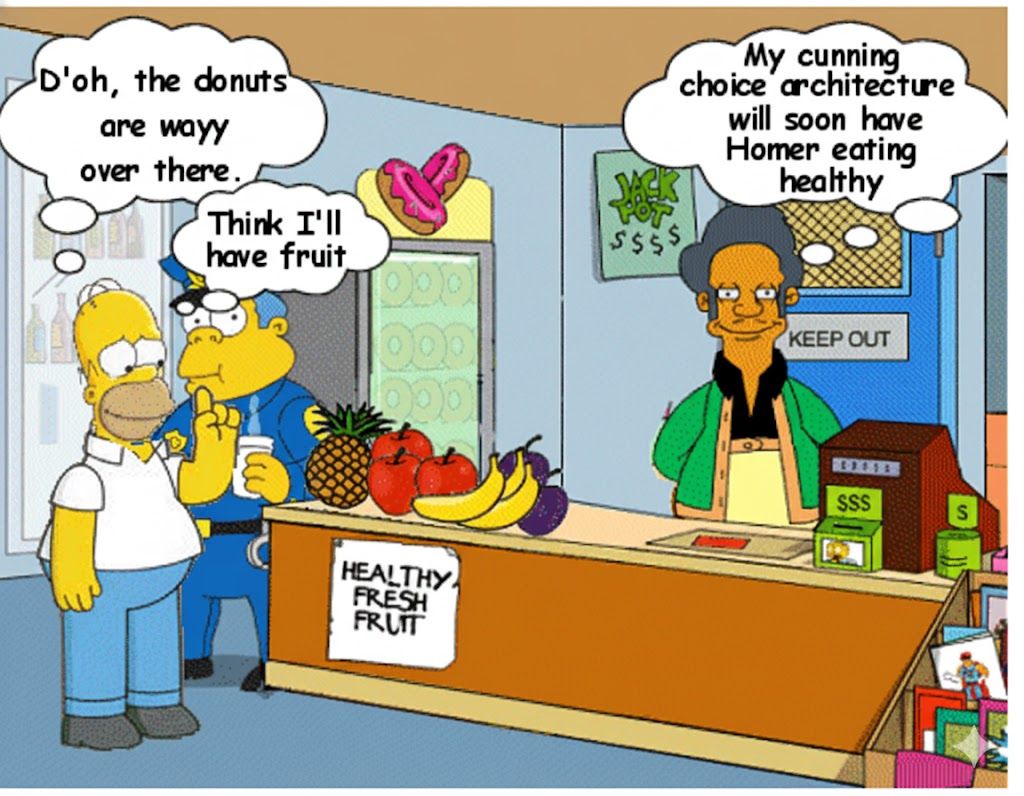
'Nudge's Two Faces: Design That Helps You vs Deceptive Traps

'Nudge's Two Faces: Design That Helps You vs Deceptive Traps

21 min read
Buying Worry: Why Smart You Is Unusually Anxious and the Perfect Escape Plan

Buying Worry: Why Smart You Is Unusually Anxious and the Perfect Escape Plan

16 min read
"Why am I the only one falling behind?" Psychological ways to escape the swamp of comparison

"Why am I the only one falling behind?" Psychological ways to escape the swamp of comparison

14 min read
Culture Reflected in a Drinking Glass: A Comparison of Eastern and Western Drinking Cultures

Culture Reflected in a Drinking Glass: A Comparison of Eastern and Western Drinking Cultures

6 min read

광고

100% Trap: The Smartest Mistake You Didn’t Know About — Perfectionism

100% Trap: The Smartest Mistake You Didn’t Know About — Perfectionism

14 min read
How to Handle Criticism Like Steve Jobs: 4 Psychological Steps to Protect Your Inner Self

How to Handle Criticism Like Steve Jobs: 4 Psychological Steps to Protect Your Inner Self

13 min read
When Your Positivity Becomes Poison: 3 Strategies to Avoid Blind Optimism

When Your Positivity Becomes Poison: 3 Strategies to Avoid Blind Optimism

20 min read
"Thinking 'It's all my fault' — Why it was your smartest mistake","Are you blaming yourself saying, 'This is my fault too'? That thought may actually be a 'psychological armor' your mind developed to protect you. Uncover the nature of the cognitive distortion called 'personalization' and discover practical ways to break the cycle of self-blame.","![Personalization](https://pub-69e75e95c2a24d169ba7d738dadaead6.r2.dev/Personalization_ff36cbddcf/Personalization_ff36cbddcf.jpg)\n\nDo you sometimes hear a voice deep inside that **\*\*says, \"This is all my fault\"\*\***? We often take that voice as evidence of weakness or a character flaw that needs fixing.\n\nBut what if that thought is actually the \*\*trace of the most sophisticated and clever survival strategy you learned to get by\*\*? More precisely, what if it is the \*\*\*\*'psychological armor'\*\*\*\* that your past self forged to impose order and regain a sense of control in a confusing world?\n\nThis piece will be a journey to dissect that worn and heavy armor — in other words, to **expose the true nature of 'self-blame' and explore how to safely let it go**. In psychology, this pattern of thinking is defined as a cognitive distortion called **'personalization'**. Personalization is a mental filter that makes you feel personally responsible for events over which you have little or no control. Unfortunately, this elaborate filter often underlies depression, anxiety, and low self-esteem.\n\nOver the next four chapters we will dissect the structure of this clever mistake.\n\n1.  We will observe the **mechanism** of how an offhand remark in daily life can transform into a storm of self-blame.\n2.  From a **neuroscientific perspective**, we will understand why this blaming voice gets louder and more persistent under stress and overload.\n3.  We will trace the deep and painful **origins** of this thought pattern.\n4.  Based on all this understanding, we will learn **concrete methods** to unlock the shackles of the thought 'it's all my fault.'\n\nThis is not a journey to shame yourself. I promise this is a journey to understand the smartest mistake that once protected you, and finally to free yourself from it.\n\n## 1. "Let's talk tomorrow": When one phrase becomes a storm of self-blame\n\nEvery story starts with an 'interpretation.' The same event can open up entirely different realities depending on the lens we wear. Especially, the lens of 'it's all my fault' is a powerful one that distorts every neutral signal in the world into an attack or criticism directed at you.\n\n!['The glasses of "It's all my fault"'](https://pub-69e75e95c2a24d169ba7d738dadaead6.r2.dev/_2d5980ef7b/_2d5980ef7b.png)\n\nLet's take a concrete scenario to look closely at how this lens operates.\n\n**The event: an email**\n\nOne late afternoon before a project deadline, Minjun, a mid-level manager at an IT company, sent an update email summarizing the project's progress to his team and Director Park.\n\nA few hours later, a notification chimed. A short reply from Director Park arrived as a 'reply all.' It contained just one sentence.\n\n> "Let's discuss the details at tomorrow's meeting."\n\nObjectively, this email is neither more nor less than a fact. Yet that single sentence created a huge ripple inside Minjun.\n\n*   **Reaction A (depersonalized interpretation):**  \n    One team member reads the email, shrugs, and thinks, "Great, I'll get a chance to align things at tomorrow's meeting. The director must be busy today." This is a neutral, fact-based interpretation of the situation.\n*   **Reaction B (personalized interpretation — inside Minjun):**  \n    Minjun's mind begins to write a completely different narrative. He feels his chest drop slightly. "Did I write something wrong? Is the report formatted incorrectly? The director must think my report is inadequate. I ruined everything. I ruined the project's good momentum."\n\n![Personalized vs Depersonalized Interpretation](https://pub-69e75e95c2a24d169ba7d738dadaead6.r2.dev/_a23bf7fd83/_a23bf7fd83.png)\n\n### The structure of self-blame: the main culprit 'personalization' and three accomplices\n\nWhat happened inside Minjun was not mere worry. It was a powerful negative feedback loop created by several cognitive distortions working together.\n\n*   **Main culprit: Personalization**  \n    At the center of this reaction is 'personalization.' Minjun connected the external, neutral event of Director Park's short email directly to an internal flaw ("I'm incompetent").\n*   **Accomplice 1: Mind Reading**  \n    Minjun assumes he can read Director Park's mind. The thought "He must think my report is insufficient" is a 'mind reading' distortion that declares someone else's thoughts without evidence.\n*   **Accomplice 2: Emotional Reasoning**  \n    After reading the email, Minjun feels anxious and ashamed. He uses that feeling as evidence of reality: "I feel incompetent, therefore I must be incompetent."\n*   **Accomplice 3: Mental Filter**  \n    Minjun ignores the many positive facts about having successfully led the project so far. His mental filter focuses only on the single, negatively perceived cue: 'the short email.'\n*   ![Personalization, Mind Reading, Emotional Reasoning, Mental Filter](https://pub-69e75e95c2a24d169ba7d738dadaead6.r2.dev/Mental_Filter_etc_c72f9a2d80/Mental_Filter_etc_c72f9a2d80.webp)\n\nThus the thought 'it's all my fault' is not a single mistake but rather a chorus of cognitive distortions joining forces. The problem is that this chorus is so familiar and automatic that we mistake it for reality.\n\nThe pain does not come from Director Park's email itself but entirely from Minjun's **interpretation** — the personalized story he told himself.\n\nRealizing this is the first step toward change. This is not just a thought but almost an automatic **cognitive reflex**. Our first intervention is not to force ourselves to 'think differently' but to simply notice, without judgment, that the reflex has activated.\n\n---\n\n## 2. Why does self-blame get worse when you're exhausted? (a neuroscience view)\n\nWhy was Minjun's reaction so extreme? The day he received the email was the last week of a long, stressful quarter. He had been sleep-deprived for days and his mental energy was nearly depleted.\n\nWhen our **brain is overloaded, the thought 'it's all my fault' transforms from a simple voice into a scream that rips the ears**.\n\n### A besieged brain: cognitive overload and negativity bias\n\nOur brain is not a supercomputer with infinite resources. When under high stress and dealing with a lot of information — in a state of **'cognitive load'** — the brain loses the capacity for nuanced thinking and relies on energy-saving shortcuts.\n\n![Cognitive Load](https://pub-69e75e95c2a24d169ba7d738dadaead6.r2.dev/Cognitive_Load_3a4a751f30/Cognitive_Load_3a4a751f30.webp)\n\nOne of the brain's strongest shortcuts in this state is the **\*\*'negativity bias'\*\***. This mechanism evolved for survival, making us pay far more attention to potential threats or negative information than to positive information. That's why one criticism sticks longer than ten compliments.\n\nIn a stress-primed state, the brain turns up the volume on this negativity bias. The neutral email from Director Park is no longer just information. Minjun's brain classifies it as a potential **'social threat'** and immediately sets off an alarm.\n\n![Negativity Bias](https://pub-69e75e95c2a24d169ba7d738dadaead6.r2.dev/Negativity_Bias_c260e15e33/Negativity_Bias_c260e15e33.jpg)\n\n### The avalanche of thought: from personalization to catastrophizing\n\nAmplified threat perception is the perfect catalyst for an avalanche of thoughts. In psychology this avalanche is called **\*\*catastrophizing\*\***: magnifying current difficulties into the worst‑case scenario.\n\n![Catastrophizing](https://pub-69e75e95c2a24d169ba7d738dadaead6.r2.dev/Catastrophizing_9f19ba40d2/Catastrophizing_9f19ba40d2.webp)\n\nMinjun's thought process is a textbook example of catastrophizing.\n\n1.  **Initial thought (personalization):** "There is something wrong with my email, so the director is upset."\n2.  **Chain reaction (the avalanche begins):** "The team will all see me as incompetent."\n3.  **Worst‑case scenario (catastrophizing):** "I'll be excluded from this project. Maybe I'll get fired. My life will be ruined."\n\nThe brain tries to protect itself by predicting the worst based on past dangerous experiences — sadly, very cleverly.\n\n### The relentless loop of thought: a stress feedback loop\n\nHere we find a crucial fact: stress, personalization, and catastrophizing form a mutually amplifying vicious cycle — a **feedback loop**.\n\n> **Stress** (depleted cognitive resources) → **Personalization** ("it's my fault") → **Catastrophizing** ("I'll be fired") → **Stress hormone release** (bodily threat response) → **More severe stress** (further cognitive depletion) → **Stronger personalization** ...\n\n![Personalization feedback loop](https://pub-69e75e95c2a24d169ba7d738dadaead6.r2.dev/_190c6c932d/_190c6c932d.png)\n\nUnderstanding this vicious cycle is vital. It explains why deciding to "think positively" in the middle of a spiral of thoughts is so difficult.\n\nIn short, the overwhelming voice of self-blame filling your head is not evidence that the situation is truly terrible. It is an emergency signal that **your brain has switched into primitive survival circuits because of overload**. Those thoughts are **symptoms**, not accurate diagnoses of the situation.\n\n---\n\n## 3. Where did that thought originate: the broken vase and moral defense\n\nWhy have we developed such an elaborate and painful program of self-blame? Why does Minjun's brain default to the script 'it's all my fault'?\n\nTo answer that, we must go back in time to the moment this program was first encoded.\n\n### The origin of the script: a broken vase\n\nYoung Minjun was playing in the living room when he accidentally knocked over his mother's most cherished vase, shattering it into pieces. With a sharp crashing sound and already worn out from work and daily pressures, his mother exploded: "Can't you be careful? Why do you keep making things hard for me?"\n\nA child's brain cannot analyze the situation like an adult. For a child, the mother is the center of the world and the source of survival. If the mother seems unhappy, the child assumes responsibility. At that moment the child's brain makes a desperate survival calculation.\n\n"Mom is unhappy. I caused it. This is my fault. If I become a 'good child,' Mom won't be unhappy anymore."\n\n### The birth of psychological armor: 'moral defense'\n\n![Unconscious resistance to protect oneself](https://pub-69e75e95c2a24d169ba7d738dadaead6.r2.dev/_ea479d2ddb/_ea479d2ddb.jpg)\n\nThis is the moment psychoanalysts call the birth of a **\*\*'moral defense'\*\***. For a child wholly dependent on caregivers, believing "I am a bad child who makes my caregiver unhappy" paradoxically feels safer than thinking "the caregiver is unpredictable and hurtful."\n\n**By turning blame toward itself, the child gains a paradoxical sense of control.** The belief "If this is my fault, then I can fix it by behaving better" offers hope. This is the first piece of the armor called 'self-blame' — the smartest mistake for survival.\n\nRepeated experiences like this imprint deep **\*\*core beliefs\*\*** in the unconscious, such as "I am responsible for other people's emotions" or "I am fundamentally flawed."\n\n### The only one you really keep messing up with\n\nThe chapter title, 'the person you frequently make mistakes with,' is actually a trick question. The person you keep failing with is not your boss, partner, or friend.\n\n#### **The only person you keep making mistakes with is yourself.**\n\nThe mistake is applying childhood survival patterns to yourself as an adult — constantly criticizing and blaming yourself.\n\nMinjun's intensified self-blame in front of an authority figure like Director Park happens because that dynamic triggers attachment patterns similar to childhood. His reaction to the director's cold email resembles the desperate response of the child who blamed themselves for the broken vase decades earlier.\n\nThus, _your inner critic is not merely a bad habit but a distorted echo of a deep desire to protect relationships and stay connected_. Now it is time to redirect that loyalty and protective instinct from others back toward yourself.\n\n---\n\n## 4. How to take off the old armor: two prescriptions for the person saying 'it's all my fault'\n\nWe now understand where the thought 'it's all my fault' comes from, how it operates, and why it intensifies under stress. Next, we'll explore concrete, practical methods to shed this old armor and move toward a lighter, freer life.\n\nThere are two approaches. One is a 'head' approach — directly addressing distorted thoughts — and the other is a 'heart' approach — healing the emotional wounds at the root of those thoughts.\n\n### Strategy 1. [Head] Rewriting the script of thought (Cognitive Restructuring)\n\n![Principles of CBT (Cognitive Behavioral Therapy)](https://pub-69e75e95c2a24d169ba7d738dadaead6.r2.dev/CBT_06a8b0b500/CBT_06a8b0b500.svg)\n\nThis approach is based on the principles of Cognitive Behavioral Therapy (CBT). The core idea is that our emotions are determined more by our 'thoughts' or 'interpretations' of events than by the events themselves. It is a **training** to become an active participant in your thoughts rather than a passive bystander.\n\n**Step 1: Catch the automatic thought**  \nThe first task is to catch the automatic thought 'it's all my fault' in the moment. Notice the moment self-blame arises and write the thought down without judgment. (Example: "Director Park was annoyed because my email was terrible.")\n\n**Step 2: Gather evidence**  \nNow become a detective and collect objective evidence.\n\n*   _Evidence supporting the thought:_ "His reply was shorter than usual."\n*   _Evidence against the thought:_ "He's very busy. It's the end of the quarter. There were no negative words in the email. He scheduled a meeting to discuss it tomorrow."\n\n**Step 3: Challenge the distortion**  \nBased on the evidence, ask questions. "Is there another way to view this situation?", "Is this outcome 100% my responsibility?", and the most powerful question: **"If my closest friend were in the same situation, what would I say to them?"**\n\n**Step 4: Create a balanced alternative thought**  \nThe goal is not blind positivity but realism.\n\n*   _Alternative thought:_ "Director Park's short reply momentarily startled me, but the most likely explanation is that he was trying to communicate efficiently amid a busy schedule. My anxiety is my interpretation, not an objective measure of my work performance."\n\nTo help this process, you can use a **\*\*Cognitive Restructuring Worksheet\*\***.\n\n| Situation | Automatic Thought & Emotion | Evidence Against the Thought | Balanced Alternative Thought |\n| --- | --- | --- | --- |\n| **Example: Boss sent a short email.** | "My report was awful so he's upset." (Anxiety, shame 90%) | He's very busy. It's quarter end. A meeting was scheduled. There were no negative words. | "His short reply probably reflects his busy schedule. My anxiety is an automatic interpretation, not necessarily fact." |\n| **Example: A friend canceled plans.** | "They're avoiding me because I'm annoying." (Sadness, rejection 80%) | The friend said they haven't been feeling well. Something urgent may have come up. They apologized multiple times. | "I'm upset that a plan was canceled, but they likely have a valid reason. This does not define our entire relationship." |\n\n### Strategy 2. [Heart] Healing inner wounds (Self-Compassion)\n\nIf the cognitive approach targets the 'head,' self-blame is actually a 'heart' problem. Deep emotional wounds of shame and inadequacy lie at its root. The most effective remedy for these wounds is **\*\*self-compassion\*\***.\n\n![Self-Compassion](https://pub-69e75e95c2a24d169ba7d738dadaead6.r2.dev/Self_Compassion_566189c089/Self_Compassion_566189c089.png)\n\nAccording to psychologist Kristin Neff, self-compassion consists of three core elements.\n\n1.  **Self-Kindness:** Treating yourself with warmth and understanding rather than harsh judgment when you make mistakes.\n2.  **Common Humanity:** Recognizing that suffering and failure are part of the shared human experience, not something you suffer alone.\n3.  **Mindfulness:** Observing painful thoughts and feelings without suppression or exaggeration, holding them in balanced awareness.\n\nHere are concrete self-compassion exercises you can practice daily.\n\n*   **Exercise 1: Speak to yourself like a friend**  \n    The classic and powerful method. Imagine your closest friend in Minjun's situation. What would you say? "It's okay, don't worry so much. The director's busy. You worked hard." Now say those warm, supportive words to yourself in the mirror.\n*   **Exercise 2: Write a compassionate letter**  \n    Imagine a friend or wise mentor who loves and supports you unconditionally. From their perspective, write a letter to your struggling self. Describe your difficulties, your self-blame and shame, and offer deep understanding, compassion, and encouragement.\n*   **Exercise 3: Be a compassionate observer (Three Chairs)**  \n    Close your eyes and imagine three chairs. In the first sits your harsh 'inner critic'; in the second sits the 'accused, shrinking you'; in the third sits the wise, warm 'compassionate observer.' From the observer's standpoint, watch the exchange between the critic (likely trying to protect you) and the accused (fearful). Then, have the observer send compassion to both sides, integrating the inner conflict toward a peaceful resolution.\n\n---\n\n## Conclusion: The courage to gratefully lay down old armor\n\nThe journey out of 'it's all my fault' requires two wings. If **cognitive restructuring** is the 'skill' that repairs the old sail and steers the rudder of your ship, then **self-compassion** is the 'strength' that calms rough waves and creates a tranquil sea for sailing. Together they produce the most powerful synergy.\n\nAt the start we compared self-blame to armor. At the end of this journey, we should not hate or destroy the armor that once protected you. Instead, understand how desperately it tried to keep you safe and offer gratitude for its effort.\n\nThen declare that you now stand in a safer, more mature world where that heavy armor is no longer needed.\n\nTo unlock the shackles of the thought 'it's all my fault' is to have the courage to put down the heavy armor, to risk being hurt, to embrace imperfection, and above all to become a warm friend to yourself.\n\nIt is the beginning of a lifelong, magnificent journey of learning to live with an open heart, a compassionate mind, and a resilient spirit.\n\n---\n\n<details><summary>Details</summary>\n\n1.  Cognitive restructuring strategies: Breaking cognitive distortions: practical strategies - FasterCapital\n2.  Five cognitive distortions and their examples in cognitive approaches - HappyCampus\n3.  Cognitive distortions: psychological traps that distort thinking - JapHakSeoGo\n4.  How To Avoid Taking Everything Personally - Pattison Professional Counseling and Mediation Center\n5.  Personalization: A Common Type of Negative Thinking - Therapy Now SF\n6.  Addressing Personalization: Overcoming Cognitive Distortions - Bay Area CBT Center\n7.  Five ways to deal with problem situations without distortion - MeetingDesignLab\n8.  15 common cognitive distortions - Reddit (r/raisedbynarcissists)\n9.  15 thinking styles that lead to massive anxiety 6/15: Personalization - Anxiety Ireland\n10.  Cognitive distortion - Wikipedia, the free encyclopedia\n11.  Neuroscience of bias: Module 3 - NCCC\n12.  Negativity bias - Wikipedia\n13.  Negativity Bias: Meaning, Psychology, And Examples - Octet Design Studio\n14.  What Is The Negativity Bias and How Can it be Overcome? - Positive Psychology\n15.  Not all emotions are created equal: The negativity bias in social-emotional development - (PMC, NCBI)\n16.  Catastrophizing: Why We Spiral Into Worst-Case Scenarios - Psychology Today\n17.  Catastrophizing and Decatastrophizing: A Comprehensive Guide - Positive Psychology\n18.  What doctors wish patients knew about stopping catastrophic thoughts - (AMA-ASSN)\n19.  Catastrophizing - Psychology Today\n20.  What is catastrophizing? 6 ways to stop catastrophic thinking - MedicalNewsToday\n21.  Catastrophising: why we do it and how we stop - Priory Group\n22.  I messed up, so love me... 'The psychology of self-blame' - Hankyoreh\n23.  5 Common Ways We Engage in Self-Blame - Psychology Today\n24.  Fear of negative evaluation, causes and coping (FNE - social anxiety) - Mind Picnic Counseling Center\n25.  Self-critical tendency (Self-Criticism) symptoms and counseling FAQ - Mind Picnic Counseling Center\n26.  Self-hatred - Namuwiki\n27.  The Relationship between Mindfulness and Shame: Moderated Mediating Effect of Self-Blame and Self-Compassion for College Students - (stress: stress)\n28.  CBT Cognitive Behavioral Therapy - The Tree Group\n29.  Cognitive behavioral therapy - Wikipedia, the free encyclopedia\n30.  Cognitive Behavior Therapy - KOCW, Kangnam University YJ\n31.  Cognitive therapy for depression - Samsung Medical Center\n32.  What is cognitive behavioral therapy? - (cbt.or.kr)\n33.  Self-compassion - Wikipedia, the free encyclopedia\n34.  'Self-compassion' that makes life happy - Distancing\n35.  Validation study of the Korean version of the Self-Compassion Scale among community-dwelling adult women - (Self-Compassion.org, Ewha Womans University)\n36.  OA Journal - The role of self-compassion in emotion regulation - Korean Journal of Health Psychology\n37.  Compassion-Focused Therapy - Wikipedia  \n    </details>

"Thinking 'It's all my fault' — Why it was your smartest mistake","Are you blaming yourself saying, 'This is my fault too'? That thought may actually be a 'psychological armor' your mind developed to protect you. Uncover the nature of the cognitive distortion called 'personalization' and discover practical ways to break the cycle of self-blame.","![Personalization](https://pub-69e75e95c2a24d169ba7d738dadaead6.r2.dev/Personalization_ff36cbddcf/Personalization_ff36cbddcf.jpg)\n\nDo you sometimes hear a voice deep inside that **\*\*says, \"This is all my fault\"\*\***? We often take that voice as evidence of weakness or a character flaw that needs fixing.\n\nBut what if that thought is actually the \*\*trace of the most sophisticated and clever survival strategy you learned to get by\*\*? More precisely, what if it is the \*\*\*\*'psychological armor'\*\*\*\* that your past self forged to impose order and regain a sense of control in a confusing world?\n\nThis piece will be a journey to dissect that worn and heavy armor — in other words, to **expose the true nature of 'self-blame' and explore how to safely let it go**. In psychology, this pattern of thinking is defined as a cognitive distortion called **'personalization'**. Personalization is a mental filter that makes you feel personally responsible for events over which you have little or no control. Unfortunately, this elaborate filter often underlies depression, anxiety, and low self-esteem.\n\nOver the next four chapters we will dissect the structure of this clever mistake.\n\n1. We will observe the **mechanism** of how an offhand remark in daily life can transform into a storm of self-blame.\n2. From a **neuroscientific perspective**, we will understand why this blaming voice gets louder and more persistent under stress and overload.\n3. We will trace the deep and painful **origins** of this thought pattern.\n4. Based on all this understanding, we will learn **concrete methods** to unlock the shackles of the thought 'it's all my fault.'\n\nThis is not a journey to shame yourself. I promise this is a journey to understand the smartest mistake that once protected you, and finally to free yourself from it.\n\n## 1. "Let's talk tomorrow": When one phrase becomes a storm of self-blame\n\nEvery story starts with an 'interpretation.' The same event can open up entirely different realities depending on the lens we wear. Especially, the lens of 'it's all my fault' is a powerful one that distorts every neutral signal in the world into an attack or criticism directed at you.\n\n!['The glasses of "It's all my fault"'](https://pub-69e75e95c2a24d169ba7d738dadaead6.r2.dev/_2d5980ef7b/_2d5980ef7b.png)\n\nLet's take a concrete scenario to look closely at how this lens operates.\n\n**The event: an email**\n\nOne late afternoon before a project deadline, Minjun, a mid-level manager at an IT company, sent an update email summarizing the project's progress to his team and Director Park.\n\nA few hours later, a notification chimed. A short reply from Director Park arrived as a 'reply all.' It contained just one sentence.\n\n> "Let's discuss the details at tomorrow's meeting."\n\nObjectively, this email is neither more nor less than a fact. Yet that single sentence created a huge ripple inside Minjun.\n\n* **Reaction A (depersonalized interpretation):** \n One team member reads the email, shrugs, and thinks, "Great, I'll get a chance to align things at tomorrow's meeting. The director must be busy today." This is a neutral, fact-based interpretation of the situation.\n* **Reaction B (personalized interpretation — inside Minjun):** \n Minjun's mind begins to write a completely different narrative. He feels his chest drop slightly. "Did I write something wrong? Is the report formatted incorrectly? The director must think my report is inadequate. I ruined everything. I ruined the project's good momentum."\n\n![Personalized vs Depersonalized Interpretation](https://pub-69e75e95c2a24d169ba7d738dadaead6.r2.dev/_a23bf7fd83/_a23bf7fd83.png)\n\n### The structure of self-blame: the main culprit 'personalization' and three accomplices\n\nWhat happened inside Minjun was not mere worry. It was a powerful negative feedback loop created by several cognitive distortions working together.\n\n* **Main culprit: Personalization** \n At the center of this reaction is 'personalization.' Minjun connected the external, neutral event of Director Park's short email directly to an internal flaw ("I'm incompetent").\n* **Accomplice 1: Mind Reading** \n Minjun assumes he can read Director Park's mind. The thought "He must think my report is insufficient" is a 'mind reading' distortion that declares someone else's thoughts without evidence.\n* **Accomplice 2: Emotional Reasoning** \n After reading the email, Minjun feels anxious and ashamed. He uses that feeling as evidence of reality: "I feel incompetent, therefore I must be incompetent."\n* **Accomplice 3: Mental Filter** \n Minjun ignores the many positive facts about having successfully led the project so far. His mental filter focuses only on the single, negatively perceived cue: 'the short email.'\n* ![Personalization, Mind Reading, Emotional Reasoning, Mental Filter](https://pub-69e75e95c2a24d169ba7d738dadaead6.r2.dev/Mental_Filter_etc_c72f9a2d80/Mental_Filter_etc_c72f9a2d80.webp)\n\nThus the thought 'it's all my fault' is not a single mistake but rather a chorus of cognitive distortions joining forces. The problem is that this chorus is so familiar and automatic that we mistake it for reality.\n\nThe pain does not come from Director Park's email itself but entirely from Minjun's **interpretation** — the personalized story he told himself.\n\nRealizing this is the first step toward change. This is not just a thought but almost an automatic **cognitive reflex**. Our first intervention is not to force ourselves to 'think differently' but to simply notice, without judgment, that the reflex has activated.\n\n---\n\n## 2. Why does self-blame get worse when you're exhausted? (a neuroscience view)\n\nWhy was Minjun's reaction so extreme? The day he received the email was the last week of a long, stressful quarter. He had been sleep-deprived for days and his mental energy was nearly depleted.\n\nWhen our **brain is overloaded, the thought 'it's all my fault' transforms from a simple voice into a scream that rips the ears**.\n\n### A besieged brain: cognitive overload and negativity bias\n\nOur brain is not a supercomputer with infinite resources. When under high stress and dealing with a lot of information — in a state of **'cognitive load'** — the brain loses the capacity for nuanced thinking and relies on energy-saving shortcuts.\n\n![Cognitive Load](https://pub-69e75e95c2a24d169ba7d738dadaead6.r2.dev/Cognitive_Load_3a4a751f30/Cognitive_Load_3a4a751f30.webp)\n\nOne of the brain's strongest shortcuts in this state is the **\*\*'negativity bias'\*\***. This mechanism evolved for survival, making us pay far more attention to potential threats or negative information than to positive information. That's why one criticism sticks longer than ten compliments.\n\nIn a stress-primed state, the brain turns up the volume on this negativity bias. The neutral email from Director Park is no longer just information. Minjun's brain classifies it as a potential **'social threat'** and immediately sets off an alarm.\n\n![Negativity Bias](https://pub-69e75e95c2a24d169ba7d738dadaead6.r2.dev/Negativity_Bias_c260e15e33/Negativity_Bias_c260e15e33.jpg)\n\n### The avalanche of thought: from personalization to catastrophizing\n\nAmplified threat perception is the perfect catalyst for an avalanche of thoughts. In psychology this avalanche is called **\*\*catastrophizing\*\***: magnifying current difficulties into the worst‑case scenario.\n\n![Catastrophizing](https://pub-69e75e95c2a24d169ba7d738dadaead6.r2.dev/Catastrophizing_9f19ba40d2/Catastrophizing_9f19ba40d2.webp)\n\nMinjun's thought process is a textbook example of catastrophizing.\n\n1. **Initial thought (personalization):** "There is something wrong with my email, so the director is upset."\n2. **Chain reaction (the avalanche begins):** "The team will all see me as incompetent."\n3. **Worst‑case scenario (catastrophizing):** "I'll be excluded from this project. Maybe I'll get fired. My life will be ruined."\n\nThe brain tries to protect itself by predicting the worst based on past dangerous experiences — sadly, very cleverly.\n\n### The relentless loop of thought: a stress feedback loop\n\nHere we find a crucial fact: stress, personalization, and catastrophizing form a mutually amplifying vicious cycle — a **feedback loop**.\n\n> **Stress** (depleted cognitive resources) → **Personalization** ("it's my fault") → **Catastrophizing** ("I'll be fired") → **Stress hormone release** (bodily threat response) → **More severe stress** (further cognitive depletion) → **Stronger personalization** ...\n\n![Personalization feedback loop](https://pub-69e75e95c2a24d169ba7d738dadaead6.r2.dev/_190c6c932d/_190c6c932d.png)\n\nUnderstanding this vicious cycle is vital. It explains why deciding to "think positively" in the middle of a spiral of thoughts is so difficult.\n\nIn short, the overwhelming voice of self-blame filling your head is not evidence that the situation is truly terrible. It is an emergency signal that **your brain has switched into primitive survival circuits because of overload**. Those thoughts are **symptoms**, not accurate diagnoses of the situation.\n\n---\n\n## 3. Where did that thought originate: the broken vase and moral defense\n\nWhy have we developed such an elaborate and painful program of self-blame? Why does Minjun's brain default to the script 'it's all my fault'?\n\nTo answer that, we must go back in time to the moment this program was first encoded.\n\n### The origin of the script: a broken vase\n\nYoung Minjun was playing in the living room when he accidentally knocked over his mother's most cherished vase, shattering it into pieces. With a sharp crashing sound and already worn out from work and daily pressures, his mother exploded: "Can't you be careful? Why do you keep making things hard for me?"\n\nA child's brain cannot analyze the situation like an adult. For a child, the mother is the center of the world and the source of survival. If the mother seems unhappy, the child assumes responsibility. At that moment the child's brain makes a desperate survival calculation.\n\n"Mom is unhappy. I caused it. This is my fault. If I become a 'good child,' Mom won't be unhappy anymore."\n\n### The birth of psychological armor: 'moral defense'\n\n![Unconscious resistance to protect oneself](https://pub-69e75e95c2a24d169ba7d738dadaead6.r2.dev/_ea479d2ddb/_ea479d2ddb.jpg)\n\nThis is the moment psychoanalysts call the birth of a **\*\*'moral defense'\*\***. For a child wholly dependent on caregivers, believing "I am a bad child who makes my caregiver unhappy" paradoxically feels safer than thinking "the caregiver is unpredictable and hurtful."\n\n**By turning blame toward itself, the child gains a paradoxical sense of control.** The belief "If this is my fault, then I can fix it by behaving better" offers hope. This is the first piece of the armor called 'self-blame' — the smartest mistake for survival.\n\nRepeated experiences like this imprint deep **\*\*core beliefs\*\*** in the unconscious, such as "I am responsible for other people's emotions" or "I am fundamentally flawed."\n\n### The only one you really keep messing up with\n\nThe chapter title, 'the person you frequently make mistakes with,' is actually a trick question. The person you keep failing with is not your boss, partner, or friend.\n\n#### **The only person you keep making mistakes with is yourself.**\n\nThe mistake is applying childhood survival patterns to yourself as an adult — constantly criticizing and blaming yourself.\n\nMinjun's intensified self-blame in front of an authority figure like Director Park happens because that dynamic triggers attachment patterns similar to childhood. His reaction to the director's cold email resembles the desperate response of the child who blamed themselves for the broken vase decades earlier.\n\nThus, _your inner critic is not merely a bad habit but a distorted echo of a deep desire to protect relationships and stay connected_. Now it is time to redirect that loyalty and protective instinct from others back toward yourself.\n\n---\n\n## 4. How to take off the old armor: two prescriptions for the person saying 'it's all my fault'\n\nWe now understand where the thought 'it's all my fault' comes from, how it operates, and why it intensifies under stress. Next, we'll explore concrete, practical methods to shed this old armor and move toward a lighter, freer life.\n\nThere are two approaches. One is a 'head' approach — directly addressing distorted thoughts — and the other is a 'heart' approach — healing the emotional wounds at the root of those thoughts.\n\n### Strategy 1. [Head] Rewriting the script of thought (Cognitive Restructuring)\n\n![Principles of CBT (Cognitive Behavioral Therapy)](https://pub-69e75e95c2a24d169ba7d738dadaead6.r2.dev/CBT_06a8b0b500/CBT_06a8b0b500.svg)\n\nThis approach is based on the principles of Cognitive Behavioral Therapy (CBT). The core idea is that our emotions are determined more by our 'thoughts' or 'interpretations' of events than by the events themselves. It is a **training** to become an active participant in your thoughts rather than a passive bystander.\n\n**Step 1: Catch the automatic thought** \nThe first task is to catch the automatic thought 'it's all my fault' in the moment. Notice the moment self-blame arises and write the thought down without judgment. (Example: "Director Park was annoyed because my email was terrible.")\n\n**Step 2: Gather evidence** \nNow become a detective and collect objective evidence.\n\n* _Evidence supporting the thought:_ "His reply was shorter than usual."\n* _Evidence against the thought:_ "He's very busy. It's the end of the quarter. There were no negative words in the email. He scheduled a meeting to discuss it tomorrow."\n\n**Step 3: Challenge the distortion** \nBased on the evidence, ask questions. "Is there another way to view this situation?", "Is this outcome 100% my responsibility?", and the most powerful question: **"If my closest friend were in the same situation, what would I say to them?"**\n\n**Step 4: Create a balanced alternative thought** \nThe goal is not blind positivity but realism.\n\n* _Alternative thought:_ "Director Park's short reply momentarily startled me, but the most likely explanation is that he was trying to communicate efficiently amid a busy schedule. My anxiety is my interpretation, not an objective measure of my work performance."\n\nTo help this process, you can use a **\*\*Cognitive Restructuring Worksheet\*\***.\n\n| Situation | Automatic Thought & Emotion | Evidence Against the Thought | Balanced Alternative Thought |\n| --- | --- | --- | --- |\n| **Example: Boss sent a short email.** | "My report was awful so he's upset." (Anxiety, shame 90%) | He's very busy. It's quarter end. A meeting was scheduled. There were no negative words. | "His short reply probably reflects his busy schedule. My anxiety is an automatic interpretation, not necessarily fact." |\n| **Example: A friend canceled plans.** | "They're avoiding me because I'm annoying." (Sadness, rejection 80%) | The friend said they haven't been feeling well. Something urgent may have come up. They apologized multiple times. | "I'm upset that a plan was canceled, but they likely have a valid reason. This does not define our entire relationship." |\n\n### Strategy 2. [Heart] Healing inner wounds (Self-Compassion)\n\nIf the cognitive approach targets the 'head,' self-blame is actually a 'heart' problem. Deep emotional wounds of shame and inadequacy lie at its root. The most effective remedy for these wounds is **\*\*self-compassion\*\***.\n\n![Self-Compassion](https://pub-69e75e95c2a24d169ba7d738dadaead6.r2.dev/Self_Compassion_566189c089/Self_Compassion_566189c089.png)\n\nAccording to psychologist Kristin Neff, self-compassion consists of three core elements.\n\n1. **Self-Kindness:** Treating yourself with warmth and understanding rather than harsh judgment when you make mistakes.\n2. **Common Humanity:** Recognizing that suffering and failure are part of the shared human experience, not something you suffer alone.\n3. **Mindfulness:** Observing painful thoughts and feelings without suppression or exaggeration, holding them in balanced awareness.\n\nHere are concrete self-compassion exercises you can practice daily.\n\n* **Exercise 1: Speak to yourself like a friend** \n The classic and powerful method. Imagine your closest friend in Minjun's situation. What would you say? "It's okay, don't worry so much. The director's busy. You worked hard." Now say those warm, supportive words to yourself in the mirror.\n* **Exercise 2: Write a compassionate letter** \n Imagine a friend or wise mentor who loves and supports you unconditionally. From their perspective, write a letter to your struggling self. Describe your difficulties, your self-blame and shame, and offer deep understanding, compassion, and encouragement.\n* **Exercise 3: Be a compassionate observer (Three Chairs)** \n Close your eyes and imagine three chairs. In the first sits your harsh 'inner critic'; in the second sits the 'accused, shrinking you'; in the third sits the wise, warm 'compassionate observer.' From the observer's standpoint, watch the exchange between the critic (likely trying to protect you) and the accused (fearful). Then, have the observer send compassion to both sides, integrating the inner conflict toward a peaceful resolution.\n\n---\n\n## Conclusion: The courage to gratefully lay down old armor\n\nThe journey out of 'it's all my fault' requires two wings. If **cognitive restructuring** is the 'skill' that repairs the old sail and steers the rudder of your ship, then **self-compassion** is the 'strength' that calms rough waves and creates a tranquil sea for sailing. Together they produce the most powerful synergy.\n\nAt the start we compared self-blame to armor. At the end of this journey, we should not hate or destroy the armor that once protected you. Instead, understand how desperately it tried to keep you safe and offer gratitude for its effort.\n\nThen declare that you now stand in a safer, more mature world where that heavy armor is no longer needed.\n\nTo unlock the shackles of the thought 'it's all my fault' is to have the courage to put down the heavy armor, to risk being hurt, to embrace imperfection, and above all to become a warm friend to yourself.\n\nIt is the beginning of a lifelong, magnificent journey of learning to live with an open heart, a compassionate mind, and a resilient spirit.\n\n---\n\n<details><summary>Details</summary>\n\n1. Cognitive restructuring strategies: Breaking cognitive distortions: practical strategies - FasterCapital\n2. Five cognitive distortions and their examples in cognitive approaches - HappyCampus\n3. Cognitive distortions: psychological traps that distort thinking - JapHakSeoGo\n4. How To Avoid Taking Everything Personally - Pattison Professional Counseling and Mediation Center\n5. Personalization: A Common Type of Negative Thinking - Therapy Now SF\n6. Addressing Personalization: Overcoming Cognitive Distortions - Bay Area CBT Center\n7. Five ways to deal with problem situations without distortion - MeetingDesignLab\n8. 15 common cognitive distortions - Reddit (r/raisedbynarcissists)\n9. 15 thinking styles that lead to massive anxiety 6/15: Personalization - Anxiety Ireland\n10. Cognitive distortion - Wikipedia, the free encyclopedia\n11. Neuroscience of bias: Module 3 - NCCC\n12. Negativity bias - Wikipedia\n13. Negativity Bias: Meaning, Psychology, And Examples - Octet Design Studio\n14. What Is The Negativity Bias and How Can it be Overcome? - Positive Psychology\n15. Not all emotions are created equal: The negativity bias in social-emotional development - (PMC, NCBI)\n16. Catastrophizing: Why We Spiral Into Worst-Case Scenarios - Psychology Today\n17. Catastrophizing and Decatastrophizing: A Comprehensive Guide - Positive Psychology\n18. What doctors wish patients knew about stopping catastrophic thoughts - (AMA-ASSN)\n19. Catastrophizing - Psychology Today\n20. What is catastrophizing? 6 ways to stop catastrophic thinking - MedicalNewsToday\n21. Catastrophising: why we do it and how we stop - Priory Group\n22. I messed up, so love me... 'The psychology of self-blame' - Hankyoreh\n23. 5 Common Ways We Engage in Self-Blame - Psychology Today\n24. Fear of negative evaluation, causes and coping (FNE - social anxiety) - Mind Picnic Counseling Center\n25. Self-critical tendency (Self-Criticism) symptoms and counseling FAQ - Mind Picnic Counseling Center\n26. Self-hatred - Namuwiki\n27. The Relationship between Mindfulness and Shame: Moderated Mediating Effect of Self-Blame and Self-Compassion for College Students - (stress: stress)\n28. CBT Cognitive Behavioral Therapy - The Tree Group\n29. Cognitive behavioral therapy - Wikipedia, the free encyclopedia\n30. Cognitive Behavior Therapy - KOCW, Kangnam University YJ\n31. Cognitive therapy for depression - Samsung Medical Center\n32. What is cognitive behavioral therapy? - (cbt.or.kr)\n33. Self-compassion - Wikipedia, the free encyclopedia\n34. 'Self-compassion' that makes life happy - Distancing\n35. Validation study of the Korean version of the Self-Compassion Scale among community-dwelling adult women - (Self-Compassion.org, Ewha Womans University)\n36. OA Journal - The role of self-compassion in emotion regulation - Korean Journal of Health Psychology\n37. Compassion-Focused Therapy - Wikipedia \n </details>

12 min read

광고

'Of course they'll understand' — Why that misconception ruins relationships

'Have you ever believed in 'telepathy (以心傳心)' only to end up misunderstanding the person closest to you? We'll dissect the deadly illusion of 'of course they'll understand' — the truth behind the 'closeness–communication bias' — using psychology experiments. Aren't you curious how to truly communicate instead of guessing?'

The Betrayal of 'Telepathy (以心傳心)': Why the Closer You Are, the More You Misunderstand (Psychology)

![Two people turned away from each other, lost in thought.png](https://pub-69e75e95c2a24d169ba7d738dadaead6.r2.dev/_49fcd8a266/_49fcd8a266.png)

Folks, the phrase '**telepathy (以心傳心)**' sounds great, right? A state where hearts connect perfectly without words. We treat it as the pinnacle of relationships, almost an ultimate goal. But what if that beautiful expectation is actually the start of a kind of cognitive trap — a 'clever foolishness' that causes us to most deeply misunderstand the people we love most?

Today I'm going to talk about this '**betrayal of telepathy**'. Strange, isn't it? Why do we carefully explain things to strangers but jump to 'of course they'll understand' with our closest spouse or friend — only to end up in disaster?

Based on the cold truths uncovered in psychology labs, we'll dissect this '**illusion of mind reading**' and examine concretely how to move from guessing to genuine understanding.

## 1. The closer you are, the greater the misunderstanding

Common sense tells us we communicate best with our closest friends or partners. We've spent so much time together, shared so many memories. That should guarantee nearly error-free communication, right?

The interesting thing is that psychological research flat-out says 'no' to that common sense. In fact, the closer you are, the more you tend to overestimate communication efficiency and commit egocentric errors more than when talking to strangers. This is called the '**closeness–communication bias**.'

![Closeness-Communication Bias.webp](https://pub-69e75e95c2a24d169ba7d738dadaead6.r2.dev/Closeness_Communication_Bias_6215d56972/Closeness_Communication_Bias_6215d56972.webp)

Imagine a married couple, Ji-hoon and Seo-yeon, after ten years. (This is fictional, but many of you have probably had a similar experience.) Ji-hoon comes home exhausted from an important project deadline. What he desperately wants is to collapse into the sofa and do absolutely nothing — a complete recharge. He thinks he's expressing how tired he is with every step and a long, earth-sinking sigh.

But Seo-yeon interprets it differently. 'Seeing him so listless, something bad must have happened at work. I should cheer him up.' She is convinced she has accurately read her husband's mind as the 'perfect spouse.' She sits beside him and energetically offers solutions: 'What happened? Tell me.' 'Dinner — should I order something tasty?' 'Do you want a hot shower first?'

Although Seo-yeon's words came from love, to Ji-hoon they are awful 'noise.' His silence was a clear signal of 'Please don't talk to me,' but Seo-yeon reads it as 'He needs more comfort.' Eventually Ji-hoon snaps: 'Please! Just leave me alone!' Seo-yeon is hurt: 'I was trying to help — how could you do that to me?'

Neither of them is entirely wrong. They've simply fallen into the fatal illusion that '**because we're close, my intention (or my interpretation) will surely be understood**.'

To demonstrate this phenomenon, psychologists **Kenneth Savitsky and Boaz Keysar** designed a clever experiment. There was a grid-like shelf in the lab with various objects. Two people sat across from each other with the shelf between them. One was the director, the other the mover. Crucially, a partition between them meant the director couldn't see all the objects while the mover could.

The director would see a picture and tell the mover, 'Move the mouse.' On the shelf there was a computer mouse visible to both and a toy mouse visible only to the mover. When the director was a stranger, the mover clearly realized, 'Oh, that person can't see the toy mouse,' and almost immediately picked up the computer mouse.

But when the director was the mover's closest friend, a shocking result appeared. The mover hesitated far longer and more often looked at or even reached for the toy mouse that the director could not see.

What does this show? The experiment makes it clear: **closeness breeds cognitive laziness.** When communicating with strangers, we consciously consider the other's perspective — 'They must be seeing something different than me' — and keep our guard up. With close others we relax, assuming 'we know each other' or 'we'll just be on the same page,' and settle into an egocentric perspective. We fall into an **'illusion of insight'**, unconsciously assuming the other shares our information.

![illusion of insight.jpg](https://pub-69e75e95c2a24d169ba7d738dadaead6.r2.dev/illusion_of_insight_b2be8e8086/illusion_of_insight_b2be8e8086.jpg)

In high-context cultures like Korea, where 'reading the room' is valued, this tendency can be amplified. Because harmony and relationships are emphasized, reading context is often preferred over explicit statements. When that cultural training combines with the 'closeness' bias, the effect can be massive. We not only assume our partner knows our mind because they're close, but society itself encourages that kind of communication.

## 2. Your guesses are always off

We also make another mistaken assumption: that our emotional state is visible on our face, in our tone, and in our gestures. We imagine our anxiety, impatience, joy, or disappointment is transparent as a window. Psychologists call this the '**illusion of transparency**.'

![illusion of transparency](https://pub-69e75e95c2a24d169ba7d738dadaead6.r2.dev/illusion_of_transparency_5e4114762d/illusion_of_transparency_5e4114762d.jpg)

One experiment that nicely demonstrates this illusion was run by Kenneth Savitsky and Thomas Gilovich. Participants sat in front of a camera and tasted 15 cups containing red liquids. Five of the cups contained an extremely foul-tasting bitter liquid (without prior warning). Their task was to keep a poker face regardless of what they tasted.

Participants drank the revolting liquid and tried to hide their expressions.

Afterwards, the participants were asked: 'How many of the observers do you think noticed the moment you drank the disgusting beverage?'

The result was surprising. Participants were sure that the intense disgust they felt had been plainly visible on their faces — 'My expression must have been awful.' They predicted many observers would notice. But when observers later watched the video, they barely detected any leakage. There was a massive gap between how strongly we feel emotions internally and how much of that is actually expressed externally.

This illusion stems from a mechanism called the '**egocentric anchor**.' We are firmly anchored to our rich inner world. Our anxiety feels like a physical force; our love feels like light radiating from our body. We fail to sufficiently adjust our perspective to account for others' lack of access to our internal state.

![egocentric anchor](https://pub-69e75e95c2a24d169ba7d738dadaead6.r2.dev/egocentric_anchor_0fd34045b5/egocentric_anchor_0fd34045b5.webp)

In relationships, this leads to the **fundamental attribution error**. When judging ourselves, we consider our complex, well-intentioned inner world (and mistakenly assume it's visible). When judging others, we rely only on their limited observable behavior.

![Fundamental Attribution Error](https://pub-69e75e95c2a24d169ba7d738dadaead6.r2.dev/Fundamental_Attribution_Error_fdb95f89cf/Fundamental_Attribution_Error_fdb95f89cf.webp)

For example, when I'm late to an appointment, I know my internal and situational reasons: 'My boss grabbed me, the road was jammed, I really couldn't help it.' Because of the illusion of transparency I expect others to understand at least somewhat. But when someone else is late, I can't know their inner situation. All I see is 'they were late.' So I may attribute it to personality: 'You're just irresponsible.'

This starts a vicious cycle where I feel unfairly judged and the other feels wrongly blamed.

## 3. The more dangerous illusion: thinking you can read the other's mind

Believing we're transparent is a problem, but an even more dangerous illusion is believing we can penetrate the other's mind. This is the core of the 'telepathy illusion' and the most direct culprit that ruins relationships.

In 1990, Elizabeth Newton at Stanford performed a legendary experiment that perfectly illustrated this illusion. Participants were split into 'tappers' and 'listeners.' The tappers' task was to tap the rhythm of a well-known song (like 'Happy Birthday') on a table. The listeners had to guess the song from the rhythm.

The key is the tappers' inner experience. While you tap the rhythm, you have the melody, lyrics, and a full orchestral soundtrack in your head. The rhythm feels unmistakably like the song. The experimenters asked tappers to predict the probability that the listener would guess the song correctly — tappers typically predicted about 50%.

'For the tapper, there's a perfect song; for the listener, it's meaningless noise.'

But for listeners the reality was different. They heard disconnected knocks with no melody or context — just 'tap. tap. tap.'

What was the actual rate of correct guesses? The tappers' predicted 50%? No — it was only about **3%**.

That 47-percentage-point gap perfectly illustrates how severe our illusion of mind reading is.

Tappers suffer from the '**curse of knowledge**.' They cannot return to a state of not knowing the song, and therefore fail to imagine the listener's perspective that hears only disjointed sounds. This is the essence of our mind-reading error.

![curse of knowledge](https://pub-69e75e95c2a24d169ba7d738dadaead6.r2.dev/curse_of_knowledge_8dabf92c8e/curse_of_knowledge_8dabf92c8e.jpg)

The curse of knowledge happens daily at work. Team lead Kim, a 10-year veteran in marketing, presents a new campaign strategy based on weeks of analysis: 'As you can see, Q3 data clearly indicate we should pivot to a V‑Gen funnel. It's an obvious conclusion.' In Kim's head are dozens of data points, competitor trends, and market subtleties playing like 'Happy Birthday.'

But for salespeople and new hires in the meeting, it's their first time seeing the data. The term 'V‑Gen funnel' is unfamiliar. 'V‑Gen, what?' All they hear is Kim's repeated 'obvious' and 'clear' — they feel confused but don't dare ask for clarification, thinking 'Am I the only one who doesn't know?' (pluralistic ignorance). Kim thinks the meeting was a success, while in reality no information was conveyed. She failed to imagine the viewpoint of those who didn't know.

Such cognitive bias increases dramatically under stress, fatigue, or emotional arousal — in other words when cognitive load is high. Our brain has a fast, intuitive System 1 and a slow, deliberative System 2. Effective communication requires the energy-demanding System 2; under stress or tiredness we deplete cognitive resources and rely on System 1 shortcuts (i.e., mind reading), which are fast but error-prone.

![cognitive load](https://pub-69e75e95c2a24d169ba7d738dadaead6.r2.dev/Cognitive_Load_6c92b3cc47/Cognitive_Load_6c92b3cc47.webp)

Thus, ironically, the moments when clear communication is most needed — during heated arguments or stressful decisions — are precisely when our brains are most likely to take the worst shortcut of 'mind reading.'

## 4. Don't guess — communicate

So what should we do? If guessing is the poison of relationships, the antidote is deliberate communication. Simple: 'Don't assume, say it.' Psychology offers powerful, structured communication techniques like the 'I‑message' and Marshall Rosenberg's 'Nonviolent Communication (NVC).'

![I-Message](https://pub-69e75e95c2a24d169ba7d738dadaead6.r2.dev/I_Message_ebe9cf0755/I_Message_ebe9cf0755.png)

Take a common couple's fight. Seeing dirty dishes in the sink, A says to B: 'You never help with housework. You're so lazy.'

This is a classic 'you‑message.' It criticizes and judges the other as the subject and just provokes defensiveness. B immediately fights back: 'What are you talking about? I took out the trash yesterday! You're always nagging.' And on it goes.

Now reconstruct the same situation using NVC's four steps.

1. Observation: A removes evaluations or judgments; states facts.
   - 'When I see the dishes in the sink...' (O)
2. Feeling: A owns their emotion without blaming the other.
   - '...I feel frustrated and overwhelmed.'
3. Need: A explains the universal need connected to that feeling.
   - '...because I value an orderly environment and a sense of partnership in running the household.'
4. Request: A makes a concrete, positive, doable request rather than a demand.
   - '...could you please wash the dishes with me now?'

![Nonviolent Communication, NVC](https://pub-69e75e95c2a24d169ba7d738dadaead6.r2.dev/Marshall_Rosenberg_Nonviolent_Communication_NVC_3e3b11ff1f/Marshall_Rosenberg_Nonviolent_Communication_NVC_3e3b11ff1f.jpg)

See the shift? The focus moves from attacking the other's character ('You're lazy') to candidly expressing one's internal state ('I feel overwhelmed'). This reveals vulnerability instead of blame and requests cooperation to meet a shared need. B is much more likely to respond: 'Oh, you feel that way? Sorry. Let's do it together.'

Using I‑messages instead of blaming is important.

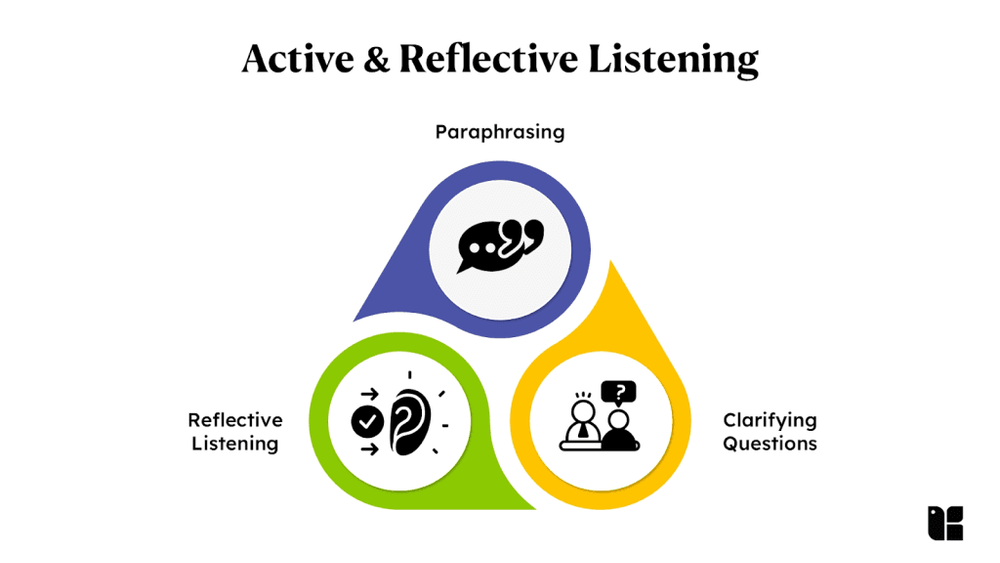
But sending a message isn't enough. The listener must also practice 'active listening.' That involves paraphrasing the speaker into your own words ('So do you mean...?' ) and asking clarifying questions, then reflecting back what you've heard to confirm accurate reception.

The following table is a practical toolbox showing core differences between destructive communication and constructive communication.

| Destructive Communication (Assuming & Blaming) | Constructive Communication (Communicating & Requesting) |
| --- | --- |
| **You‑message**: 'You're always late.' | **I‑message**: 'When you arrive late, I feel worried and like our agreed time isn't being respected.' |
| **Evaluation/Judgment**: 'That's a stupid idea.' | **Observation**: 'When I heard that proposal...' |
| **Hiding feelings/needs**: (silence, sighs, sarcasm) | **Feeling & Need**: '...I was worried because I want our financial planning to feel stable.' |
| **Coercion/Threat**: 'If you don't do this, then...' | **Request**: 'Would you be willing to brainstorm other options with me?' |

That said, I‑messages are not a cure‑all. In my experience they can be misused as manipulation ('You're making me sad because you didn't do what I wanted'). They can also fail entirely if the other person is uninterested in your feelings or when a serious power imbalance exists.

So view these techniques as tools to begin communicating with someone willing to connect — not as weapons to force change on someone who doesn't want it.

## 5. For those who desperately want to be 'good at guessing'

Why do we so badly want to be good at guessing? At the root is a deep, natural desire for connection. The goal is not to suppress that longing but to redirect it away from the flawed strategy of 'mind reading' toward an effective strategy: **building genuine empathy**.

Researcher Brené Brown makes an excellent distinction between empathy and sympathy. Imagine someone shouting from the bottom of a deep hole, 'I'm drowning in this!'

- Sympathy is standing at the edge of the hole and saying, 'Oh poor you, that's terrible. Look, the sun is shining up there!' It's distant and wraps the problem in forced positivity, which can make the other feel more isolated.
- Empathy is climbing down the ladder into that dark hole and saying, 'I don't know the right words, but you're not alone. I'm here with you.'

![Being there with someone](https://pub-69e75e95c2a24d169ba7d738dadaead6.r2.dev/_cd141c3ba5/_cd141c3ba5.png)

Empathy offers connection rather than solutions, a sense of 'withness.' True empathy is learnable and consists of four components: 1) accepting the other's perspective, 2) withholding judgment, 3) recognizing the other's emotions, and 4) communicating that recognition.

One practical method is the 'hypothesis–test–feedback loop.' If you guess the other's emotion, present it as a hypothesis rather than fact.

![Hypothesis-Test-Feedback Loop](https://pub-69e75e95c2a24d169ba7d738dadaead6.r2.dev/Hypothesis_Test_Feedback_Loop_1338b57117/Hypothesis_Test_Feedback_Loop_1338b57117.png)

'Sounds like you're really worried about this — did I get that right?' This gives the other a chance to correct or elaborate, turning a unilateral guess into a mutual exploration.

Ultimately the most powerful tool is **metacognition** — thinking about your own thinking. It means stepping back in the middle of a conversation to notice your cognitive biases as they happen.

![metacognition](https://pub-69e75e95c2a24d169ba7d738dadaead6.r2.dev/metacognition_d591e3ce4d/metacognition_d591e3ce4d.webp)

In heated moments say to yourself: 'Wait. I'm certain I know what they're thinking, but this might be the illusion of mind reading. Stop and ask instead.'

True telepathy isn't a passive, magical mental connection. It's an achievement of active, brave, and skillful effort. When we abandon the illusion of mind reading and embrace the vulnerable, intentional work of listening, clarifying, and connecting, that's when real results emerge.

It's not about being good at guessing; it's about having the courage to ask, the patience to listen, and the willingness to truly hear answers. That's perhaps the only way to rescue our most precious relationships from 'clever mistakes' and guide them to genuine wisdom.

<details><summary>References</summary>

* High-context and low-context cultures [Wikipedia]
* What are the differences between high context and low context cultures? [Country Navigator]
* Smart mistakes you didn't know you were making [Arthur Freeman, Rose Dwolff (Google Books / Aladin)]
* The closeness-communication bias: Increased egocentrism among friends versus strangers [Savitsky, Keysar, Epley, Carter & Swanson (Moodle@Units / Columbia Business School / ResearchGate)]
* When Closeness Does–And Doesn't–Help a Couple's Communication [For Your Marriage]
* Couples sometimes communicate no better than strangers, study finds [UChicago News]
* Study: We Communicate Better With Strangers Than Friends, Spouses [Consumer Affairs]
* Why We Listen Better To Strangers Than Family [Kate Murphy (Awakin.org)]
* The Dual Process model: the effect of cognitive load on the ascription of intentionality [NIH]
* Heuristics [Psychology Today / Fiveable / Asana]
* Example-based learning in heuristic domains... [Frontiers]
* High-context and low-context cultures [EBSCO]
* You don't know my mind?: illusion of transparency [Korean Psychological Newspaper]
* [Tri-Cee Corporate Psychology] Fast feedback is effective for low-performing team members [Maeil Business Newspaper]
* Illusion of transparency [Wikipedia]
* The illusion of transparency: biased assessments of others' ability to read one's emotional states [PubMed / Communication Cache]
* The Illusion of Transparency [You Are Not So Smart]
* The illusion of transparency and normative beliefs about anxiety during public speaking [ResearchGate]
* The illusion of transparency, why misunderstandings happen... [YouTube]
* Exploring The Illusion Of Transparency When Lying And Truth-Telling... [CUNY Academic Works]
* Pluralistic Ignorance: Definition & Examples [Simply Psychology]
* Pluralistic Ignorance [The Decision Lab]
* The Bystander Effect [Psychology Today]
* Bystander effect [Wikipedia]
* The Illusion of Transparency in Negotiations [MIT Press Direct]
* Power and the Illusion of Transparency in Negotiations [Stephen Michael Garcia]
* Why Your Negotiations Are Doomed (And How to Rescue Them) [Disaster Avoidance Experts]
* INTRAPSYCHIC PROCESSES [Northwestern Law]
* How Managers Self-Sabotage When Giving Negative Feedback [INSEAD Knowledge]
* I‑Message (I-Message) [Daum Cafe]
* Your Complete Nonviolent Communication Guide [Positive Psychology]
* Emotional Communication [KOCW]
* Non Violent Communication (NVC) Model [UCOP]
* How You Can Use the NVC Process [nonviolentcommunication.com]
* What is I-message? [Hello Smile Counseling Center]
* NVC Feelings and Needs List [Sociocracy For All]
* Nonviolent Communication in the Workplace: Best Practices [Proaction International]
* I-Messages and You-Messages [Beyond Intractability]
* The Power of I Statements: Communicating Feelings Effectively [Well Beings Counselling]
* Lecture 6: Beautiful conversation with children [school.jbch.org]
* How to be an empathetic listener in a world that doesn't... [Reddit]
* Want Kids to Comply? Why I‑Messages Can Backfire [Education World]
* What's Wrong with I‑Messages? [Dr. Jane Bluestein]
* Are 'I feel' statements actually better? [Reddit]
* Can I become an empathy expert too? [Comedy.com]
* [Focus Report] Brain training to build empathy [Brain Media]
* Dr Brené Brown: Empathy vs Sympathy [Twenty One Toys / Kelli Walker Coaching / Dailymotion / Craftdeology / Prayer and Poutine]
* An Overview of Empathy [NIH (PMC)]
* How Empathic Listening Can Build Deeper Connections in Your Life [Verywell Mind]
* Brené Brown on What it Really Means to Trust [Mindful.org]
* Courageous Connection: How Vulnerability Fosters Trust [Ruck-Shockey]
* The Power of Vulnerability by Brené Brown (Transcript) [Farnam Street]
* The role of metacognition in human social interactions [NIH (PMC)]
* Unleashing Metacognition: Enhance Thinking & Communication [Mindshift Works]
* Metacognition and Uncertainty Communication... [Arxiv]
* Knowing Ourselves Together: The Cultural Origins of Metacognition [PMC]

</details>

'Of course they'll understand' — Why that misconception ruins relationships 'Have you ever believed in 'telepathy (以心傳心)' only to end up misunderstanding the person closest to you? We'll dissect the deadly illusion of 'of course they'll understand' — the truth behind the 'closeness–communication bias' — using psychology experiments. Aren't you curious how to truly communicate instead of guessing?' The Betrayal of 'Telepathy (以心傳心)': Why the Closer You Are, the More You Misunderstand (Psychology) ![Two people turned away from each other, lost in thought.png](https://pub-69e75e95c2a24d169ba7d738dadaead6.r2.dev/_49fcd8a266/_49fcd8a266.png) Folks, the phrase '**telepathy (以心傳心)**' sounds great, right? A state where hearts connect perfectly without words. We treat it as the pinnacle of relationships, almost an ultimate goal. But what if that beautiful expectation is actually the start of a kind of cognitive trap — a 'clever foolishness' that causes us to most deeply misunderstand the people we love most? Today I'm going to talk about this '**betrayal of telepathy**'. Strange, isn't it? Why do we carefully explain things to strangers but jump to 'of course they'll understand' with our closest spouse or friend — only to end up in disaster? Based on the cold truths uncovered in psychology labs, we'll dissect this '**illusion of mind reading**' and examine concretely how to move from guessing to genuine understanding. ## 1. The closer you are, the greater the misunderstanding Common sense tells us we communicate best with our closest friends or partners. We've spent so much time together, shared so many memories. That should guarantee nearly error-free communication, right? The interesting thing is that psychological research flat-out says 'no' to that common sense. In fact, the closer you are, the more you tend to overestimate communication efficiency and commit egocentric errors more than when talking to strangers. This is called the '**closeness–communication bias**.' ![Closeness-Communication Bias.webp](https://pub-69e75e95c2a24d169ba7d738dadaead6.r2.dev/Closeness_Communication_Bias_6215d56972/Closeness_Communication_Bias_6215d56972.webp) Imagine a married couple, Ji-hoon and Seo-yeon, after ten years. (This is fictional, but many of you have probably had a similar experience.) Ji-hoon comes home exhausted from an important project deadline. What he desperately wants is to collapse into the sofa and do absolutely nothing — a complete recharge. He thinks he's expressing how tired he is with every step and a long, earth-sinking sigh. But Seo-yeon interprets it differently. 'Seeing him so listless, something bad must have happened at work. I should cheer him up.' She is convinced she has accurately read her husband's mind as the 'perfect spouse.' She sits beside him and energetically offers solutions: 'What happened? Tell me.' 'Dinner — should I order something tasty?' 'Do you want a hot shower first?' Although Seo-yeon's words came from love, to Ji-hoon they are awful 'noise.' His silence was a clear signal of 'Please don't talk to me,' but Seo-yeon reads it as 'He needs more comfort.' Eventually Ji-hoon snaps: 'Please! Just leave me alone!' Seo-yeon is hurt: 'I was trying to help — how could you do that to me?' Neither of them is entirely wrong. They've simply fallen into the fatal illusion that '**because we're close, my intention (or my interpretation) will surely be understood**.' To demonstrate this phenomenon, psychologists **Kenneth Savitsky and Boaz Keysar** designed a clever experiment. There was a grid-like shelf in the lab with various objects. Two people sat across from each other with the shelf between them. One was the director, the other the mover. Crucially, a partition between them meant the director couldn't see all the objects while the mover could. The director would see a picture and tell the mover, 'Move the mouse.' On the shelf there was a computer mouse visible to both and a toy mouse visible only to the mover. When the director was a stranger, the mover clearly realized, 'Oh, that person can't see the toy mouse,' and almost immediately picked up the computer mouse. But when the director was the mover's closest friend, a shocking result appeared. The mover hesitated far longer and more often looked at or even reached for the toy mouse that the director could not see. What does this show? The experiment makes it clear: **closeness breeds cognitive laziness.** When communicating with strangers, we consciously consider the other's perspective — 'They must be seeing something different than me' — and keep our guard up. With close others we relax, assuming 'we know each other' or 'we'll just be on the same page,' and settle into an egocentric perspective. We fall into an **'illusion of insight'**, unconsciously assuming the other shares our information. ![illusion of insight.jpg](https://pub-69e75e95c2a24d169ba7d738dadaead6.r2.dev/illusion_of_insight_b2be8e8086/illusion_of_insight_b2be8e8086.jpg) In high-context cultures like Korea, where 'reading the room' is valued, this tendency can be amplified. Because harmony and relationships are emphasized, reading context is often preferred over explicit statements. When that cultural training combines with the 'closeness' bias, the effect can be massive. We not only assume our partner knows our mind because they're close, but society itself encourages that kind of communication. ## 2. Your guesses are always off We also make another mistaken assumption: that our emotional state is visible on our face, in our tone, and in our gestures. We imagine our anxiety, impatience, joy, or disappointment is transparent as a window. Psychologists call this the '**illusion of transparency**.' ![illusion of transparency](https://pub-69e75e95c2a24d169ba7d738dadaead6.r2.dev/illusion_of_transparency_5e4114762d/illusion_of_transparency_5e4114762d.jpg) One experiment that nicely demonstrates this illusion was run by Kenneth Savitsky and Thomas Gilovich. Participants sat in front of a camera and tasted 15 cups containing red liquids. Five of the cups contained an extremely foul-tasting bitter liquid (without prior warning). Their task was to keep a poker face regardless of what they tasted. Participants drank the revolting liquid and tried to hide their expressions. Afterwards, the participants were asked: 'How many of the observers do you think noticed the moment you drank the disgusting beverage?' The result was surprising. Participants were sure that the intense disgust they felt had been plainly visible on their faces — 'My expression must have been awful.' They predicted many observers would notice. But when observers later watched the video, they barely detected any leakage. There was a massive gap between how strongly we feel emotions internally and how much of that is actually expressed externally. This illusion stems from a mechanism called the '**egocentric anchor**.' We are firmly anchored to our rich inner world. Our anxiety feels like a physical force; our love feels like light radiating from our body. We fail to sufficiently adjust our perspective to account for others' lack of access to our internal state. ![egocentric anchor](https://pub-69e75e95c2a24d169ba7d738dadaead6.r2.dev/egocentric_anchor_0fd34045b5/egocentric_anchor_0fd34045b5.webp) In relationships, this leads to the **fundamental attribution error**. When judging ourselves, we consider our complex, well-intentioned inner world (and mistakenly assume it's visible). When judging others, we rely only on their limited observable behavior. ![Fundamental Attribution Error](https://pub-69e75e95c2a24d169ba7d738dadaead6.r2.dev/Fundamental_Attribution_Error_fdb95f89cf/Fundamental_Attribution_Error_fdb95f89cf.webp) For example, when I'm late to an appointment, I know my internal and situational reasons: 'My boss grabbed me, the road was jammed, I really couldn't help it.' Because of the illusion of transparency I expect others to understand at least somewhat. But when someone else is late, I can't know their inner situation. All I see is 'they were late.' So I may attribute it to personality: 'You're just irresponsible.' This starts a vicious cycle where I feel unfairly judged and the other feels wrongly blamed. ## 3. The more dangerous illusion: thinking you can read the other's mind Believing we're transparent is a problem, but an even more dangerous illusion is believing we can penetrate the other's mind. This is the core of the 'telepathy illusion' and the most direct culprit that ruins relationships. In 1990, Elizabeth Newton at Stanford performed a legendary experiment that perfectly illustrated this illusion. Participants were split into 'tappers' and 'listeners.' The tappers' task was to tap the rhythm of a well-known song (like 'Happy Birthday') on a table. The listeners had to guess the song from the rhythm. The key is the tappers' inner experience. While you tap the rhythm, you have the melody, lyrics, and a full orchestral soundtrack in your head. The rhythm feels unmistakably like the song. The experimenters asked tappers to predict the probability that the listener would guess the song correctly — tappers typically predicted about 50%. 'For the tapper, there's a perfect song; for the listener, it's meaningless noise.' But for listeners the reality was different. They heard disconnected knocks with no melody or context — just 'tap. tap. tap.' What was the actual rate of correct guesses? The tappers' predicted 50%? No — it was only about **3%**. That 47-percentage-point gap perfectly illustrates how severe our illusion of mind reading is. Tappers suffer from the '**curse of knowledge**.' They cannot return to a state of not knowing the song, and therefore fail to imagine the listener's perspective that hears only disjointed sounds. This is the essence of our mind-reading error. ![curse of knowledge](https://pub-69e75e95c2a24d169ba7d738dadaead6.r2.dev/curse_of_knowledge_8dabf92c8e/curse_of_knowledge_8dabf92c8e.jpg) The curse of knowledge happens daily at work. Team lead Kim, a 10-year veteran in marketing, presents a new campaign strategy based on weeks of analysis: 'As you can see, Q3 data clearly indicate we should pivot to a V‑Gen funnel. It's an obvious conclusion.' In Kim's head are dozens of data points, competitor trends, and market subtleties playing like 'Happy Birthday.' But for salespeople and new hires in the meeting, it's their first time seeing the data. The term 'V‑Gen funnel' is unfamiliar. 'V‑Gen, what?' All they hear is Kim's repeated 'obvious' and 'clear' — they feel confused but don't dare ask for clarification, thinking 'Am I the only one who doesn't know?' (pluralistic ignorance). Kim thinks the meeting was a success, while in reality no information was conveyed. She failed to imagine the viewpoint of those who didn't know. Such cognitive bias increases dramatically under stress, fatigue, or emotional arousal — in other words when cognitive load is high. Our brain has a fast, intuitive System 1 and a slow, deliberative System 2. Effective communication requires the energy-demanding System 2; under stress or tiredness we deplete cognitive resources and rely on System 1 shortcuts (i.e., mind reading), which are fast but error-prone. ![cognitive load](https://pub-69e75e95c2a24d169ba7d738dadaead6.r2.dev/Cognitive_Load_6c92b3cc47/Cognitive_Load_6c92b3cc47.webp) Thus, ironically, the moments when clear communication is most needed — during heated arguments or stressful decisions — are precisely when our brains are most likely to take the worst shortcut of 'mind reading.' ## 4. Don't guess — communicate So what should we do? If guessing is the poison of relationships, the antidote is deliberate communication. Simple: 'Don't assume, say it.' Psychology offers powerful, structured communication techniques like the 'I‑message' and Marshall Rosenberg's 'Nonviolent Communication (NVC).' ![I-Message](https://pub-69e75e95c2a24d169ba7d738dadaead6.r2.dev/I_Message_ebe9cf0755/I_Message_ebe9cf0755.png) Take a common couple's fight. Seeing dirty dishes in the sink, A says to B: 'You never help with housework. You're so lazy.' This is a classic 'you‑message.' It criticizes and judges the other as the subject and just provokes defensiveness. B immediately fights back: 'What are you talking about? I took out the trash yesterday! You're always nagging.' And on it goes. Now reconstruct the same situation using NVC's four steps. 1. Observation: A removes evaluations or judgments; states facts. - 'When I see the dishes in the sink...' (O) 2. Feeling: A owns their emotion without blaming the other. - '...I feel frustrated and overwhelmed.' 3. Need: A explains the universal need connected to that feeling. - '...because I value an orderly environment and a sense of partnership in running the household.' 4. Request: A makes a concrete, positive, doable request rather than a demand. - '...could you please wash the dishes with me now?' ![Nonviolent Communication, NVC](https://pub-69e75e95c2a24d169ba7d738dadaead6.r2.dev/Marshall_Rosenberg_Nonviolent_Communication_NVC_3e3b11ff1f/Marshall_Rosenberg_Nonviolent_Communication_NVC_3e3b11ff1f.jpg) See the shift? The focus moves from attacking the other's character ('You're lazy') to candidly expressing one's internal state ('I feel overwhelmed'). This reveals vulnerability instead of blame and requests cooperation to meet a shared need. B is much more likely to respond: 'Oh, you feel that way? Sorry. Let's do it together.' Using I‑messages instead of blaming is important. But sending a message isn't enough. The listener must also practice 'active listening.' That involves paraphrasing the speaker into your own words ('So do you mean...?' ) and asking clarifying questions, then reflecting back what you've heard to confirm accurate reception. The following table is a practical toolbox showing core differences between destructive communication and constructive communication. | Destructive Communication (Assuming & Blaming) | Constructive Communication (Communicating & Requesting) | | --- | --- | | **You‑message**: 'You're always late.' | **I‑message**: 'When you arrive late, I feel worried and like our agreed time isn't being respected.' | | **Evaluation/Judgment**: 'That's a stupid idea.' | **Observation**: 'When I heard that proposal...' | | **Hiding feelings/needs**: (silence, sighs, sarcasm) | **Feeling & Need**: '...I was worried because I want our financial planning to feel stable.' | | **Coercion/Threat**: 'If you don't do this, then...' | **Request**: 'Would you be willing to brainstorm other options with me?' | That said, I‑messages are not a cure‑all. In my experience they can be misused as manipulation ('You're making me sad because you didn't do what I wanted'). They can also fail entirely if the other person is uninterested in your feelings or when a serious power imbalance exists. So view these techniques as tools to begin communicating with someone willing to connect — not as weapons to force change on someone who doesn't want it. ## 5. For those who desperately want to be 'good at guessing' Why do we so badly want to be good at guessing? At the root is a deep, natural desire for connection. The goal is not to suppress that longing but to redirect it away from the flawed strategy of 'mind reading' toward an effective strategy: **building genuine empathy**. Researcher Brené Brown makes an excellent distinction between empathy and sympathy. Imagine someone shouting from the bottom of a deep hole, 'I'm drowning in this!' - Sympathy is standing at the edge of the hole and saying, 'Oh poor you, that's terrible. Look, the sun is shining up there!' It's distant and wraps the problem in forced positivity, which can make the other feel more isolated. - Empathy is climbing down the ladder into that dark hole and saying, 'I don't know the right words, but you're not alone. I'm here with you.' ![Being there with someone](https://pub-69e75e95c2a24d169ba7d738dadaead6.r2.dev/_cd141c3ba5/_cd141c3ba5.png) Empathy offers connection rather than solutions, a sense of 'withness.' True empathy is learnable and consists of four components: 1) accepting the other's perspective, 2) withholding judgment, 3) recognizing the other's emotions, and 4) communicating that recognition. One practical method is the 'hypothesis–test–feedback loop.' If you guess the other's emotion, present it as a hypothesis rather than fact. ![Hypothesis-Test-Feedback Loop](https://pub-69e75e95c2a24d169ba7d738dadaead6.r2.dev/Hypothesis_Test_Feedback_Loop_1338b57117/Hypothesis_Test_Feedback_Loop_1338b57117.png) 'Sounds like you're really worried about this — did I get that right?' This gives the other a chance to correct or elaborate, turning a unilateral guess into a mutual exploration. Ultimately the most powerful tool is **metacognition** — thinking about your own thinking. It means stepping back in the middle of a conversation to notice your cognitive biases as they happen. ![metacognition](https://pub-69e75e95c2a24d169ba7d738dadaead6.r2.dev/metacognition_d591e3ce4d/metacognition_d591e3ce4d.webp) In heated moments say to yourself: 'Wait. I'm certain I know what they're thinking, but this might be the illusion of mind reading. Stop and ask instead.' True telepathy isn't a passive, magical mental connection. It's an achievement of active, brave, and skillful effort. When we abandon the illusion of mind reading and embrace the vulnerable, intentional work of listening, clarifying, and connecting, that's when real results emerge. It's not about being good at guessing; it's about having the courage to ask, the patience to listen, and the willingness to truly hear answers. That's perhaps the only way to rescue our most precious relationships from 'clever mistakes' and guide them to genuine wisdom. <details><summary>References</summary> * High-context and low-context cultures [Wikipedia] * What are the differences between high context and low context cultures? [Country Navigator] * Smart mistakes you didn't know you were making [Arthur Freeman, Rose Dwolff (Google Books / Aladin)] * The closeness-communication bias: Increased egocentrism among friends versus strangers [Savitsky, Keysar, Epley, Carter & Swanson (Moodle@Units / Columbia Business School / ResearchGate)] * When Closeness Does–And Doesn't–Help a Couple's Communication [For Your Marriage] * Couples sometimes communicate no better than strangers, study finds [UChicago News] * Study: We Communicate Better With Strangers Than Friends, Spouses [Consumer Affairs] * Why We Listen Better To Strangers Than Family [Kate Murphy (Awakin.org)] * The Dual Process model: the effect of cognitive load on the ascription of intentionality [NIH] * Heuristics [Psychology Today / Fiveable / Asana] * Example-based learning in heuristic domains... [Frontiers] * High-context and low-context cultures [EBSCO] * You don't know my mind?: illusion of transparency [Korean Psychological Newspaper] * [Tri-Cee Corporate Psychology] Fast feedback is effective for low-performing team members [Maeil Business Newspaper] * Illusion of transparency [Wikipedia] * The illusion of transparency: biased assessments of others' ability to read one's emotional states [PubMed / Communication Cache] * The Illusion of Transparency [You Are Not So Smart] * The illusion of transparency and normative beliefs about anxiety during public speaking [ResearchGate] * The illusion of transparency, why misunderstandings happen... [YouTube] * Exploring The Illusion Of Transparency When Lying And Truth-Telling... [CUNY Academic Works] * Pluralistic Ignorance: Definition & Examples [Simply Psychology] * Pluralistic Ignorance [The Decision Lab] * The Bystander Effect [Psychology Today] * Bystander effect [Wikipedia] * The Illusion of Transparency in Negotiations [MIT Press Direct] * Power and the Illusion of Transparency in Negotiations [Stephen Michael Garcia] * Why Your Negotiations Are Doomed (And How to Rescue Them) [Disaster Avoidance Experts] * INTRAPSYCHIC PROCESSES [Northwestern Law] * How Managers Self-Sabotage When Giving Negative Feedback [INSEAD Knowledge] * I‑Message (I-Message) [Daum Cafe] * Your Complete Nonviolent Communication Guide [Positive Psychology] * Emotional Communication [KOCW] * Non Violent Communication (NVC) Model [UCOP] * How You Can Use the NVC Process [nonviolentcommunication.com] * What is I-message? [Hello Smile Counseling Center] * NVC Feelings and Needs List [Sociocracy For All] * Nonviolent Communication in the Workplace: Best Practices [Proaction International] * I-Messages and You-Messages [Beyond Intractability] * The Power of I Statements: Communicating Feelings Effectively [Well Beings Counselling] * Lecture 6: Beautiful conversation with children [school.jbch.org] * How to be an empathetic listener in a world that doesn't... [Reddit] * Want Kids to Comply? Why I‑Messages Can Backfire [Education World] * What's Wrong with I‑Messages? [Dr. Jane Bluestein] * Are 'I feel' statements actually better? [Reddit] * Can I become an empathy expert too? [Comedy.com] * [Focus Report] Brain training to build empathy [Brain Media] * Dr Brené Brown: Empathy vs Sympathy [Twenty One Toys / Kelli Walker Coaching / Dailymotion / Craftdeology / Prayer and Poutine] * An Overview of Empathy [NIH (PMC)] * How Empathic Listening Can Build Deeper Connections in Your Life [Verywell Mind] * Brené Brown on What it Really Means to Trust [Mindful.org] * Courageous Connection: How Vulnerability Fosters Trust [Ruck-Shockey] * The Power of Vulnerability by Brené Brown (Transcript) [Farnam Street] * The role of metacognition in human social interactions [NIH (PMC)] * Unleashing Metacognition: Enhance Thinking & Communication [Mindshift Works] * Metacognition and Uncertainty Communication... [Arxiv] * Knowing Ourselves Together: The Cultural Origins of Metacognition [PMC] </details>

13 min read
Stop Social Media Comparisons! Psychological Skills to Build Your Own Wealth Formula

Stop Social Media Comparisons! Psychological Skills to Build Your Own Wealth Formula

13 min read
The Only Way to Beat Algorithms: Drive a 4WD Truck, Not an F1 Car

The Only Way to Beat Algorithms: Drive a 4WD Truck, Not an F1 Car

8 min read
Invisible Wealth: The Art of Buying Freedom, Not Show

Invisible Wealth: The Art of Buying Freedom, Not Show

7 min read

광고

The Evolution Chronicle of GS Retail, a Distribution Empire Built on Success and Failure

The Evolution Chronicle of GS Retail, a Distribution Empire Built on Success and Failure

9 min read
The Most Realistic Way for Ordinary You to Become Rich: Rediscovering the Savings Rate

The Most Realistic Way for Ordinary You to Become Rich: Rediscovering the Savings Rate

7 min read