

Has anyone lived without experiencing conflict? Probably not. From minor disagreements to major disputes that shake the fate of an organization, conflict always makes us uncomfortable.
We often regard such conflicts as ‘failures’ or ‘mistakes’ to be avoided. We might even blame ourselves, thinking, “Ah, I shouldn’t have said that.”
But what if we need to change this perspective slightly? What if conflict isn’t ’evidence of failure,’ but a ‘powerful signal’ indicating unresolved issues in our relationships, systems, or inner selves?
The problem is that this signal is so complex and loud. At this point, there is a very useful 3-step psychological framework to decode this signal: the E-R-I model. This model is like a map that tells us how the three elements—Emotion, Reason, and Intuition—operate in conflict situations and in what order we should decode these signals.
This article doesn’t just introduce the E-R-I model. It delves deep into this map through the lens of modern science: neuroscience and behavioral economics.
- We examine neuroscience to understand why, at the moment conflict erupts, we can’t help but exhibit ‘foolish’ emotional reactions (E).
- Comparing it with the theories of Nobel laureate Daniel Kahneman, we redefine the surprising relationship between Reason (R) and Intuition (I).
- Finally, through real-life business dispute cases that spiraled into disaster, we will analyze why this E-R-I model so easily fails in reality and how to effectively utilize this map.
Part 1. The E-R-I Model: A 3-Step Roadmap to Decode Conflict
What is the E-R-I Model? The Secret to ‘Smart Mistakes’
Why do we make ‘smart mistakes’? Situations where we know logically “this isn’t right” but get carried away by emotions and mess things up.
Some psychologists diagnose the core of this problem not as a lack of logic, but as being tricked by our own ‘Emotions’ (E). People who are easily hurt by minor conflicts, who immediately get angry, or who only talk about themselves are all exacerbating the situation not because of the logical cause of the conflict, but because they cannot control their ’emotions’ exploding in that situation.
Based on this diagnosis, the ‘E-R-I Model’ is presented as a 3-step sequential approach to handling conflict.
- E (Emotion): First, recognize and resolve your overwhelming emotions.
- R (Reason): After emotions subside, step back and calmly analyze the root cause of the conflict.
- I (Intuition): Go beyond the limits of rational analysis to exercise insight (wisdom) and find creative new alternatives.
‘Conquering Conflict’ is the ability to follow these three steps in order. The order is crucial. The tragedy begins when we try to move to step 2 (R) without resolving step 1 (E). The reason lies in how our brain works.

[Deep Dive] The Neuroscience of E (Emotion): Why Do We Fail When Trying to Act Rationally?
It’s a brilliant insight that the E-R-I model places ‘Emotion’ first. It precisely matches the biological sequence of how our brains operate in conflict situations.
Conflict or extreme stress is perceived by our brains as a ’threat to survival.’ At this moment, the amygdala, the most primitive part of the brain and the ‘danger alarm system,’ immediately sounds an emergency bell. This emergency bell is the ‘Fight-or-Flight’ response, which manifests as the extreme emotions (E) like anger and fear we feel in conflict situations.
Now, a critical event occurs. The moment the emergency bell rings, the amygdala effectively cuts off the power to the prefrontal cortex, the ‘CEO’ of the brain responsible for higher-level thinking, logic, and impulse control.
This state, termed ‘Amygdala Hijack’ by psychologist Daniel Goleman, is precisely when we are deceived by our emotions. It’s a state where the brain’s CEO (‘R’, Reason) is imprisoned by the brain’s alarm system (‘E’, Emotion).
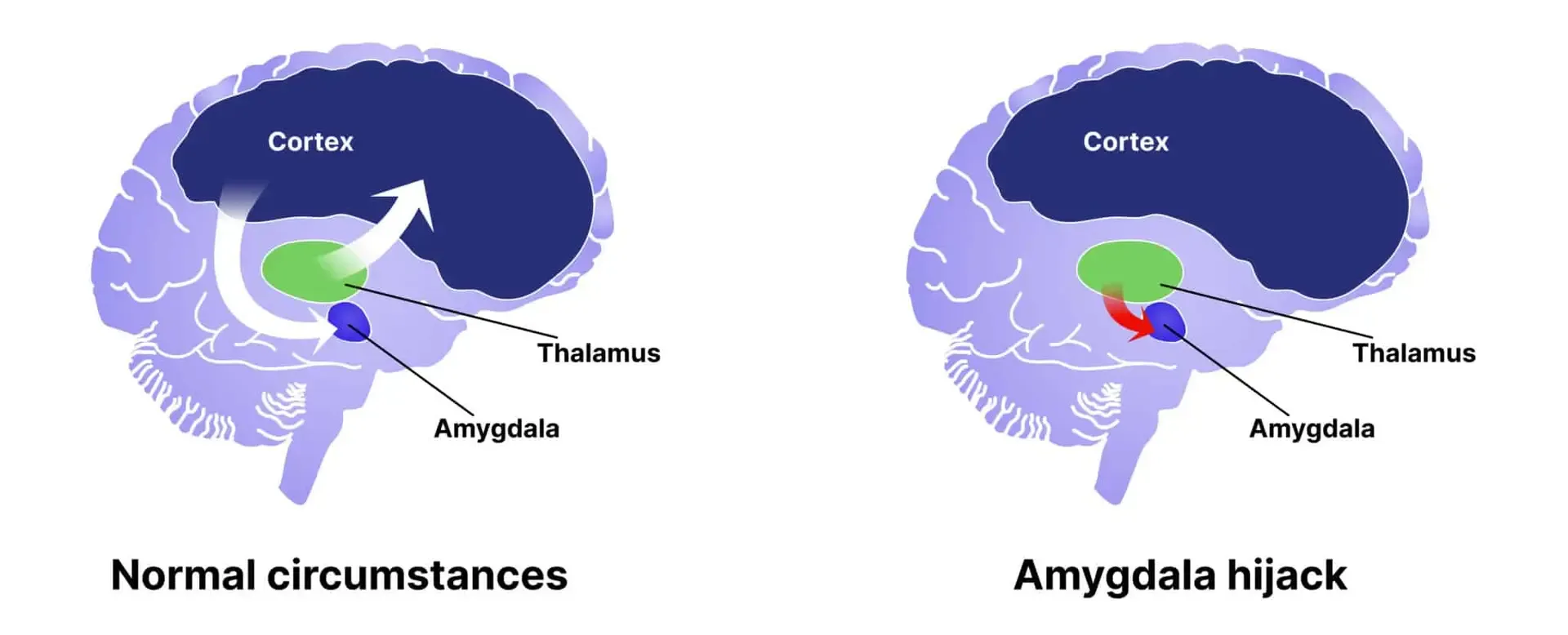
Therefore, the reason the E-R-I model prioritizes ‘E’ is clear. The first step in conflict resolution cannot be trying to use ‘R’ (Reason). The CEO is absent anyway. The most urgent first task is to turn off the loud emergency bell called ‘E’ (Emotion) and allow the brain’s CEO (Reason) to return to its office and function.
[Deep Dive] The Relationship Between R (Reason) and I (Intuition): Daniel Kahneman and E-R-I
However, there’s a point of confusion here. The E-R-I (Emotion→Reason→Intuition) model might seem to contradict Nobel laureate Daniel Kahneman’s ‘Dual Process Theory.’
Kahneman described our thinking process using two systems:
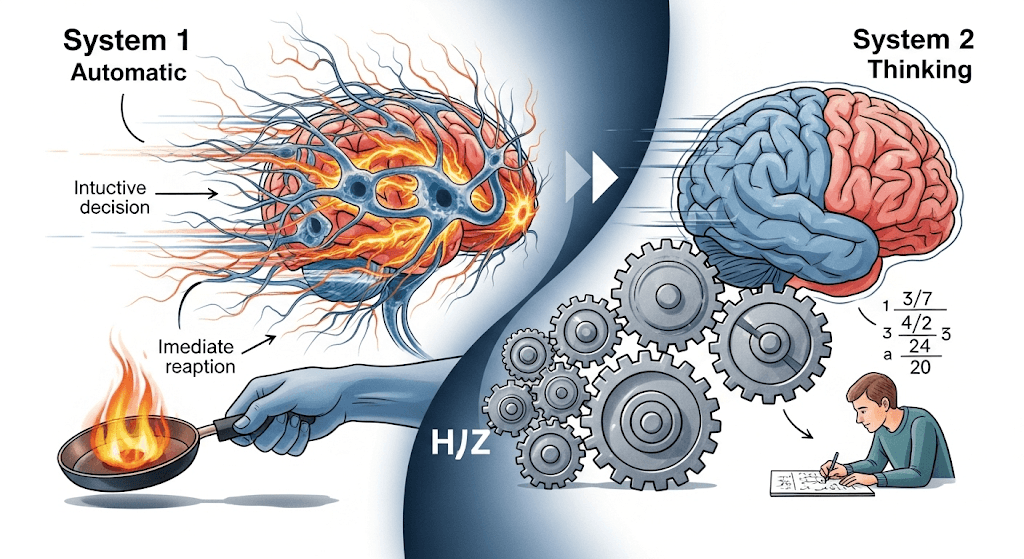
- System 1 (Fast Thinking): Operates quickly, automatically, emotionally, and ‘intuitively’ (e.g., the feeling of “knowing it at a glance”).
- System 2 (Slow Thinking): Operates slowly, requires effort, logically, and ‘rationally’ (e.g., solving complex math problems).
In Kahneman’s model, ‘Intuition’ (System 1) operates before ‘Reason’ (System 2) and often leads us into traps. Then why are the orders of ‘Intuition’ and ‘Reason’ reversed in the two models?
The answer is that we use the word ‘Intuition’ with different meanings.
- Kahneman’s ‘System 1 Intuition’: This is closer to an untrained, automatic ‘Reaction’ or ‘Impulse.’ It is essentially the same as ‘E’ (raw emotion), the target of control in the E-R-I model.
- The E-R-I Model’s ‘I’ (Intuition): This is not impulsive ‘System 1.’ It is a highly trained ‘Insight’ or ‘Wisdom’ that emerges after controlling ‘E’ (Emotion) and going through ‘R’ (Reason) analysis.
Therefore, integrating and reinterpreting the true process of the E-R-I model with Kahneman’s theory results in the following:
- [E] Emotion: Control the raw emotions, i.e., the impulses of ‘System 1’ filled with ‘amygdala hijack’ and biases.
- [R] Reason: Activate ‘System 2’ to calmly analyze the situation and formulate strategies.
- [I] Intuition: Integrate ‘E’ (emotional intelligence) and ‘R’ (logical analysis) to manifest creative wisdom and insight that transcends analytical frameworks.
Part 2. Real-World Conflicts: Why and How the E-R-I Model Fails
In theory, the sequential roadmap E→R→I seems perfect. Resolve emotions in step 1, identify causes with reason in step 2, and find creative alternatives with intuition in step 3.
However, reality is not that simple. In complex real-world conflicts, this order collapses disastrously. Especially when ‘R’ (Reason) operates without resolving ‘E’ (Emotion) in step 1, that reason becomes a tool for disaster rather than resolution. Let’s examine the failure mechanism through actual cases.
[Case 1: Partner’s Betrayal] When E (Emotion) Corrupts R (Reason) into ‘Rationalization’
Case: Mr. A started a business with his partner, Mr. B, who had a poor credit history. Mr. A discovered that Mr. B was siphoning off additional profits through his wife’s bank account. However, Mr. A condoned this issue, thinking, ‘The growth of the main business is more important.’ Later, when Mr. B began using corporate funds at his discretion, the relationship eventually broke down.
At this point, Mr. B demanded that Mr. A acknowledge his initial capital as a ’loan’ and sign a promissory note with notarization. Mr. A readily agreed, wanting to ‘smoothly settle the relationship.’ This decision became a shackles. Mr. B used this note as grounds to seize the corporate account when Mr. A failed to pay interest for two months, pushing the company into a dire situation.
E-R-I Model Failure Analysis (Mr. A’s Case):
- E (Emotion): The emotion dominating Mr. A was not ‘anger’ towards Mr. B, but a longing for ‘conflict avoidance’ and a ‘smooth relationship.’ He experienced ‘amygdala hijack’ (shock, anger), but instead of resolving this emotion, he chose to suppress it.
- R (Reason): Mr. A used ‘R’ (Reason). However, this reason was completely corrupted by the unresolved emotion of ‘conflict avoidance’ (E). His reason devolved into a tool for ‘rationalization’ rather than problem-solving.
- “B is embezzling” → “But the main business is growing, so it’s okay.” (Rationalization)
- “B is demanding a dangerous promissory note” → “But I have no choice if I want to settle smoothly.” (Rationalization)
- I (Intuition): Mr. A’s ‘I’ (intuition/wisdom) likely sent clear signals like “This person is dangerous,” or “This promissory note is poison.” However, ‘E’ (conflict avoidance) suppressed this intuition, and ‘R’ (Reason) justified this suppression.
This case clearly shows how crucial the first step of E-R-I (‘Resolving E’) is. Mr. A’s reason, by suppressing ‘E’ and jumping to ‘R,’ was used not to find a solution, but to create ’the worst legal shackles.’
[Case 2: K-Pop Management Rights Dispute] When E (Emotion) Weaponizes R (Reason)
Case: A conflict erupted between the founder and current management of a leading K-pop entertainment company (SM) in Korea. The management accused the founder of attempting to pocket vast profits through unreasonable means. This conflict escalated into an “emotional battle” and a “mud-slinging war of attrition.”
As the emotional chasm deepened, both sides activated ‘R’ (Reason/Strategy).
- Management’s R: They made the strategic decision to issue new shares to a third party (Kakao) to exclude the founder’s influence.
- Founder’s R: To defend management control, they made the strategic decision to sell their shares to a competitor (HYBE).
E-R-I Model Failure Analysis (Clash of E-R):
- E (Emotion): As the term “emotional battle” suggests, this conflict was underpinned by strong emotions (E) such as betrayal and anger. The revelations were an ’emotional explosion’ rather than ’emotional resolution.’
- R (Reason/Strategy): Both sides’ ‘R’ (Reason) was perfectly weaponized not for conflict resolution, but for ‘waging war.’ Kakao’s entry and HYBE’s participation in the acquisition were highly calculated strategic moves born from both sides’ reason.
- I (Intuition/Wisdom): The final stage of E-R-I, ‘I’ (true intuition/wisdom), was completely absent in this massive war. The ‘I’ perspective—“Where are the artists, fans, and employees?” and “What is the essence of the K-pop industry?"—fundamental values were ignored amidst the clash of E and R.
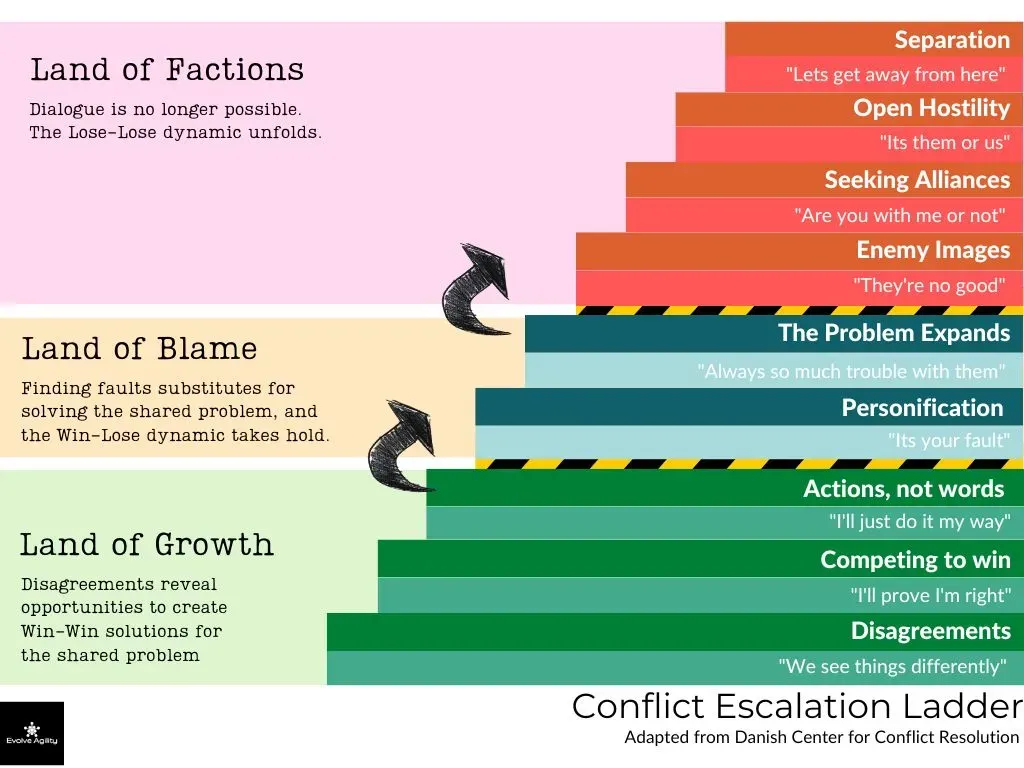
This case starkly demonstrates how, when step 1 (‘Resolving E’) fails catastrophically, step 2 (‘Applying R’) can transform into a ‘Conflict Escalation Model’ that paradoxically escalates the conflict.
[Case 3: The Hanjin Family’s ‘Sibling Rivalry’] A Zero-Sum Game Where I (Wisdom) is Lost
Case: Following the death of the late Chairman Cho Yang-ho of the Hanjin Group, a ‘sibling rivalry’ erupted over the group’s management rights. Chairman Cho Won-tae and his older sister, former executive vice president Cho Hyun-ah, engaged in a fierce shareholding battle. In this process, both sides justified their actions by claiming to uphold “the late chairman’s dying wishes” and yearn for the group’s stability and development.
E-R-I Model Failure Analysis (The Trap of R and Absence of I):
- E (Emotion): The conflict stemmed from deep-seated emotional conflicts unique to family businesses, namely the need for recognition as the true successor, long-standing grievances, and the will to power (E).
- R (Reason): This case clearly illustrates the ’trap of reason.’ The “late chairman’s dying wishes” cited by both sides were not objective ‘reason’ (R). They were merely rationalizations to justify their own ’emotions’ (E) and persuade outsiders. This ‘R’ (justification) was a facade to hide ‘E’ (will to power).
- I (Intuition/Wisdom): The final stage of the E-R-I model, ‘I’ (intuition/wisdom), was completely absent.
- _If ‘I’ had been active, there would have been the insight that “no one wins this fight, and the entire group will be jeopardized.”
- If ‘I’ had been active, they would have moved beyond the zero-sum game of shareholding battles (‘R’) to seek ‘creative alternatives’ at a higher level, such as “strengthening professional management,” or “establishing transparent governance,” for the ‘stability and development of the group.’
The Hanjin case shows how conflicts mired solely in E (Emotion) and R (Rationalization) result in destructive zero-sum games.
Conclusion: E-R-I, The Inner Alchemy That Transforms Mistakes into Wisdom
The E-R-I model is not simply a 3-step strategy to avoid or win conflicts. It is a sophisticated roadmap that penetrates the workings of our inner selves—our brains (neuroscience) and cognition (behavioral economics)—which operate intensely in conflict situations.
As seen in the tragic cases, the failure of this model occurs when the sequence is ignored.
- E (Emotion): This is the first gateway to becoming the master, not the slave, of emotions, escaping ‘amygdala hijack.’ Here, not only ‘anger’ but also passive emotions like ‘conflict avoidance’ (Case 1) must be managed.
- R (Reason): This is the second step, where we avoid the trap of ‘rationalization’ corrupted by emotion (Cases 1, 3) and re-establish the brain’s CEO (prefrontal cortex) as a tool for ‘resolution.’ When this stage meets the explosion of ‘E,’ it becomes the worst weapon of ‘conflict escalation’ (Case 2).
- I (Intuition): This is the final destination, transcending E and R, to find ‘creative alternatives’ and Win-Win wisdom that goes beyond zero-sum games, based on emotional intelligence.
True ‘smartness’ is not about avoiding conflict. It lies in clearly understanding how each stage of E-R-I operates within us and how it fails when a conflict ‘signal’ sounds.
Whether we leave conflict as a destructive ‘mistake’ or transform it into ‘wisdom’ that grows individuals and organizations through the ‘inner alchemy’ of E-R-I, the choice ultimately depends on our ability to understand and orchestrate the dynamics of this trio.