
Two Friends, Different Destinies
Here is a story about two friends who could easily be found around us.
- A: A ‘wizard of returns’ envied by everyone, boasting an astonishing 20% annual return, but due to a lifestyle of spending as much as he earns, his savings rate remained at 10%.
- B: In contrast, B is an ordinary office worker who quietly invests in an index fund with an 8% annual return and steadily saves 50% of his income.
Ten years later, trials came for both. When a terrible financial crisis halved the market, A’s glamorous empire, built on leverage, collapsed in an instant, leading him to bankruptcy. Meanwhile, B’s assets also decreased, but thanks to the solid foundation of savings he had built up over time, he was able to withstand the crisis and even seize new opportunities.
So, who was truly wealthy? Should we teach our beloved children the fleeting techniques of returns, or should we pass down the wisdom of saving that builds wealth steadily like a tortoise?
This story is a journey to uncover the true value of the key to wealth, ‘savings,’ dispelling the fog of the ‘myth of returns’ that momentarily captivated us.

Chapter 1: The Sweet Illusion of ‘Returns’
“Did you hear? That stock made a killing!” “Someone turned their life around with just one apartment!” Why do such stories shake our hearts so much?
1. The Desire for a ‘Big Win’
Our brains react much more thrillingly to a single ‘big win,’ even if it is very rare, than to steady success. Seeing a few success stories around us leads us to believe, ‘I can do it too.’ Perhaps investing gives us the excitement of buying an ‘intellectual lottery.’
2. The Whisper of the Financial Industry
The financial industry grows by selling us the hope of ‘higher returns.’ The more we trade and subscribe to complex products, the greater their profits become. The simple truth of “Save 50% of your salary and invest it in an index fund” is merely too simple advice to charge high fees for.
3. Numbers Don’t Lie
Let’s verify with simple numbers instead of a hundred words.
| Category | A (High Return, Low Savings) | B (Medium Return, High Savings) |
|---|---|---|
| Annual Salary | 100 million KRW | 100 million KRW |
| Savings Rate | 10% | 50% |
| Annual Savings | 10 million KRW | 50 million KRW |
| Investment Return | 15% | 8% |
▶ After 1 Year, What Are Their Assets?
- A: 10 million KRW (principal) + 1.5 million KRW (profit) = 11.5 million KRW
- B: 50 million KRW (principal) + 4 million KRW (profit) = 54 million KRW
▶ After 5 Years, the Gap Widens (Simple Calculation)
- A: About 71 million KRW
- B: About 293 million KRW
The results are very clear. Especially in the early stages of building wealth, the ‘savings rate,’ which we can fully control, is overwhelmingly more important than the ‘returns’ that we cannot control.
Chapter 2: Saving as an Act of Buying Freedom, Not Deprivation
When you hear the word ‘saving,’ do you picture a painful image of giving something up and tightening your belt? It’s time to change that thought. Saving is not ‘giving up consumption’ but an act of purchasing the most valuable product in this world, ‘freedom.’
Reason 1: The Freedom to Say ‘No!’
Sufficient savings give you the power to confidently say “No!” to unwanted jobs, uncomfortable relationships, and unreasonable demands. A truly wealthy person is not someone who drives a flashy sports car, but someone who wakes up in the morning thinking, “Today, I can do anything I want.”
Reason 2: The Power to Seize Life’s ‘Golden Ticket’
Unexpected opportunities arise in life. A good business idea or a sudden drop in real estate prices, a ‘golden ticket,’ can only be seized by those who are prepared. Saving will serve as a ‘shield’ that protects you in times of crisis and a powerful ‘spear’ that launches your life onto a different trajectory during decisive opportunities. This is why Warren Buffett always keeps a large amount of cash on hand.
Chapter 3: Psychological Techniques to Increase Savings Rate
“I understand that saving is important. But is it really that easy?” That’s right. Saving is not a matter of willpower but a matter of psychology. Let’s explore clever techniques to trick our minds and enjoy saving.
Technique 1: Invisible and Automatic (The Magic of Automation)
The most powerful saving method is to eliminate the opportunity for doubt. Create a ‘Pay Yourself First’ system. Set it up so that a predetermined amount automatically transfers to your savings or investment account as soon as your salary arrives. Don’t make saving a matter of willpower; make it a fixed cost, like your phone bill.
Technique 2: Breathe Life into Goals (Emotional Labels)
Abstract goals do not motivate us at all. Give your savings account a specific and exciting name.
- ‘Retirement Fund’ → ‘Mediterranean Cruise Fund for Age 70’
- ‘Children’s Education Fund’ → ‘Celebration Party Fund for Our Daughter’s Harvard Admission’
- ‘Emergency Fund’ → ‘A Strong Shield to Protect Our Family in Any Crisis’
This way, whenever you want to buy something, you can remind yourself that you are giving up ’the Mediterranean cruise’ or ’the smile of your daughter’ and gain the strength to resist temptation.

Technique 3: Finding Your Own ‘Happiness Line’ (Cost-Effectiveness of Happiness)
Many of us have experienced that as income increases, strangely, we don’t save more money. This is because our spending tends to increase with our income. However, the happiness derived from material consumption fades away faster than we think. What matters is not comparing ourselves to others but finding the ‘enough’ that truly brings happiness to ‘me.’ Setting a principle that half of any increased income must be saved is also a very wise approach.
Chapter 4: The One Legacy to Pass on to Children
What is the greatest legacy we can pass on to our children? It is not money itself, but the ‘wisdom to create and maintain wealth on their own.’ And at the heart of that wisdom lies the ‘habit of saving.’
1. Saving Teaches ‘Attitude’
Children who experience saving from a young age learn more than just money.
- Patience and Delayed Gratification: They learn to postpone current pleasures for greater goals.
- Planning and Execution: They naturally learn the process of setting and achieving goals.
- Gratitude and Value: They come to appreciate the value of money and the worth of labor.
2. The Best Financial Education Shown by Parents
The most powerful education for children is the life that parents demonstrate rather than a hundred words.
- The ‘Three Jars’ System: Have them divide their allowance into three transparent jars labeled ‘Spend,’ ‘Save,’ and ‘Share.’ Children will visually learn about the flow and balance of money.
- Family Financial Meetings: Set a common goal like, “Let’s all save 300,000 KRW for our family summer vacation!” to cultivate a sense of responsibility while saving together.
- Conversations about Consumption: When they beg for a toy, naturally discuss the other wonderful things they could do with that money (opportunity cost) to teach rational spending habits.
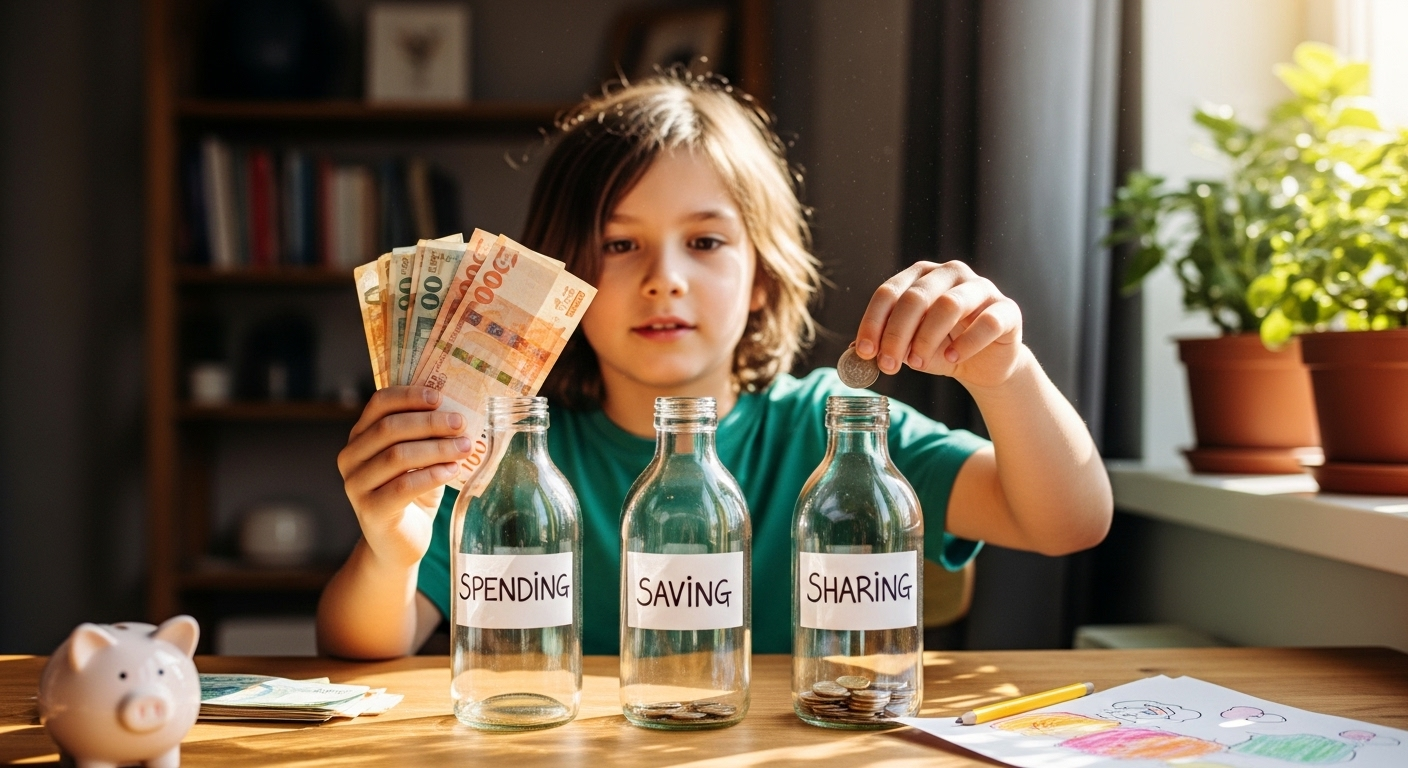
Passing on the habit of saving to children is not just about the skill of accumulating money; it is a process of helping them plan their lives proactively and build a strong inner self that remains unshaken in any crisis.
Conclusion: Your Choice Shapes Your Child’s Future
The true alchemy of wealth is not the flashy magic of predicting the future of the market. It lies in the simple truth of “spending less than you earn and steadily increasing the difference,” which is high savings rate.
Wealth based on flashy returns can betray you at any moment, becoming ‘fragile fortune.’ However, the castle of savings built through your sweat and patience will create ‘unbreakable wealth’ that will steadfastly protect you and your family through any economic storm.
Now the choice is yours. And that choice will soon become your child’s future.
What will you teach your child: the gambler’s skill of leaving luck to the capricious market, or the sage’s wisdom of steadily building freedom?