
The Factory of Intelligence Manufacturing: NVIDIA’s AI Factory and the Global Supply Chain Tectonic Shifts Driven by the Vera Rubin Architecture
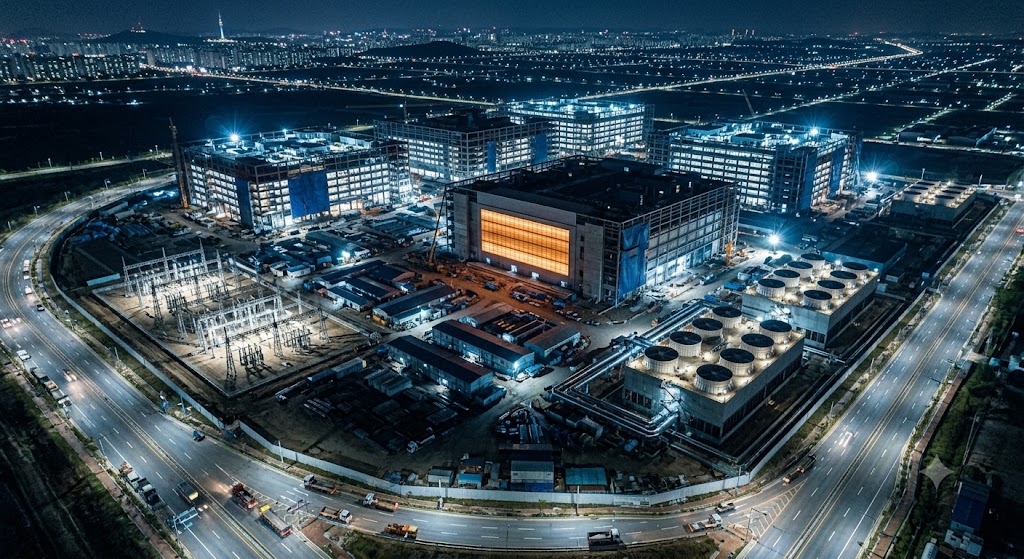
There are three types of factories in the world.
The first burned coal to churn out physical products.
The second used electricity to assemble standardized components.
And now, humanity is facing the third type of factory.
This factory continuously produces ‘intelligence’ by inputting power and data.
-> The products are invisible. They have no weight. Yet, a price exists, and that price is reshaping the global economic landscape.
This is the essence of the AI Factory, as defined by NVIDIA.
At Computex 2026 in Taipei, Jensen Huang declared the unveiling of the next-generation platform, Vera Rubin NVL72.
The purpose of computing has changed.
-> The era of the passive warehouse, storing data and serving web pages, is over.
-> Now, computers must be power plants that ceaselessly manufacture intelligence – capable of real-time inference, decision-making, and action.**
Two reactions coexist in the face of this declaration.
One is the gaze of investors looking at stock charts.
The other is the ear of engineers hearing the collapse of decades-old infrastructure paradigms.
This article aims to reach that second ear – the one that hears the physics behind the numbers, the supply chain behind the specifications, and the shifts in power quietly redrawing the landscape behind those supply chains.
To begin that story, we must go back to the most fundamental place: how electricity becomes heat, and why that heat is changing everything.
Chapter 1. Why Factories Are Collapsing: The Engineering of Voltage and Heat
To understand existing data centers, one must remember a core premise.
It was a world of ‘predictable static load’.
Even with tens of thousands of users clicking on a website simultaneously, servers quietly dissipated heat according to schedules finely divided into milliseconds. The power consumption per rack was in the range of 10 to 15 kilowatts (kW). Indoor air conditioners and the cool airflow beneath raised floors were sufficient.
However, agent AI has shattered the premise of that quiet world.
AI agents, which make autonomous decisions and use tools, consume almost no power in idle states, but instantly draw power at maximum voltage the moment a large-scale inference command is issued. Engineers call this a ‘Transient Spiky Load Profile’.
This violent fluctuation of current creates voltage spikes that can instantaneously physically destroy components in existing Power Distribution Units (PDUs).
Existing power plants and the grid were not designed to respond to these irregular and destructive transient load surges.
The problem isn’t just voltage.
The laws of thermodynamics impose an even more brutal constraint.
A rack consuming nearly 200kW of power is, thermodynamically speaking, equivalent to running an industrial electric heater constantly in that space.
Air has a critically low capacity to absorb heat – its specific heat capacity – compared to liquids.
Water’s specific heat (approximately 4,184 J/kg·K) is more than four times higher than air’s (approximately 1,005 J/kg·K), and its density is over 800 times greater. In terms of heat that can be cooled within the same volume, water vastly surpasses air by thousands of times.
Going into specific numbers makes it clearer.
The fundamental equation of cooling engineering is this: The heat load to be dissipated (Q) is determined by the product of the fluid’s mass flow rate (m), specific heat (Cp), and the temperature difference between inlet and outlet (ΔT).
To forcefully cool over 100kW of heat with an air-cooled system, the fan speed must be raised to the noise level of a jet engine, and the power consumed by that fan exceeds the power used for computation by the server, reaching a ‘cooling efficiency inversion.’ This is a physical limit that cannot be overcome by force. It’s a black hole of energy waste where the cooling system itself generates more heat for cooling. This is a physical limit that cannot be overcome by force. It’s a black hole of energy waste where the cooling system itself generates more heat for cooling.**
Therefore, AI Factories are transitioning to liquid cooling. It’s not a choice; it’s a conclusion dictated by physics.
However, the introduction of liquid cooling creates new risks.
If even a single drop of water leaks from the cooling pipes, server equipment carrying 800-volt (V) high voltage will immediately cause an electrical arc explosion, turning billions of dollars worth of infrastructure into ashes.
This is why quick-disconnect (QD) leak-free valves and metal cold plates controlled with less than a micrometer’s error require precision manufacturing capabilities on par with aerospace engineering.
The power supply method is also changing from the ground up.
Traditional data centers reduced high-voltage alternating current (AC) power from power plants through transformers and then supplied it to servers through multiple conversion stages. Energy was lost at each conversion stage, and this loss turned back into heat, increasing the cooling load.
AI Factories solve this problem with an 800V high-voltage direct current (HVDC) busbar architecture.
-> It reduces conversion stages and uses digitally controllable Solid State Transformers (SSTs) to increase voltage levels, delivering the same power more efficiently with thinner wiring.
This is the reality facing traditional data center operators.
The power systems must be replaced.
The entire cooling system must be dismantled.
During this process, not a single leak accident can be tolerated.
And even after all this work is completed, there are only a few places on Earth capable of manufacturing the hardware they will use.
Chapter 2. The Brainwaves of Agent AI: Why Existing Accelerators Are Insufficient
When humans play Go, they don’t just make a single intuitive move.
-> They unfold dozens of future scenarios like branches of a tree in their minds, simulate the outcome of each branch, and then choose the best one.
Agent AI does the same.
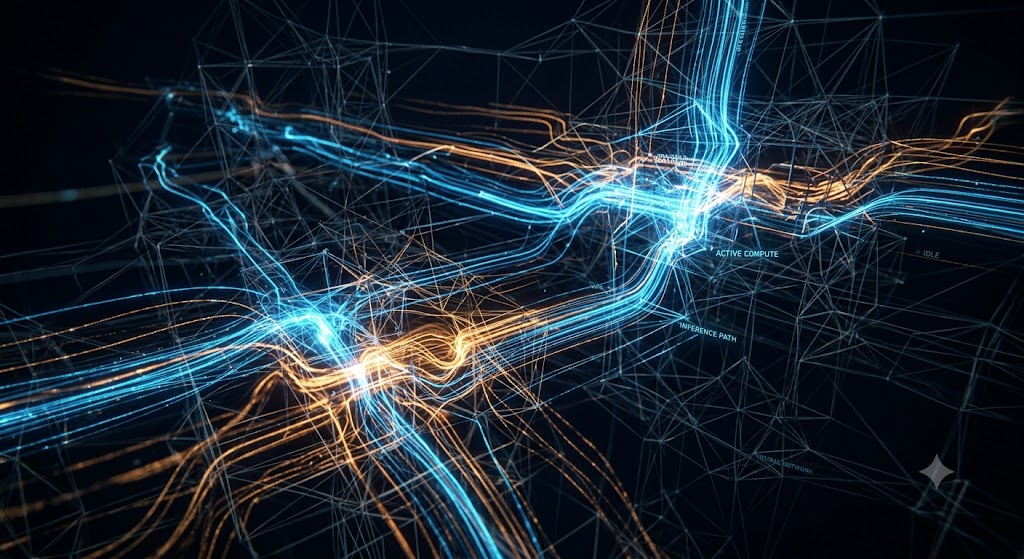
-> Even for a simple question, it engages in endless internal inference loops.
In software engineering, this is called ‘Test-Time Scaling’ or ‘Chain of Thought’ for inference steps.
This inference loop is divided into two asymmetrical stages.
The first is the ‘Prefill’ stage.
This is the phase where the user’s vast input document is interpreted all at once, and the GPU’s parallel matrix computation capabilities are maximized.
Thousands of tensor cores perform matrix multiplications simultaneously, and during this stage, the GPU’s computational units operate at their designed maximum efficiency.
The second is the ‘Decode’ stage.
This is the segment where words (tokens) are generated one by one in sequence, and this is where the structural bottleneck occurs.
-> Every time a new word is generated, all previously generated words’ computational cache information, i.e., the KV cache, must be re-read from memory. While waiting for this memory data, the GPU’s powerful compute units are idle for over 90% of the time.
This means that billion-dollar accelerators spend most of their time waiting rather than computing.
-> In computer architecture, this is called the ‘Memory-Bound Bottleneck’.
This bottleneck worsens exponentially as the model handles longer and more complex conversational contexts.
-> An agent that has exchanged 100 conversations with a user must store all 100 conversations in its KV cache and re-read this entire cache with every response.
-> The size of the cache dictates the memory bandwidth requirement.
When the Mixture of Experts (MoE) architecture is added, the bottleneck spreads throughout the network.
The large model is split into specialized domains, with each part distributed across different GPU nodes.
Every word results in tens of thousands of tokens being transferred to and re-aggregated from different nodes, creating an ‘All-to-All’ traffic storm.
A packet transmission delay of just 1 microsecond can halt the entire distributed system.
MoE is important for another reason.
It’s the only way to increase specialization without increasing the overall size of the Transformer model.
-> For example, a model with 1 trillion parameters would require computation of all 1 trillion if made into a single dense structure. However, in an MoE structure, only a fraction, say 10% to 20%, might be activated for each inference.
While computational efficiency increases, inter-node communication traffic explodes. If this traffic cannot be controlled in nanosecond units, the advantages of the MoE architecture are entirely eroded by communication latency costs.
The conclusion is simple.
Computational systems in the era of agent AI can only be solved through integrated designs that overcome communication bottlenecks between memory and memory, and between servers and servers, in nanosecond units, not just the speed of individual chips.
This is why NVIDIA has started selling ‘complete rack systems’ instead of individual chips.
-> The world has shifted from individual component peak specs to the lowest system-wide bottleneck determining performance.
Chapter 3. Vera Rubin NVL72: Dissecting the Monster Rack
The star of Computex 2026 was undoubtedly Vera Rubin NVL72.
The name comes from astronomer Vera Rubin, who discovered the existence of dark matter through the anomaly of galactic rotation speeds.
The metaphor that the unseen moves the world was applied to this machine that manufactures unseen inference results.
Rubin NVL72 puts the traditional semiconductor retail model of selling individual chipsets to rest.
A single rack operates as one virtual single processor, welded together with 72 accelerators and 36 CPUs.
It weighs approximately 1.3 tons. Power consumption is up to 230kW. The price has not been disclosed, but market estimates suggest it exceeds several million dollars per rack.
Dissecting its internal structure reveals:
Eighteen Compute Trays and nine NVLink 6 Switch Trays are alternately arranged. Each Compute Tray contains two Vera CPUs and four Rubin GPUs.
To prevent voltage drop due to cable wiring, a cableless design is adopted where the rear of the tray directly mates with a copper backplane.
The elimination of cable bundles, weighing tens of kilograms each, not only improves physical space efficiency but also fundamentally enhances signal quality.
The performance figures are provocative.
Inference performance is 3,600 PFLOPS (Petaflops), a 5x increase over the previous generation Blackwell.
Memory bandwidth is 22 TB/s per GPU, 2.75x that of Blackwell (8 TB/s).
But the most shocking number is this:
The cost per token for computation drops to one-tenth of the previous generation.
-> This means that one-fourth the hardware is needed to achieve the same inference results.
Translating these figures into real-world units:
If a cloud company operates GPT-4 level model inference at current costs, with the Rubin generation, they can serve 10 times more users at the same cost, or provide 10 times more complex inferences to the same users.
If the cost of multi-stage inferences performed by agents becomes one-tenth of the current level, the economic viability of agent services fundamentally changes.
The threshold for commercializing agent functions that are currently unusable due to cost is lowered.
The Seven Chipsets Constituting the Rack
The Rubin platform is not a competition of individual chip performance.
Seven dedicated chipsets each eliminate one bottleneck, creating a system where bottlenecks disappear.
Following the reason for existence of each chipset in order, the computational structure of agent AI systems becomes clear.
Rubin GPU. 3nm process, 336 billion transistors. It ingests 22 TB of data per second into the chip via HBM4 memory.
Recall that memory bandwidth was the bottleneck in previous generations. 22 TB/s directly attacks that bottleneck.
The 3rd generation Transformer Engine incorporates hardware-accelerated compression algorithms that dynamically convert computational precision, maximizing the deployment speed of ultra-large multimodal models.
Vera CPU. 88 Olympus cores. It’s not a general-purpose operating system but a dedicated command center for AI agent workflows.
It has increased performance from the previous Grace CPU (72 cores) while fundamentally changing the architecture’s purpose.
It instantly translates Python code and virtualized containers into hardware instructions and acts as a mediator, sending KV cache flows to the network.
This is a design intended to structurally eliminate the CPU from becoming a bottleneck in AI agent workflows.
NVIDIA Groq 3 LPU. Based on 128GB ultra-high-speed SRAM, it exclusively handles decode operations.
It’s the dedicated processing unit for the memory bandwidth bottleneck described earlier, i.e., KV cache read latency.
It acts as a shield, allowing the Rubin GPU to maintain 100% utilization. It’s a division of labor: the GPU only computes, and the LPU only supplies memory.
NVLink 6 Switch. Enables 72 GPUs within the rack to share each other’s data without physical distance barriers.
Its bidirectional 3.6 TB/s bandwidth is double that of the previous generation (1.8 TB/s).
It eliminates communication overhead by completing synchronization operations within the switch during communication using the SHARP (Scalable Hierarchical Aggregation and Reduction Protocol) architecture. -> It’s a structure that absorbs the All-to-All traffic storm problem at the network layer.
ConnectX-9 SuperNIC. Provides 1.6 Tbps bandwidth and a hardware RDMA (Remote Direct Memory Access) engine when expanding communication to external clusters.
It eliminates bottlenecks in virtual tunnels with large switches. It’s the connecting link required when building large AI Factory clusters composed of thousands of racks, extending beyond a single rack.
BlueField-4 DPU. Handles virtualization control, encryption, and storage I/O overhead completely separate from the main computer.
In conjunction with dedicated BlueField-4 STX flash array switches, it offloads agent KV cache data from main memory at ultra-high speeds.
As a result, the rack’s token processing efficiency expands by up to 5 times or more.
By removing security and storage overhead from the CPU and GPU, it allows these two chips to focus solely on computation.
Spectrum-6 Ethernet Switch. 102.4 Tbps transmission performance. It serves as the backbone gateway enabling the full deployment of CPO optical technology, which will be explained in the next chapter.
These seven are all designed by NVIDIA. While it’s not physically impossible for buyers to mix products from other companies, the performance of each chipset is optimized assuming cooperation with the other six chipsets, so to achieve peak performance, one essentially must fill the entire system with NVIDIA components. This is the reality of platform exclusivity.
It’s a structure of dependency created by design, not coercion.
Chapter 4. The Death of Copper: The Revolution of CPO and Optical Networking
Servers in an AI Factory exchange synchronized signals in nanosecond units.
If copper wires are used to transmit these signals, two problems arise.
First, high-frequency electrical signals dissipate as heat due to the skin effect, causing the signal voltage to drop sharply.
At high frequencies, electrons concentrate near the surface of the conductor, which is equivalent to a reduced effective cross-sectional area, leading to a rapid increase in resistance. Power loss is proportional to the square of resistance, so as frequency increases, the energy efficiency of copper wires degrades exponentially.
Second, the powerful electromagnetic fields emitted by hundreds of thousands of GPUs flood surrounding wiring with electromagnetic interference (EMI) noise, increasing the bit error rate.
Even if 1 out of 1,000 bits is flipped, the data is corrupted. In an AI Factory where trillions of bits flow every nanosecond, the accumulation of this error rate makes the cost of retransmission and error correction as significant as the computational cost.
-> NVIDIA’s answer is Spectrum-X Ethernet Photonics.
It replaces the metal wiring in the networking backbone with Silicon Photonics. Electrical signals are converted into light.
The core of this technology is the Co-Packaged Optics (CPO) architecture.
In the traditional method, electrical signals generated by the switch chip traveled along the mainboard’s copper traces to detachable optical transceiver modules outside the device, and then were converted to light after passing through a DSP (Digital Signal Processor) retimer chip. This journey could be 10 to 15 centimeters long, and heat and signal distortion accumulated at each stage.
CPO converts electrical signals into light immediately within 1 millimeter of the switch semiconductor package. The DSP chip itself for signal amplification becomes unnecessary.
-> The result is over a 5x reduction in energy consumption per port.
-> Beyond simply saving energy, reduced heat dissipation lowers additional cooling loads, and more ports can be integrated into the same space, increasing overall network density.
The physical properties of light provide two additional benefits.
Signal attenuation is virtually eliminated, allowing signals to traverse distances of several kilometers in just about 1 microsecond.
This changes the physical placement flexibility of AI Factories.
Until now, accelerators had to be placed physically close to each other for low-latency communication. With the widespread adoption of CPO, racks distributed in buildings kilometers apart can collaborate with the same latency.
-> This changes the design freedom of data center campuses.
It is completely immune to electromagnetic noise, even when placed next to high-voltage power lines.
Light is not affected by electromagnetic fields.
Distributed training interruptions, a common cause of failure in AI Factories due to network module failures, are structurally eliminated.
Distributed training requires thousands of GPUs to operate synchronously for weeks or months, and a single network link failure during this process would halt the entire training. -> CPO physically removes this cause of failure.
The figure of over a 5x increase in infrastructure uptime comes from this context.
Chapter 5. The Soul of Software: DSX OS and FOX Blueprint
Assembling the hardware doesn’t complete the intelligence factory.
Without software that makes tens of thousands of accelerator cards move without a single microsecond of delay, it’s just a non-operational lump of metal.
DSX OS: The Operating System That Turns a Rack into a Single Brain
A traditional operating system is a manager that fairly distributes resources.
Multiple applications take turns using CPU time.
However, if this static allocation method is applied to an AI Factory, synchronization delays will accumulate as thousands of accelerator cards wait for each other’s intermediate computation values to arrive.
DSX OS adopts a fully distributed control structure that views the entire rack as a single processor, rather than from the perspective of individual applications.
-> It calculates in real-time when network packets arrive inside the chip, and where the next decode token should be in which HBM memory bank to take the shortest path, and paves the way in advance.
This is not manual scheduling. It’s an autonomous control loop that collects chip-level telemetry data in real-time and uses predictive models to redistribute traffic before bottlenecks occur.
The error handling method changes most dramatically.
When a memory bit flip (soft error) is detected in a specific GPU core, in the traditional method, the entire compute node would be halted. -> In scenarios where the training of models with trillions of parameters was interrupted by the failure of a single chip, this could result in the loss of a week’s worth of computational assets. This ’training interruption’ problem was the most feared type of failure for companies operating large-scale AI research.
DSX OS captures the state of the operation of the faulty compute unit as a virtual container and transfers it to an adjacent idle unit within 1 millisecond.
The entire system does not stop. The user doesn’t even know a failure occurred. This is the Self-Healing Automation Engine.
FOX Blueprint: Sealing the Physical Factory with a Digital Twin
FOX (Factory Operations Blueprint) has a broader scope.
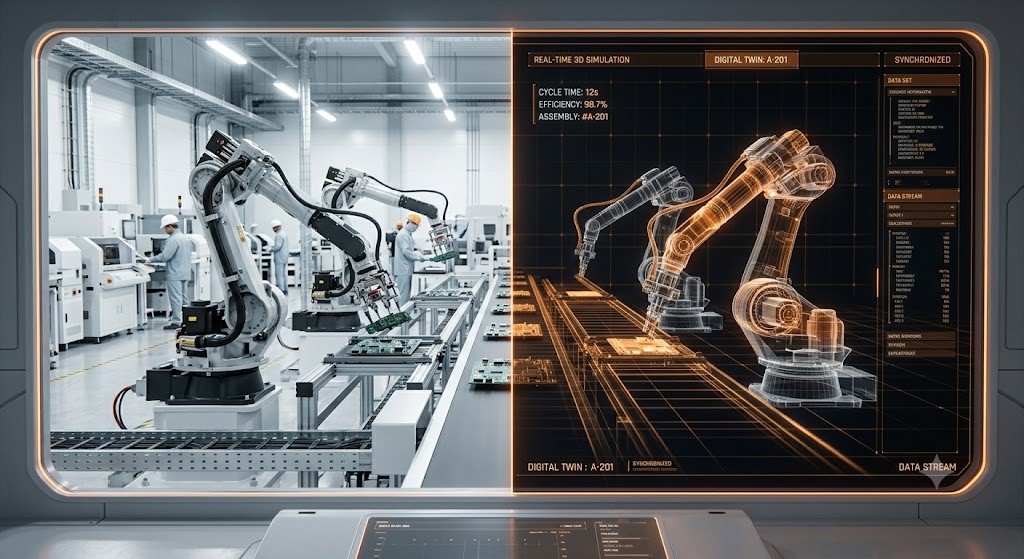
It’s a reference design philosophy that links all sensors, autonomous robots, and quality inspection equipment in a physical manufacturing plant with NVIDIA’s digital twin platform, Omniverse, in real-time.
*-> Data generated in the physical factory flows into the virtual factory, and the results simulated in the virtual factory are fed back to control the physical factory’s robots. *
It’s a structure where software robots practice actual machine operations in advance, and defect inspection models learn tens of thousands of images of virtual defects before they actually occur.
This concept might sound abstract, so three real-world examples bring it to reality.
Pegatron. Based on the NemoClaw framework, they have completed an intelligent autonomous logistics robot, an AI vision defect inspection system, and a hierarchical structure where a master agent coordinates multiple subordinate agents. Multiple agents are responsible for logistics, quality, safety, and energy management, and the master agent integrates their decisions to optimize factory-wide resource allocation in real-time. They have reduced redundant physical asset investment costs by over 15% by eliminating idle reserve equipment.
Amphenol. They combined NVIDIA’s generative AI platform, Cosmos, with inspection lines for over 300 types of micro-connectors. The lack of defect data in the early stages of new product production is a common hurdle for all manufacturers, as there is no defect data for products not yet produced, preventing prior training of defect inspection models. Amphenol solved this problem by synthesizing a large number of virtual defect images. The speed of building defect inspection models was reduced by 12 times, and the period for yield stabilization in the early stages of new product launches was shortened from weeks to hours.
Foxconn. Beyond the manufacturing floor, they deployed the NemoClaw-based CoDoctor AI solution within a general hospital. Linked with the Nurabot collaborative nursing robot for medical staff, it automatically recorded patient vital data in real-time charts and tracked the causes of medication discrepancies with over 90% accuracy. While it might seem unusual for a company that operates manufacturing plants to develop hospital AI solutions, the logic of the FOX Blueprint is the same: a structure where multiple agents cooperate in a complex environment, process real-time data, and a central master agent coordinates the whole.
These three examples collectively demonstrate one thing.
The value of the FOX Blueprint comes not from buying new machines, but from intelligently connecting the data generated by existing machines.
The key is that the platform’s penetration method is not hardware sales but standardization of data flow. Once a factory begins operating based on the FOX Blueprint, the cost of switching to another platform becomes not the cost of hardware replacement, but the cost of rebuilding years of accumulated process data and agent training assets.
Chapter 6. The Supply Chain War: The Maps of Taiwan and Korea
The design of Vera Rubin originates in Santa Clara, California. However, the ability to translate that design into a tangible, functioning 230kW metal cabinet is limited to a few places on Earth.
Taiwan: The De Facto Ruler of the Silicon Empire
TSMC. The relationship between NVIDIA and TSMC is now beyond customer-supplier; it’s a shared destiny.
As of 2026, NVIDIA’s share of TSMC’s total revenue is poised to exceed 20%. They are pre-booking and operating the 3nm advanced lithography lines for Rubin and have seized control of global supply shortages through advanced packaging technologies like CoWoS (Chip on Wafer on Substrate) and SoIC (System on Integrated Chips), which combine HBM4 and logic dies on a single substrate.
If TSMC encounters supply problems, NVIDIA’s product launch schedule comes to a halt. The H100 supply shortage from 2023 to 2024 demonstrated this structural vulnerability to the world in real-time. However, TSMC is well aware of the leverage this dependency gives it. Without TSMC, there is no Rubin, and without Rubin, there are no AI Factories.
The ODM Trio. Foxconn, Quanta Computer, and Wistron physically assemble the 1.3-ton complete liquid-cooled racks based on NVIDIA’s blueprints.
Foxconn, with its world-leading production capacity, has secured a core stake in the contracts for delivering the complete Rubin NVL72 racks. They are using the Omniverse platform in their own lines to halve design error rates, and this experience becomes a reference case for the FOX Blueprint.
Foxconn is becoming both a customer of NVIDIA and a marketing tool for NVIDIA in a cyclical structure.
Quanta, through its subsidiary QCT (Quanta Cloud Technology), has solidified its position as a leader in rapidly designing and delivering customized network and rack layouts for hyperscale customers. While the standardized Rubin NVL72 rack is the base, major cloud providers like Google, Microsoft, and Amazon require custom variations to fit their data center designs. The speed of these custom design variations is their differentiating point.
Wistron has completed its transition to an automated engineering system within Taiwan, breaking away from reliance on mainland China’s workforce, thereby eliminating supply chain reliability risks. In the context of escalating US-China geopolitical tensions, securing domestic production capacity in Taiwan is not just a matter of efficiency but a strategic response to customer demands for supply chain security.
Masters of Energy Conversion. A rack consuming 220kW means that even a 1% efficiency loss in voltage conversion generates over 2kW of ‘free-riding’ heat. This heat requires energy to cool, and that energy in turn creates more heat. The difference of 1% in power conversion efficiency has a cascading effect on the size of cooling equipment and electricity bills.
Delta Electronics has developed 800V HVDC conversion busbar architectures and high-speed digital Solid State Transformer (SST) solutions and has entered the field validation stage. They have halved the design cycle by integrating AI acceleration solutions into their SmartDesign platform.
Lite-On provides custom high-power Battery Backup Power (BBP) packs to ensure computation data doesn’t evaporate even during power grid fluctuations.
Artisans of the Liquid Cooling Loop. AVC and Auras Technology dominate manifold and leak-free valve modules that precisely control water pressure in cooling pipes.
Cooler Master, leveraging 33 years of thermal control design expertise, mass-produces dedicated copper cold plates and pump units for MGX-based rack structures on automated lines.
While the unit cost of the parts they provide may be low, the Rubin NVL72 cannot operate without them. They are the quietest but most essential links in the supply chain.
Korea: The Meaning of the HBM4 Partnership
Just before Computex 2026, NVIDIA held its first exclusive event for Korean partners in Taipei: ‘Korea Partner Night.’
This event is not just a ceremony. It signals that NVIDIA has provided a separate platform to manufacturing partners outside of Taiwan for the first time.
SK Hynix and Samsung Electronics. These are the countries that produce HBM4 (6th generation High Bandwidth Memory), which determines the core performance of Vera Rubin. The 22 TB/s bandwidth per GPU is impossible without HBM4.
The structure of HBM is unique. Multiple DRAM dies are stacked vertically and placed side-by-side with the GPU in a 2.5D configuration on a substrate (base die). The physical distance between the memory and the processor is extremely short, leading to a surge in bandwidth.
Starting with the HBM4 generation, the manufacturing process for this base die changes. Because the internal logic of the base die cannot be easily implemented with traditional memory processes, it must transition to cutting-edge foundry fine-pitch processes. This is the key.
SK Hynix and Samsung Electronics design and produce the memory stacks, but the base die comes from TSMC’s advanced processes. The technologies of the two countries are literally sealed within a single package.
Without Korea’s memory engineering, there is no HBM4; without Taiwan’s foundry process, there is no HBM4 base die; and without both, there is no Rubin GPU. The technological dependency of three countries is concentrated within the Rubin package.
Beyond this memory alliance, Korea’s technology ecosystem is broadly connected.
Naver Cloud is executing a Sovereign AI strategy, aiming not to rely on overseas clouds for its domestic data, based on Korean language-specific models.
Doosan and LG Electronics are pursuing the acquisition of core control technologies for autonomous manufacturing processes and smart factory transitions.
These are not mere chip buyers. They are positioning themselves as the foremost technological allies in the era of the Autonomous Physical Factory, where artificial intelligence precisely controls physical environments.
Korea Partner Night was NVIDIA’s official recognition of this positioning.
Chapter 7. The Small Giant in Your Pocket: RTX Spark and On-Device Agents
After dominating the data center market, NVIDIA is also making inroads into the personal device market. The tool for this is the RTX Spark.
RTX Spark is a single silicon chip that combines a 20-core Arm Olympus CPU and a Blackwell-generation accelerator with 6,144 CUDA cores.
In collaboration with Microsoft, it targets the personal AI PC market.
The decisive innovation is 128GB of Unified Memory.
-> The CPU and GPU share the same memory space. Traditional personal graphics cards have VRAM limited to around 16GB to 24GB, making it impossible to run large models with over a hundred billion parameters. If the model cannot be loaded entirely into VRAM, the process of loading necessary parts from system memory repeatedly during computation slows down by 10 to 100 times.
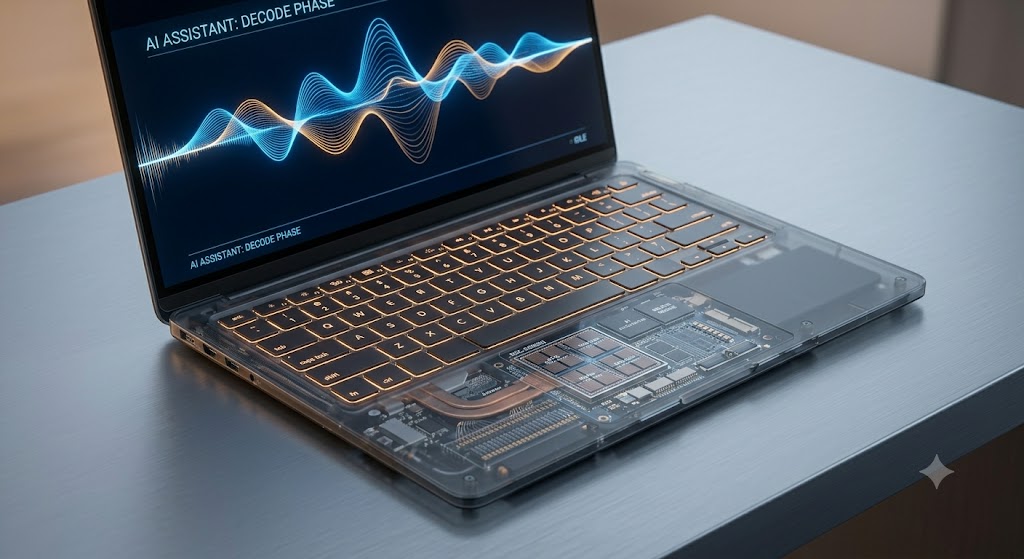
RTX Spark breaks this boundary, allowing models with 120 billion parameters to run locally and independently at speeds of tens of tokens per second without a network connection.
Frontier-class AI inference is possible on airplanes, in basements, or in internally networked environments without internet access.
The practical implications are threefold.
First, cost. Cloud AI services charge per token for each query. Running models locally eliminates this cost.
-> While seemingly minor for individual users, for enterprises where agents perform thousands of subtasks, the cost structure fundamentally changes. Operating an agent service that consumes millions of tokens daily via the cloud incurs API costs of tens of millions of won per month, but switching to on-device processing handles this cost as a one-time hardware purchase.
Second, privacy. All user data is processed only within the device. It is not transmitted to external servers.
Company confidential documents, personal medical records, financial data – all of these are handled only on-device.
This opens the door to adopting AI capabilities even in regulatory environments that prohibit cloud AI use (finance, healthcare, law, defense).
Third, NVIDIA’s strategic calculation. As software developers worldwide begin developing AI services on laptops equipped with RTX Spark, they will become familiar with the CUDA libraries that NVIDIA has refined over many years.
When they deploy the services they create to the cloud, they are already within NVIDIA’s accelerated hardware ecosystem.
It’s a structural design that pipelines developers from local training to data center customers at the deployment stage. It intertwines hardware sales and the developer ecosystem into a single product.
Chapter 8. The Turning Point: What We Are Witnessing
At this point, we need to step back.
The figures revealed by NVIDIA are overwhelming.
Vera Rubin’s token production efficiency is one-tenth of the previous generation, and its performance is five times higher. Factories adopting the FOX Blueprint have achieved double-digit cost reductions. RTX Spark runs large models on laptops.
However, the true meaning of these figures lies not in the numbers themselves.
The first change is that the criteria for measuring the value of computing are shifting.
It’s not ‘Cores per Dollar’ or ‘Gigaflops per Dollar,’ but ‘Tokens per Dollar.’
This is redefining computing infrastructure in the language of manufacturing.
Output per unit time, production per unit cost, defect rate, uptime – the KPIs for this factory are not the language of data centers but the language of the manufacturing floor.
This is the moment the computing industry redefines itself from an IT service industry to a manufacturing industry.
The second change is the shift in bottleneck location.
For the past three years, the bottleneck in AI infrastructure has been the GPU chipset itself. H100 demand far outstripped supply, making lead times of tens of weeks commonplace.
This bottleneck is now slowly being resolved. However, new bottlenecks are emerging.
Delays in power grid connection, increased lead times for ultra-high voltage transformers, and a shortage of precise liquid cooling pipe manufacturing capabilities.
In other words, what now limits the expansion speed of AI Factories is not the capability to design and produce chips, but the capability to supply power to the chips and cool their heat.
Building a new substation takes years. The global lead time for ultra-high voltage transformers has already exceeded one to two years. The number of manufacturers capable of mass-producing precision liquid cooling components is few and far between globally.
The third change is the paradox of geographic concentration.
In the AI Factory era, infrastructure is more deeply dependent on the semiconductor manufacturing ecosystems of Taiwan and Korea than ever before.
This simultaneously creates a structure that carries both the strongest performance and the highest geopolitical risk.
The trend of Sovereign AI in various countries is a reaction to mitigate this risk.
However, the manufacturing capability of core semiconductors cannot be dispersed in the short term. Process know-how and talent ecosystems accumulated over decades are not replicated simply by drawing different locations on a map.
These three changes converge to one conclusion.
The entry barrier in the AI Factory era is no longer AI algorithm development capability.
Control over the physical infrastructure – supplying power, cooling heat, connecting optically, and securing memory bandwidth – is the next high ground of competition.
Chapter 9. The Final Question: The World Beyond the Intelligence Factory
In the summer of 2026, the world is beginning to bifurcate into companies that can operate a few rack cabinets and those that cannot.
This is not unprecedented.
In the 1970s, companies were divided into those with mainframe computers and those without.
In the 1990s, companies were divided into those connected to the internet and those not.
In the 2000s, companies were divided into those using the cloud and those maintaining their own servers.
-> Each transition was met with skepticism, with the attitude of ‘it’s just another tool,’ yet each time, those who first mastered the tool dominated the next decade.
The scope of what is happening now is broader than previous transitions.
This is because it is not confined to a single industry or a single job category.
Agent AI is changing the speed between ‘judgment’ and ’execution’ in any field: hospitals, factories, finance, logistics, legal services, education – you name it.
Semiconductors and networking are becoming the infrastructure for intelligence produced everywhere, not just in specific buildings.
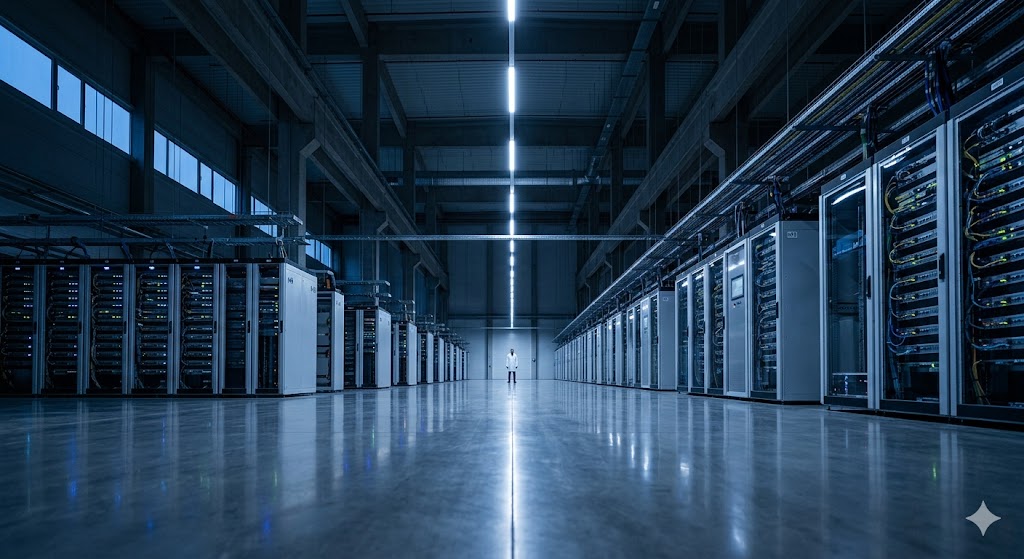
The remaining question is this:
When the cost of manufacturing intelligence drops by a tenth, and the supply of intelligence approaches infinity, how will the value of intelligence itself be redefined?
When factories begin mass production, rarity disappears, and design remains.
When the First Industrial Revolution replaced the hands of artisan craftsmen, the surviving value was design sensibility and contextual understanding that machines could not imitate.
When the Second Industrial Revolution churned out standardized products, the surviving value was the ability to imagine their uses.
The Third Factory has begun mass-producing intelligence. When inference ability, language generation, and pattern recognition begin to emerge from factories, what will become scarce next?
The answer to this question is not provided by machines.
References
- NVIDIA Factory Operations Blueprint Gives Factories a New AI Brain — Esther Lee (NVIDIA Blog)
- NVIDIA Vera Rubin Ramps Into Full Production to Power Agentic AI — NVIDIA News Room
- Nvidia’s Big Bet: Entering the AI Personal Computer Chip Market — Financial Times
- AI Factories: The New Infrastructure of Intelligence — NVIDIA Developer Blog
- AI Infrastructure Boom Puts NVIDIA and Taiwan at the Heart of Computex — Indian Express
- Nvidia enters Windows AI PC race with new RTX Spark chip — Indian Express
- TSMC Expands Use of NVIDIA AI Technologies Across Chip Production Operations — SemiWiki
- What Are the Differences Between AI Factories and Traditional Data Centers — Fortanix Blog
- AI Factory vs AI Data Center Design Requirements — Giga Energy
- What Makes an AI Factory Structurally Different — CtrlS Data Center Blog
- NVIDIA Unveils Vera, the CPU for Agents — NVIDIA News Room
- CoreWeave Becomes First to Deploy NVIDIA’s Vera Rubin NVL72 System — StreetInsider News
- Supermicro Reveals DCBBS blueprints for NVIDIA Vera Rubin NVL72 and HGX Rubin — Supermicro Press
- Silicon Photonics for AI Clusters: Performance and Reliability Metrics — Lambda Labs Blog
- Korea Emerges as a Core Nvidia Partner Beyond HBM at Computex — Choi Hyo-jung (Chosun Biz)