
Have you ever witnessed scenes in life that you simply couldn’t understand?

They are undoubtedly smarter than most.
Yet, paradoxically, this very ‘smartness’ often drives them into the most fatal traps.
Many psychologists point to this as the ‘paradox of the conversational narcissist’
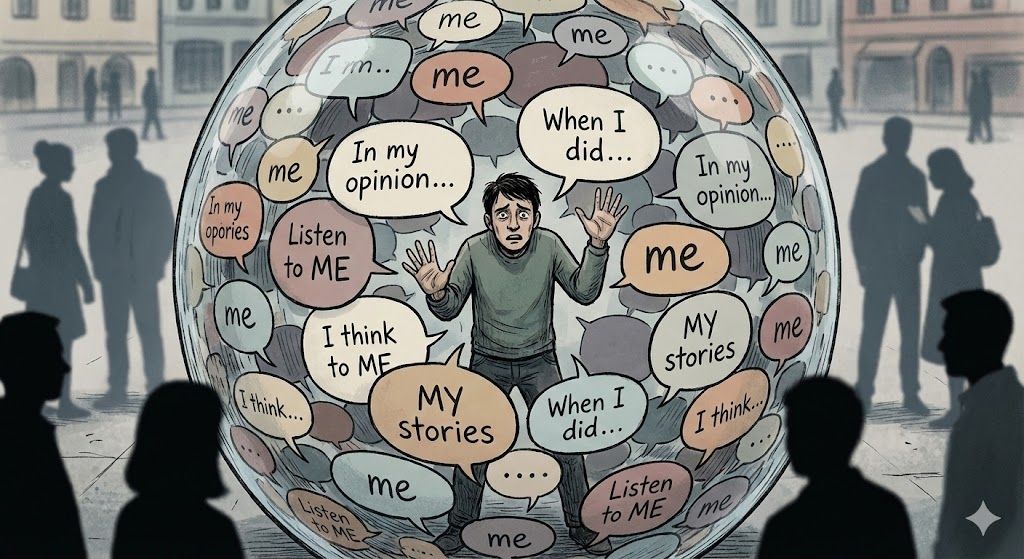
Their logic is so perfect that there’s no room to accept the other person’s perspective. Their minds are consumed by this thought:
“I’m 100% right, why can’t they understand?”
At this moment, conflict transforms from ‘a problem to be solved’ into ‘an object to be enlightened’.
But friends, true reason isn’t about proving yourself right to subdue the other person.
The real attitude of an intelligent person is ‘strategic flexibility’—knowing precisely what weapon you hold and being able to switch it according to the situation.
Today, we will take out and polish the 5 conflict resolution tools that lie dormant in your subconscious.
We invite you to witness the dramatic moments of how Steve Jobs’ 독단 (doggedness/authoritarianism) led Apple to crisis, and conversely, how Nelson Mandela’s concession saved a nation.
1. Diagnosis: Are You a Shark or a Teddy Bear?
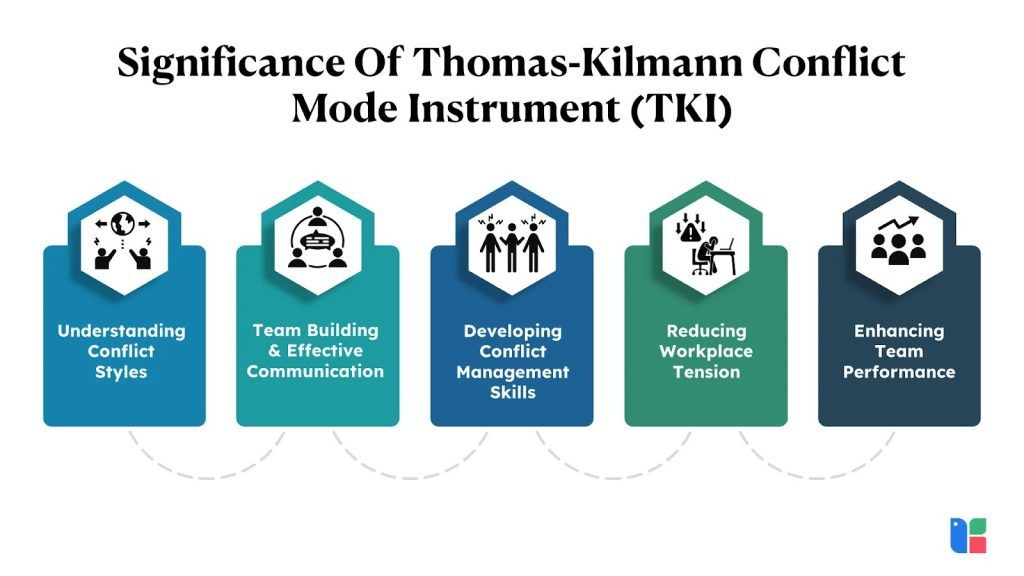
The TKI (Thomas-Kilmann Instrument) model, considered the bible of conflict management, dissects our complex and subtle fighting styles into two clear axes:
- X-axis: Cooperativeness - How much do you consider the other person’s needs?
- Y-axis: Assertiveness - How much do you assert your own needs?
At the intersection of these two axes, we encounter five different ‘animals’. In my experience, everyone has one ‘specialty’ among these. Let’s find out where you belong.
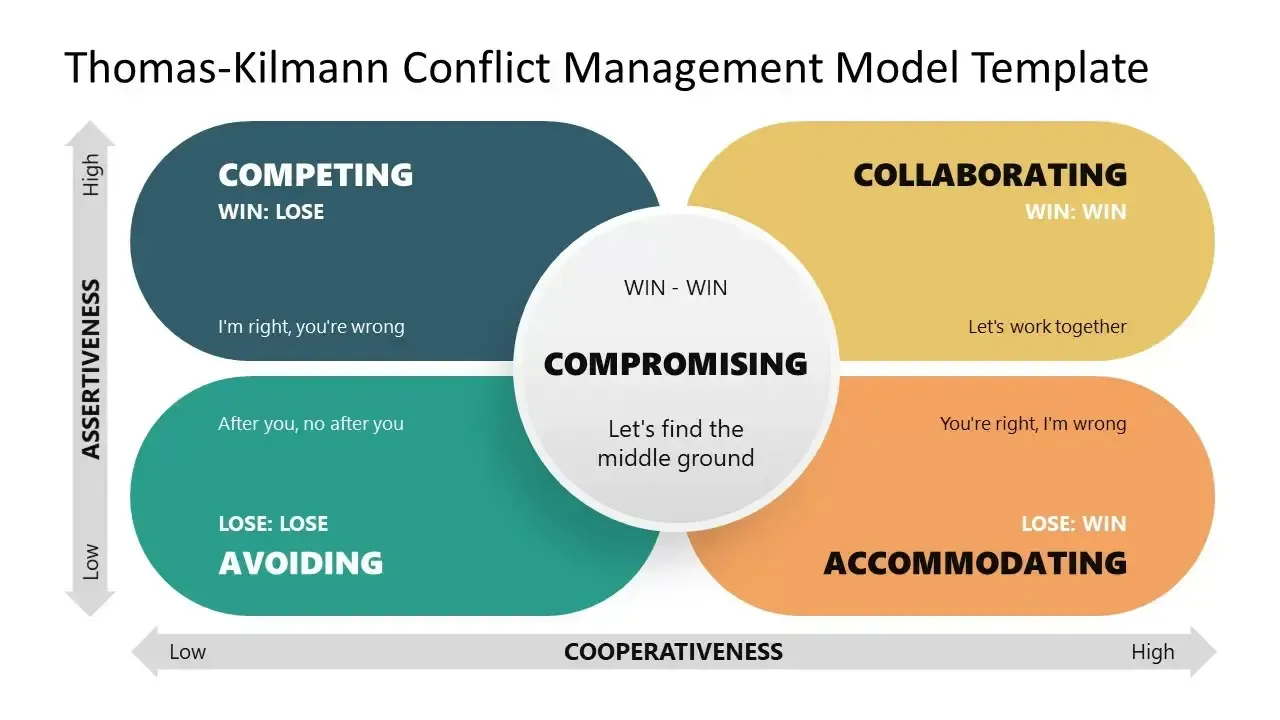
① Shark (Competing): “My Victory is Justice”
- Characteristics: High assertiveness, low cooperativeness. Achieving one’s own goals is paramount. To this end, they use status, power, and logic to pressure the other party.
- Key phrases: “Do it my way,” “This is non-negotiable.” (Suffocating to hear, right?)
② Teddy Bear (Accommodating): “Your Happiness is My Peace”
- Characteristics: Low assertiveness, high cooperativeness. They willingly sacrifice their own needs to preserve the relationship. They fear conflict itself and tend to blindly accommodate the other party.
- Key phrases: “Yes, you’re right,” “Whatever you say.”
③ Turtle (Avoiding): “Running Away is Shameful but Helpful?”
- Characteristics: Low assertiveness, low cooperativeness. They physically or psychologically withdraw from conflict situations. They prefer to sweep problems under the rug or postpone them.
- Key phrases: “Let’s talk later,” “Well, I don’t really know.”
④ Fox (Compromising): “Let’s Split the Difference and End This Quickly”
- Characteristics: Moderate assertiveness and cooperativeness. They seek quick solutions by making small concessions. They are masters of ‘give and take’.
- Key phrases: “I’ll yield this time, but you owe me next time.”
⑤ Owl (Collaborating): “A Third Way We Create Together”
- Characteristics: High assertiveness, high cooperativeness. They thoroughly explore creative alternatives that satisfy both parties’ needs.
- Key phrases: “What do we truly want?” “Is there perhaps another way?”
⚠️ The Biggest Misconception: “Owl is Good, Shark is Bad?”
Here’s a critical error most people make.
It’s the mistaken assumption that “Collaborating (Owl) is the most ideal, while Avoiding (Turtle) or Competing (Shark) are bad personalities.”
This is completely wrong.
Imagine this:
If, in an operating room during a critical patient situation, the doctor were debating with the nurses, “What should we do?” The patient would die. At that moment, a decisive ‘Shark’ is necessary.
Conversely, when your spouse asks what’s for dinner, is there a need to argue about logic? It’s wise to just be the ‘Teddy Bear’ then.
The issue isn’t the ’type’ itself. The problem is ‘rigidity’—the mistaken belief that the hammer in your hand is your only tool, and you try to pound every nail in the world with it.
2. Depth: Why Do I Always Fight the Same Way?
Theoretically, we know we should adapt our approach to the situation.
But in crucial moments, why do we always act as we always have?
Even when our mind says, “Calm down and listen,” our mouths are already lashing out at the other person, or we find ourselves retreating and hiding behind a closed door.
This is because your ‘Attachment System’ reacted before your rational mind could.
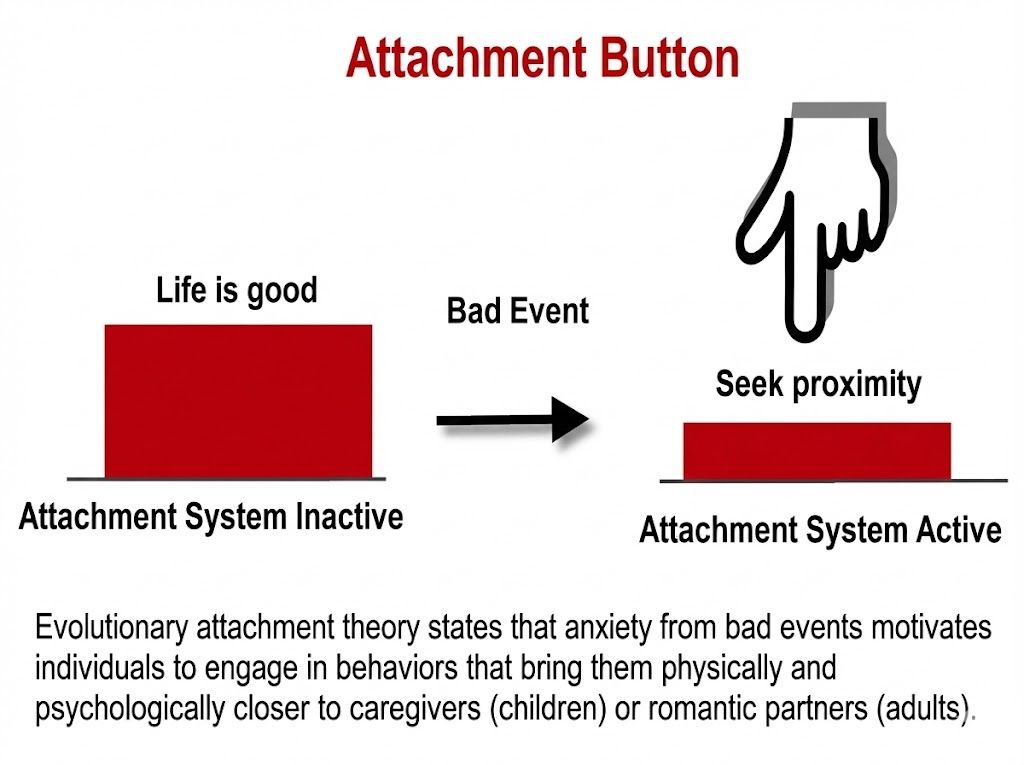
1) The Tragedy of Anxious Attachment and ‘Accommodating (Teddy Bear)’
For those with anxious attachment, conflict isn’t just a difference of opinion.
_It’s a terrifying alarm bell that signals ’the end of the relationship’. The primal fear of “What if they leave me?” paralyzes reason. _
Therefore, they choose the Accommodating approach, giving up their rightful claims and unconditionally yielding.
While it may seem peaceful on the surface, resentment and anger gradually build up inside, eventually erupting.
2) The Isolation of Avoidant Attachment and ‘Avoiding (Turtle)’
Conversely, people with avoidant attachment extremely dislike ’emotional clashes’ with others.
They cannot tolerate someone encroaching on their space or making emotional demands. When conflict arises, they retreat into their ‘cave.’
While this is a self-protection strategy, it ultimately leads to missing the golden opportunity for resolution and invites the misunderstanding that "You are ignoring me.”
3) The Composure of Secure Attachment and ‘Collaborating (Owl)’
People with secure attachment perceive conflict not as ’the end of a relationship,’ but as ‘a process of adjustment.’
This is because they have the belief, “Even if we disagree, our relationship is safe,” a ‘secure base’.
This allows them the mental space to listen to the other person while still asserting their own views.
Ultimately, understanding one’s own conflict resolution style (Self-Awareness) goes beyond simply knowing one’s personality.
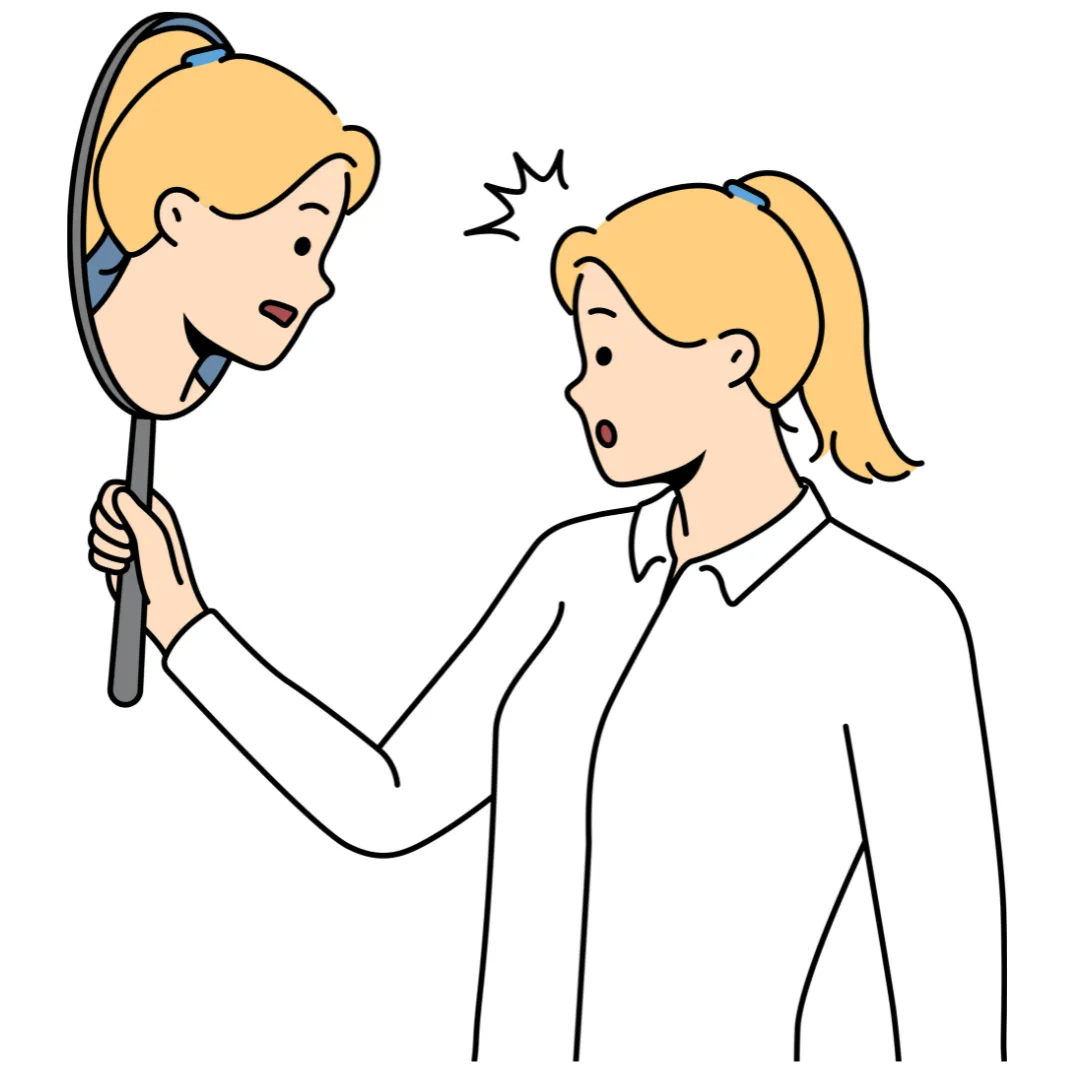
It is a painful process of confronting your unconscious motivations: “Ah, I’m holding back my words because I’m afraid of abandonment,” or “I’m running away because I want to avoid emotional exhaustion.”
However, only through this realization can you stop the automatic reactions and finally make an ‘intelligent choice’.
3. Strategy: The Decisive Move That Changed History
We have enough theory. Now, let’s master when and how to use the five weapons through actual historical and business case studies.
Strategy 1. Competing: A ‘Sword’ That Can Be Poison or Medicine
- [Case of Failure] Steve Jobs’ Ousting in 1985 The young Steve Jobs was a classic ‘Shark’. During the Macintosh project, he belittled colleagues and pressured the board to impose his perfectionism. While he might have ensured product quality (issue), he utterly failed to win people’s hearts (relationships). Ultimately, he was expelled from the company he founded. Overusing the competing strategy in situations requiring long-term partnership is like scoring an own goal.
- [Case of Success] Leadership in Crisis Situations However, when an organization faces an existential crisis, or unethical practices are discovered, someone must step up and say, “No!” Disasters like Volkswagen’s ‘Dieselgate’ or the Enron scandal occurred due to the absence of healthy ‘Sharks’ within the organization. When principles are compromised, competing is the bravest choice.
Strategy 2. Avoiding: Not Cowardice, but a Strategic ‘Pause’
- [Case of Failure] Neville Chamberlain’s Misjudgment Before World War II, British Prime Minister Chamberlain pursued an ‘appeasement policy’ to avoid conflict with Hitler. He believed he had achieved peace by avoiding war, but it only gave Hitler time to regroup. Avoiding a festering wound ultimately leads to a greater catastrophe.
- [Case of Success] An Escalated Meeting Room However, when voices are raised and emotions are out of control during a meeting, saying, “Let’s take a 10-minute break and revisit this agenda,” is the best strategy. Postponing judgment when information is insufficient is also a wise ‘strategic avoidance.’ Avoidance should not be escape, but waiting for a better timing.
Strategy 3. Accommodating: Not Surrender, but ‘Concession’ for a Greater Victory
- [Case of Success] Nelson Mandela’s Rugby Diplomacy Black South Africans wanted the dismantling of the ‘Springboks,’ the national rugby team favored by white people. Mandela’s supporters demanded a strong ‘competing’ response. However, Mandela, setting aside the anger of the black community, embraced them by wearing the team’s uniform, a symbol for white South Africans (Accommodating). By conceding on a minor issue (the rugby team), he achieved national unity, a far greater win (Big Win). This is strategic accommodation. The attitude of “I’ll concede for you,” rather than “I lost,” creates a sense of ‘indebtedness’ in the other party, leading to greater cooperation later.
Strategy 4. Compromising: The Art of Realistic Deal-Making
- [Case of Success] Costco Uijeongbu Store’s Coexistence Agreement Conflicts over the entry of large retail stores usually devolve into ‘zero-sum’ games. However, Costco and the merchants of Uijeongbu City chose ‘compromise’ after endless confrontation. The merchants abandoned their opposition to the store’s entry, and Costco agreed not to sell core items of small businesses, such as rice, cigarettes, and official garbage bags. Neither side was 100% satisfied (Mini-Lose). But they chose coexistence over catastrophe (Mini-Win). When time is short or forces are equal, compromise is the most efficient exit.
Strategy 5. Collaborating: Creative Destruction That Makes the Impossible Possible
- [Case of Success] The Camp David Accords
Egypt and Israel had shed blood over the Sinai Peninsula for 30 years.
- Egypt: “Return the land.” (Restoration of sovereignty)
- Israel: “Absolutely not. They’ll attack us from there again.” (Security concerns) Looking only at the positions, there was no solution. However, with President Jimmy Carter’s mediation, they identified each other’s deep interests. The result? “Egypt gets back the land (satisfying sovereignty), but it will be demilitarized, preventing Israeli tanks from entering (satisfying security).” This is collaboration. Going beyond dividing things in half, it creates a third alternative that fully satisfies both parties’ needs.
4. Expansion: New Conflict Strategies for the Digital Age
Nowadays, we fight more often through Slack or KakaoTalk than face-to-face.
In non-face-to-face situations, buffers like facial expressions and tone of voice disappear.
A text message like “Please handle this” can be read as a polite request by one person and a curt order by another.
This is the misunderstanding created by ‘Virtual Distance’. Conflict strategies in the digital age need to be slightly different.

- Strategic Use of Emojis: Appropriate emoticons complement the dryness of text and serve as an excellent tool for conveying ‘Accommodating’ softness. Even a rigid report can be lubricated by a smiley face at the end.
- Asynchronous Avoidance: When angry, not replying immediately but ‘saving as draft’ is an excellent ‘Avoiding’ strategy in the digital age. It buys time for emotions to cool down.
- Switching to High-Context Communication: When misunderstandings deepen via text (unresolvable compromise), immediately switch to a video call or phone call (high-context channel) to enter a ‘Collaborating’ mode. A simple phrase like “Can we talk for a moment?” is more powerful than dozens of KakaoTalk messages.
Epilogue: Don’t React, Respond
Our goal isn’t to become saints or people who never get angry. Our goal is to widen the ‘space between stimulus and response’.
When conflict arises, your heart will race, and your face will flush.
Your inner child will scream, “Run!” or “Attack!” At that very moment, pause and ask yourself:
“Where are my current emotions coming from?” “What weapon do I need most in this situation?”
When the other party attacks without logic, calmly retreat like a Turtle (Avoidance) to catch your breath. When facing important principles, be as firm as a Shark (Competing). For loved ones, be a Teddy Bear (Accommodation) and graciously yield.
And when faced with truly critical issues, become an Owl (Collaboration) and work through the night to find solutions.
The conversational narcissist destroys the world with a single hammer,
while the alchemist of conflict builds a new world with five tools.
Your armory is now open. So, which weapon will you choose today?
References
- The 10 Dumbest Mistakes Smart People Make and How to Avoid Them - Arthur Freeman, Rose DeWolf
- Thomas-Kilmann Conflict Mode Instrument (TKI) - Kenneth W. Thomas, Ralph H. Kilmann
- Getting to Yes: Negotiating Agreement Without Giving In - Roger Fisher, William Ury
- Attached: The New Science of Adult Attachment - Amir Levine, Rachel Heller
- Steve Jobs - Walter Isaacson
- Long Walk to Freedom - Nelson Mandela
- The Camp David Accords: A Case Study in International Negotiation - Shibley Telhami