
73 Seconds of Tragedy, and the Silence at Our Dinner Table

On January 28, 1986, the U.S. Space Shuttle Challenger, launched amidst the cheers of people worldwide, disintegrated into a cloud of white smoke just 73 seconds later.
Faced with this tragic event that turned seven precious lives into stars, we often recall mechanical failures. However, a truth colder than a component malfunction lay hidden beneath the surface.
It was ‘a lack of responsibility.’
The night before the launch, engineers desperately warned that freezing temperatures could make the rubber O-rings brittle, potentially causing a gas leak.
But NASA managers postponed the decision, citing “uncertain data,” while engineers remained silent, stating, “It’s beyond my authority.”
There was no leader in that conference room to prevent the catastrophic outcome. Only ‘bystanders’ wanting to avoid the weight of decision and people crushed by the pressure of a vast system, rendered powerless.
But strangely, when you think about it, the structure of this terrible tragedy feels familiar.
Let’s shift our gaze from space to our living rooms.
You come home exhausted after work, and the dishes from breakfast are still piled in the sink.
Your spouse, lounging on the sofa watching TV, casually says, “I was going to do it in a bit.”
Suddenly, something hot boils up inside you.
“That’s it! I’ll just do it myself!”
You put on the rubber gloves roughly and think:
‘This household doesn’t run without me.’
At this very moment, you become the cursed **‘Atlas’**, who must bear the heavens alone, and your spouse becomes the **‘Bystander’*, who deliberately ignored the warning signs of Challenger.
Dr. Gini Graham Scott calls this phenomenon ‘The Responsibility Trap.’
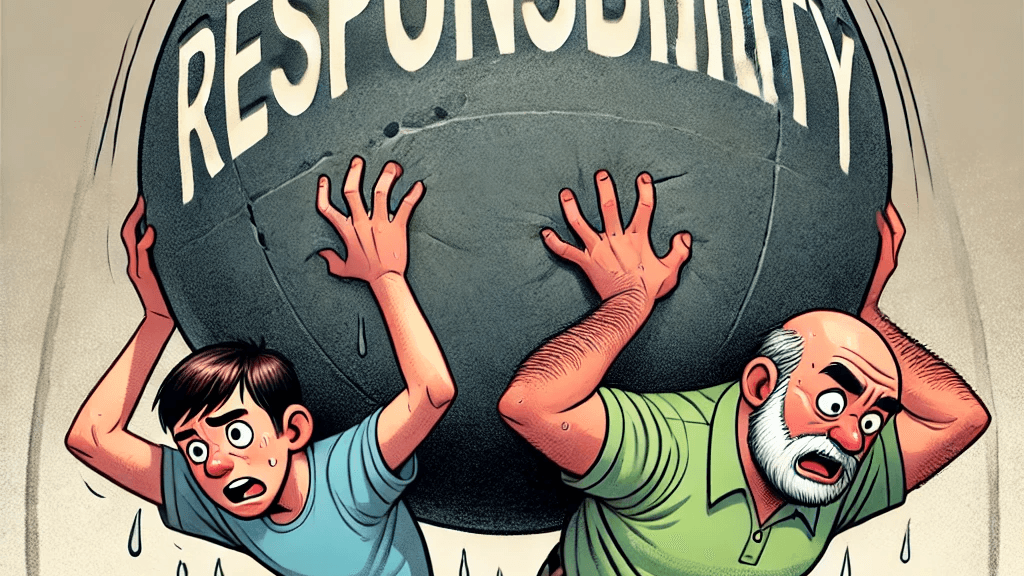
This isn’t just about who does more dishes.
It’s a story about a highly destructive psychological game, born from a tangled web of anxiety and fear.
Today, we aim to unravel the rules of this insidious game and find ways to set down the heavy burden that weighs you down.
1. The First Face: The ‘Bystander’ in the Shadows (The Avoider)
“I did nothing, therefore I made no mistakes.”
We often point fingers at those who evade responsibility, calling them “lazy” or “irresponsible.”
But if we apply a psychological scalpel and peer into their inner world, we find an emotion far more primal than laziness crouching there: ‘Fear.’
Dodging the Arrows of Blame (Blame Shifting)
Avoiding responsibility is, in fact, a very instinctive human defense mechanism to avoid pain.
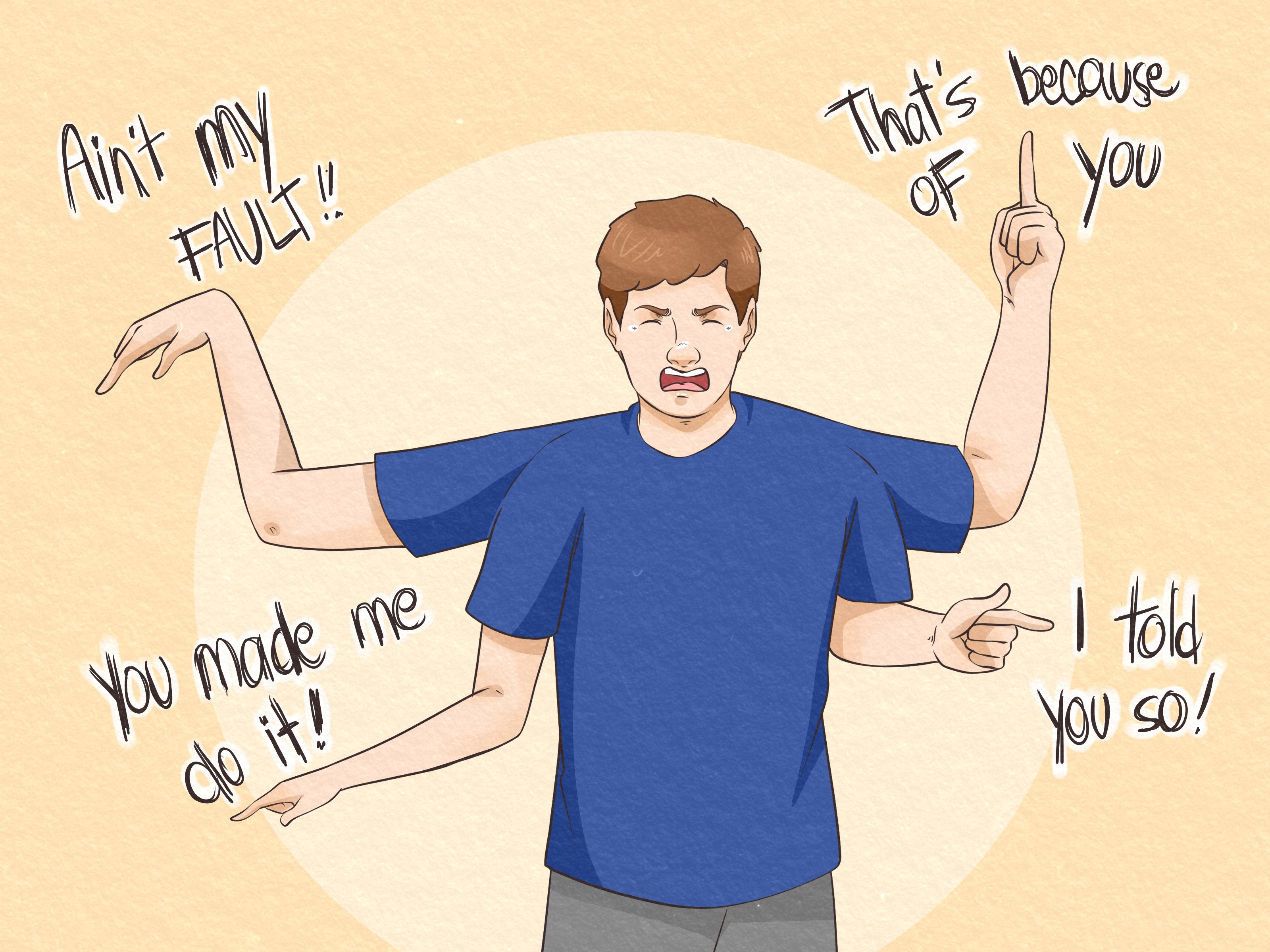
The reason managers at the Challenger disaster pushed for the launch might have been that the fear of public criticism and budget cuts resulting from a launch delay loomed larger than the immediate risk of explosion.
They병적으로 fear ‘Blame’ that will be cast upon them if they fail. The moment their mistakes are revealed, they fear being branded as “incompetent” or “a bad person,” and unconsciously seek a scapegoat.
- “You speak in such an annoying tone that I lose the desire to do it, even if I was going to.” (Blaming the other)
- “The economy is so bad, there was nothing we could do.” (Blaming the environment)
These statements might sound like attacks, but they are actually desperate struggles to protect a crumbling self-esteem.
The Swamp of Cognitive Dissonance and Self-Justification
Social psychologist Carol Tavris explains this with the concept of ‘Cognitive Dissonance.’

Everyone holds the belief that “I am a good person.”
However, admitting “I made a mistake” cracks this belief.
The brain cannot tolerate this discomfort.
So, it makes a choice. Instead of changing behavior to apologize, it changes thoughts.
“I’m not lazy. My wife is just too obsessive about cleanliness. If I do it, I’ll just get nagged anyway, so not doing it is the way to keep the peace.”
This self-justification offers momentary peace of mind.
However, in the long run, it breeds ‘Learned Helplessness,’
permanently confining oneself to the position of a ‘child who needs someone to take care of them.’

2. The Second Face: The Lonely Giant ‘Atlas’ (The Over-functioner)
“I have to carry it all, or the world will fall apart.”
Opposite the bystander stands ‘Atlas,’ who carries the world’s burdens.
They are competent, diligent, and quick. They are known as ‘high performers’ at work and ‘problem solvers’ at home.
But their dedication often suffocates relationships.
Dina’s Scrambled Eggs: Devotion or Control?
Let’s look at Dina’s case, mentioned by psychotherapist Terri Cole.
Dina returns home exhausted after a long day at work and sees her husband, Edgar, cooking.
But her husband’s movements seem clumsy. Eggshells might fall in, and the heat is too high.
Unable to bear it, she shouts:
“Move over, I’ll just do it!”
She snatches the pan and instantly makes perfect scrambled eggs.
Dina probably thinks she sacrificed herself for the family. However, from a psychological perspective, she was closer to controlling the situation.
People with an Atlas tendency engage in ‘Over-functioning.’
They feel extreme anxiety when others’ methods, speed, or results of handling tasks don’t meet their standards (which are usually very high).

- Fear of Unpredictability: They cannot tolerate the ‘chaos’ of their spouse making a mess in the kitchen or serving a bad meal.
- The Perfectionism Trap: “If it’s going to be mediocre, I’d rather do it myself and finish it perfectly to feel at ease.”
The Atlas Complex and Parentification
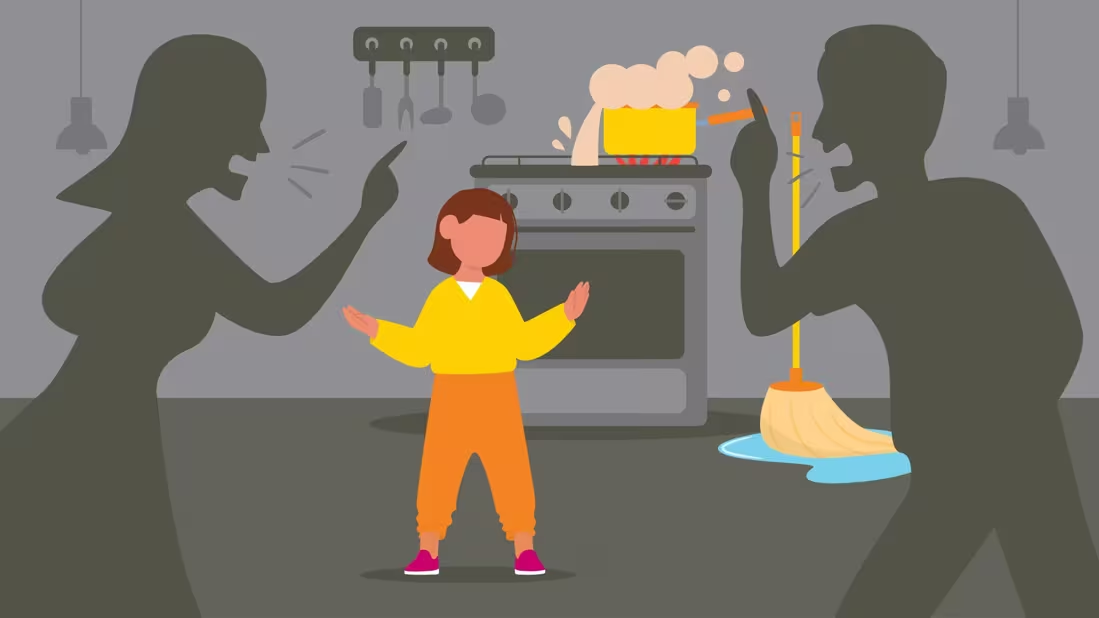
Where do these tendencies come from? In many cases, they are linked to childhood experiences.
When parents are emotionally immature or absent, a child often takes on adult roles for survival. This is called ‘Parentification.’
_“I have to take care of my younger siblings.”, “I need to be good so Mom won’t be sad.”
Adults who grew up this way develop a ‘blurred boundary,’ mistaking others’ emotions and problems for their own responsibility.
They try to prove their worth by being ‘an indispensable person’ to someone.
But the cost is too high.
Their own needs are thoroughly ignored, leaving only ‘Burnout’ and deep ‘Emptiness.’
3. The Destructive Dance: The Tango of the Over-functioner and Under-functioner
The greatest tragedy is that these two types are drawn to each other like the N and S poles of a magnet.
It’s like a meticulously choreographed tango.
- Atlas’s Intervention: “Ah, this is frustrating, I’ll just do it.” (Over-functioning kicks in)
- Bystander’s Retreat: “Right, you’re better at it…” (Under-functioning intensifies)
- Functional Polarization: Atlas becomes increasingly competent, while the bystander becomes increasingly incompetent.
- Cycle of Resentment: Atlas gets angry, “Why am I suffering alone?” while the bystander feels belittled or rebels, “They’re looking down on me.”
[Key Insight] The surprising truth is that no one truly benefits in this relationship.
Research shows that ‘free-riders’ in team projects experience greater psychological conflict and stress than diligent participants.
This is because they lack a sense of belonging and must constantly confirm their own worthlessness.
Atlas breaks their body, while the Bystander’s mind deteriorates.
4. Trap Escape Manual: From Control to Trust, From Avoidance to Choice
So, how can we stop this hellish dance?
Dr. Gini Graham Scott says, **“Don’t try to change the other person; change your own dance steps.”
Prescription for Atlas: “Endure Anxiety and Delegate”
Let’s be honest. If you are Atlas, your biggest enemy isn’t your spouse’s laziness, but your ‘anxiety.’
- Practice Pausing: When you see someone struggling, hold back the words “No, that’s not how you do it…” on the tip of your tongue for just 30 seconds. That 30-second void is the only soil for the other person’s sense of responsibility to grow.
- Effective Delegation: Saying “Just do it” is not delegation, it’s abandonment.
- What & When: Clearly define the desired outcome and deadline.
- How: Leave the method entirely to the other person. If the dishwashing order is different from yours but the dishes are clean, that’s a success.
- Praise: Instead of “Why did you do it that way?” say “Thanks for doing it; I got to rest because of you.”
Prescription for the Bystander: “Don’t Fear Blame; Participate”
If you are a bystander, what holds you back isn’t ability, but ‘fear of being wrong.’
- Start with Small Choices: Instead of grand responsibilities, take the initiative in small decisions like choosing tonight’s dinner menu or tying the trash bag.
- The Power of Admitting Mistakes: Trust the power of “Sorry, I forgot.” The moment you admit a mistake, you are elevated from the object of blame to a ‘partner in solving the problem.’ When you lower your defenses, the other person’s attacks also stop.
Conversation Techniques to Save Relationships: I-Messages and Acknowledging Dynamics
Blame closes people’s ears. Now, try shifting the subject from ‘You’ to ‘I’ and ‘We.’
Example of I-Message:
- (X) “Why do you always leave your socks anywhere? You’re so selfish.”
- (O) “When I see socks on the living room floor**(Fact), I feel like I’m your personal assistant(Impact), which makes me feel upset and drained(Emotion). I would really appreciate it if you could put them in the hamper(Request)**.”
And then, try to have a conversation that bravely acknowledges each other’s roles.
“Honey, thinking about it, I think my lack of trust and constant interference made you retreat further. I want to break this vicious cycle. What part can I let go of so you can take it on?”
5. Conclusion: Atlas, Letting Go of the Burden and Grasping a Human Hand
In mythology, Atlas was punished by Zeus to bear the heavens forever, but in reality, we can let go of that burden at any time.
Because responsibility is not a cross to be borne alone, but a ‘skill of cooperation’ that becomes lighter only when shared.
If your shoulders feel heavy as lead right now, consider whether you’re not perhaps preventing someone else from growing, simply because you’re too capable.
Conversely, if you feel like hiding now, ask yourself if it’s not simply because you fear being blamed, rather than because you are incompetent.
It’s time to stop that lonely and painful dance.
When Atlas dares to let go of the burden, and the Bystander dares to shoulder it,
We can finally become true partners, walking side-by-side, looking each other in the eye.
It’s okay not to be perfect.
In fact, don’t we need a little space for each other to fill it?
What matters is not being perfect alone, but the process of filling imperfections together.
References
- Scott, G. G. (2017). The Problem of Taking Too Much Responsibility & The Problem of Avoiding Responsibility. In A Survival Guide for Working with Bad Bosses. Amacom.
- Tavris, C., & Aronson, E. (2007). Mistakes Were Made (But Not by Me). Mariner Books. (Concept of Cognitive Dissonance)
- Cole, T. (2021). Boundary Boss. Sounds True. (Concept of Over-functioning)
- Vaughan, D. (1996). The Challenger Launch Decision. University of Chicago Press. (Analysis of the Challenger incident)
- Bowen, M. (1978). Family Therapy in Clinical Practice. (Family therapy theory of over- and under-functioning)