

“Buying worry”… it’s an odd phrase. How your mind locks itself up, and how you can get out of there. Shall we talk about that escape?
We all tend to think we’re pretty smart. We solve complex problems and plan for the future. We believe we make rational decisions.
But you know what? That very intelligence sometimes trips us up.
Especially for competent and diligent people. Oh, really… those people often suffer from a constant ’low-grade anxiety’, that is, the habit of ‘buying worry’. They plan meticulously and work hard, yet somewhere in their mind they keep simulating possibilities of failure.

This article isn’t about a petty “Oh, I’m a little worried” complaint.
This is an exploration of the fundamental **‘cognitive mistake’** where, based on hypothetical “what ifs…”, one constructs negative scenarios and gets trapped. Smart people attacking themselves with their most powerful weapon, ‘imagination’? It’s a strange phenomenon. This isn’t a simple behavioral slip. It’s… how to put it, a deeply rooted ‘thinking style’ issue.
Now, let’s dissect this chronic habit properly. And draw a concrete roadmap to reclaim the mental energy we’ve lost.
You who stage Murphy’s Law for yourself: Why does the world feel especially harsh to me?
Imagine the morning of an important presentation. How does your day go?
The alarm you trusted betrays you and doesn’t ring; the coffee you hastily make spills on your favorite white shirt. If you barely leave the house, the road is jammed. You just miss the subway in front of your eyes.
What do you think then? “Of course, a day like today, nothing will go right.”
It feels like the whole universe is out to get you. You’ve all felt that, right?
We call this ‘Murphy’s Law.’ “Anything that can go wrong will go wrong.” For many people, this is just synonymous with ‘bad luck.’
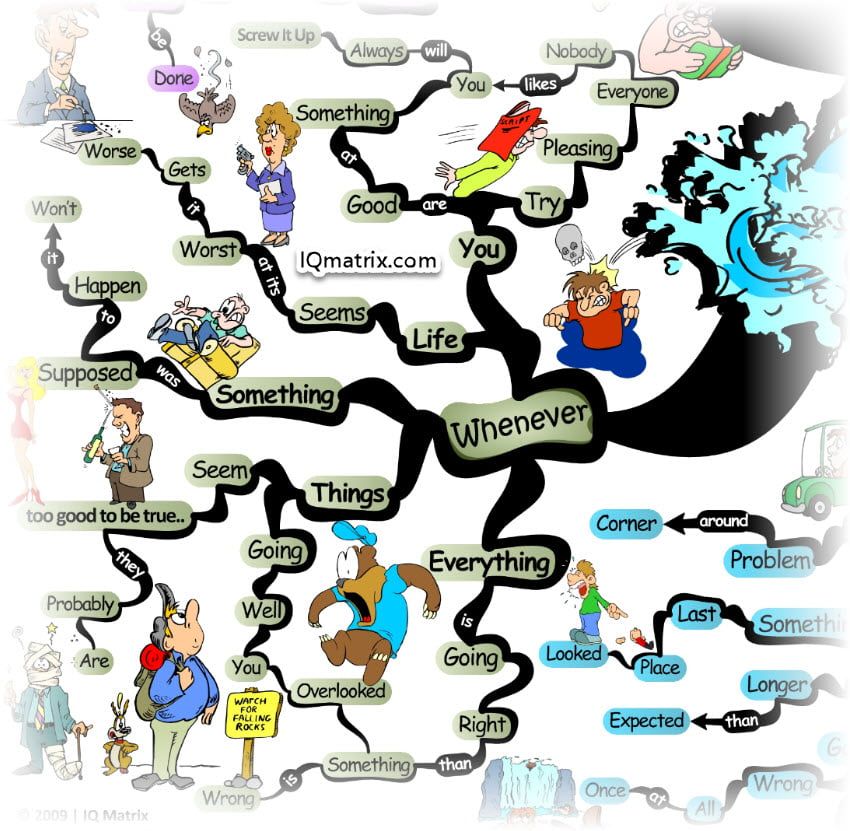
But that’s a complete misunderstanding of the law’s essence.
To be honest, Murphy’s Law wasn’t originally a pessimistic credo. It was a safety-engineering warning. “Prepare for every possible error.” In other words, it’s a very realistic advice: if you don’t prepare, problems are likely to occur — not because the universe hates you.
People who buy worry are somewhat different. They don’t just ’experience’ Murphy’s Law. They actively ‘***direct*** and ‘***stage*** it. Like a director who casts themselves as the protagonist of misfortune, they meticulously collect only the evidence of bad luck in their lives.
Why is that? Behind this phenomenon two very powerful psychological mechanisms about how our brain perceives reality are at work.
How the brain designs a biased reality
Our brain is not a video camera that records reality as it is.
It’s more like a sophisticated ‘pattern-recognition machine’ that interprets the world through predetermined filters. Those filters are ‘cognitive biases,’ and they are the breeding ground for chronic worry.
The first mechanism is ‘confirmation bias.’ This is the tendency to _embrace information that fits one’s existing beliefs or hypotheses and ignore information that contradicts them._

If you harbor a belief like “I’m unlucky” or “Things always go wrong on important days,” your brain will go hunting for evidence to ‘confirm’ that belief. The toast landing butter-side down becomes a powerful piece of evidence. But the dozens of toasts you ate last week without issue? Those are conveniently deleted from the statistics.
The second is ‘selective memory.’ Our memory is not fair. Events laden with strong emotion are etched more deeply and vividly in our minds.

Like how the memory of that day you overslept and panicked is much more vivid than the ordinary commute you had yesterday. Memories of being stuck at a red light when you’re in a rush are vivid, while the many green lights when you weren’t late are simply forgotten.
Now, these two mechanisms reinforce each other to create a powerful vicious cycle.
The premise ‘I’m unlucky’ activates a confirmation-bias filter. ▷ This filter makes negative events stand out. ▷ These selected negative events trigger strong emotions and are deeply stored in the brain according to selective-memory principles. ▷ When you later think about ‘how lucky I am,’ these vivid negative memories pop up first. ▷ And those memories then ‘prove’ the initial premise all over again: “See, I am unlucky.”
In the end, Murphy’s Law is not an external force. It’s an internal, self-reinforcing cognitive loop.
We don’t just observe bad luck; we are _actively participating in the ‘creation’ of that pattern through the way we filter and remember the world._
That’s why the world feels especially harsh to you. Realizing this is the first step to stepping out of the cosmic victim role and becoming the designer of your perception.
Flawed premises: Digging up the roots of worry
If you’ve recognized that it’s not the world being harsh but your ‘perception’ that’s the problem, now it’s time to dig into how that perception is formed.
Chronic worrying isn’t just “because I’m a bit timid…”
It’s rooted in logic built upon wrong premises — systematic errors in thinking called ‘cognitive distortions.’
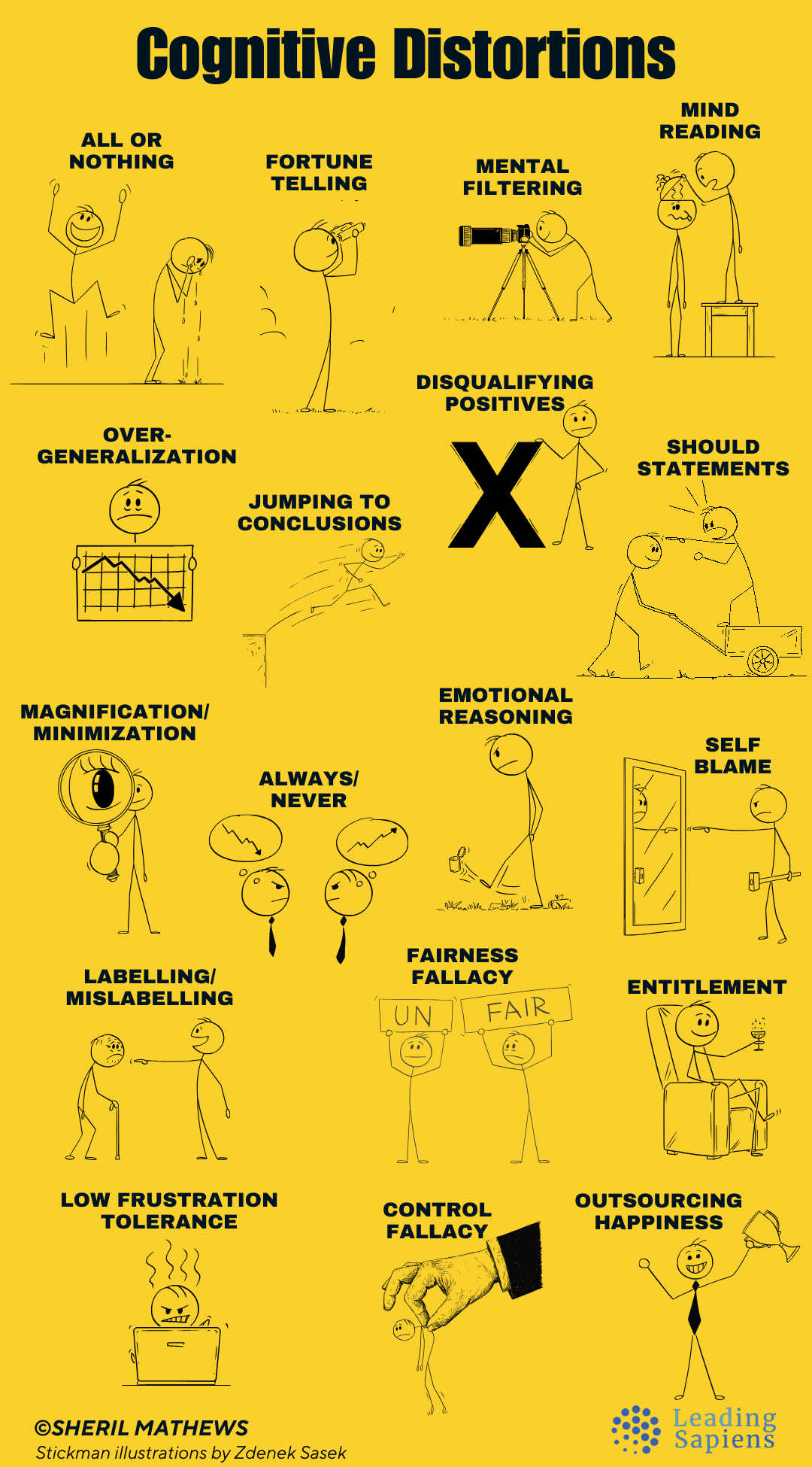
A core principle in Cognitive Behavioral Therapy (CBT) is this: events themselves don’t make us anxious; our ’thoughts’ about those events determine our emotions. So to uproot worry, you must identify these mental saboteurs — the cognitive distortions hiding in your mind.
The mental saboteur guide that controls your mind
Cognitive distortions are like ‘distorted lenses’ that prevent you from seeing reality as it is. Let’s look at the ones that amplify worry.
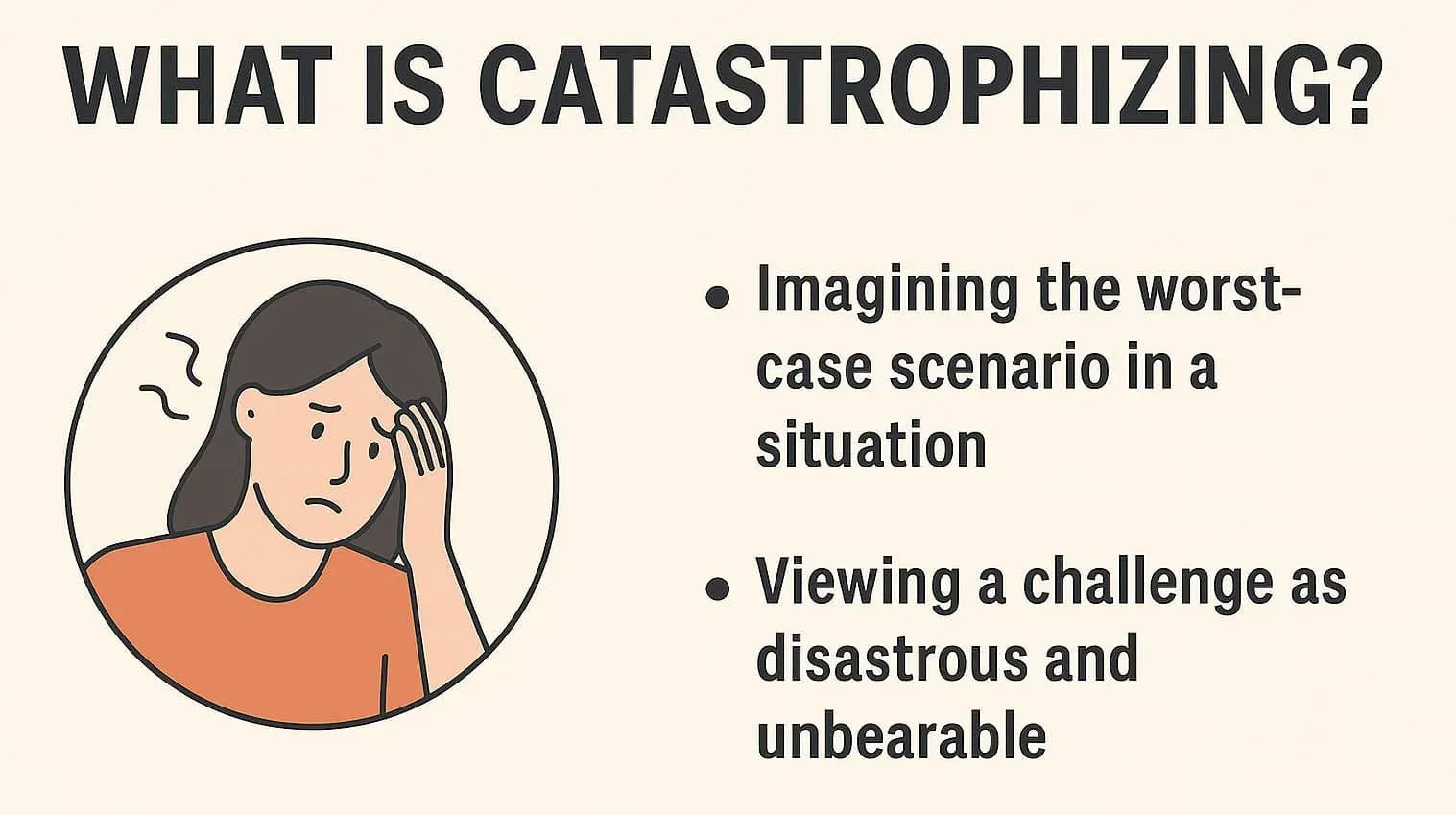
- Catastrophizing: The thinking that “turns a needle thief into a cattle thief.” From a minor negative event you write the worst-case scenario. When your boss replies to your detailed report with just ‘Noted.’, you conclude, “The manager is furious about my report. My career is over.” That’s catastrophizing.
Catastrophizing - Mind Reading: Assuming others think negatively of you without evidence. Hearing colleagues whisper in the hallway and concluding, “They’re definitely gossiping about how I bombed the presentation yesterday.”

Mind Reading - Overgeneralization: Taking one or two negative experiences and expanding them into sweeping statements using words like “always” or “never.” After failing one interview you think, “I’m hopeless. I’ll never get a job.”
Overgeneralization - Black-and-White Thinking: Seeing everything as ‘success or failure’, ‘perfect or worthless’ — only extremes. Eating one cookie on a diet and thinking, “Ah, it’s ruined. My diet for the week is totally blown. I might as well eat everything.” That’s black-and-white thinking.

Black-and-White Thinking
The engine of self-destruction: how worry becomes a ‘self-fulfilling prophecy’
These cognitive distortions are dangerous because they do more than just sour your mood.
They directly influence reality and become the driving force of a ‘self-fulfilling prophecy’ — the prophecy ****that you enact yourself****.

Sociologist Robert Merton introduced this concept: a ‘false definition’ of a situation evokes new behavior which makes the original false conception come true.
This mechanism can shape not only individual lives but the fate of huge organizations.
A tragic example is Kodak, the king of film.
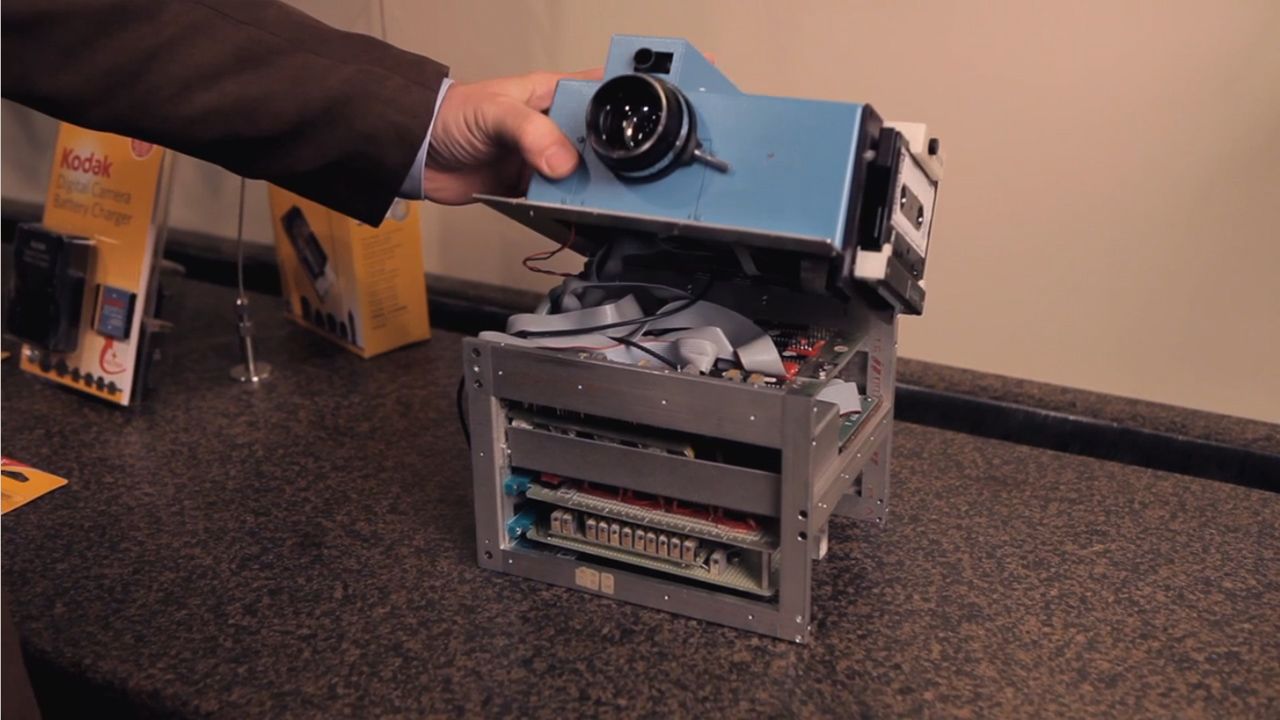
In 1975, an engineer at Kodak invented the world’s first digital camera.
But Kodak’s management saw this innovative technology as a ’threat.’ They had a strong black-and-white logic in their heads: “We are a film company.” They envisioned a ‘catastrophic’ future in which digital cameras would cannibalize their core film business.
This faulty premise led to self-destructive actions. Kodak intentionally slowed the development of digital technology and poured money into improved film technologies like ‘Advantix.’ While they ignored the future, competitors like Sony and Canon rapidly captured the digital market.
What happened in the end? Kodak’s prophecy came true. Digital technology ended the film era, and Kodak — stubbornly clinging to its identity as a ‘film company’ — went bankrupt.
Their fear became reality because of the very actions they took to avoid that fear.
Kodak’s story has important lessons for individuals.
A student thinking “I’m bad at math, so I’ll fail this exam” — that thought (a cognitive distortion) creates anxiety and undermines concentration. They fail to prepare adequately and then, as expected, get a low score. Then they think again, “See? I knew I was bad at math.”
In this way, a prophecy born from false thinking becomes reality through changes in behavior.
Many of the automatic thoughts in our heads, especially those that provoke anxiety, are often based on defective ‘premises’ rather than on facts.
The first rebellion from the prison of worry is to start doubting the validity of that voice in your head. Your thought might not be true.
‘What if’ imagination: are you the master or the tool?

Among the capacities of the human brain, the one I find most wondrous is the ability for counterfactual or hypothetical thinking — to simulate futures that don’t yet exist.
“What if…”
This ability that starts with ‘What if’ is the driving force behind all human creativity, innovation, and planning. If Einstein hadn’t imagined “What if I rode alongside light?” relativity might not exist.
Thus, imagination is a powerful tool that evolved us, but it is also the fuel for all anxieties and worries.
The ‘what if’ knife is double-edged. Depending on how you use it, it can either dominate you or serve as a very faithful tool.
The dark face: when ‘what if’ becomes a weapon that attacks you
Uncontrolled ‘what ifs’ amplified by cognitive distortions create destructive spirals of anxiety.
“What if I get fired?” This small spark can quickly spread into a catastrophic scenario: “I won’t be able to pay the mortgage, my family will be on the street, my life is over.”
Ruminating on negative thoughts is called ‘rumination.’ Rumination not only amplifies emotional pain but also causes physical symptoms like headaches, insomnia, and heart palpitations.
Also, if too many negative ‘what ifs’ accumulate, we fall into ‘decision paralysis.’

“What if this choice is wrong?”, “What if a better opportunity appears and I miss it?”
So many negative possibilities make even simple decisions feel like huge risks. Eventually, you can’t choose anything and end up procrastinating or avoiding.
The bright face: how to use ‘what if’ as a tool for growth and recovery
The point is not to eliminate ‘what if’ thoughts. You can’t, and you shouldn’t try to. The key is consciously redirecting their direction.
You can reconfigure imagination — the source of fear — into a strategic tool.
Step 1: Turn passive worry into active preparedness.
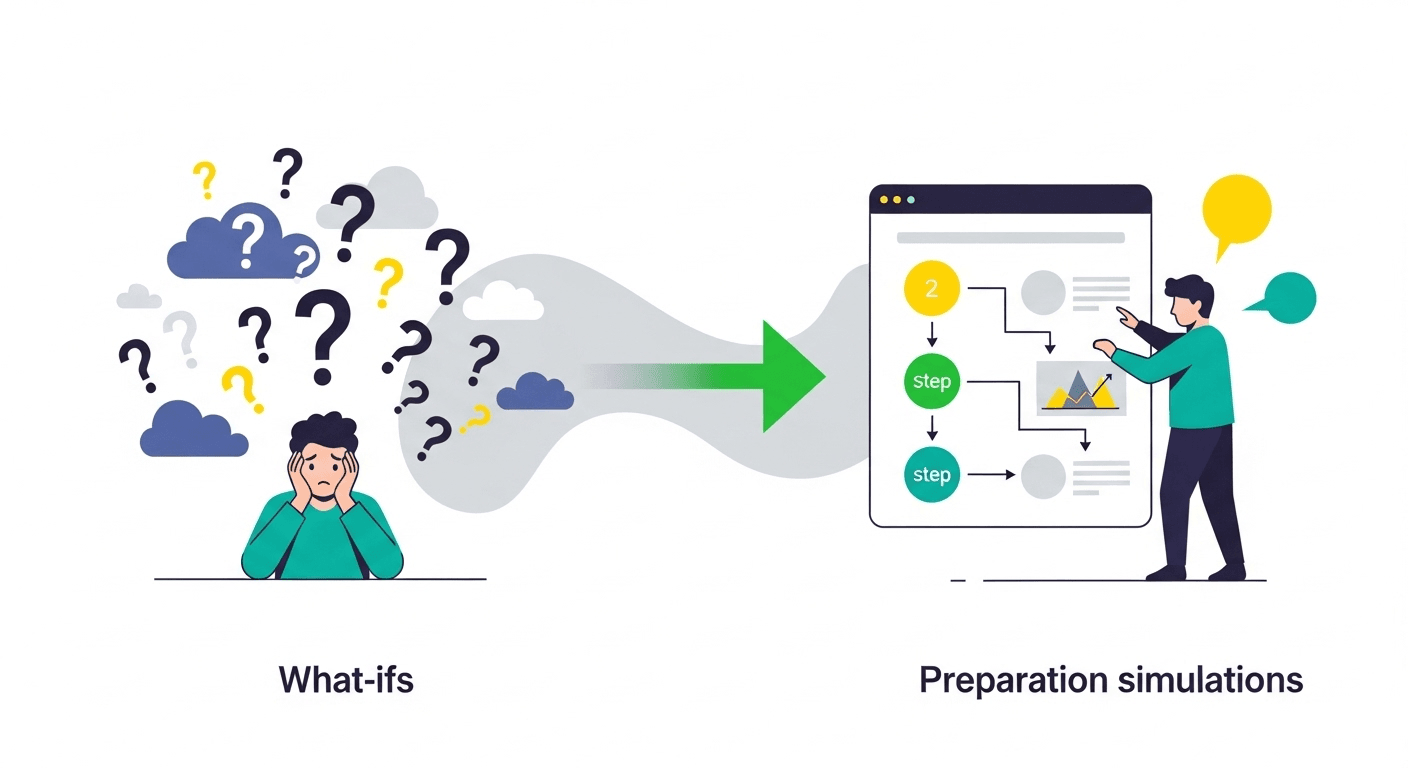
Uncontrolled ‘what ifs’ are future-oriented, negative, and passive: “What if there’s a fire?” This produces anxiety but no solution.
Turn it into an active ‘preparedness simulation.’ Pilots don’t just worry “What if the engine fails?” — they train in simulators for engine failure and follow checklists. A presenter, instead of worrying “What if the projector fails?”, prepares handouts in advance.
Using ‘what if’ as a tool for contingency planning transforms vague anxiety into concrete confidence.
Step 2: Turn self-blame into reflective analysis.

When we make mistakes, we often fall into self-blaming thoughts like “Why was I so stupid?” That’s a past-oriented and destructive use of ‘what if.’
Turn it into ‘reflective analysis’ instead: “What if I had acted differently then?”, “What would be the best approach next time in a similar situation?” These questions turn failure into valuable data for future success.
Step 3: Turn taken-for-granted things into special gratitude.

‘What if’ can also be used to rediscover the value of the present. This is called generating gratitude through counterfactual thinking. “What if I had never met my partner? What would my life be like?”, “What if that earlier accident had been slightly worse?”
Imagining worse scenarios can remind us of the preciousness of what we take for granted and is a powerful psychological tool that increases life satisfaction.
In conclusion, the mental function ‘what if’ is neutral. It’s just a tool.
The chronic worrier picks up this powerful hammer and strikes themselves.
By contrast, resilient people use this tool as a compass, blueprint, or magnifier to navigate, build, and appreciate their lives.

Your imagination can be a torture chamber or a training ground. The choice depends on learning to consciously control your imagination.
Practical guide for those who buy worry: becoming the master of your thoughts
So far we’ve busted the illusion of Murphy’s Law, identified thinking errors that create worry, and examined both faces of the ‘what if’ imagination.
Now it’s time to move from understanding to action.
In this chapter I’ll present concrete, practical tools in step-by-step form so you can become the master of your thoughts rather than a slave to worry.
Step 1: Immediate first aid (calming the storm of anxiety)
The goal of this step: when acute anxiety hits, immediately calm the situation.
- Technique 1: Mindful breathing (anchoring the mind) When anxious, our thoughts run uncontrollably into the future. But our breath? It’s always in the ‘present.’ Breath doesn’t force thoughts to stop. It redirects attention back to present sensations and acts as an anchor for the mind. Try inhaling through the nose for 4 seconds, holding for 4 seconds, and exhaling slowly through the mouth for 6 seconds. This simple act can calm an overheated sympathetic nervous system.
- Technique 2: Grounding (5-4-3-2-1 technique) This is a technique to forcibly switch your brain’s mode from abstract worry to processing concrete sensory information. When anxiety rises, pause and do this. 5 things you can see, 4 things you can feel touching your body, 3 things you can hear, 2 things you can smell, 1 thing you can taste. Acknowledge them in order. This breaks the chain of anxious thoughts and brings you back to the safe ‘here and now.’
Step 2: Systematic reprogramming (changing thinking habits with CBT)
Beyond first aid, now you need to correct the underlying ‘habit’ of worry itself.
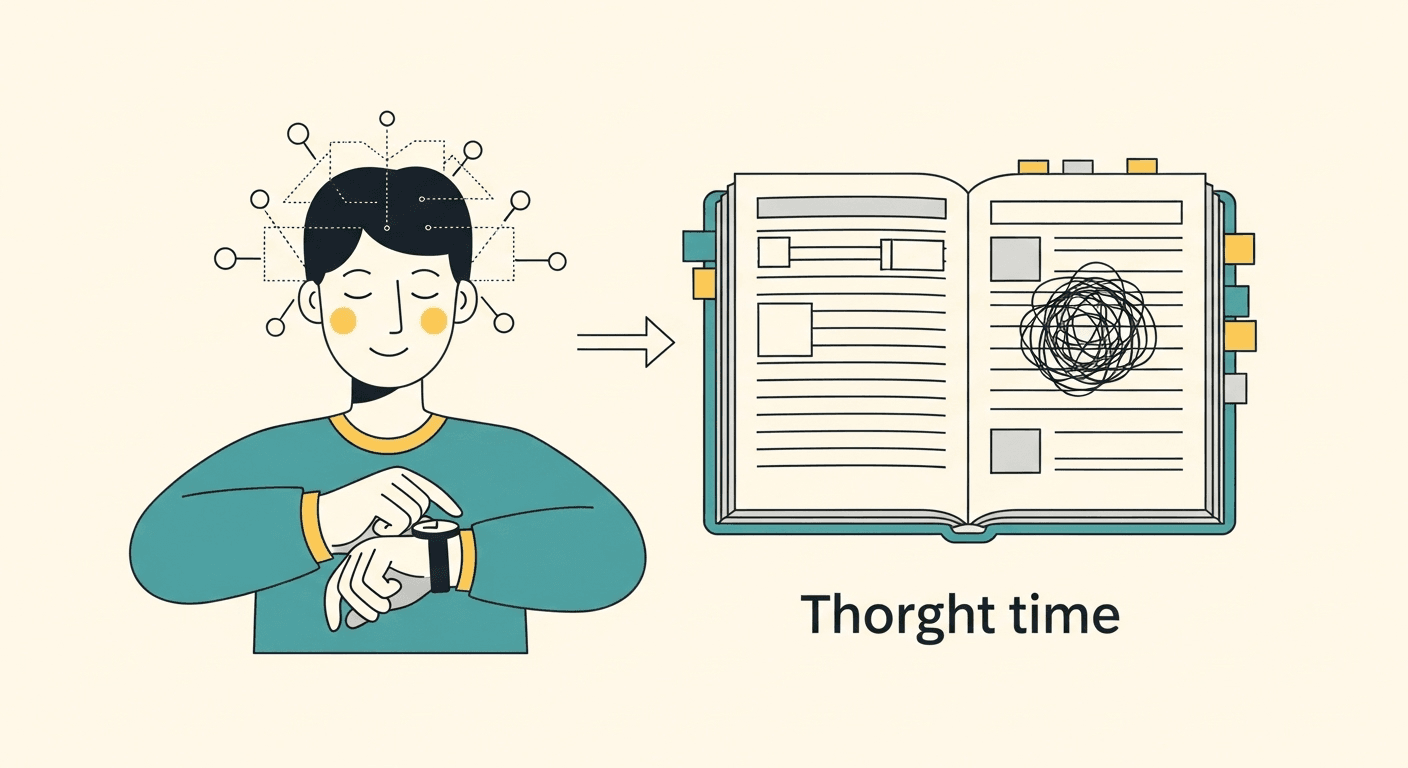
- Technique 1: Schedule ‘worry time’ It may sound paradoxical, but one of the most effective ways to control worry is to deliberately set aside time to worry. 15 minutes at 5 PM every day. This is your ‘worry time.’ If worries arise at other times, jot them down and tell yourself, “I’ll handle this at 5.” This training does two things. First, acknowledging the worry rather than fighting it weakens its power. Second, it trains your brain that worrying is not a 24/7 activity but a scheduled one.
- Technique 2: Thought record (the scalpel of awareness) This is a core CBT tool. It trains you to dissect and challenge automatic negative thoughts. Try filling it out like the table below. It helps correct thinking errors.
| Item | Description | Example |
|---|---|---|
| 1. Situation | Objectively record the specific event that triggered the emotion. | The boss replied to my detailed report with “Thanks.” |
| 2. Automatic thought | Write down the thoughts that passed through your head at that moment. | “They must not like my report. They think I’m incompetent. My next performance review is ruined.” |
| 3. Emotion | Note the emotions and rate their intensity 0-100. | Anxiety (90), Shame (70) |
| 4. Cognitive distortion | Which thinking error does this thought reflect? (e.g., mind reading, catastrophizing) | Mind reading, Catastrophizing |
| 5. Rational response | Find evidence about the automatic thought and write a more balanced alternative thought. | “The boss is very busy; short replies are his normal style. There’s no concrete evidence he is dissatisfied. ‘Thanks’ may just mean what it literally says. Don’t jump to conclusions; wait for actual feedback.” |
| 6. Outcome | After the rational response, re-rate the current emotion and its intensity. | Anxiety (40), Relief (60) |
The act of completing this record separates the thought from you. It makes the thought an object to observe, diagnose, and counter, enabling the formation of healthier neural pathways.
Step 3: The ultimate framework (Stoic ‘dichotomy of control’)
Now the final step. I think this is a simple yet profound philosophical framework that applies to all life’s challenges, including worry.
Ancient wisdom, a modern antidote to anxiety
Stoic philosophers like Epictetus and Marcus Aurelius proposed the ‘dichotomy of control’ as a central principle for achieving tranquility.
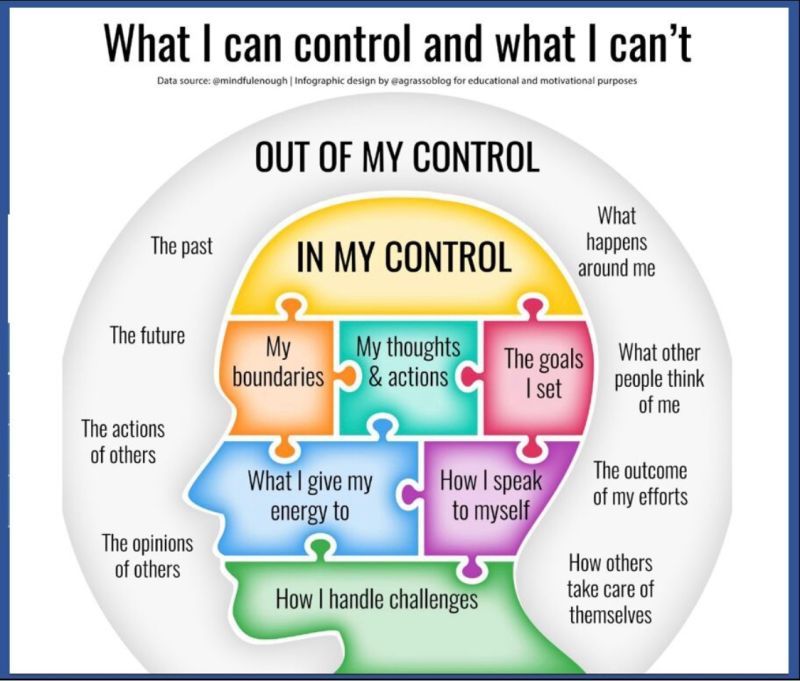
Divide everything in the world into two categories.
- What I can control vs. what I cannot control
What I can control: my judgments, intentions, efforts, and responses to events.
What I cannot control: the results of efforts, others’ evaluations, some aspects of health, the economy, the weather.
What is the essence of worry? It’s a futile mental effort to control what you cannot control. That’s a massive waste of energy.
When faced with a problem, ask first: “Is this within my circle of control or outside it?”
- If it’s uncontrollable (e.g., the weather on presentation day), the only rational response is ‘acceptance.’
- If it’s controllable (e.g., preparing for the presentation), then you should channel energy into action, not worry.
This shifts how you set goals. Goals shouldn’t be “I will win the tennis match” (an outcome you can’t fully control) but rather, “I will play my best game” (an effort you can control).
Such a shift makes ‘success’ something always within your grasp, irrespective of external outcomes.
Stoic philosophy can serve as an operating system for the tools we’ve learned. Mindfulness helps you ’notice’ anxious thoughts, the thought record helps you ‘refute’ them, and the dichotomy of control helps you decide whether a thought is even worth wrestling with.
Conclusion: It’s time to stop paying that expensive price
Buying worry. It’s not a personality flaw.
It’s an ‘cognitive habit’ built on the illusion of Murphy’s Law, fueled by faulty ’thinking logic,’ and weaponized by misused imagination.
But habits can be changed.
Learning how to anchor in the present amid the storm of anxiety (mindfulness), how to logically correct thinking errors (CBT),
and how to willingly let go of what you can’t control (Stoic philosophy).
By learning these, we can break the vicious cycle of this exhausting habit.
Buying worry may have been an unconsciously trained ‘choice.’
Now you can ‘choose’ to stop paying that expensive price of anxiety and invest that precious mental energy into building a life with purpose and tranquility.