
— The Gigawatt Alliance Between NVIDIA and NAVER, and the Geopolitics Behind It
On the evening of June 5, 2026, pork belly was sizzling on the grill at a restaurant in Hongdae, Mapo-gu, Seoul.
On one side of the table sat Lee Hae-jin, Global Investment Officer (GIO) of NAVER.
Across from him sat Jensen Huang, CEO of the company selling the world’s most expensive semiconductors, holding a shot of soju.
The venue was neither a Michelin-starred establishment nor a formal banquet hall arranged by the Ministry of Foreign Affairs. It was a smoke-filled Korean barbecue joint.
Three days later, Jensen Huang appeared at NAVER’s second headquarters, ‘1784’, located in Bundang-gu, Seongnam-si, Gyeonggi-do.
He walked down corridors where autonomous robots navigated inside the building,
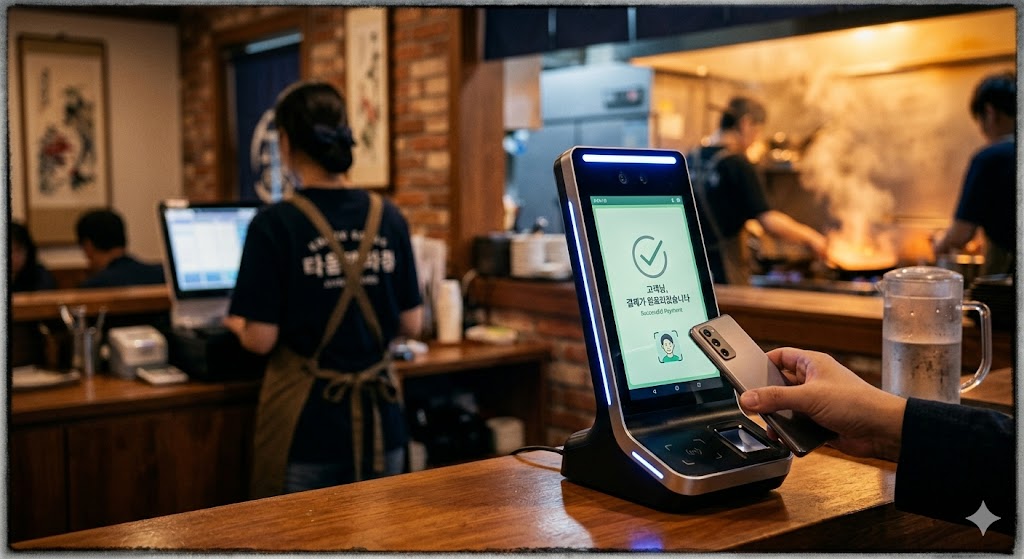
witnessed a facial recognition payment system complete transactions without a wallet,
and waved to developers worldwide alongside GIO Lee Hae-jin in front of the cameras of the live-streaming platform ‘CHZZK’.
Stitching these scenes together creates an unconventional picture.
Why did the head of the world’s largest AI infrastructure enterprise visit the headquarters of a South Korean portal company in person? Why was the announcement made in a barbecue joint rather than a conference hall?
The answer does not lie on the surface. Looking at the scale of the deal reveals a different landscape.
What both companies agreed upon is far more than a simple GPU supply contract.
It is a plan to jointly build ultra-massive AI infrastructure worldwide, starting with 55 megawatts (MW) by the first half of 2027, expanding to 200 megawatts in 2028, and ultimately reaching 1 gigawatt (GW) over the medium to long term.
One gigawatt is roughly four times the maximum design capacity (270 megawatts) of ‘GAK Sejong’, NAVER’s hyperscale data center—the largest in Asia. A data center of that scale does not yet exist.
This article traces what lies between a plate of samgyeopsal and a gigawatt contract.
1. This Is Not a Machine Transaction — The History of Data Centers Becoming Factories
In the early 2010s, data centers were essentially refrigerated warehouses housing web and email servers.
A passive infrastructure where servers returned HTML when a user opened a webpage. Power consumption was modest, and air conditioning was sufficient for cooling.
The moment that changed completely can be pinpointed to a single date: November 30, 2022. The launch date of ChatGPT.
Ever since Large Language Models (LLMs) were deployed in front of real users, the identity of the data center has undergone a total overhaul.
It became a factory that feeds on raw text data as its raw material, executes hundreds of billions of floating-point operations around the clock, and churns out intelligence measured in units called ’tokens’.
The concept Jensen Huang termed the ‘AI Factory’ compresses that transformation into a single phrase.
When data centers turned into factories, industrial-scale problems followed. The most unforgiving constraint is power.
A conventional server rack consumed around 10 kilowatts (kW).
A single rack loaded with NVIDIA’s latest Blackwell accelerator clusters exceeds 120 kilowatts.
When over 10 times more power enters the same physical space, heat generation also surges tenfold. Conventional air conditioning cannot dissipate that heat. The servers would melt.
NVIDIA solved this problem with software. Moving beyond merely selling GPUs, they built a platform that orchestrates the power grid itself through code.
The name of that platform is DSX (Data Center Systems eXperience).
The challenge is that DSX cannot simply be integrated into just any data center.
Operating a gigawatt-scale AI factory requires not only software control capabilities, but also the prerequisite physical infrastructure capable of handling it.
Cooling systems engineered to manage high-density heat, operational frameworks that respond instantly to power fluctuations, and decades of accumulated data center design expertise.
NAVER possesses all of these. This accounts for half the reason Jensen Huang personally visited NAVER.
2. From Samgyeopsal to Facial Recognition Terminals — The Physical Foundation of Trust
What Jensen Huang witnessed at the Hongdae restaurant was something no tech briefing could replicate.
GIO Lee Hae-jin never pulled out his wallet.
He simply showed his face to ‘Connect’, NAVER’s offline payment terminal installed at the counter. The terminal’s built-in camera captured his biometric data, a local neural network completed cross-verification, and the payment went through. The entire process took barely a second.
The significance of this scene does not lie in the payment technology itself. What matters is where it operated.
A regular eatery in the commercial district of Hongdae, Mapo-gu, Seoul. Not a smart-city pilot project, but a real store run by a small merchant.
Beyond AI generating text inside computer monitors, Jensen Huang witnessed firsthand the reality of ‘practical AI’ fully integrated with offline payment infrastructure.
It was undeniable proof that zero gap existed between what NAVER claimed and what NAVER had actually implemented.
For a technology company, such evidence carries more weight than any press release.
Three days later during the visit to 1784, both leaders appeared together in a live broadcast from ‘Vision Stage’, the virtual studio of the live-streaming platform CHZZK.
It is highly unusual for the CEO of a global Big Tech company to appear on a local South Korean streaming platform.
Breaking away from the rigid conventions of corporate alliance announcements, this scene served as a public demonstration of mutual, heartfelt trust between the two organizations.
Strategic technology alliances do not begin on spreadsheets.
They begin with the conviction that the partner actually executes what they claim to do. Jensen Huang gained that conviction first at a barbecue joint.
3. How to Write Power as Code — Anatomy of NVIDIA DSX
If power is the physical ceiling of an AI factory, DSX is the system that pushes past that limit via software.
Dissecting this four-layer platform in sequence reveals the operational mechanics of a gigawatt factory.
DSX OS — The nervous system of the factory. In a multi-tenant cloud environment where thousands of GPU racks operate concurrently, it automatically monitors hardware lifecycles and immediately executes software-level self-healing (remediation) upon failure. This eliminates the need for human engineers to reboot servers in front of a rack at 3 AM.
DSX MaxLPS — An engine that boosts GPU density by up to 40% within a fixed power budget. Here is how it works: AI computing workloads are non-uniform. While some GPUs operate at peak capacity for training runs, adjacent racks sit idle awaiting inference requests. That is when stranded power occurs. MaxLPS detects and recovers this idle power in real time, reallocating it to active GPUs. It drives more GPUs under a capped megawatt budget, maximizing the number of generated tokens per megawatt.
DSX Flex — Directly synchronizes signals from the utility power grid with the data center’s compute scheduler. During peak power hours or instantaneous disruptions in renewable energy supply, it automatically throttles deep learning training queues down to nanosecond precision to mitigate local grid overload. This is the moment a data center transforms from a passive consumer of the grid into an active balancing mechanism.
DSX Exchange — A hub connecting the IT domain (software compute signals) and the OT domain (cooling pumps, HVAC valves, power buses) via the high-speed MQTT protocol. When GPU temperatures exceed threshold limits, the software accelerates cooling pump RPMs in real time. It closes the loop where physical infrastructure dynamically responds to compute loads.
NAVER Cloud agreed to integrate these four layers across its entire cloud environment.
Rather than a straightforward GPU purchase, it is a strategic decision to redesign the entire infrastructure operating model on top of the DSX architecture.
4. Why GAK Sejong Remains Viable — Three Decades of Cooling Engineering
While DSX manages power through software,
dissipating the heat generated by that power belongs to NAVER’s domain. That represents the second core asset NAVER brings to this alliance.
In 2013, NAVER completed its first data center, ‘GAK Chuncheon’, in Chuncheon, Gangwon Province.
The unique hallmark of this facility was a design that virtually eliminated traditional air conditioning.
Leveraging its mountainside location, it introduced the AMU (Air Management Unit) system, drawing outdoor cold air directly into server rooms.
For approximately 90% of the year, servers are cooled without running air conditioners.
Its Power Usage Effectiveness (PUE) is 1.09, ranking among the world’s best.
Completed in 2023, ‘GAK Sejong’ elevated that engineering to the next level.
The centerpiece was the elimination of air supply ducts.
Conventional data centers blow chilled air into every corner of the server room through massive duct networks. Ducts introduce frictional resistance, requiring heavy-duty fans that consume substantial electrical power.
GAK Sejong’s NAMU III eliminated ducts entirely, replacing them with a dense grid array of BLDC (Brushless DC) fans. It moves greater volumes of air with zero frictional drag and lower power consumption.
The challenge is that Blackwell and Vera Rubin generation accelerators are pushing air cooling to its physical boundaries.
Dissipating heat loads exceeding 120 kilowatts per rack using air alone causes energy costs to skyrocket.
NAVER is preparing answers in two directions.
One is Direct Liquid Cooling (DLC): mounting cold plates directly onto GPU chip surfaces to extract heat via fluid circulation.
The other is Immersion Cooling: submerging entire servers into non-conductive dielectric fluid.
A hybrid system combining both approaches with NAMU III air cooling will be deployed in server rooms scheduled for completion in 2027.
Crucially, this cooling architecture was co-designed at the hardware level with NVIDIA’s next-generation liquid cooling specifications.
Software (DSX) and physical facilities (GAK Sejong cooling) were engineered to interact within a unified architecture.
Artificial intelligence reads GPU thermal telemetry and modulates fan speeds and coolant flow rates in real time.
This marks the distinction between a simple GPU buyer and a strategic alliance partner.
The former buys racks; the latter co-designs the very infrastructure that enables those racks to exist.
5. Why Activate Only 55 Billion Parameters — The Paradox of Nemotron 3 Ultra
At the upper tier of this hardware alliance sits an alliance of model architectures.
Standard large language models activate their entire weight parameter space when predicting a single word.
For a model with 500 billion parameters, generating the word ’the’ requires 500 billion operations. It is pure waste.
Yet under conventional architectures, it was an unavoidable structural inefficiency.
Nemotron 3 Ultra resolves this differently.
Dividing its full 550 billion (550B) parameters by functional specialization into clusters of ‘Experts’,
it selectively activates only 55 billion (55B) weights depending on the intent and characteristics of the input sentence.
A dynamic router called LatentMoE executes that selection within nanoseconds.
By utilizing only 10% of total capacity, it delivers output quality equivalent to or exceeding models that activate their entire parameter set.
Added to this is a Mamba layer.
Conventional Transformer architectures demand quadratic computational scaling when processing long contexts (O(N²)).
Processing 1 million tokens was theoretically close to impossible.
Mamba mathematically compresses sequences to process them in linear time (O(N)).
Ingesting a 2,000-page report in a single inference loop becomes fully achievable.
The result is encapsulated in two figures: a 5x leap in inference throughput, and a 30% reduction in computing costs.
NAVER is fine-tuning this architecture on Korean language corpora and East Asian regulatory datasets to elevate the foundational capabilities of HyperCLOVA X.
Rather than simply importing a foreign model, NAVER established a collaborative partnership starting from base architecture design.
NAVER became the first South Korean enterprise to join NVIDIA’s latest model alliance, the Nemotron Coalition.
This illustrates the fundamental difference between being a technology importer and a technology producer.
6. When Agents Enter the Enterprise — The Security Philosophy of NemoClaw
If Nemotron 3 Ultra serves as the brain,
NemoClaw acts as the neural protective barrier ensuring that brain operates securely within enterprise environments.
When AI agents are deployed into real-world business workflows, the greatest barrier is not capability. It is trust.
The moment an agent accesses internal file systems, parses accounting ledgers, and queries corporate emails, the fear of intellectual property leakage halts enterprise adoption.
That fear is far from unfounded.
Conventional AI agents often failed to self-regulate the boundaries of their permissions once granted access.
NemoClaw addresses this vulnerability at the hardware level, not merely through software.
Agents execute exclusively inside an ‘OpenShell’ sandbox.
Any access to directories, IP ports, or network routes not explicitly whitelisted by the administrator is physically barred at the kernel level (Capability Drops).
Access is not simply denied; the resources remain entirely invisible to the agent.
All outbound packets undergo real-time inspection, and should any anomaly be detected, the agent kernel triggers an immediate self-healing shutdown.
The practical shift enabled by this architecture is profound.
A legal department can assign an agent to summarize 1,000 contracts.
The agent accesses only the designated contract directory, cannot see anything outside it, and returns summaries exclusively to the legal team.
Proprietary source code leaking to external servers or transmitting ping packets to competitor domains becomes structurally impossible.
NAVER and NVIDIA plan to officially release this platform domestically in the second half of this year.
Enterprise clients will be able to deploy NemoClaw-based agents directly inside their proprietary environments.
Autonomous coding assistants, financial transaction analytics agents, internal compliance review automation—domains previously blocked by security concerns can now move forward.
The pace at which the agentic era permeates enterprise operations may well be measured from the release of NemoClaw.
7. Teaching the City — Cosmos and the Seoul World Model
AI entering the physical world demands an entirely different category of intelligence.
Language models generating text require syntax and semantics.
Robots navigating roadways require the laws of physics.
How much tires slip on rain-slicked asphalt, how long camera sensors take to adjust when exiting a tunnel, and how rapidly brakes must engage when a pedestrian unexpectedly steps into traffic.
These capabilities do not stem from pure data; they arise from experience—and accumulating experience requires a reality where accidents can occur.
What NVIDIA’s Cosmos 3 delivers is a virtual replica of that reality.
Cosmos 3 is a foundation model that mastered real-world physical dynamics by directly training neural networks on hundreds of millions of hours of video depicting global driving environments, physical object manipulation, and mechanical interactions.
When a user feeds text prompts or sensor telemetry, Cosmos 3 computes acceleration, collision deformation, specular reflections, and tire-road friction coefficients with physical fidelity to generate synthetic 3D video.
While legacy simulations required engineers to manually hardcode physics equations, Cosmos 3 learned them autonomously from data.
NAVER Cloud layered Seoul’s spatial data on top of this engine.
Field datasets accumulated from operating NAVER Map since the early 2000s, over 1.2 million panoramic images captured by LiDAR-equipped survey vehicles traversing Seoul, and high-precision terrain data accurate to within centimeters of road width.
Stacking this data atop Cosmos 3’s physics simulation created the ‘Seoul World Model’.
A concrete scenario illustrates what this model enables.
2:00 AM at the northern approach of Mapo Bridge. Torrential rain is pouring.
Streetlights are out. A pedestrian suddenly darts into the roadway.
How should ‘ROOKIE’, the autonomous logistics robot, respond? Replicating this scenario iteratively on actual public roads is impossible.
Inside the Seoul World Model, this exact condition can be duplicated limitlessly to fine-tune ROOKIE’s decision-making algorithms.
Maintaining localization purely through spatial memory when camera sensors blow out from sudden glare at tunnel exits,
or calculating precise friction coefficients on oil-slicked intersection surfaces—
all of this is simulated thousands of times inside virtual Seoul before being deployed to ROOKIE’s onboard control stack.
The bottleneck of Physical AI is not data, but validation. The Seoul World Model made that validation infinitely repeatable in the virtual domain.
8. The War for Data Sovereignty — Geopolitics of Sovereign AI
Throughout technological history, whoever controlled infrastructure controlled the market.
When 19th-century Great Britain commanded the undersea telegraph network, global financial intelligence and diplomatic cables had to route through London.
When 20th-century America dominated core internet backbones and cloud platforms, worldwide digital traffic fell under US legal jurisdiction.
In the AI era, infrastructure consists of data centers and language models—domains currently dominated by Google, Microsoft, and Amazon.
Certain nations find this dynamic deeply unsettling.
The European Union legally prohibits domestic healthcare data, judicial records, and defense documents from residing on servers subject to US jurisdiction.
Middle Eastern oil-producing nations acutely recognized the perils of technological dependency following US sanctions on Iran.
Southeast Asian countries lack domestic-language foundation models, watching their citizens’ linguistic data siphon continuously into foreign corporations.
All of these nations share an imperative named ‘Sovereign AI’.
AI infrastructure that operates on sovereign soil using domestic data, free from foreign legal subordination.
The dilemma is where to acquire it.
It cannot be bought from US Big Tech, which inevitably delivers services bounded by its own domestic laws and policy frameworks.
Nor can it be sourced from China, where geopolitical friction creates an alternative vector of dependency.
NAVER occupies that exact vacuum.
NAVER commands a full-stack maturity achieved by only a handful of players globally.
A proprietary large language model (HyperCLOVA X),
Asia’s largest low-power hyperscale data center (GAK Sejong) to run it,
and an integrated cloud infrastructure guaranteeing data sovereignty.
Most importantly, NAVER possesses a proven track record of delivering these capabilities to sovereign government clients.
Case in point: the $100 million digital twin national infrastructure contract signed with Saudi Arabia’s Ministry of Municipal and Rural Affairs and Housing.
Volumetric 3D spatial scanning of major cities including Riyadh, deployment of Arabic-specialized AI models, and complete data isolation within domestic servers.
This contract demonstrated NAVER’s ability to communicate in the language of client nations rather than through the lens of a technology exporter.
From NVIDIA’s vantage point, this is precisely where NAVER’s strategic value lies.
Jensen Huang traveling directly to negotiate with Middle Eastern governments could easily backfire.
US Big Tech pitching ‘Sovereign AI’ is an inherent contradiction in terms. Through NAVER, however, the narrative changes.
A trusted, neutral partner that has already earned the confidence of regional governments integrates NVIDIA hardware into sovereign domestic infrastructure.
This is not merely a sales strategy; it is a geopolitical doctrine.
9. What Failure Taught — MACH-1 and the Logic of the Platform Pivot
In 2022, NAVER partnered with Samsung Electronics to begin designing its proprietary AI accelerator chip, ‘MACH-1’.
The motivation was clear: NVIDIA GPUs were prohibitively expensive and perpetually in short supply.
Utilizing commercial LPDDR memory instead of costly HBM and hardwiring inference operations tailored to HyperCLOVA X directly onto silicon offered a path to price competitiveness. Over 40 elite researchers were deployed to the project.
MACH-1 did not falter due to deficits in hardware engineering. It failed on timing.
By 2024, precisely as MACH-1’s silicon design was being finalized, AI model architectures pivoted in an entirely different direction.
Mixture-of-Experts (MoE), multi-million-token context windows, and hybrid Transformer-Mamba topologies emerged.
These developments were incompatible with the algorithmic structures hard-etched into MACH-1’s circuitry.
ASICs lock in their supported algorithm profiles at the point of tape-out; they cannot be updated like software.
On top of that stood the insurmountable wall of CUDA. Over decades, global AI researchers and developers built an entire ecosystem of optimization tools, training frameworks, and inference runtimes on NVIDIA’s CUDA. For a new accelerator chip to replicate that ecosystem from scratch takes years—and during those years, AI models advance another full generation.
The innovation lifecycle of AI model architectures spans 2 to 4 months.
ASIC development from design to mass production requires a minimum of 18 to 24 months.
As long as these two timelines coexist, ASICs tailored to specific algorithms become obsolete by the time they reach volume production.
When Samsung Electronics unveiled its MACH-2 roadmap without naming NAVER as a co-development partner, the collaboration effectively concluded.
NAVER used this setback to pivot its overarching strategy.
It withdrew from silicon manufacturing to focus on securing control over the software stack.
Platform competition over silicon competition: controlling infrastructure via DSX and NemoClaw on top of NVIDIA GPUs, governing models via HyperCLOVA X, and owning endpoints via FaceSign and CHZZK.
Paradoxically, this platform-centric posture makes NAVER an ideal partner for NVIDIA.
Not a rival contesting hardware territory, but an ally co-expanding the global market by maximizing the utility of that hardware.
Failure laid the foundation for the alliance.
10. The Inflection Point: The Question Posed by a Gigawatt
Everything discussed so far—DSX, GAK Sejong, Nemotron, NemoClaw, the Seoul World Model, Sovereign AI—might appear to be discrete technology announcements.
Yet they are converging answers to a single fundamental question:
As artificial intelligence becomes the core infrastructure of human society, who controls that infrastructure?
At this very moment, that control remains concentrated within a handful of American enterprises.
Training datasets, model weights, cloud services, and hardware supply chains all reside under US legal frameworks and corporate policies. The moment global governments rely upon them, they cede a portion of their digital sovereignty.
The Gigawatt AI Factory Alliance is an ambitious attempt to reshape that dynamic.
NVIDIA supplies the hardware, while NAVER integrates and operates it within networks of trust established with non-Anglophone governments.
Europe secures GDPR-compliant Sovereign AI infrastructure, the Middle East acquires localized AI operating natively in Arabic, and Southeast Asia processes domestic data within sovereign borders.
While framed in the rhetoric of technological democratization, it is, in reality, a geopolitical realignment of the AI infrastructure market.
NAVER occupies a distinct position in this realignment.
A third-party alternative—neither US Big Tech nor Chinese Tech. One of an exceedingly rare tier of enterprises operating proprietary models, managing sovereign infrastructure, and engaging sovereign states from a position of geopolitical neutrality.
Here, a critical question arises:
Does NAVER supplying Sovereign AI represent a genuine transfer of technological sovereignty, or merely a more sophisticated variant of technological dependency?
There is no easy answer. How truly ‘Saudi Arabian’ is an AI model trained atop infrastructure engineered by NAVER?
Does hosting servers at GAK Sejong in South Korea and training HyperCLOVA X on Korean text genuinely place the Riyadh government’s data under absolute sovereignty?
The weight of this question lies not in engineering, but in history.
For the term ‘sovereignty’ to hold substance, there must exist a clear trajectory toward dissolving dependency.
Whether sovereignty means simply substituting a US Big Tech vendor with NAVER, or establishing a transitional pathway until local governments cultivate the internal capability to train models and operate infrastructure independently—that distinction is never spelled out in a contract.
11. Beyond the Pivot — How Technology Blends into Everyday Life
Let us return to the scene where Jensen Huang witnessed facial recognition payment at the Hongdae restaurant.
The technical mechanics of that moment have been detailed.
Yet the broader significance of that scene outlasts technical exposition.
The claim that AI will change the world has been repeated for decades.
The moment that statement acquires genuine meaning is when technology blends so seamlessly into human behavior that it ceases to be noticed.
Looking into a payment terminal becoming as instinctive as reaching for a wallet—that is precisely the inflection point.
If FaceSign manifested that reality inside a single neighborhood eatery, the Gigawatt AI Factory represents the endeavor to scale that reality across the daily lives of billions.
The scale differs, but the trajectory is identical: technology fading from conscious awareness. The invisibility of the machine is the ultimate hallmark of complete integration.
ROOKIE, running endless synthetic miles through torrential nocturnal downpours inside the Seoul World Model, will one day deliver cargo through real Seoul streets at 3:00 AM without human intervention.
An agent reviewing enterprise contracts inside a NemoClaw sandbox will one day handle half the drafting workloads once managed by attorneys.
While GAK Sejong’s cooling architecture manages GPU thermal dissipation,
an AI ethics policymaker thousands of kilometers away in the European Parliament will review legislative drafts hosted on domestic Sovereign AI infrastructure.
Few realize these systems are interconnected.
Fewer still realize that a single plate of samgyeopsal is linked to a gigawatt contract.
12. The Final Question
A wide chasm always separates the declaration of a technology alliance from its physical realization.
A 1-gigawatt AI factory does not yet exist.
The target is 55 megawatts by the first half of 2027, and there is no guarantee even that milestone will materialize on schedule.
Whether the Sovereign AI market unfolds in the direction NAVER anticipates remains equally uncertain.
Whether sovereign governments genuinely seek technological self-reliance or simply lower-cost alternatives remains ambiguous.
The catalog of uncertainties could easily expand.
Yet Jensen Huang’s physical presence in Seoul is an incontrovertible fact.
He shared grilled pork belly, observed facial recognition payments, watched autonomous robots navigate corridors, and went live on a local streaming broadcast.
The CEO of the world’s most valuable semiconductor company personally visiting a partner’s headquarters is no routine diplomatic gesture.
It is an unmistakable signal that NVIDIA views NAVER not as a mere customer, but as an indispensable partner sharing a common destiny.
Whether that calculation proves correct will become clear after 2027.
Until then, there is one question we must continually ask:
In a world where AI infrastructure becomes as critical to national sovereignty as the electrical grid itself, how closely are we paying attention to who designs it and who operates it?
While gigawatt factories are quietly being constructed, most of the world is looking elsewhere.
References
- NVIDIA DSX Platform Technical Playbook and Reference Architecture Guide for AI Factories — Warren Barkley, Chris Alexiuk (NVIDIA Infrastructure Engineering)
- Hybrid Transformer-Mamba MoE Architecture: Nemotron 3 Ultra Technical Report — NVIDIA AI Research Lab (NVIDIA Cosmos Lab)
- Sovereign AI Infrastructure Expansion using NVIDIA DSX Platform on GAK Sejong — NAVER Cloud Technical Whitepaper (Noh Sang-min, Kim Yu-won)
- Physical AI Simulation and Spatial Intelligence: Seoul World Model Development conditioned on NVIDIA Cosmos 3 — NAVER Cloud Spatial Intelligence Center (Lee Hae-jin, Kim Yu-won)
- NemoClaw and OpenShell Sandbox Hardening User Guide for Autonomous Agent Deployment — NVIDIA Product Security Team
- Study on Eco-friendly Hybrid HVAC System and NAMU III Energy Efficiency Maximization at GAK Sejong — NAVER Integrated Data Center (Noh Sang-min)
- FaceSign Offline Facial Recognition Payment Terminal ‘Connect’ Empirical Report — NAVER Financial Technology Development Division (Lee Hae-jin, Choi Soo-yeon)
- Lessons from Samsung MACH-1 LPDDR-Dedicated ASIC Design and Analysis of CUDA Software Dependency — Journal of the Korea AI Semiconductor Society (Jung Chae-yoon, Lee Ja-kyung)
- Sovereign AI Deployment Patterns: Middle East and European Market Analysis 2025–2026 — NVIDIA Global Partnership Report
- NAVER Saudi Arabia Ministry of Housing Digital Twin Contract: Technical Architecture and Outcomes — NAVER Global Geo-Intelligence Group
- Power Usage Effectiveness (PUE) Benchmarking: Hyperscale Data Centers in Asia-Pacific — Uptime Institute Asia Pacific Report 2025
- Agentic AI: Enterprise Deployment Security Requirements and Containment Architectures — Gartner Technology Research (2026)
- Mixture-of-Experts Models: Scaling Laws, Routing Efficiency, and Hardware Implications — DeepMind / Google Research (2025)
- Geopolitics of AI Infrastructure: Sovereign Compute and the New Technology Multipolarity — MIT Technology Review Policy Series (2026)
- NVIDIA Vera Rubin Platform: Compute Architecture and Memory Subsystem Design — NVIDIA Technical Disclosure (2025)