

Would you like to hear a story about a friend named Ji-yeon? Everyone agreed she was a prodigy, and she had a perfect strategy for perfect grades. She filled her notes densely, highlighted importance with colorful pens… she would only move on after she perfectly understood everything. At first, people praised her, saying, “Wow, she’s really diligent.” That ‘smart’ habit? At first it looked like a guaranteed ticket to success.
But over time… that clever strategy slowly tightened around her like, well, an outrageous tyrant. If a handwriting in her notebook didn’t look quite right, she’d tear out the whole page, and if the pens on her desk weren’t arranged perfectly in a row, she couldn’t read a single line. In the end… forget A+. She often couldn’t get past the first page of the exam material and would stay up all night; if she managed to avoid failing, that was lucky.
Is this only Ji-yeon’s story? I don’t think so.

This kind of ‘maladaptive perfectionism’—where the pursuit of perfection trips you up—is especially common among our generation placed in achievement-focused, barren environments. It’s bitter, really. Many of us create our own rules to feel some sense of control and safety in an uncertain world. This inner tyrant approaches promising ‘order’ at first, but ultimately imprisons us in an invisible jail.
So I decided to write this. I wanted to probe that thing’s identity and find the keys to open the door of that prison. I hope this will be a map to help you walk back into a freer life—from understanding the chains that bind us to discovering the courage to break them. You are invited.
The Rules That Strangle Us
This prison called compulsion is strange. It’s built from invisible rules. But why are these rules so powerful? We need to examine their roots from psychological, neurobiological, and social perspectives to understand the blueprint of this prison.
The inner tyrant that says “You must…”: Perfectionism as a product of a culture of comparison
I believe the seed of all compulsions hides in the belief “You must—”: “I must be perfect,” “I must never make mistakes.” Where do these rules come from? Follow their roots and you often meet the culture of comparison pervasive in our society and the perfectionism that blooms inside it. We constantly compare ourselves with others and are compared in return.
Psychology divides this into ‘adaptive perfectionism’ and ‘maladaptive perfectionism.’ The former sets high standards and enjoys the process as a positive force; the latter… ah… is an excessive worry about mistakes and a pathological fear of failure. It’s basically self-destructive whipping.

When these tendencies harden, they can become “Obsessive-Compulsive Personality Disorder (OCPD).” It’s fairly common—found in about 2–8% of the general population—but people who have it often… um… don’t realize it’s a problem. They sacrifice flexibility and efficiency and fixate only on order, perfection, and control. They cling to petty rules and lose sight of what really matters.
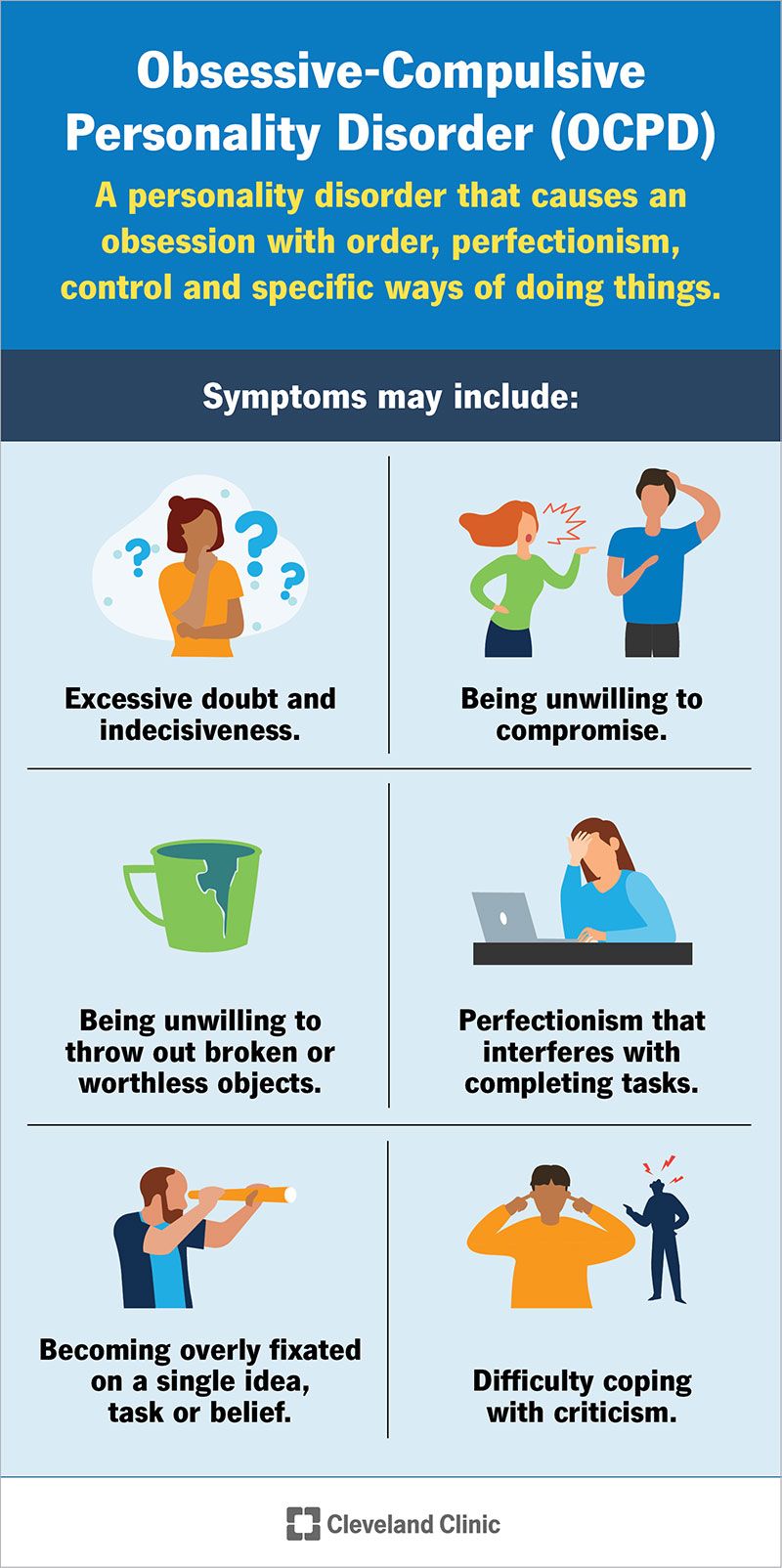
Back to Ji-yeon’s story: her inner world was full of rules like, “I must understand every word perfectly,” “Notes must be aesthetically perfect,” “One mistake and it’s a failure.” Rules created to help her succeed paradoxically paralyzed her.
Why are they so powerful? Because they give the illusion of control.
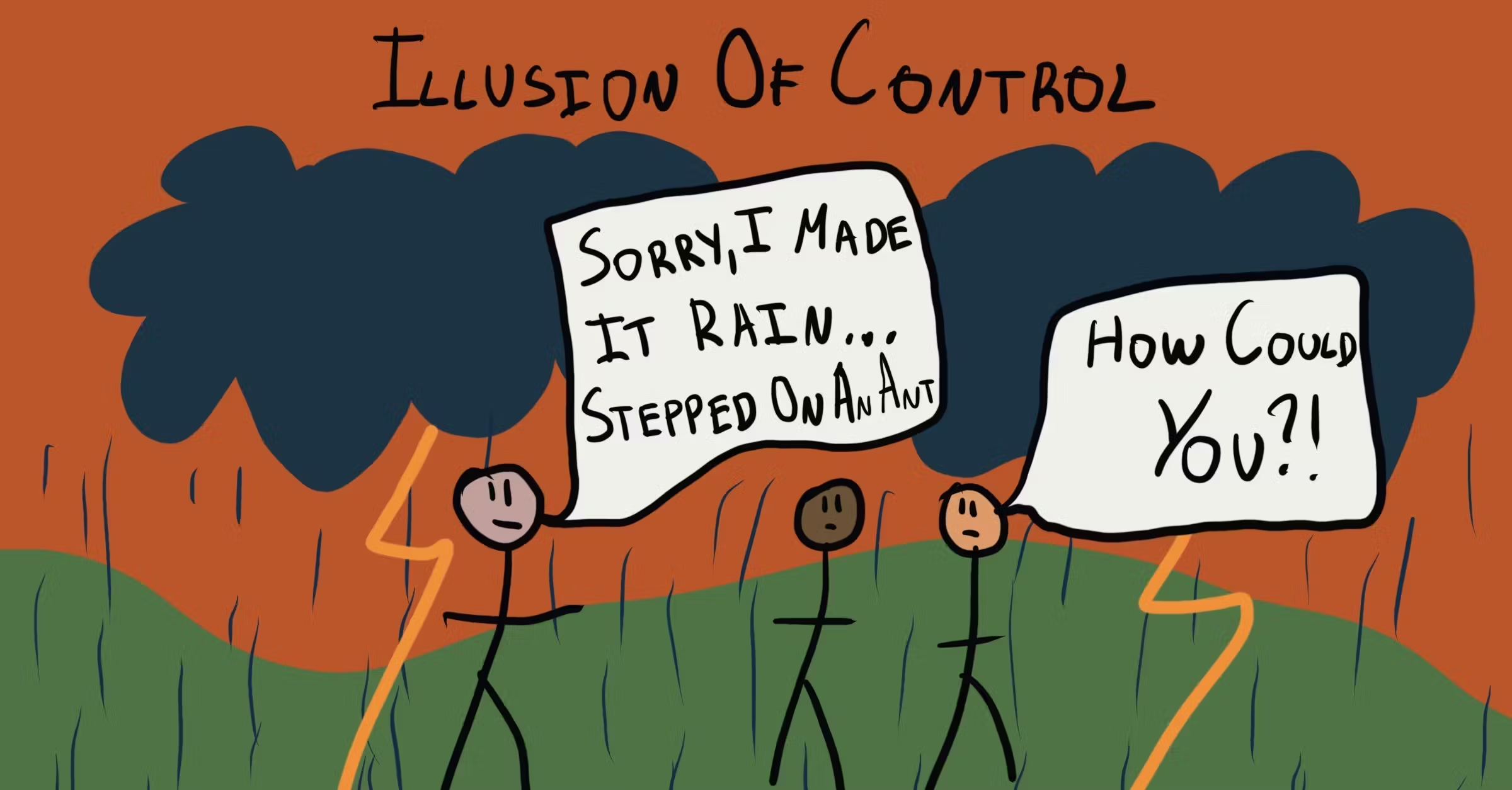
We’re all anxious, honestly—uncertain futures, others’ evaluations… When we follow strict self-made rules it feels like perfect results will be guaranteed and our value and safety will be secured. But that’s a fundamental illusion. Arranging pens perfectly (‘process control’) won’t guarantee passing an exam (‘outcome control’). This small misunderstanding is the first brick in the huge prison of compulsion.
A broken alarm system in the brain: the vicious cycle of Obsessive-Compulsive Disorder (OCD)
When it goes beyond being merely meticulous and daily life becomes painful, then it may not be a personality quirk but a brain disorder that needs treatment: ‘Obsessive-Compulsive Disorder (OCD).’
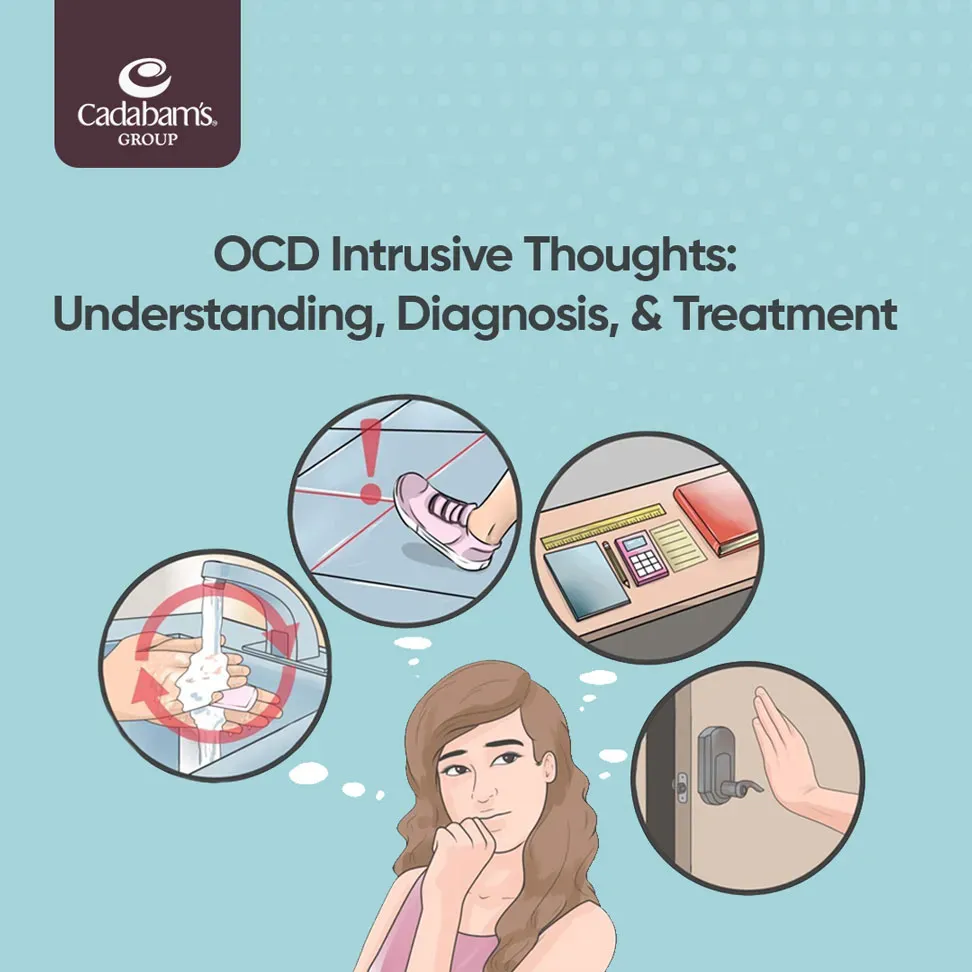
OCD comes as a pair: unwanted, intrusive, maddening thoughts (‘obsessions’) and repetitive actions carried out to reduce that anxiety (‘compulsions’).
It’s like a ‘hiccup of the brain.’ There’s no real danger, but part of the brain’s circuitry keeps sounding unnecessary alarms. Experts explain that a specific brain circuit called the cortical–striatal–thalamic–cortical (CSTC) loop malfunctions. That circuit normally helps plan actions, form habits, and apply brakes by saying, ‘Okay, you can stop now.’ In OCD, that brake is broken. So even after something is resolved, the brain keeps signaling, ‘Danger! Danger!’
Importantly, most people who experience this are aware their thoughts or behaviors are irrational. But they can’t stop. That helplessness is truly awful.
The case of young office worker Min-jun illustrates this well. He is tormented by horrendous intrusive thoughts that he might harm his loved ones. Rationally, he knows it’s impossible. But the thoughts feel vivid and terrifying. His compulsions aren’t obvious to others. Whenever a ‘bad’ thought arises, he must mentally repeat certain ‘good’ words to ’neutralize’ that thought.
Why does this cycle not stop? Because of ‘relief.’ This is the scary reward. Compulsions temporarily reduce anxiety. (1) Obsessions cause intense anxiety (pain). (2) Compulsions temporarily remove that pain and give relief. (3) The brain then strongly learns, ‘Ah! This is the answer!’
Ultimately OCD is not about the specific behavior itself but addiction to that momentary ‘relief’ the behavior brings. Desperate attempts to feel safe end up strengthening the link between intrusive thought and perceived danger and make the brain’s alarm system more sensitive—a tragic loop.
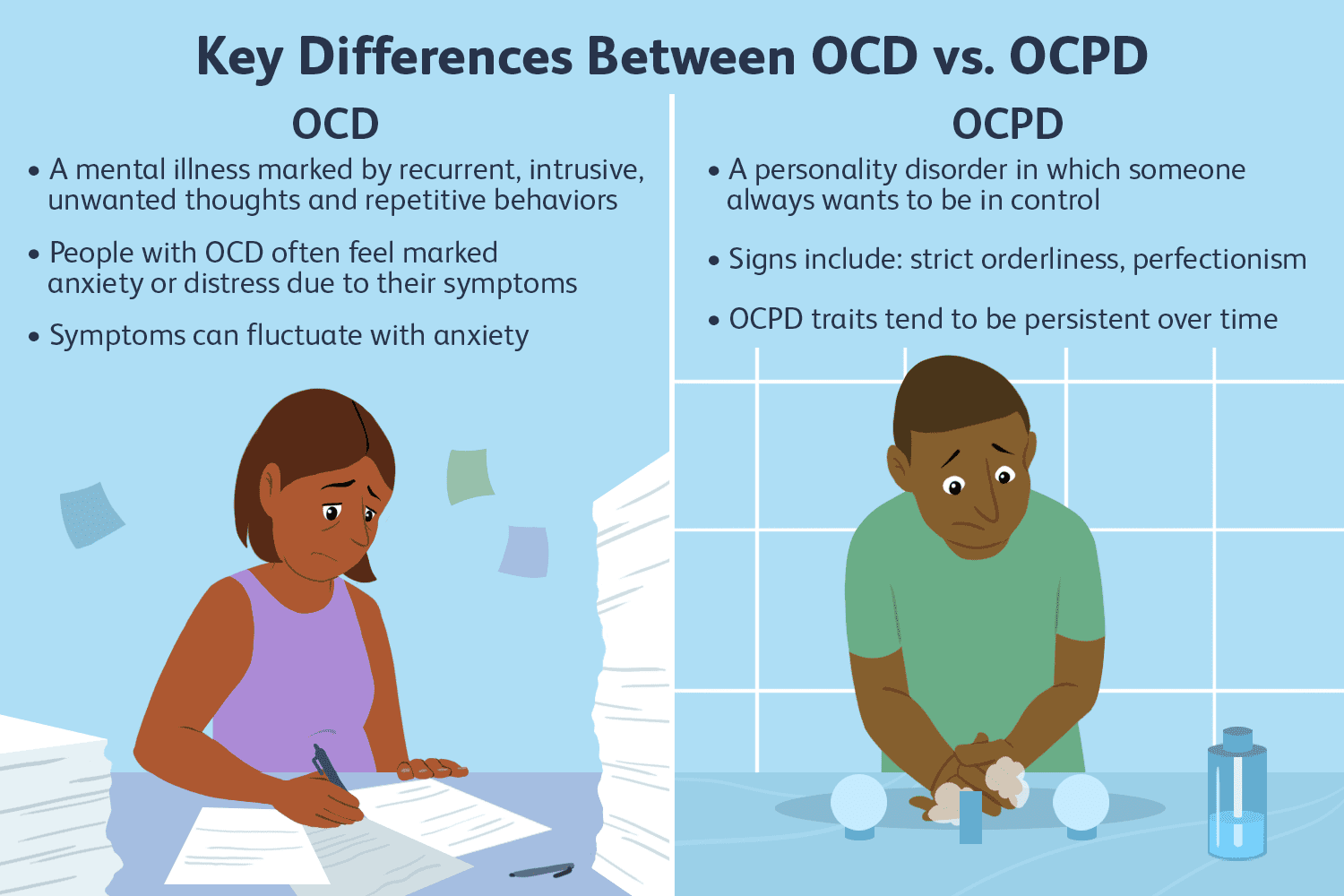
Do you know the difference between OCD and OCPD?
The prison called the ‘disease of developed countries’: the society that pushes us
This is often called the ‘disease of developed countries’ or ‘modern society illness.’ In fact, the number of OCD patients in our country has steadily increased recently, and the highest incidence is in people in their 20s. Future anxiety, fierce competition, and an overload of information—these digital-age characteristics are surely related.
Ah, social media. It truly forces you to see other people’s perfectly edited lives in real-time. It makes you compare and feel deprived. It internalizes the pressure: ‘I must be perfect like them.’

These societal pressures likely amplified Ji-yeon and Min-jun’s inner suffering. Ji-yeon’s perfectionism probably intensified amid fierce university competition, and Min-jun’s anxiety worsened in a high-stress environment where a small mistake could be catastrophic. Their inner struggles may be a mirror of the external world we live in.
Modern societal anxieties are often vague and uncontrollable—economic uncertainty, job instability, endless social comparison—creating a massive sense of helplessness. The brain, interestingly, prefers solving concrete, solvable problems.
So OCD may be the brain’s desperate adaptive attempt to convert this massive, abstract anxiety into something ‘controllable’ and concrete. Instead of facing enormous fears, the brain fixates on immediately solvable concrete problems like ‘Are my hands clean?’ or ‘Did I turn off the gas valve?’ Thus compulsive behaviors may be a frantic attempt to soothe abstract terror by performing specific, controllable actions.
Becoming free from obsessions
Now that we roughly understand the prison’s blueprint, we need to find a way out. Fortunately, there are effective methods to break down these solid walls and move toward freedom. This is less about merely eliminating symptoms and more like training to learn a new way of living.
Courage to face fear: the power of Exposure and Response Prevention (ERP)
The gold-standard treatment for OCD—the most highly regarded intervention—is ‘Exposure and Response Prevention (ERP).’
The principle is simple but powerful. Intentionally expose yourself to situations or stimuli that trigger obsessions (exposure), and consciously refrain from performing the usual compulsive act (response prevention), enduring the anxiety that rises.
Through this process the brain learns two key things. First, ‘Huh? If I endure it, the anxiety gradually dulls’ (this is called ‘habituation’). Second, ‘Even without that compulsion, the terrible thing I feared didn’t happen!’ (this is ‘inhibitory learning’).
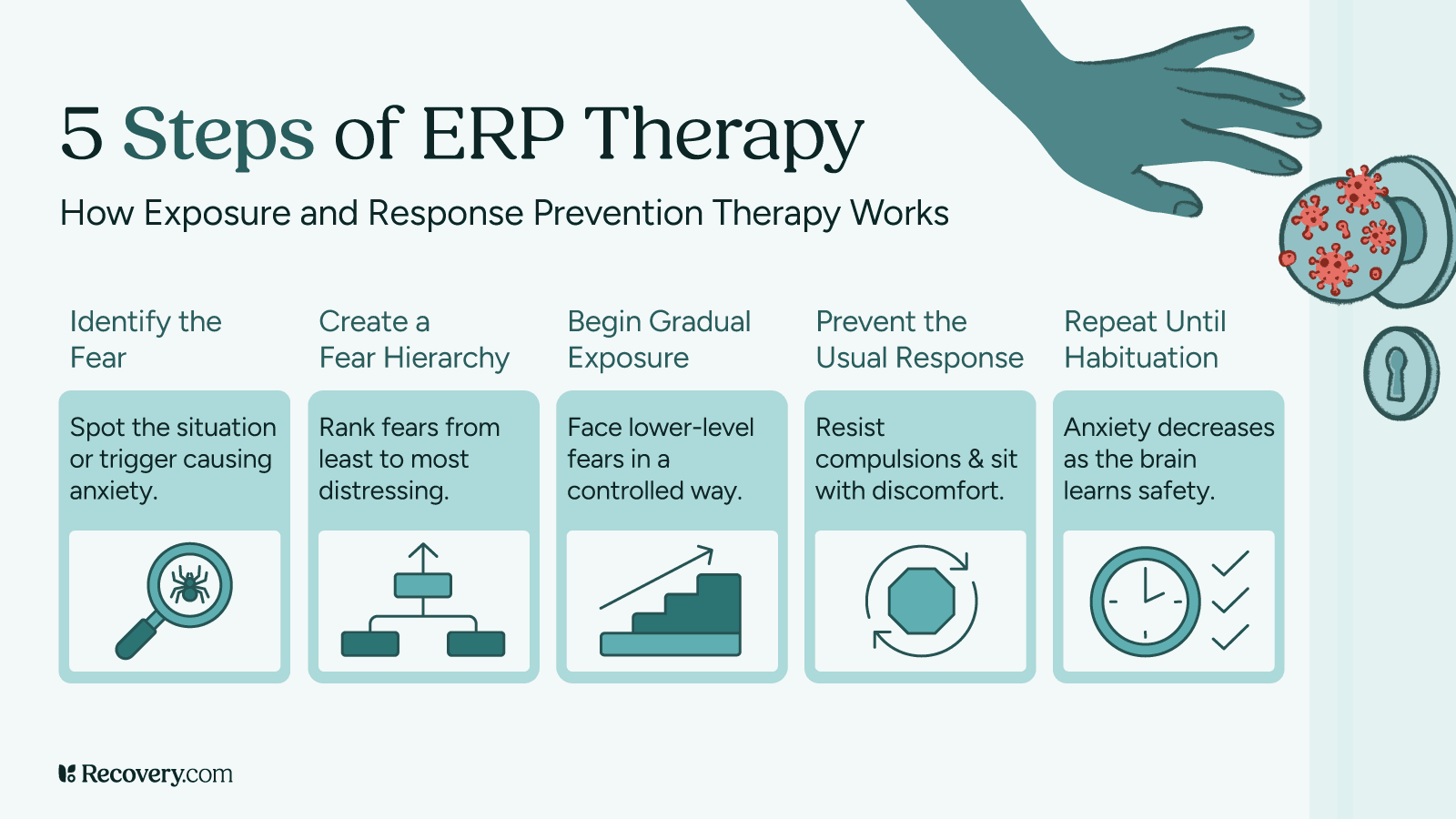
The case of Yeon-woo, who couldn’t go outside without plastic gloves due to severe contamination obsessions, clearly shows this. A therapist had her lightly touch the dust on a floor she perceived as ‘dirty’ with her fingertip and then urged her to resist the urge to wash. The anxiety she initially rated at 50 out of 100 gradually dropped to the 30s and then the 10s as she faced the anxiety without performing the compulsion. Her brain finally realized, “Oh! Even if I don’t perform the ritual (washing), the anxiety peaks and then naturally subsides!”
People with OCD already know logically that their fear is irrational. So logical persuasion like, “That’s not dangerous,” often doesn’t work. Fear is engraved not in the rational brain but in emotional circuits like the amygdala as conditioned reflexes.
What makes ERP truly effective, in my view, is that it bypasses logical argument and speaks the only language the emotional brain understands—’experience.’ Repeatedly enduring anxiety without the compulsion overwrites the brain with new data: ‘The catastrophe you predicted didn’t happen.’ ERP is a therapeutic act of risk-taking in a safe environment and the most reliable way to rewire a faulty alarm system in the brain.
Like watching clouds in the sky: the wisdom of Mindfulness and Acceptance and Commitment Therapy (ACT)
Another approach gaining traction is to stop trying to eliminate or fight obsessive thoughts themselves and instead change your relationship with those thoughts. Mindfulness and Acceptance and Commitment Therapy (ACT) are emblematic. ACT sees the attempt to avoid or control uncomfortable thoughts and feelings—’experiential avoidance’—as the core problem. That struggle only amplifies suffering.
- Mindfulness: A posture of nonjudgmental noticing of experiences (thoughts, emotions, sensations) in the present moment. When obsessive thoughts arise, instead of being swept away by them, you train to observe at a distance like watching clouds pass by: “Ah, there’s that thought again.”
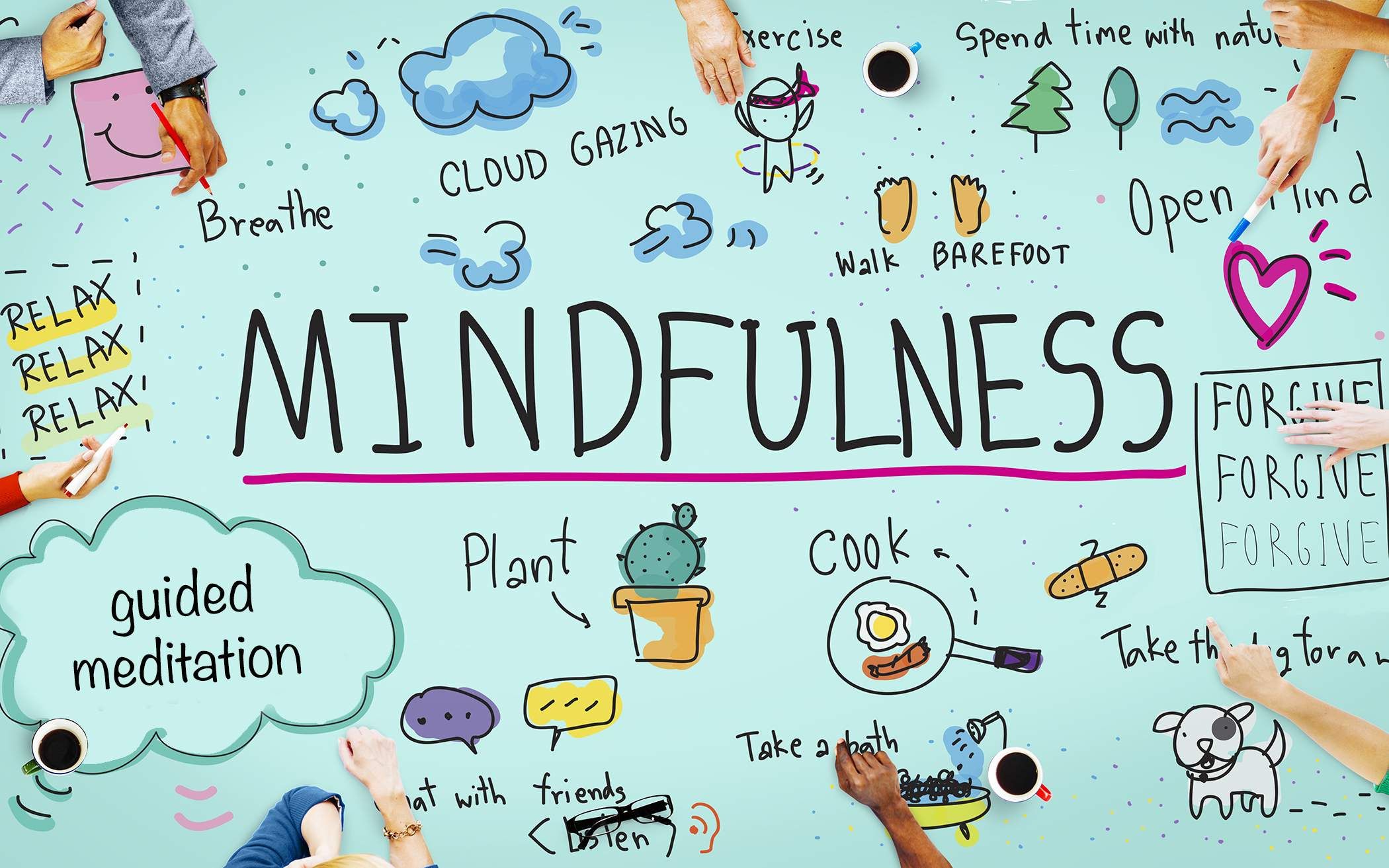
Mindfulness - Cognitive defusion (ACT): The process of separating yourself from your thoughts. Rather than being captured by the thought “I am a bad person,” you notice, “Ah, the thought ‘I am a bad person’ is playing in my mind.” This small distance can create huge change.
- Acceptance (ACT): Instead of fighting to eliminate uncomfortable thoughts or emotions, actively make room for them to exist in your mind. This is not giving up but courageously ending unnecessary inner battles.
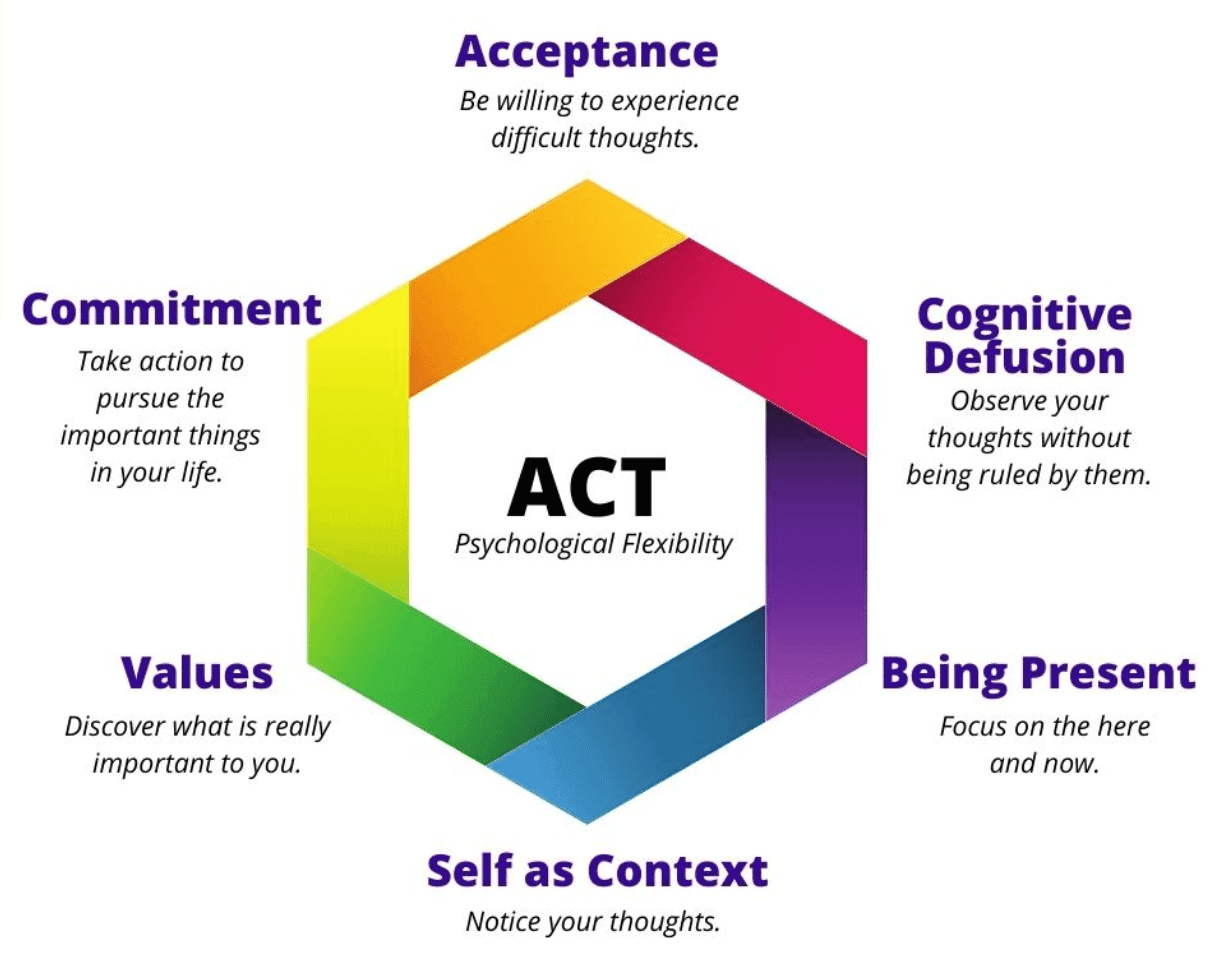
Acceptance and Commitment Therapy, ACT
Back to Min-jun: the therapist taught him cognitive defusion techniques. Whenever a terrible thought arose, he would hum the “Happy Birthday” tune along with the thought or imagine writing the thought on a leaf and letting it float away in a stream. It sounds odd, right? But this helped Min-jun see his intrusive thoughts as mere ‘mental noise’ rather than urgent commands or reflections of his true self. He began learning to let thoughts exist without forcibly eliminating them.
You know the famous ‘pink elephant’ example: “Don’t think of a pink elephant!” and what happens? You think of a pink elephant. That’s it. Trying to control unwanted thoughts paradoxically strengthens them. When we stop fighting thoughts—when we accept the existence of the thought rather than obsessing about its content—we paradoxically become freer of it. The emotional fuel that powers the thought is cut off, and it weakens. This isn’t winning an internal war; it’s signing a peace treaty.
From “must-do” to “what matters”: reclaiming a values-driven life
Ultimately, escaping compulsion is not just about reducing symptoms. It’s about reclaiming a rich, meaningful ‘my life.’ ACT offers two tools for this: ‘values clarification’ and ‘committed action.’
- Values clarification: Rediscover what really matters in your life—things you may have neglected while fighting compulsive symptoms. Connection with family, creativity, learning, kindness… anything meaningful.
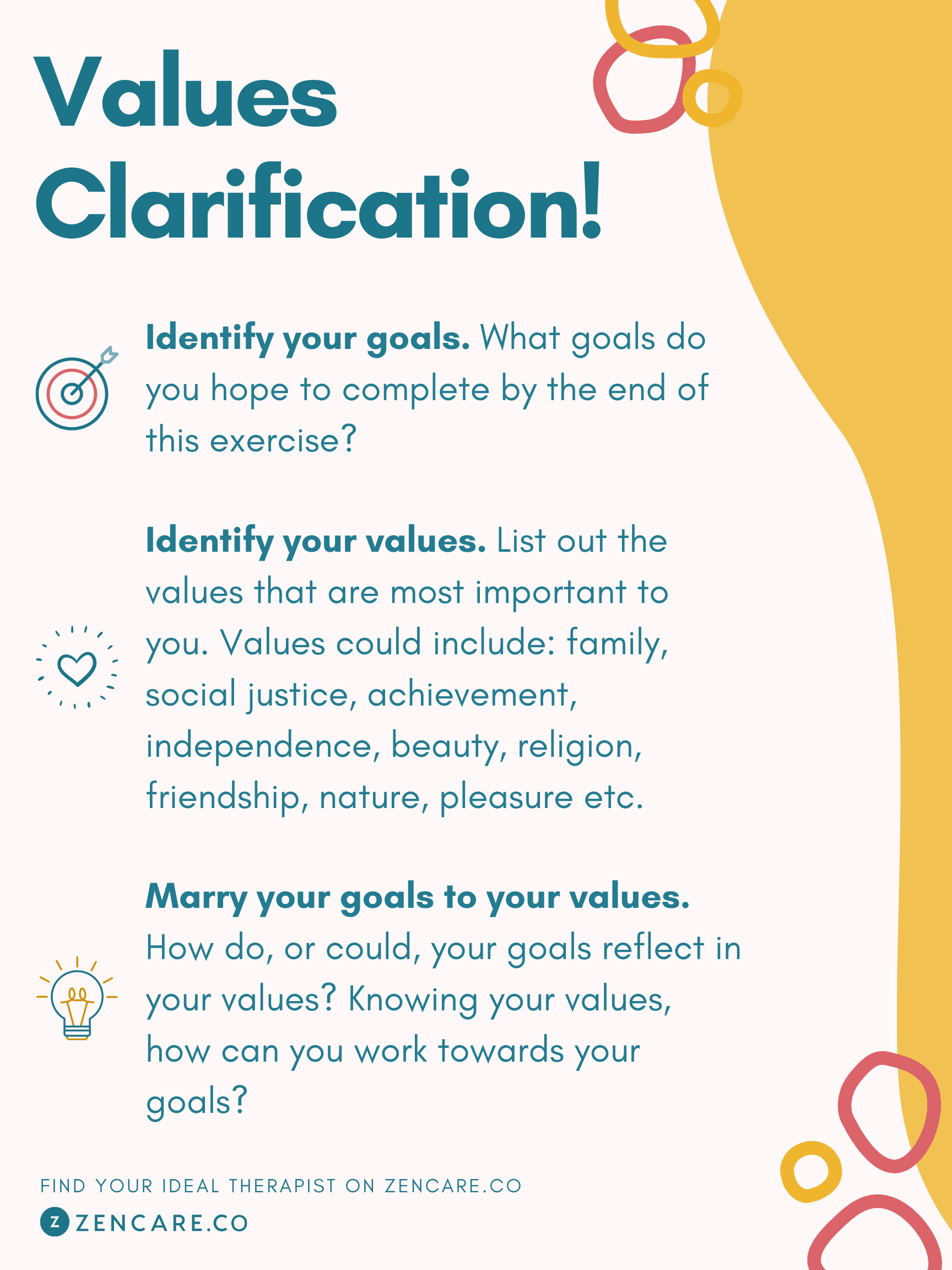
Value Clarification - Committed action: Concrete actions you take toward values even when obsessions or anxiety arise.
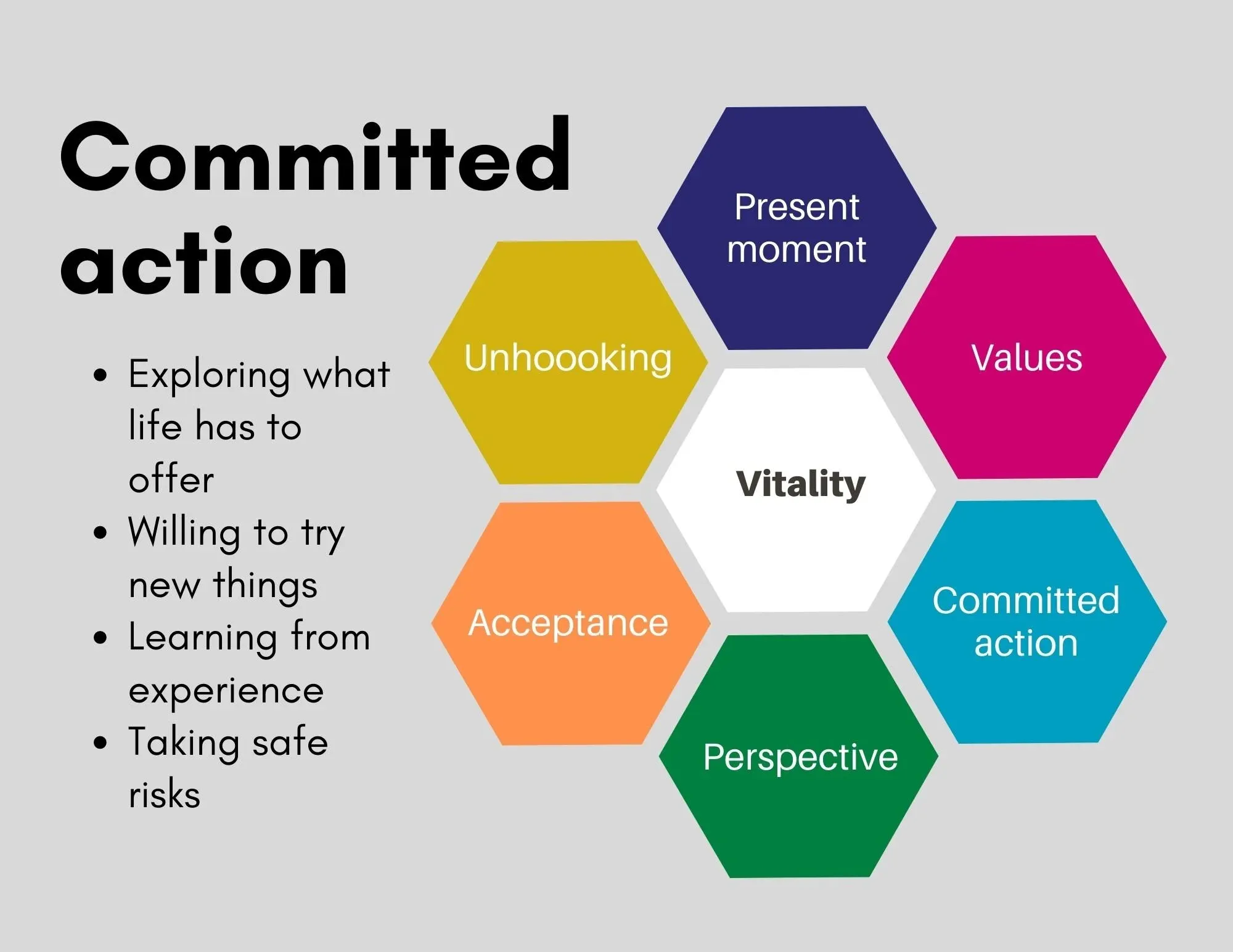
Committed Action
Min-jun realized that being a present, kind partner was extremely important to him. His obsessions whispered, “You are dangerous! Stay away from your partner!” But he chose committed action. Even while terrifying thoughts screamed in his head, he sat on the couch and took his partner’s hand. He brought his anxiety along like a companion and stepped toward his value.
That may not be a victory over obsessive thoughts per se, but it was a profound victory for his life.
This is the crucial shift: the criterion for ‘success’ in recovery changes. If success used to mean a day without intrusive thoughts, now success means a day when you took some action toward what you care about despite the anxiety. When the question shifts from “How do I get rid of this anxiety?” to “Even with this anxiety, what value-driven life will I move toward?” life begins to change. We stop being ‘patients’ and become the active ‘authors’ of our own life story.
For those suffering from obsessions
If you’re reading this and thinking, “This is my story,” there’s one last message I want to give. It’s a consolation and a small guide for a new start.
You are not alone, and this is not your fault
First, please remember this. You are never alone. OCD appears in about 2–3 out of every 100 people—more common than many assume. The WHO lists it among the top disorders that significantly reduce quality of life; this is clearly a medical issue beyond mere willpower.
It is not because your will is weak or your personality is flawed. No. The pain you feel is real, and that struggle deserves respect.
Shame and the fear of being the only one—“Am I the only one who’s weird?"—are the biggest barriers to seeking help. Many hide their symptoms for years because they fear being labeled ‘crazy.’
But don’t equate this illness with who you are. Try to separate the two: “This is not me; it’s a malfunctioning alarm system in my brain. It’s a treatable condition.” I truly believe that this small shift in perspective is the most important and greatest first step toward recovery.
Small steps for a new beginning
Professional treatment is best, of course, but small daily habits can build a solid base of resilience. ERP and ACT can be demanding and energy-consuming.
- Breathing to regulate anxiety: When anxiety surges, simple deep-breathing techniques like the 4-7-8 method can calm an overexcited nervous system. Inhale through the nose for 4 seconds, hold for 7, and exhale slowly through the mouth for 8 seconds.
- Stress management: Regular exercise, sufficient sleep, and a balanced diet—these are the basics of mental health. They increase resilience to stress.
- Practice self-compassion: Perfectionism and compulsions often bring harsh self-criticism. Self-compassion is crucial. Instead of berating yourself for mistakes, practice speaking to yourself as you would to a struggling friend—with warmth and kindness.
These aren’t direct cures, but they stabilize the nervous system and replenish a tired body and mind—creating the sturdy foundation needed to endure the demanding therapeutic journey.

Asking for help is the ultimate sign of strength
Finally… seek professional help. It’s not a sign of weakness. It’s the greatest courage and evidence of strength—to face your problem and work to resolve it.
Cognitive Behavioral Therapy (CBT/ACT) and medication (mainly SSRIs) are the most scientifically proven powerful tools. Combined, they have tremendous synergy. Medication can lower the volume of the brain’s hypersensitive alarm system and calm the waves, while psychotherapy teaches you how to ‘surf’—practical skills for living again.
If you don’t know where to start, reach out to a professional.
Your suffering can end. Really. The journey to freedom begins the moment you take the hand offered to you.