100% Trap: The Smartest Mistake You Didn’t Know About — Perfectionism
phoue
•14 min read•--
A Ghost in the System
The Trap of Perfectionism
Imagine a highly competent software engineer. He spends months on a single piece of code for a new app. Polishing, optimizing, rewriting — chasing an impeccable, even perfect elegance.
Then the problem arises. When he finally deemed his work “ready!”, the market had already… moved on. A competitor released a “good enough” version first, captured the market, and his once-perfect code became an obsolete relic.
Sound familiar? This anecdote clearly shows that perfectionism is not merely a virtue — it can be a powerful self-destructive mechanism.
This is the most deceptive kind of “smart mistake.” Perfectionism can feel like a noble devotion to excellence, but frankly, it’s an intellectual trap. Setting standards that are “so high they can never be met” ends up preventing anything meaningful from being accomplished — arguably the most foolish mistake of all.
In this piece, we’ll track the ghost of perfectionism in three stages.
First, we’ll dissect how logically flimsy the concept of “100% perfect” actually is.
Second, we’ll dig into the emotional engine driving perfectionism — the nature of shame.
Finally, we’ll offer practical paths out of this brutal loop toward a more resilient and compassionate life.
1. The Imperfection of Perfection
The goal of “100% perfect” isn’t just hard to reach. It’s logically, philosophically, and practically impossible. Chasing it is like pursuing a mirage.
1.1. 14 Years of Development Hell: The Parable of the Never-Ending Game
The longest-developed video game duke nukem forever
One dramatic example of the perfectionism trap in modern tech is the story of the video game Duke Nukem Forever. First announced in 1997, this game went through an astonishing 14 years of development. Fourteen years! It earned the title of one of the longest-development cycles in video game history.
The core problem was the relentless, almost pathological perfectionism of the project’s lead, George Broussard. Every time a new technology appeared in another game, he ordered the team to scrap existing work and adopt the latest engine or features.
What began on the Quake II engine was switched to the Unreal engine, then repeatedly upgraded to newer versions of Unreal — an endless cycle. It was as if the finish line kept running further away. The team motto became “when it’s done,” which turned into a cynical joke.
When the game finally launched in 2011, how did it fare? It was a critical and commercial failure. A once-promising project had become a Frankenstein of patched-together, dated ideas after 14 years.
This story powerfully exemplifies Voltaire’s adage: “Perfect is the enemy of good.” Setting an unattainable standard leads to paralysis and failure. The result of pursuing 100% perfection? Over a decade of effort with 0% success.
Perfect is the enemy of good
1.2. Ghosts in the Axioms: Gödel’s Incompleteness Theorems
Beyond anecdotes, let’s examine the logical impossibility of perfection. This may be dense, but it’s important.
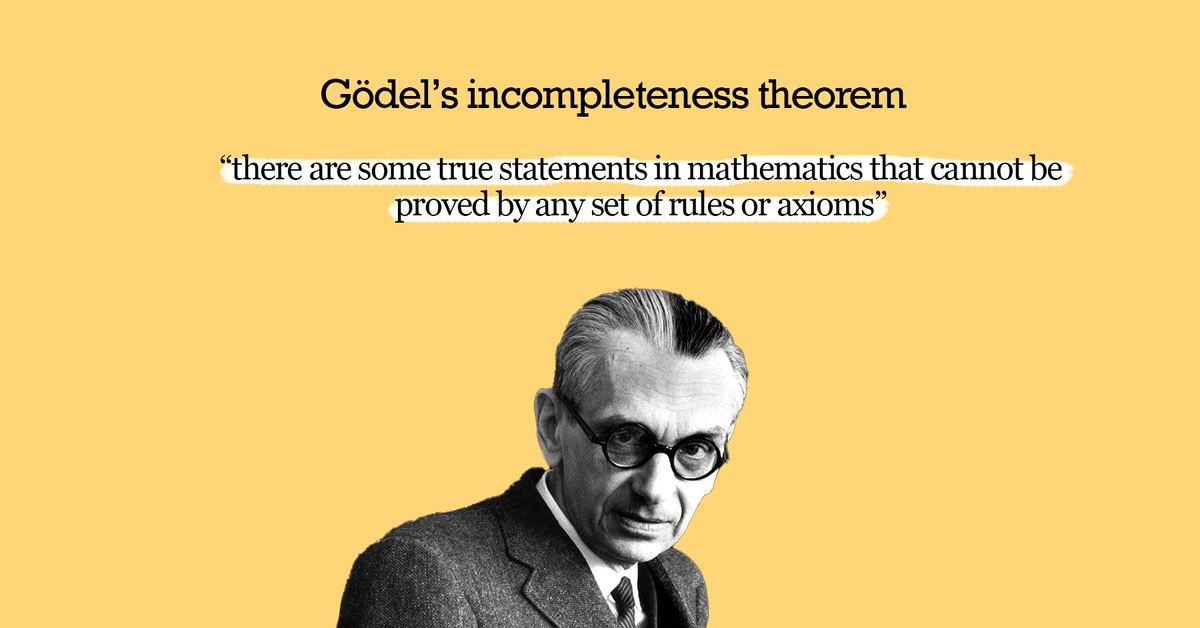
The 20th century’s greatest logician and mathematician, Kurt Gödel, changed the paradigm of logic after Aristotle. His Incompleteness Theorems proved that the concept of a perfect formal system is logically contradictory.
Incompleteness Theorems
Put metaphorically, Gödel showed that for any sufficiently complex formal system of mathematics or logic (like Peano arithmetic), if the system is consistent (i.e., free of contradictions), then it must be incomplete. That means there are true statements in the system that cannot be proved using the system’s own rules. Moreover, the second incompleteness theorem goes further: no sufficiently powerful system can prove its own consistency.
This is not just a mathematical curiosity. It’s a proclamation about the fundamental limits of all rule-based systems.
Think about personal standards we erect in pursuit of perfection — they are also, in essence, a formal system. Gödel’s proof suggests that our internal “rulebook for perfection” is inherently flawed. It can never be complete, and it cannot validate its own validity. Demanding 100% perfection is asking for the logically impossible.
1.3. The Beauty of Broken Things: Wabi-Sabi and Kintsugi
If Western logic proves the impossibility of perfection, let’s turn to Eastern wisdom, which outright aestheticizes imperfection. Japanese philosophy of wabi-sabi offers a powerful alternative to perfectionism.
Wabi values humble simplicity, quietness, and restraint.
Sabi celebrates the beauty that aging and wear impart over time.
Combined, wabi-sabi finds beauty in things that are imperfect, impermanent, and incomplete. It prizes authenticity over perfection.
The art of kintsugi (金継ぎ) best embodies this philosophy. It repairs broken pottery using lacquer mixed with gold, silver, or platinum powder. Kintsugi doesn’t hide the cracks as shameful flaws; it highlights them with gold, turning the vessel’s history and restoration into a story of resilience. Amazingly, a kintsugi-repaired piece is often regarded as more beautiful and valuable than before it broke.
Kintsugi: Japanese philosophy ‘wabi-sabi’ rejects perfectionism
What a profound lesson for life — our wounds, failures, and imperfections are not defects to be concealed in shame. They are evidence of the journey we’ve walked and our resilience. Embracing them makes us more whole. This directly challenges the perfectionist belief that flaws reduce worth.
In conclusion, the impossibility of perfection is a universal principle. The same truth emerges from a failed tech project (Duke Nukem), rigorous formal logic (Gödel), and an enduring aesthetic tradition (kintsugi). The struggle for perfection opposes practicality, logic, and even the essence of beauty.
2. Perfectionism Is a Desire to Avoid Shame
Now that we’ve analyzed what perfectionism is, let’s examine why we cling to it. Why are we so obsessed with being perfect?
Perfectionism isn’t primarily a noble pursuit of excellence. At least, not entirely. It’s more accurately a psychological defense rooted in deep fear of shame and criticism.
A psychological defense born from deep fear of shame and criticism
2.1. The Armor We Wear: Brené Brown’s Research
Imagine a young professional preparing for a major presentation. You may have had similar experiences. He creates over a hundred slides for a 20-minute talk, memorizes every word overnight, agonizes over fonts.
Is his real aim to convey useful information? Probably not. His true goal is to construct an impenetrable fortress against any criticism or questioning. He simply does not want to be criticized.
This type of perfectionism connects to “insecurity, a fear of being embarrassed.” The anecdote illustrates it vividly.
To explain the emotional core scientifically, we should look to the work of Dr. Brené Brown, who has spent two decades researching vulnerability, courage, and shame.
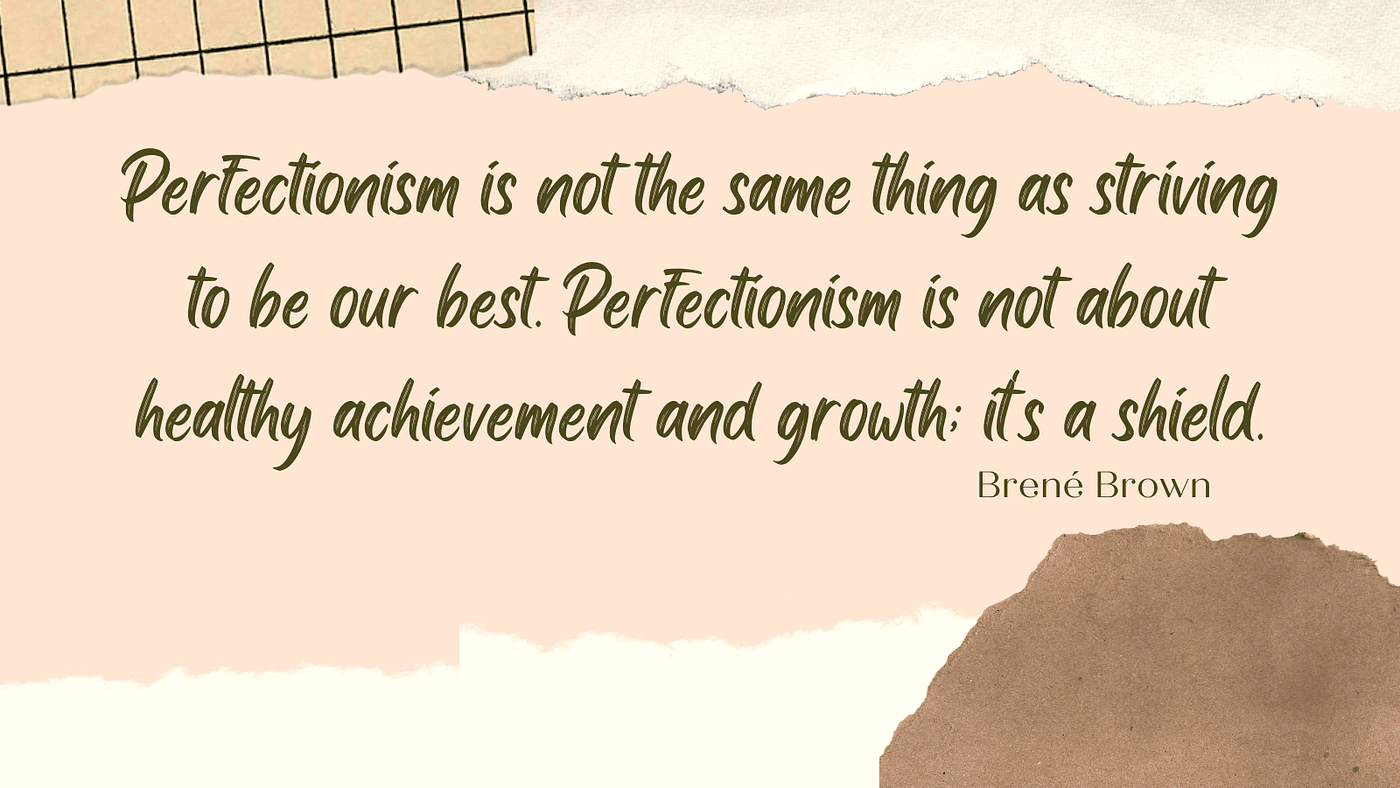
Brown’s central claim is clear: perfectionism is not about you; it’s about what people will think of you. She likens perfectionism to a “20-ton shield” we carry, believing it will protect us. It is a resonant metaphor.
But the shield actually prevents us from being authentically seen. It’s one of the heaviest pieces of emotional armor we don to keep the pain of vulnerability at bay.
Perfectionism as a 20-ton shield carried to protect oneself from how others may view them
2.2. A Crucial Difference: Healthy Striving vs. Perfectionism
Many perfectionists defend themselves by saying, “I just have high standards.” But Brown’s research reveals a decisive difference between the two.
Healthy striving is self-focused. It asks, “How can I get better?” and focuses on fulfilling one’s potential.
Perfectionism is other-focused. It is consumed by “What will others think?” and aims to obtain approval and positive evaluation from others.
Healthy Striving vs Perfectionism
This distinction is further illuminated by the axis of guilt and shame.
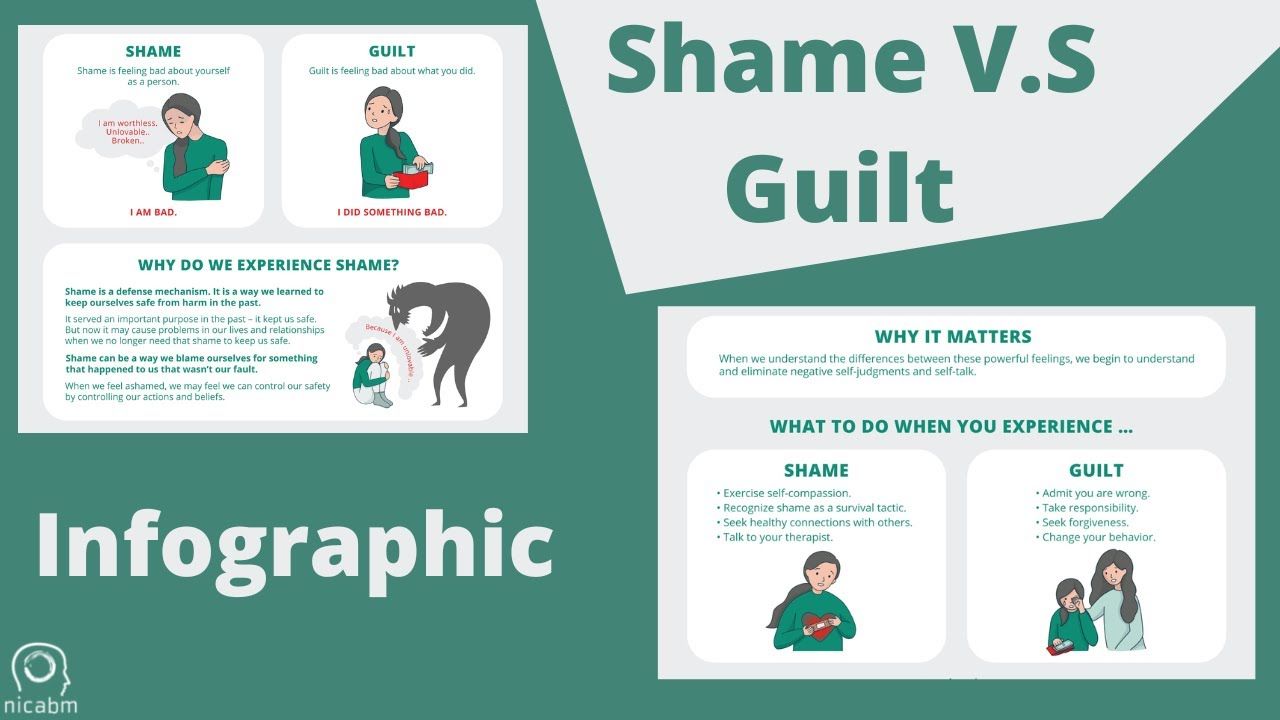
Guilt is about “I did something bad.” It’s action-focused and can lead to constructive outcomes like apology or behavioral change.
Shame is about “I am bad.” It’s self-focused. Shame declares that one is fundamentally flawed and unworthy of love or belonging. It is a terrifying fear of catastrophic disconnection.
guilt vs shame
Ultimately, the real aim of perfectionism is to escape this shame. The inner logic goes like this: “If everything I do is perfect, I can avoid the criticism that would confirm my deepest fear — that I am worthless.”
Trait
Healthy Striving (Intrinsic)
Perfectionism (Extrinsic)
Motivation
Desire for growth and mastery
Fear of failure, criticism, shame
Focus
Process-oriented (enjoys the work)
Outcome-oriented (obsessed with results)
Reaction to failure
Seen as a learning opportunity
Seen as evidence of personal defect
Core question
“How can I do better?”
“What will others think of me?”
Emotional driver
Self-improvement
Need for approval and acceptance
This table refutes the common defense of perfectionists — “I just have high standards” — and offers a useful framework for diagnosing one’s thinking and behaviors.
Perfectionism is not about performance. It’s fundamentally a relational problem rooted in the fear of not belonging. So productivity hacks or time-management tips alone will likely fail to heal the underlying wound.
2.3. The High Cost of the Armor: What Perfectionism Steals from Us
The 20-ton armor we wear to protect ourselves ironically produces the very things we fear.
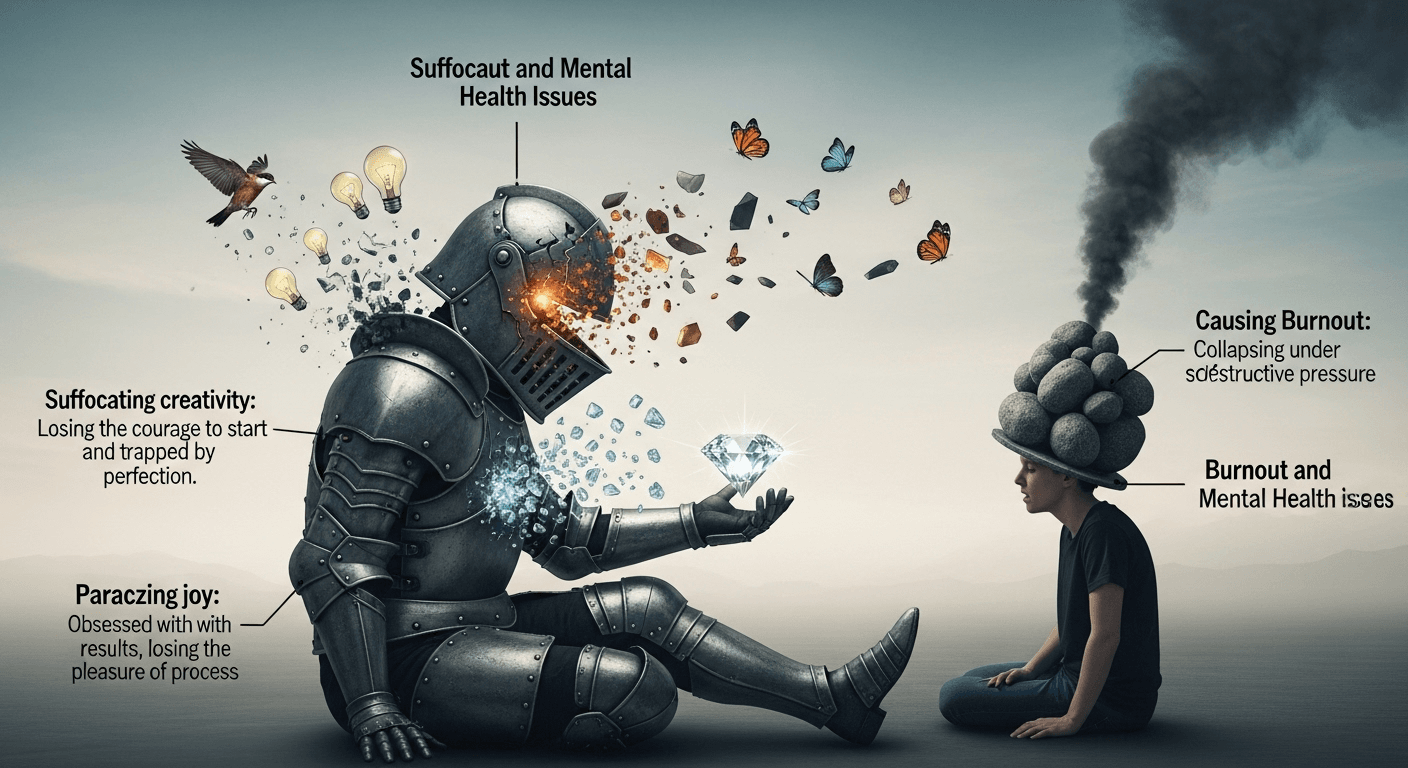
The high cost of perfectionism
It suffocates creativity and innovation: Perfectionism is the enemy of experimentation. Fear of failing at first attempt leads to paralysis and procrastination.
It numbs joy: As Brown argues, you cannot selectively numb emotions. When we try to deaden fear and shame, we also deaden joy, gratitude, and happiness. Life becomes a risk-management exercise rather than a vibrant experience.
It causes burnout and mental-health issues: Constant pressure and self-criticism are exhausting. Research links perfectionism with anxiety, depression, and even self-harm, because individuals get trapped in cycles of self-reproach.
3. For Those Who Are Addicted to Perfectionism
So what can you do? In this final section, I offer evidence-based antidotes to perfectionism. Beyond simple tips, we’ll explore systematic practices to build resilience and self-acceptance.
3.1. Lower the Shield: The Power of Self-Compassion
I once heard the story of a musician who had suffered stage fright for years from perfectionism. Before a small gig, instead of repeating “don’t make mistakes,” he told himself, “It’s okay to be nervous. It’s okay to hit a wrong note. Just focus on the music and the audience.”
During the performance he did miss a note. (Laughter.) But he smiled at the audience and kept playing. To his surprise, the audience didn’t criticize him; they felt more connected to his humanity. He realized that vulnerability, not perfection, is the source of real connection.
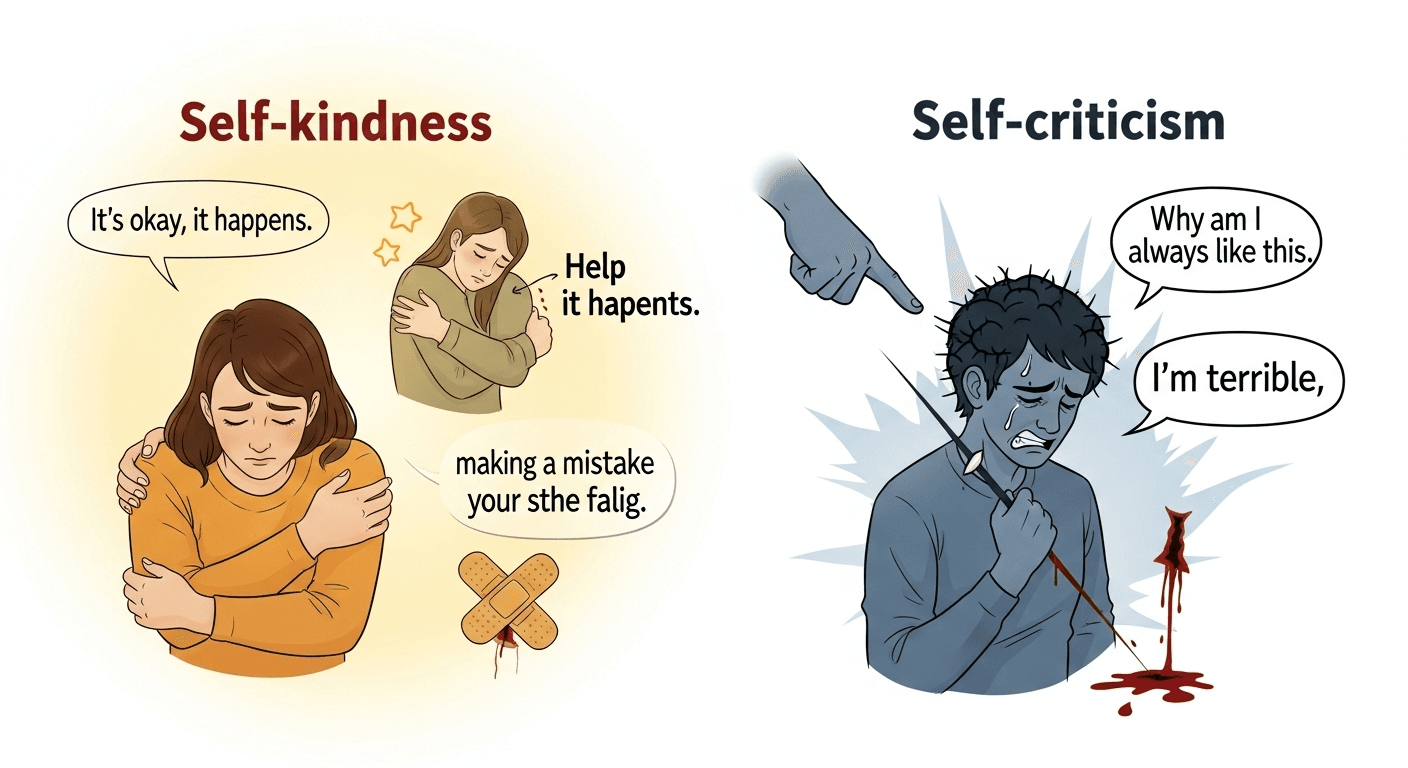
This story illustrates the shift from self-criticism to self-kindness.
At the heart of that shift is Self-Compassion. Kristin Neff, a pioneer in self-compassion research, explains that self-compassion is not self-indulgence. It is offering to yourself the same kindness and care you would give a good friend. Self-compassion is often a more stable and reliable source of self-worth than self-esteem, which fluctuates with external evaluation and comparison.
Self-Compassion
3.2. Three Pillars of a Resilient Mind: A Practical Toolbox
Neff argues that self-compassion is a learnable skill composed of three core elements. These elements directly counter the three pillars of perfectionistic pain: self-criticism, isolation, and emotional overwhelm.
Self-Kindness vs. Self-Judgment:
Instead of harshly criticizing yourself when you fail, intentionally practice warmth and understanding. Replace the inner critic with a voice of gentle acceptance: not “I’m an idiot,” but “That was hard — I struggled.”
Self-Kindness vs Self-Criticism
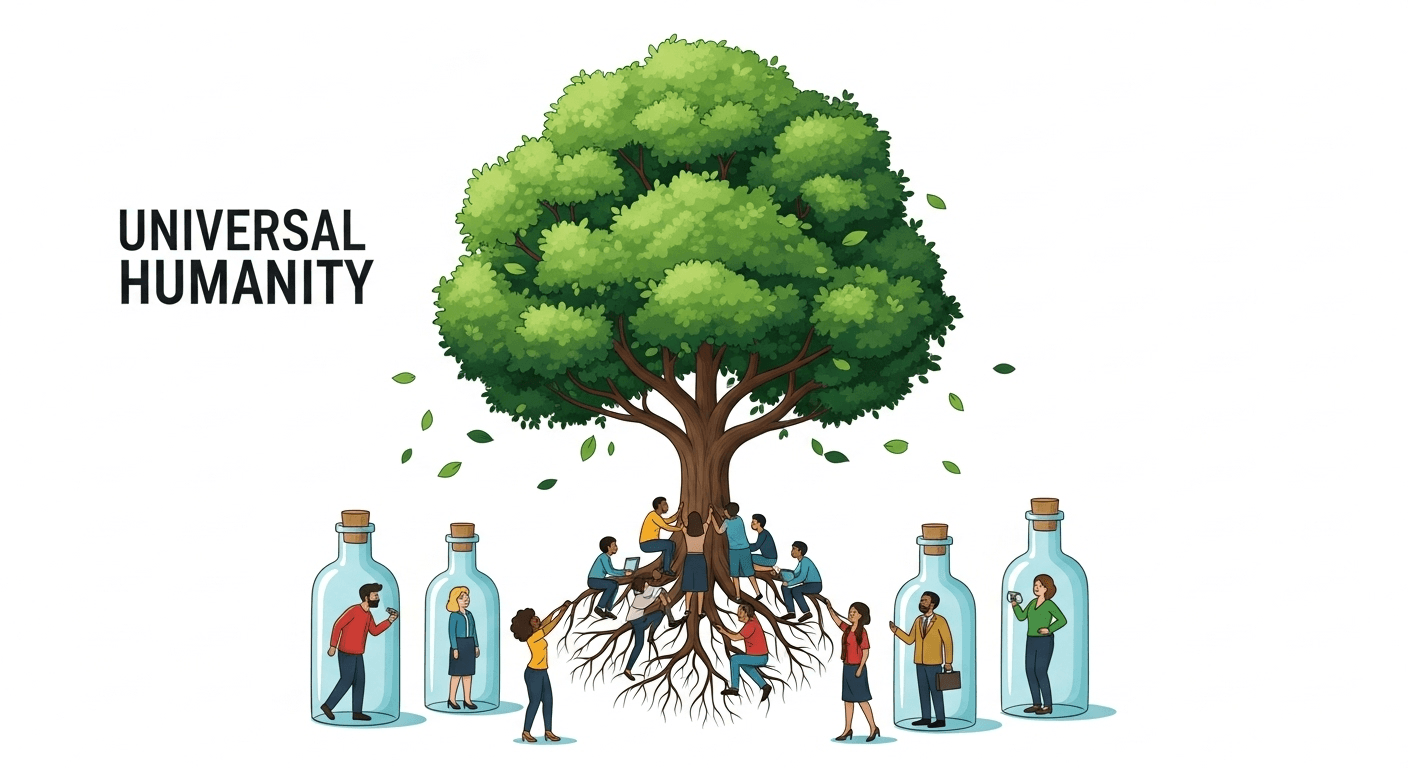
Common Humanity vs. Isolation:
Recognize that suffering, failure, and imperfection are part of the shared human experience. When perfectionists fail, they often feel, “Why am I the only one?” Common humanity reminds us that everyone goes through hard times — our pain connects us rather than isolates us.
Common Humanity vs Isolation
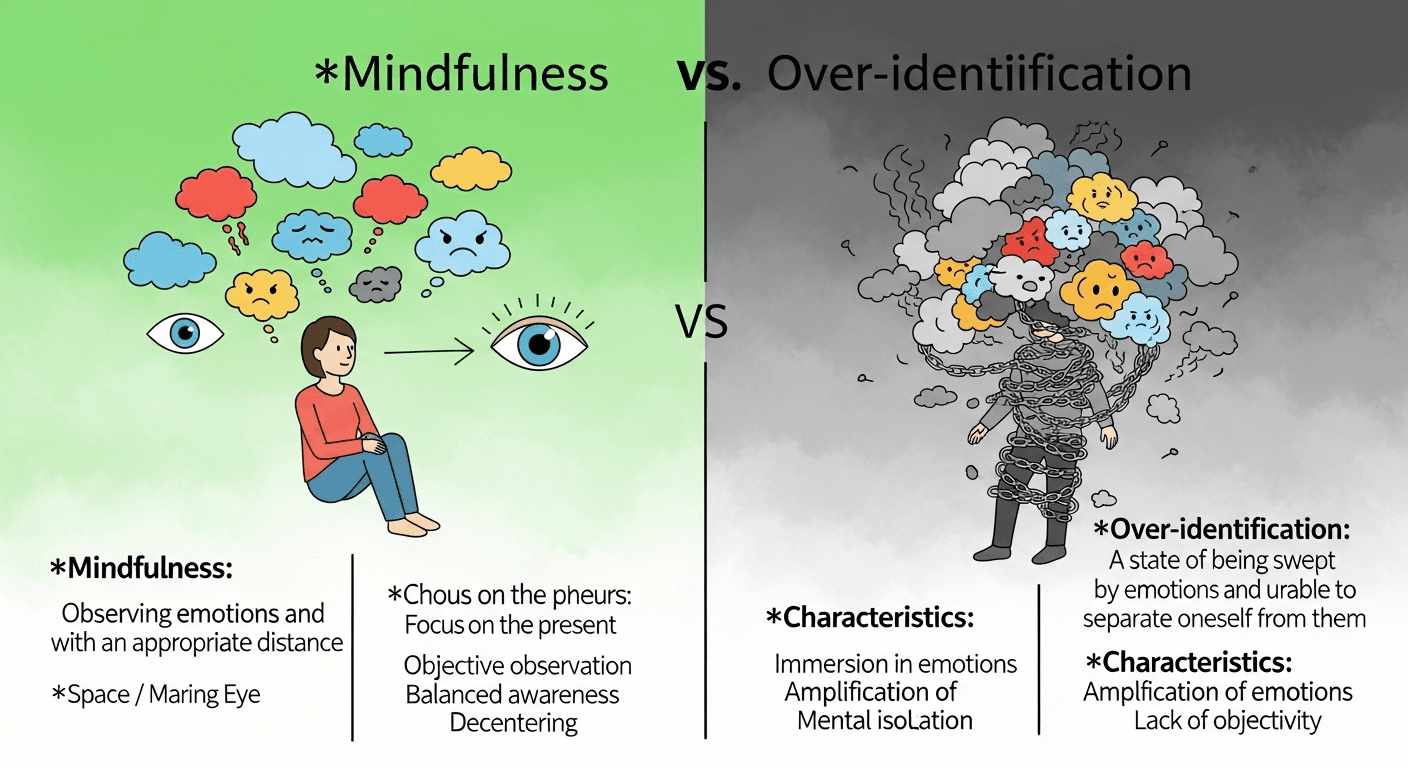
Mindfulness vs. Over-Identification:
Observe negative thoughts and feelings without suppressing them or becoming engulfed by them. Notice the pain (“this is painful”) without letting it define you as your whole reality (“this pain is my entire self”).
Mindfulness vs Over-Identification
A powerful daily practice that uses these elements is the “Self-Compassion Break.” Try it in moments of intense stress or self-criticism.
Step 1 (Mindfulness): Acknowledge the painful moment. “This is a moment of suffering.”
Step 2 (Common Humanity): Remind yourself that suffering is part of life. “Suffering is a part of life. Others feel this too.”
Step 3 (Self-Kindness): Offer yourself a kind gesture. Place your hand on your chest and say, “May I be kind to myself.”
3.3. Rewriting the Rules: From “I Must Be Perfect” to “I’m Good Enough to Start”
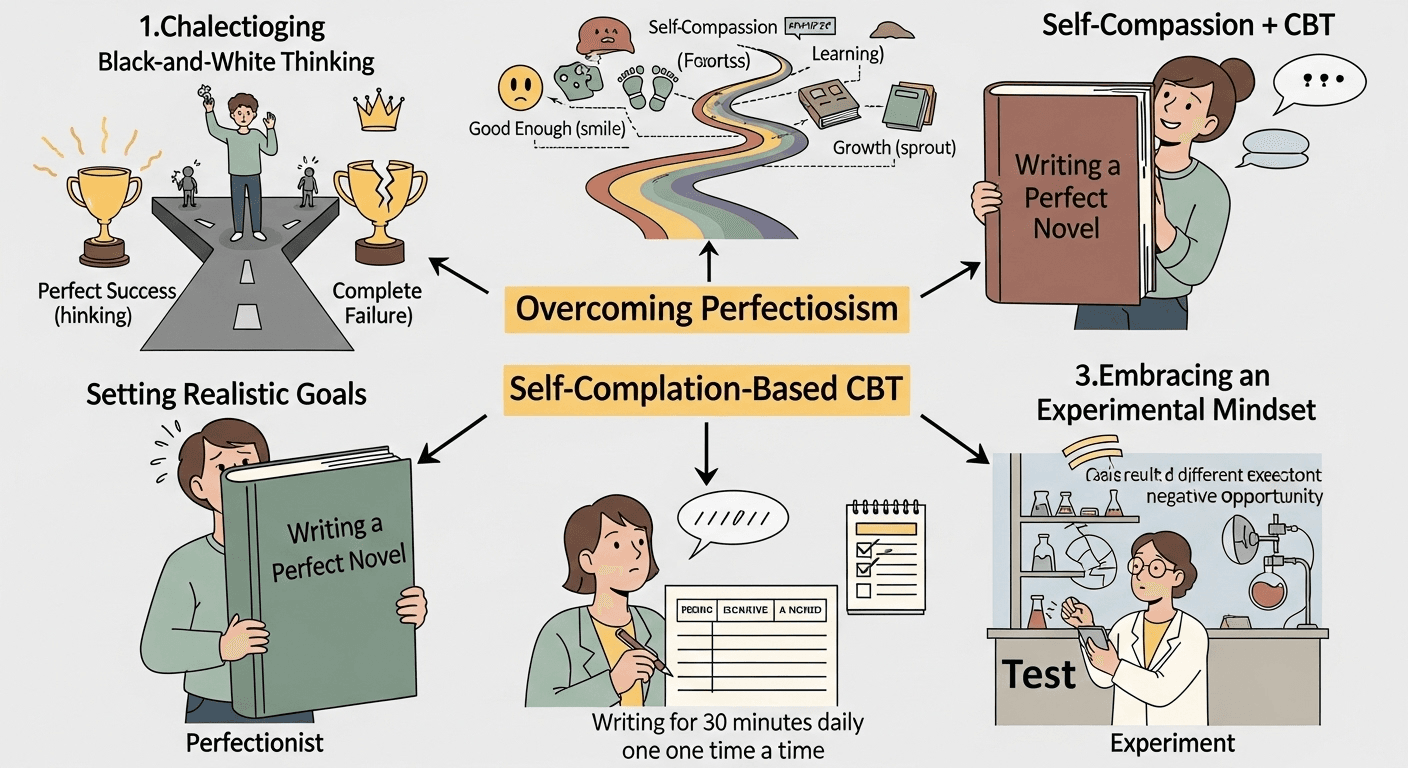
On the foundation of self-compassion, cognitive-behavioral therapy (CBT) techniques aimed at perfectionism are highly effective.
From ‘I must be perfect’ to ‘I’m good enough to start’
Challenge all-or-nothing thinking: Let go of the binary view of “perfect success” vs. “total failure.” Embrace the vast middle ground of “good enough,” progress, and learning.
Set realistic, process-focused goals: Instead of “write the perfect novel,” aim for “write 30 minutes a day.” Shift focus from intimidating outcomes to manageable processes.
Adopt an experimental mindset: Reframe tasks not as tests of your worth but as experiments for gathering data. The goal of an experiment is learning, not perfection. This reduces the burden of failure and encourages action.
In therapy, a client once said, “I realized I wasn’t trying to do well; I was trying not to fail.” That’s a piercing insight. The chains of perfectionism loosen not when we hit perfect goals, but when we accept our imperfect selves and find meaning in the process.
Conclusion: The Courage to Exist as Incomplete
It’s been a long journey. We witnessed how perfection is an illusion in logic and practice (Duke Nukem, Gödel, kintsugi), diagnosed its root in fear of shame rather than a pure desire for excellence (Brené Brown), and discovered a powerful, compassionate road through treating ourselves like a good friend (Kristin Neff).
The aim isn’t to abandon the pursuit of excellence. Don’t misunderstand. The aim is to decouple achievement from self-worth.
Letting go of the demand for 100% perfection may be the bravest act of all. It is choosing to show up in the world as whole, imperfect, and resilient — to engage in our work and lives with a full, compassionate heart.
Letting go of the demand for 100% perfection
And in my view, that is the smartest decision we can make.
References
1. Smart Mistakes You Didn’t Know — [Google Books] (Arthur Freeman, Rose D'Wolff)
2. Smart Mistakes You Didn’t Know — [Aladin] (Arthur Freeman, Rose D'Wolff)
3. Book — — [Tistory] (coffeemix)
4. Duke Nukem Forever was a development NIGHTMARE! — [YouTube]
5. Development of Duke Nukem Forever — [Wikipedia]
6. Why Duke Nukem Forever Failed: 15 Years Of Development Later — [YouTube]
7. Duke Nukem Forever: A Development Hell Tragedy — [YouTube]
8. Perfect is the enemy of good — [Wikipedia]
9. [Kyobo Bookstore] Incompleteness: Gödel’s Proof and Paradox — [kakao gift]
10. Incompleteness: Gödel’s Proof and Paradox — [Kyobo Bookstore] (Rebecca Goldstein)
11. Gödel’s Incompleteness Theorems — [Wikipedia]
12. The Wonders of Wabi-Sabi: Embracing Imperfection in Japanese Art — [Trip To Japan]
13. [Review] Perfectly Imperfect, Everyday Wabi-Sabi! — [Art Insight]
14. [Review] Everyday Wabi-Sabi [Book] — [Art Insight]
15. Wabi-Sabi Wonders: The Allure of Imperfection in Japanese Culture — [SUPPLIER STUDIO]
16. The Beauty of Imperfection — [Tistory] (eastch)
17. Wabi-Sabi Interior Design: Finding Imperfect Beauty in Nature — [homify]
18. The Gifts of Imperfection: The Psychology of Courage Against Shame, Anxiety, and Compulsion — [KEPCO Open Library] (Brené Brown)
19. The Gifts of Imperfection — [YES24] (Brené Brown)
20. The Gifts of Imperfection — [Court Library | eBook Service] (Brené Brown / translated by An Jin-yi)
21. The Gifts of Imperfection — [Aladin] (Brené Brown)
22. The Gifts of Imperfection — [Kyobo Bookstore] (Brené Brown)
23. The Gifts of Imperfection Summary — [Aure's Notes] (Brené Brown)
24. [Review] The Gifts of Imperfection (Brené Brown) Summarized — [YouTube]
2Examples. The Gifts of Imperfection Summary of Key Ideas and Review — [Blinkist] (Brené Brown)
25. A Review of Brené Brown's “The Gifts of Imperfection”: being imperfect is actually perfect — [Bound 2 Books]
26. Perfectionist Tendencies: A Virtue of Effort or a Mental Trap? — [Mind Picnic]
27. Book Review: The Gifts of Imperfection by Brené Brown — [Hush Your Mind]
28. Why Excessive Perfectionism Is Dangerous — [Health Chosun]
29. Why Perfectionists Are Not Welcome — [HiDoc]
30. Training to Care for Yourself (Kristin Neff on active self-compassion) — [GIMSSINE]
31. Kristin Neff | Humanities / Social Authors — [YES24]
32. Self-Compassion — [Wikipedia]
33. Love Yourself — [Kyobo Bookstore] (Kristin Neff)
34. [New Release] Love Yourself — [Daum Cafe] (Kristin Neff / translators)
35. The Three Components of Self-Compassion — [The University of North Carolina at Chapel Hill]
36. The 3 Elements of Self-Compassion, According to Kristin Neff — [Self-Compassion Academy]
37. Tips for Coping with Perfectionism — [Ewha Womans University Counseling Center]
38. Positive Perfectionism? Negative Perfectionism? There Are Types of Perfectionism! — [MyCounselor]
39. Escape the Shackles of Perfectionism and Discover Your True Self — [Jo Seong-a Counseling Center]