
Have you experienced this too? Your thesis deadline is one week away. The desk is piled with references, and the only thing on the monitor is the lonely blinking cursor in an empty Word window. Strangely, though, your mind is calm. “I can grind it out this weekend. If I spend all of Saturday on it and finish on Sunday, it will be perfect.” For some reason, confidence wells up.
You remember last semester staying up all night before a similar report, surviving on coffee, and hitting the submit button with ten minutes to spare — that thrilling, terrifying moment feels like a distant memory unrelated to “this time.”
This is a cognitive illusion we’re all too familiar with. (From my experience, believing in some last-minute superhuman surge of power also counts.) Psychologists Daniel Kahneman and Amos Tversky called this the “planning fallacy.” The essence of this error is simple: ignoring clear data from past experience and focusing only on an idealized future scenario in which everything goes smoothly without obstacles. We firmly believe we’ve learned from past failures and trick ourselves into thinking, “This time will be different.”
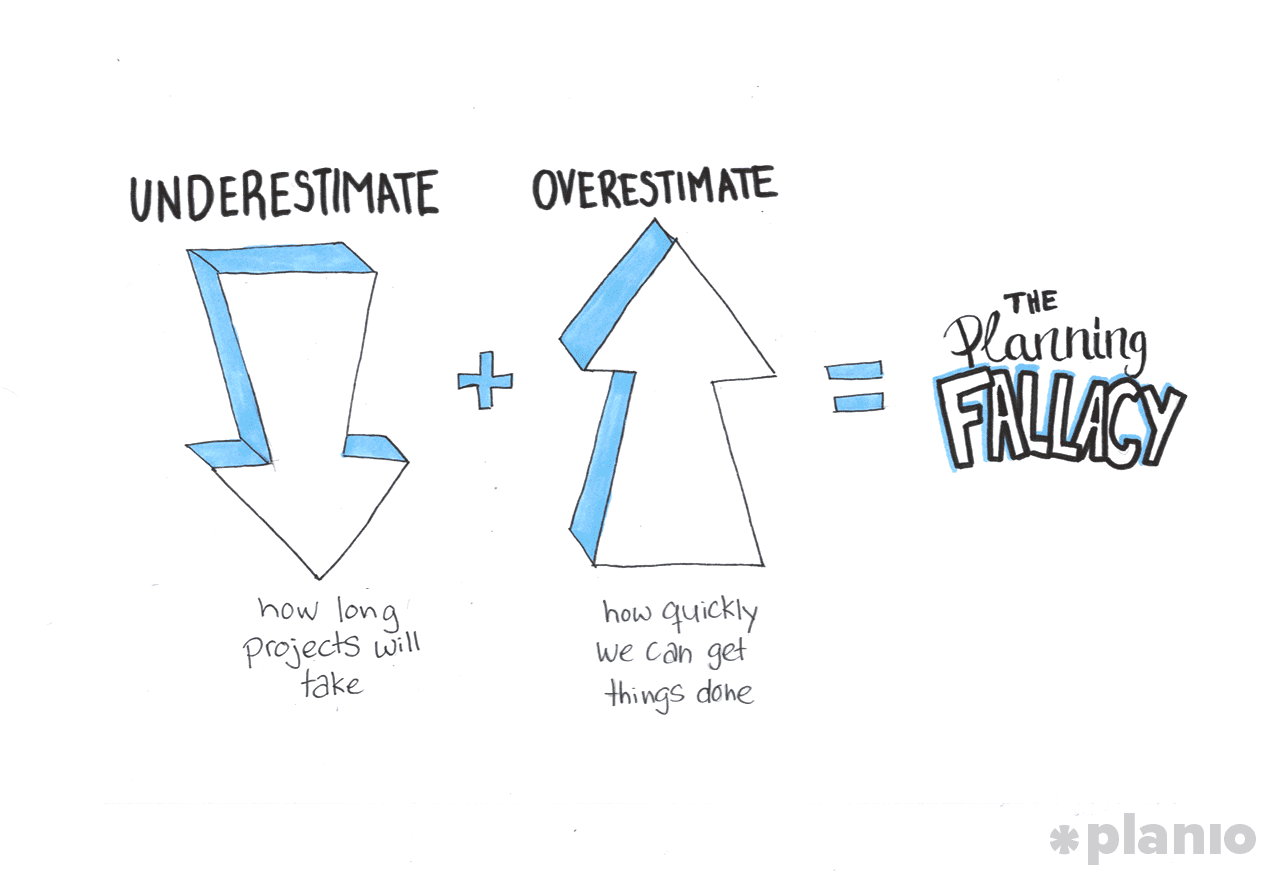
In fact, the planning fallacy is only part of a bigger picture: the massive illusion called “optimism bias.” Also known as “unrealistic optimism,” it’s the tendency to believe, “I will be luckier than others.” Smokers think they are less likely than other smokers to get lung cancer; investors believe their stock will escape a market crash. Statistically, not everyone can be above average — it’s a clear systemic error.
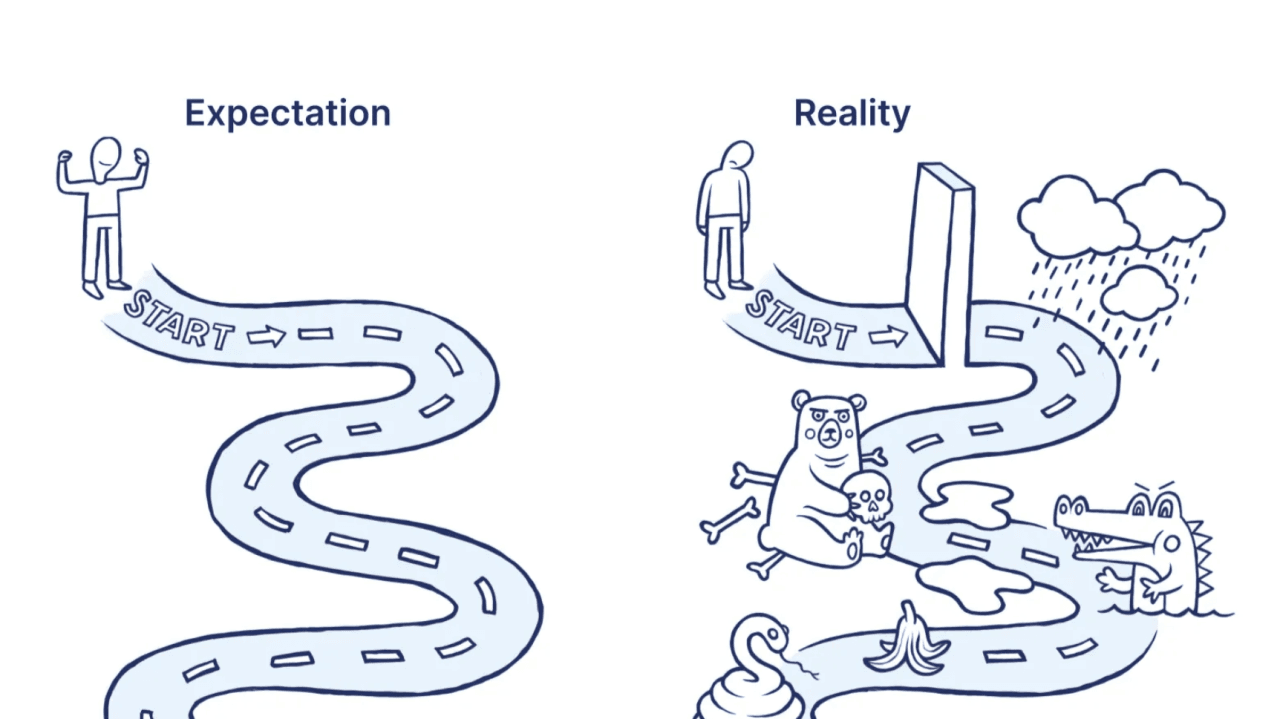
Of course, human history has advanced on the fuel of optimism. Explorers heading for unknown continents, scientists challenging seemingly impossible technologies, entrepreneurs risking bankruptcy — without optimism they might never have taken the first step. Optimism clearly gives us hope and is a powerful engine that propels us toward a better future.
But from the perspective of the “smart mistakes” I discuss here, optimism untethered from reality is one of the most dangerous cognitive traps. It becomes not mere hope but a mirage that distorts reality. It can ruin individual lives, sink massive organizations, and sometimes cause terrible tragedies.
In this chapter I’ll probe the dark shadow behind optimism’s bright light. How can one of humanity’s greatest virtues produce some of the worst disasters? How can we harness optimism’s power without falling into its deadly illusions?
The journey to that answer begins against the cold, silent backdrop of space.
1. The Harms of Excessive Optimism: The Tragedy of the Challenger
On January 28, 1986, it was unusually cold one morning at Kennedy Space Center in Florida. The space shuttle Challenger emitted white vapor on the launch pad, and the whole country watched in hushed anticipation as the historic flight of the first civilian astronaut, teacher Christa McAuliffe, was about to begin.

But beneath that excitement and expectation lurked a fatal danger. The problem lay in the design of the large solid rocket boosters (SRBs) attached to both sides of Challenger. At the joints where several cylindrical segments were connected, there were rubber sealing components called O-rings, two at each joint. The O-rings’ role was simple but critical: to tightly seal so that the thousands-of-degrees hot gases inside the rocket could not leak out.
The issue was that these rubber O-rings were extremely vulnerable to low temperatures. When temperatures drop, O-rings lose elasticity and harden. They need to withstand the enormous pressure at ignition and seal the gaps perfectly, but their ability to do so deteriorates greatly in the cold. And, unfortunately, that morning at Kennedy the temperature was close to freezing.
Here’s the truly frightening part: this was not an unforeseeable “surprise” event. The O-rings’ sensitivity to temperature had been known to NASA and to the booster manufacturer Morton Thiokol engineers for years. Erosion of the O-rings by hot gases had been observed in previous flights. In July 1985, when secondary O-ring erosion was discovered, NASA issued an official “launch constraint.”
Yet launches continued. Why? As flights accumulated, minor O-ring damage began to be viewed as an “acceptable risk.” Successful missions that didn’t end in disaster were recast as evidence that the O-ring problem wasn’t serious — reinforcing an optimistic belief instead of warning.
The night before the launch an urgent teleconference was held between NASA and Morton Thiokol. Morton engineer Roger Boisjoly presented clear data: the forecast temperature at the scheduled launch time was in the low 30s Fahrenheit (around 0°C), well below the lowest temperature in past data where O-ring performance had been assured (about 11.7°C). The engineering team’s conclusion was firm and unanimous. “Do not launch.”
But the NASA managers’ response was cold. George Hardy of Marshall Space Flight Center said he was “appalled” by Thiokol’s no-launch recommendation. The atmosphere of the meeting quickly flipped. The focus shifted from “Is launching safe?” to “Prove why we should not launch.” Roles were completely reversed.
This was a decisive moment where optimism paralyzed reason. NASA managers’ optimism was not based on data or engineering analysis. It was a vague belief that “it has been okay so far, so it will be okay now,” combined with organizational pressure to meet the launch schedule and a collective hubris born of many successful missions. Ultimately, Thiokol management buckled under NASA’s pressure and overruled their engineers, signing the launch approval.
The next morning Challenger was engulfed in a massive fireball 73 seconds after liftoff. Seven astronauts lost their lives.
Richard Feynman, Nobel laureate and a member of the accident investigation commission, demonstrated the tragedy’s essence in a simple, shocking demonstration at the hearings. He dunked a piece of O-ring material into ice water and showed how it lost elasticity and failed to return to its original shape in front of everyone. Behind the complex engineering debates lay the cold, unforgiving reality of basic physics that had been ignored.
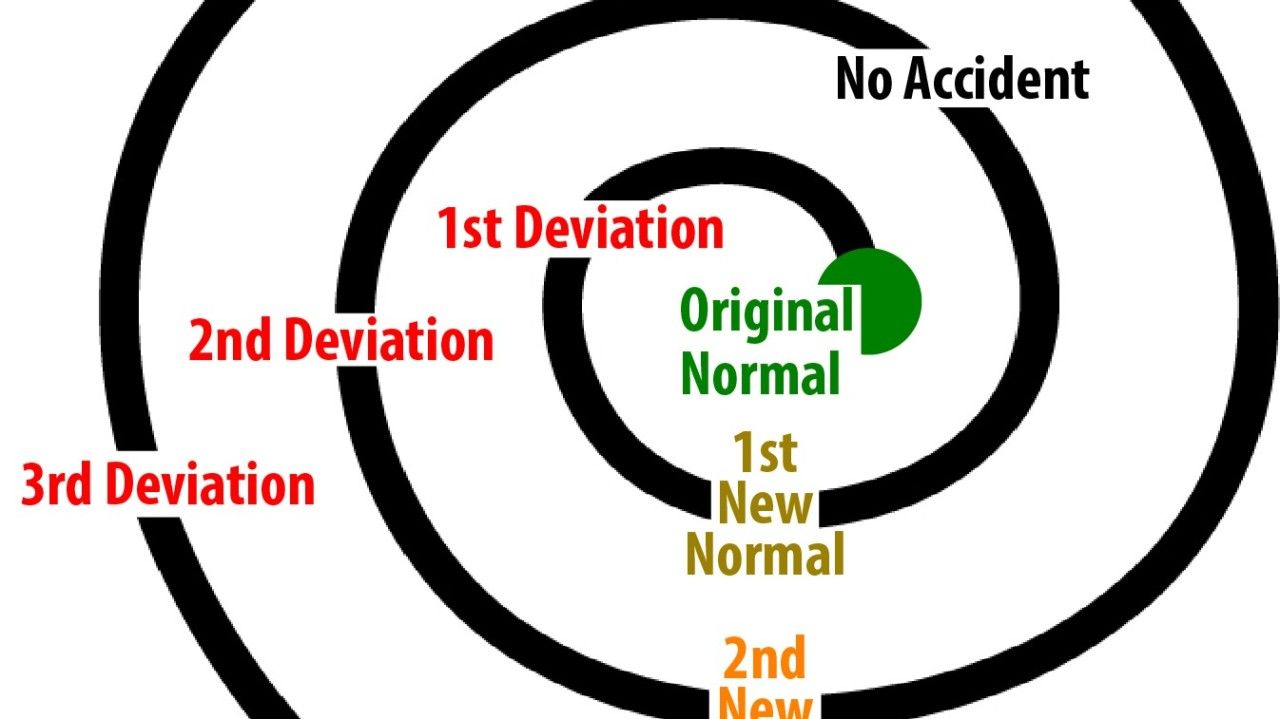
The Challenger tragedy was not merely a technical defect. It was the inevitable result of the process of tolerating and rationalizing small problems until the threshold of acceptable risk eroded — the phenomenon known as ‘Normalization of Deviance.’ Early optimistic thinking like “this level of erosion is acceptable” became institutionalized through repeated quasi-successes, and clear warnings were reinterpreted as evidence of the system’s robustness rather than danger.
Ultimately, the Challenger disaster was not a sudden accident but the apex of failures built up by optimism intoxicated by success. It stands as the painful lesson of how optimism can blind an entire organization, cause it to ignore clear warnings, and lead to irreversible tragedy.
2. Escaping Past Glory: The Icarus Paradox

Success is sweet. But its shadow is long and dark. For companies that once dominated a market and set industry standards, past success can be both an asset and a heavy shackle. The very strengths that led a company to the top can become fatal weaknesses in a changing environment. This phenomenon is the “Icarus Paradox.” Just as Icarus’ wings melted when he flew too close to the sun, success-inebriated companies lose the ability to face reality and fly blindly toward the sun of past glory until they fall.
At the center of such collapse is always a dangerous optimism: the belief that past success formulas will remain valid forever.
Kodak: Sunk by the Future It Invented
The history of 20th-century photography is almost synonymous with Kodak. Film, cameras, photographic paper — this giant seemed to dominate everything related to photography.

One of history’s greatest ironies is that the seed of the digital revolution that sank Kodak was planted by Kodak itself. In 1975, Kodak engineer Steve Sasson invented the world’s first digital camera. This 3.6 kg device, looking like a giant toaster, took 23 seconds to record a black-and-white image onto a cassette tape, but it was undoubtedly the “future.”

But Kodak’s executives failed to recognize that future. They treated Sasson’s invention as a “cute toy,” not understanding its disruptive potential. Their eyes were fixed not on the future but on the massive profits the film business provided.
Management’s optimism was not about photographic technology’s future but a blind faith in the permanence of the film business. They feared digital technology would cannibalize their film sales, so instead of leading the innovation they focused on protecting existing markets. They optimistically believed they could control the pace of digital transition and deliberately delayed the commercialization of digital cameras to minimize the impact on film sales.
Kodak’s fatal mistake was underestimating the speed of digital technology’s evolution. While they clung to their glorious past in film, competitors like Sony and Canon quickly adapted to digital innovation and took market share. When Kodak finally entered the digital camera market in earnest, the landscape had already been decided. The company that once epitomized photography paid dearly for ignoring changing customer needs and eventually filed for bankruptcy protection in 2012, swept away by the very future it had helped invent.
Nokia: The Cost of a Giant’s Arrogance
What about Nokia? From the late 1990s to the mid-2000s, Nokia was undisputed king of the mobile phone market. With robust hardware, innovative design, and massive R&D investment, Nokia dominated globally. Their position seemed invincible.
Then in January 2007, Steve Jobs unveiled the iPhone.

Nokia’s reaction was closer to ridicule than caution. According to a former Nokia consultant, Nokia’s management dismissed the iPhone as a kind of “joke.” They rooted this judgment in past success. Nokia had released a touchscreen phone in 2005 that had failed, so they hastily concluded that “consumers don’t want touchscreens.” They mocked the iPhone’s usability: “Why make a phone that’s hard to operate with one hand?”
Nokia’s optimism sprung from a rigid faith in a hardware-centric formula for success. They believed a phone’s essence lay in call quality and durability, with internet services simply as add-ons.
They completely failed to grasp the paradigm shift the iPhone introduced: an ecosystem centered on software and the App Store. To Nokia’s eyes, the iPhone was expensive, had poor battery life, and was fragile — an “unattractive product.” That arrogance, coupled with bureaucratic inertia in a giant organization, caused an atherosclerosis of innovation. Clear market signals of a seismic shift were filtered out internally, and managers intoxicated by past success ignored them. Nokia collapsed helplessly in the new battlefield of smartphones and, once a titan, quietly faded into history.
The cases of Kodak and Nokia clearly show how success breeds dangerous optimism. Their optimism wasn’t a vague faith in the future — it was a narrow belief ‘anchored’ in their past success models. Kodak optimistically believed in the “future of film,” not the future of imaging; Nokia optimistically believed in “their hardware,” not the future of mobile communication.
Success does more than foster complacency; it activates cognitive defense mechanisms to preserve past glory. Leaders view any information that contradicts their success mythology as a threat and close their eyes and ears to the waves of change, committing fatal mistakes.
3. The People Who Encourage Optimistic Thinking
So far we’ve seen how optimism operates dangerously within individual cognition and organizational culture. But this dangerous optimism isn’t just an inner illusion or an internal problem — it’s also a powerful external pressure constantly demanded and enforced by society, culture, and our closest relationships.
The Tyranny of ‘Good Vibes Only’: Toxic Positivity
When someone is going through something hard, we want to offer comfort. “Think positively,” “It will be okay,” “There are worse things — hang in there.” Most of these remarks come from good intentions. But few people realize that such superficial consolation can actually cause deep harm.

Forcing someone to maintain a positive attitude while dismissing the seriousness of their situation or the depth of their pain is called “toxic positivity.” Toxic positivity regards negative emotions like sadness, anger, anxiety, and disappointment as signs of failure or weakness to be suppressed or ignored. This denies the natural and necessary spectrum of human emotions.
Toxic positivity does serious damage to relationships. If one partner honestly opens up about pain or anxiety and the other responds, “Just think positively,” dismissing that emotion, the person in pain feels ignored and rejected. Repeated experiences lead them to judge that revealing vulnerability is unsafe, and they shut down. This creates a vicious cycle of shame and silence that erodes trust and emotional intimacy. In severe cases, it can function as emotional abuse — akin to a form of gaslighting that causes the person to doubt their own emotions and perception of reality.
The Grand Illusion of the Self-Help Industry
The pressure to be positive extends beyond personal relationships into society at large. The modern self-help industry and so-called “success science” constantly spread the message that a positive mindset is the sole or primary key to success. From mystic beliefs that “if you truly want it, the universe will help you” to simplistic causal claims that failures are solely the result of negative thinking, this massive industry rests on one premise: If you want to change your reality, change your thoughts.
On the surface this narrative appears to give individuals limitless possibility and control. But beneath it lies a dangerous logic that shifts all responsibility for failure onto the individual. If you are struggling financially or failing at work, it’s not due to social structures or economic systems — it’s because you didn’t think positively enough or didn’t try hard enough.
This narrative diverts attention away from macro issues like precarious labor markets and growing inequality. Instead of questioning the system, individuals are driven into endless self-improvement and positive-thinking training, searching for the problem within themselves.
Seen this way, the social pressure to be positive is not merely a cultural trend. It functions as a powerful ideological tool to preserve the status quo — a kind of social control. ‘Dangerous optimism’ is not only an individual cognitive error; it’s an invisible force shaping how we perceive and interact with the world. The sweet whisper that changing your inner world is all you need can be the most cunning trap that keeps us from changing the external realities that truly need change.
4. When Positive Thinking Goes Too Far: The Consequences
Ultimately, all of this stems from a fundamental cognitive error that ripples into all areas of life.
From the NASA managers who pressed the Challenger launch button, to Kodak executives who ignored the digital camera, to the friend who silences a suffering friend with “cheer up!”, to the ordinary person who keeps postponing retirement planning — there’s a shared mistake. They overestimate the likelihood of positive outcomes and underestimate the chance of negative ones. Whatever the scale or shape of the disaster, the seed is the same optimism.
The consequences of this dangerous optimism surface across our lives.

- Health and safety risks: The belief “Bad things won’t happen to me.” This primal form of optimism causes people to systematically underestimate personal risks. Thinking “I’ll be fine” leads to delaying vaccinations, not buckling seat belts, and neglecting health checkups.
- Financial ruin: In the financial markets, this optimism fuels speculative bubbles and ruins individual investors. Even if investors rationally know markets can fall, they implicitly believe “that bad thing won’t happen to me.” Overconfidence in their investment judgment and ignoring basic principles like diversification leave them helpless when an unexpected market collapse occurs.
- Project and career failures: The “planning fallacy” mentioned at the start is the most common side effect. Individually it means missed deadlines and stress; organizationally it can mean catastrophe. The Sydney Opera House is a monumental example: planned for 4 years and $7 million, it took 14 years and nearly $102 million — almost 15 times the original budget — to complete. This is the cost of optimistic planning.
- Erosion of trust: Toxic positivity in relationships may not cause dramatic visible catastrophes, but it slowly and surely destroys the foundation of trust and intimacy. Preferring superficial positivity over empathy sends the message that “your true emotions are unwelcome.”
The consequences of excessive optimism affect everything from individual health to huge projects and the depth of human relationships. The root cause is the same: refusing to face reality as it is, clinging to hopeful scenarios, and willfully ignoring potential risks and obstacles.
Optimism propels us forward, but when that force ignores the gravity of reality, we inevitably fall.
5. For the Overly Positive: 3 Realistic Strategies
So how should we handle this powerful yet dangerous tool called optimism?
The goal is not to eliminate optimism. That’s neither possible nor desirable. The real task is to transform blind optimism into “smart optimism” grounded in reality. That means keeping hope without ignoring worst-case possibilities; pursuing positive visions while coldly analyzing obstacles. Fortunately, there are concrete strategies we can use.
Strategy 1: Use productive anxiety with defensive pessimism
At first glance, “pessimism” seems like a negative mindset to avoid. But not all pessimism is harmful. Some people harness pessimistic predictions as a powerful driver of success; this is called “defensive pessimism.”
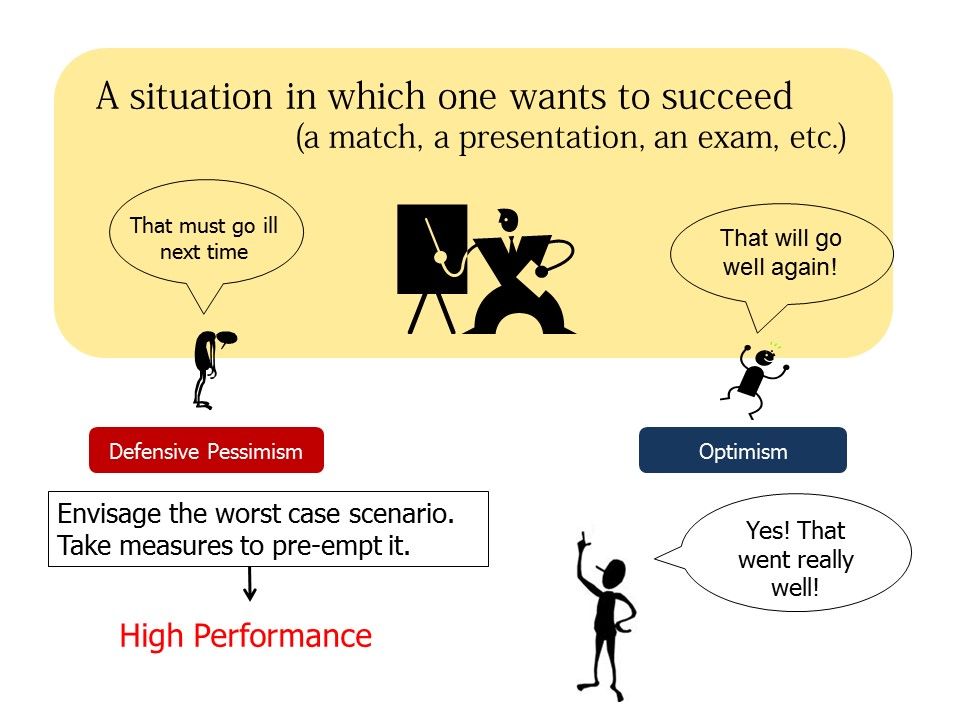
Importantly, this is a cognitive strategy, not a personality type. People who use it intentionally lower their expectations before an important task, then vividly imagine all the worst-case scenarios that could occur.
“What if the projector fails during my presentation?”
“What if the interviewer asks something I didn’t prepare for?”
“What if a key data point is wrong?”
Those imaginings don’t lead them into helplessness; instead, anxiety becomes a catalyst to act. They start planning countermeasures for each potential problem. They back up presentation files in multiple places, prepare answers to likely questions, and recheck data multiple times.
For them, anxiety is not a paralyzing toxin but an energy to be controlled through thorough preparation. As a result, defensive pessimists often outperform optimists who assume everything will be fine. The paradox: blind positivity breeds complacency, while controlled pessimism breeds excellence.
Strategy 2: Conduct a pre-mortem to experience failure ahead of time
When a new project starts in organizations, it’s common to cultivate a positive mood by sharing high expectations for success. In that climate, pointing out potential problems can feel like a morale killer. To break groupthink and positivity pressure, psychologist Gary Klein invented a powerful technique called the “pre-mortem.”
The procedure is simple but highly effective.
- Failure assumption: After the project plan is finalized, the leader assembles the team and declares, “Looking into the crystal ball, one year from now this project has failed spectacularly and completely.”
- Cause analysis: Each team member quietly writes down as many and as specific reasons for that hypothetical failure as they can think of. They imagine, “Why did it fail?”
- Share and revise the plan: Team members take turns presenting the failure causes they wrote down (no criticism or rebuttal allowed!). After collecting all inputs, the team reviews the list, identifies real threat factors, and revises the plan by adding safeguards.
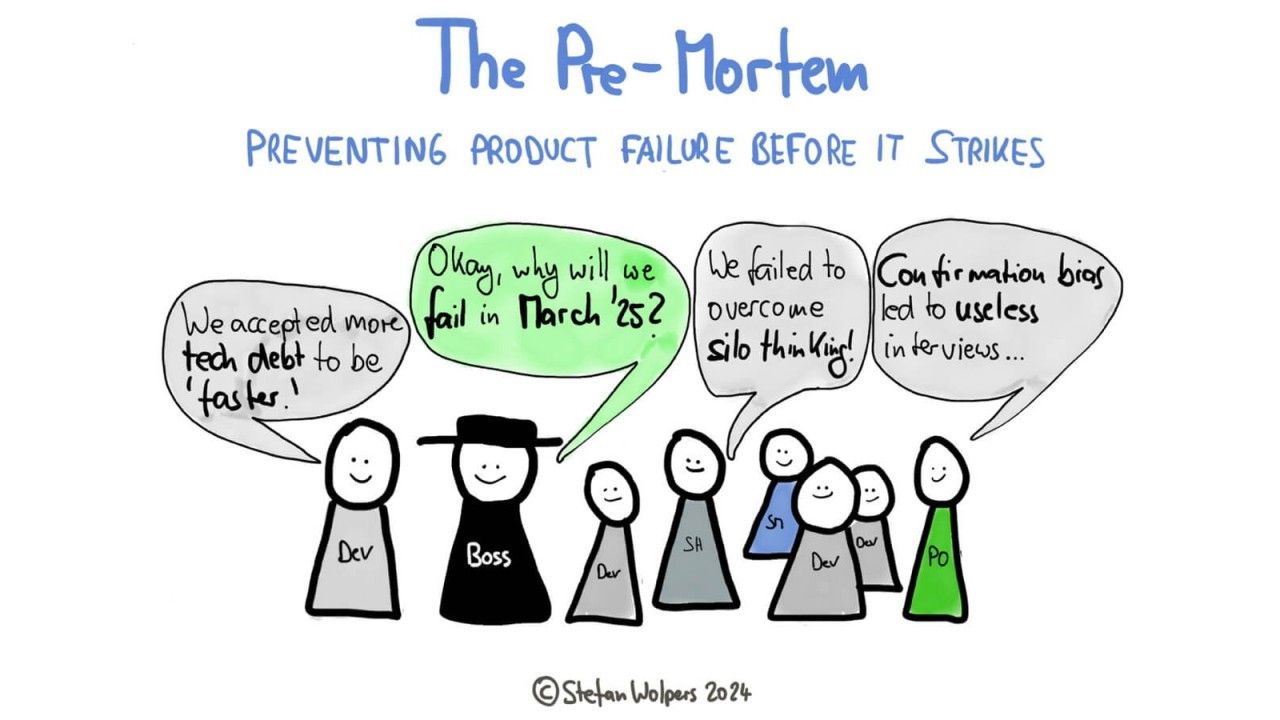
This technique leverages the power of “prospective hindsight” rather than retrospective hindsight. Research shows that imagining an event as already having occurred improves people’s ability to identify causes by about 30%. The pre-mortem gives team members psychological safety to surface potential risks hidden behind the curtain of blind optimism.
Experiencing failure before a project even starts and learning from it is the smartest way to prevent real failure. Isn’t that brilliant?
The ultimate aim: embody realistic optimism (the Stockdale Paradox)
The most refined and resilient mindset is neither blind optimism nor defensive pessimism, but a blend of both: “realistic optimism.”
This concept is best illustrated by the “Stockdale Paradox,” named after U.S. Navy Admiral Jim Stockdale, who survived seven and a half years as a prisoner of war in Vietnam.
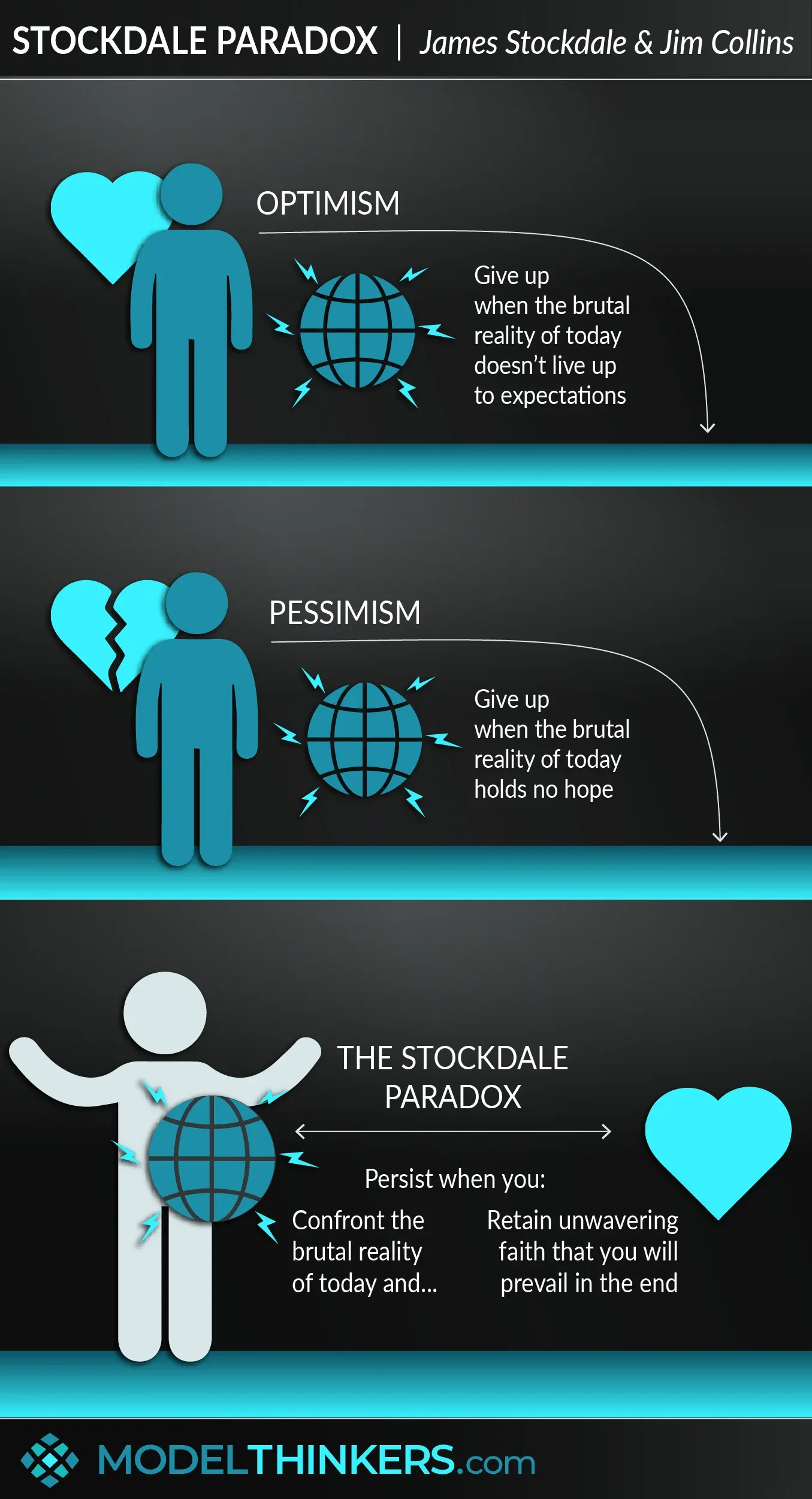
Stockdale described the people who didn’t survive as “the blind optimists.”
They believed, “I’ll be out by this Christmas,” and when that didn’t happen they hoped, “I’ll be out by Easter.” When their hopes were repeatedly dashed, they lost heart and died.
Those who survived, Stockdale included, adopted a different attitude. They held two seemingly contradictory beliefs simultaneously:
- Unwavering faith in the outcome: They never abandoned the absolute belief that they would ultimately prevail and survive.
- Brutal acceptance of reality: At the same time, they faced the harsh, brutal reality of their situation with no illusions.
This is the ultimate antidote to dangerous optimism.
Realistic optimism is not the vague hope that “everything will work out.” It’s the conviction that “I will ultimately win,” while accepting that the path will be far more brutal than imagined. It’s a rigorous mental training to find the optimal balance between hope and reality, faith and analysis.
To face the darkness before you and still keep faith in the light at the end of the tunnel — isn’t that the real secret of resilient achievers?
The following table clearly shows the differences among the three main mindsets discussed in this chapter.
| Feature | Dangerous Optimism | Defensive Pessimism | Realistic Optimism |
|---|---|---|---|
| Approach to new goals | “Everything will go perfectly. No problem!” | “What’s the worst-case scenario? Let’s think of everything that could go wrong.” | “I believe the goal can be achieved. Now let’s analyze and prepare for the biggest obstacles.” |
| Reaction to setbacks | Shock, disappointment, denial. “This can’t be happening…” | “I expected this. Fortunately I had countermeasures ready.” | “This is one of the expected difficulties. Acknowledge it and learn: how should we revise the plan?” |
| Underlying belief | “Bad things won’t happen to me.” | “Bad things can happen, so prepare thoroughly to prevent them.” | “I believe I will ultimately succeed, but the path will be harsh.” |
| Outcome | Preventable failures, wasted resources, broken trust | Thorough preparation driven by anxiety and high performance | Resilience after adversity and long-term success |