
The World’s Narrowest Bottleneck
Fifty-four kilometers wide.
The tankers passing daily through this waterway leading from the Persian Gulf to the Arabian Sea carry roughly 20 percent of the world’s seaborne petroleum trade.
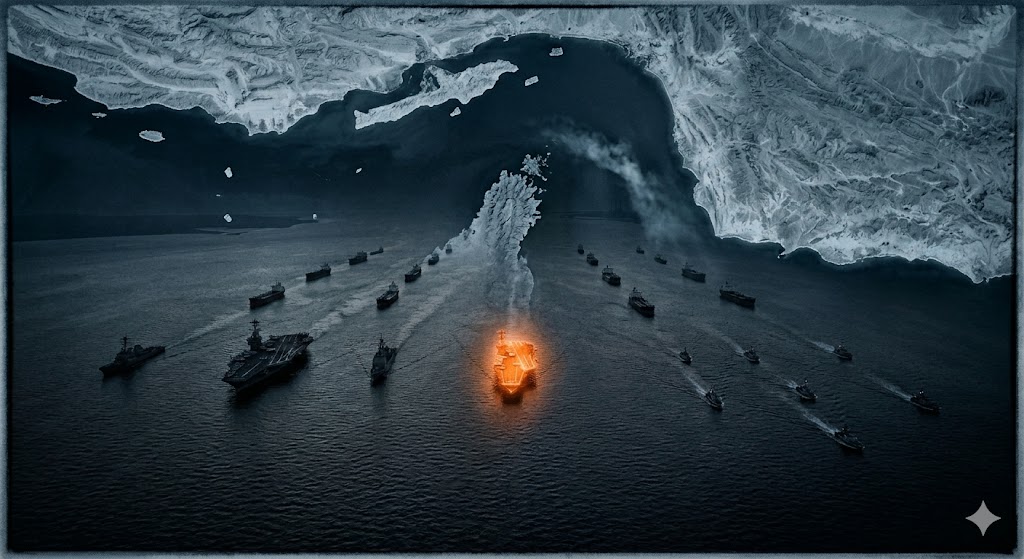
On the morning of February 28, 2026, as the United States and Iran plunged into full-scale conflict and the Islamic Revolutionary Guard Corps blockaded the Strait of Hormuz,
the global economy felt firsthand just how heavy those 54 kilometers really were.
The war had been foretold. Structurally, at least.
In June 2025, U.S. strikes on Iranian nuclear facilities conducted in coordination with Israel ended without formal all-out war in what came to be known as the “Twelve-Day War.”
Yet the negotiations held over the ensuing nine months in Muscat, Oman, ultimately failed to bridge the chasm between “zero enrichment” and “infringement on sovereignty.”
From the moment U.S. President Donald Trump sent a personal letter to Ayatollah Khamenei in March 2025 setting a 60-day ultimatum, the clock was already ticking toward a different fate.
And at 9:45 AM on February 28, 2026, “Operation Epic Fury” commenced.
Part 1. Anatomy of the War: 12 Days and 4 Months
A Foretold Collision
Throughout 2025, Iran faced compounding pressures of internal collapse.
Large-scale anti-government protests sparked by economic ruin spread nationwide toward year-end, while the U.S. officially backed the protesters and hinted at potential military intervention.
Iranian hardliners responded not with negotiation, but by asserting regional presence. Operations by the Houthis and Hezbollah escalated simultaneously.
The immediate trigger for the breakdown of talks was technical.
The International Atomic Energy Agency (IAEA) detected evidence of highly enriched uranium concealed in an undeclared underground Iranian facility.
When the U.S. demanded “zero enrichment,” Iran denounced it as an infringement on its sovereignty and walked out of negotiations. The logic of strikes and counterstrikes had passed entirely into the hands of internal hardliners.
Top-level intelligence provided to the U.S. by Israeli Prime Minister Benjamin Netanyahu accelerated the timeline.
On February 28, 2026, the United States launched surprise airstrikes.
Airstrikes and the Crisis of Regime Collapse
Through “Operation Epic Fury,” a significant portion of Iran’s political and military leadership was eliminated, including Supreme Leader Ali Khamenei and key nuclear negotiator Ali Larijani.
Faced with imminent regime collapse, Iran immediately elevated Khamenei’s son, Mojtaba Khamenei, as the successor Supreme Leader.
The counteroffensive was comprehensive.
Iran immediately blockaded the Strait of Hormuz.
Simultaneously, ballistic missiles and suicide drones were launched toward 17 U.S. military bases across the Middle East, the U.S. Fifth Fleet headquarters in Bahrain, and Israeli territory.
As Hezbollah struck northern Israel, Israel responded by bombarding Beirut, Lebanon.
It was the largest full-scale conflict in the Middle East since the 2003 invasion of Iraq.
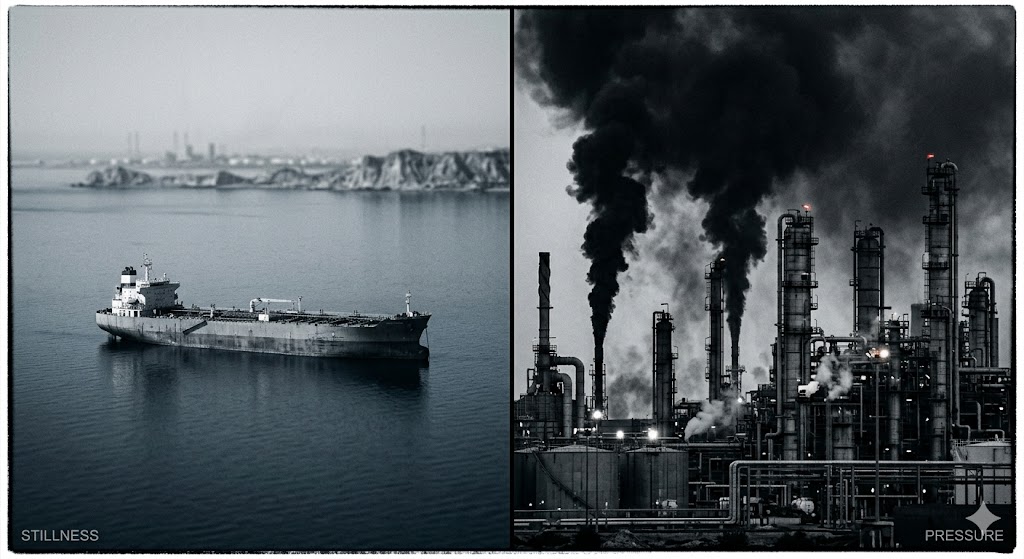
The asymmetry of casualties and damage was stark.
Fifteen U.S. service members were killed and approximately 200 wounded.
Israel suffered 2 military and 17 civilian deaths, along with a total of 2,989 injured.
In Iran, airstrikes killed 4,000\~5,000 military personnel, destroyed more than 190 ballistic missile launchers, and sank or crippled 90 naval vessels.
Civilian casualties ranged between 390 and 1,298 depending on the monitoring organization. In Lebanon, 687 people lost their lives.
The scale of military losses was far heavier for Iran. Yet Iran held the weapon of economic retaliation.
A Divided International Community
The international response fractured sharply.
Citing violations of territorial sovereignty, Russia and China fiercely condemned the U.S. and Israel as perpetrators of war crimes and abstained from UN Security Council resolutions.
British Prime Minister Keir Starmer made clear his opposition to regime change by force, yet scrambled the RAF for defensive operations after British bases in Cyprus and Bahrain were targeted in Iranian retaliations.
The true significance of this divide was not military.
A direct challenge to the U.S.-led security order was explicitly voiced on the official stage of the UN Security Council for the first time.
It was a declaration that they would not endorse “America’s war.”
Part 2. When Hormuz Closed: The Economic Anatomy of War
The Price of 54 Kilometers
The closure of the Strait of Hormuz sent global crude oil prices surging in a matter of days.
The shockwaves propagated through precise channels.
**First channel: **Transportation. Public transit costs rose 17 percent, while airfares and logistics expenses surged in tandem. It was akin to a tax levied directly on everyday mobility.
Second channel: Food. Natural gas is the primary feedstock for nitrogen fertilizer. When energy prices skyrocket, the production cost of energy-intensive fertilizers spikes immediately. Right after the outbreak of war, nitrogen fertilizer prices jumped by over 30 percent. With a time lag, global grocery prices followed suit.
Third channel: Manufacturing. Petroleum is raw material. Plastics, synthetic fibers, pharmaceutical ingredients, paints, adhesives—most foundational materials of modern manufacturing originate from petroleum. The oil shock pushed up the prices of finished goods across the board.
The figures estimated by the U.S. Congressional Joint Economic Committee were stark.
As the Trump administration’s tariff policies compounded the supply shocks of the Iran war, individual U.S. households faced an average additional spending burden of over $3,100 per household from 2025 through May 2026. *$3,100—nearly half the monthly income of a median American household.*
Reigniting Inflation Across the G20
Looking back at pre-war forecasts, the average inflation rate across the G20 was converging toward 2.8 percent.
Central banks were finally concluding their 2022\~2024 tightening cycle and preparing for monetary easing.
The blockade of Hormuz turned back the clock.
The average G20 inflation rate surged to 4.0 percent.
The IMF officially warned of a scenario where prolonged high oil prices could drag global growth down to the 2 percent range while driving inflation above 6.0 percent.
The underlying terror was not mere inflation—it was the return of stagflation, where growth stalls while prices soar.
Financial markets experienced a simultaneous super-strong dollar and falling asset values.
A flight to safety battered emerging market currencies, triggering a cascading risk of capital flight.
Part 3. The Price Paid by South Korea
The Figure of 70 Percent
A look into South Korea’s crude oil import structure reveals the contours of its vulnerability.
Over 70 percent reliance on Middle Eastern crude oil. In peacetime, this figure had been hailed for decades as a “stable supply route.”
Once the Strait of Hormuz closed, it turned into clear evidence of structural vulnerability.
In the early stages of the war, seven South Korean-flagged vessels carrying roughly 14 million barrels of crude—equivalent to the entire daily consumption of South Korean households—were detained or stranded due to passage restrictions in the strait. A red alert was triggered across refinery and manufacturing utilization rates.
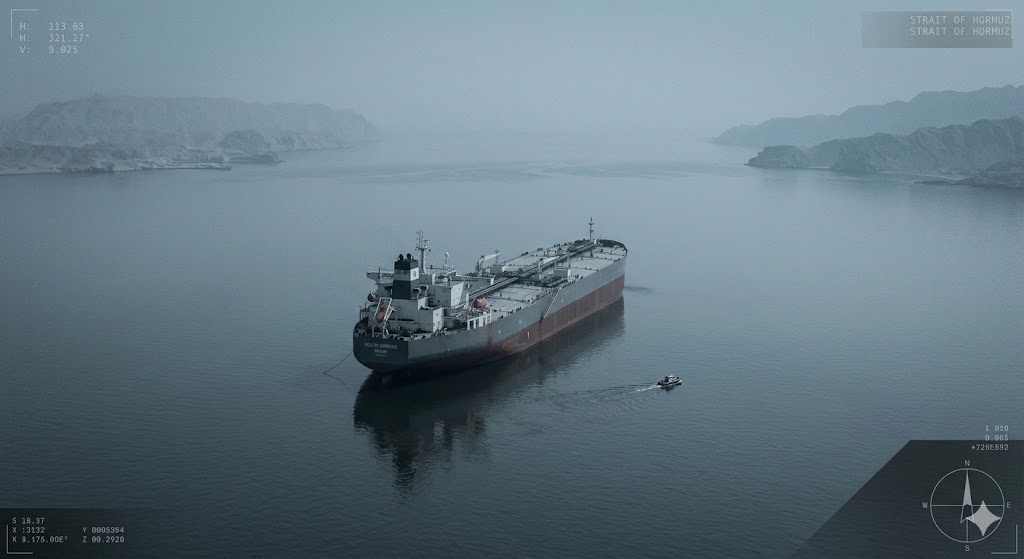
Worsening trade balances due to elevated oil prices and a tumbling Korean won driven by dollar preference pushed import inflation pressures to the extreme.
Warnings emerged of stagflation risks where sustained high oil prices could shave an additional 0.8 percentage points off South Korea’s economic growth rate while propelling inflation up by 2.9 percentage points.
Translating those numbers reveals their true weight.
Assuming the South Korean economy operates at an estimated growth rate of around 1.8 percent as of 2025, a 0.8 percentage point drop pulls growth effectively down to the low 1 percent range.
With demographic deterioration and sluggish domestic demand already well underway, this represents far more than a statistical metric. It is a figure directly tied to jobs and household livelihoods.
The Double Squeeze on the Petrochemical Industry
The shock sustained by South Korea’s petrochemical industry went far beyond simple cost increases.
Even before the war, the sector had already been languishing under structural downturn pressures.
China had been aggressively expanding massive new production facilities to undercut unit prices, progressively eroding the cost competitiveness of South Korean producers.
The restructuring clock was ticking, albeit at a measured pace.
The Hormuz blockade forcibly accelerated that timeline.
Confronted with the dual blow of skyrocketing raw material costs, companies were pushed to the brink, drastically pulling forward their restructuring schedules.
*What was once “restructuring to be done someday” turned into “a survival strategy that must be executed right now.”
This is the real mechanism through which energy supply shocks ripple across the broader economy.
Beyond the mere fact that oil prices climb, the greater destructive power lies in snapping links that were already fragile.
Part 4. The Islamabad Agreement: An Incomplete Period
Trump’s 80th Birthday Gift
June 14, 2026, 5:29 PM.
The statement released by President Donald Trump via Truth Social on his 80th birthday was brief:
“A deal with the Islamic Republic of Iran has been finalized.”
The delivery format itself was a telling signal. Not a formal State Department declaration, nor a joint press conference with the Secretary of State, but a personal social media account.
Trump framed this not as a diplomatic milestone, but as a personal triumph.
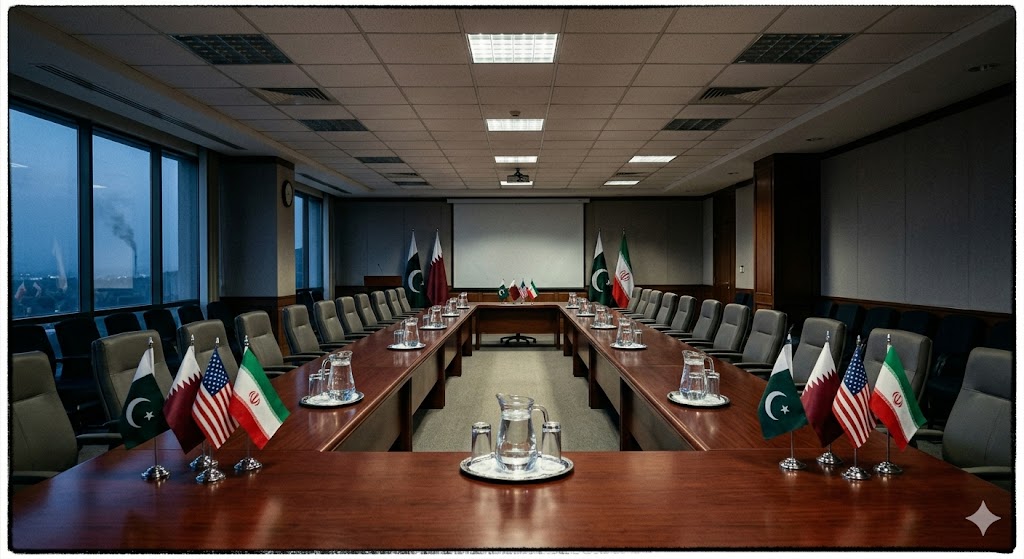
Brokered through the mediation of Pakistan and Qatar, the deal came to be known as the “Islamabad Agreement,” named after the capital of the mediating host nation.
The official peace agreement signing ceremony is scheduled to take place on June 19, 2026, in Geneva, Switzerland.
The U.S. deployed four C-17 heavy transport aircraft to Geneva to coordinate the delegation headed by Vice President JD Vance.
Representing the Iranian side are Parliamentary Speaker Mohammad Bagher Ghalibaf and Foreign Minister Abbas Araghchi, both authorized to sign on behalf of Supreme Leader Mojtaba Khamenei.
The fact that Khamenei himself does not stand before the signing table reveals Iran’s negotiating posture—“Iran’s Supreme Leader has not capitulated to this agreement.”
Anatomy of the Accord: Landmines Hidden Within 14 Clauses
On the surface, the Islamabad Agreement appears pristine.
Gunfire ceases along the front lines, the strait reopens, and discussions on dismantling the nuclear program resume.
Yet placing the detailed text alongside what was left unagreed paints an entirely different picture.
Military Ceasefire: The U.S. demanded an unconditional, immediate ceasefire and a permanent end to Iranian drone and missile strikes.
The accord included an immediate and permanent cessation across all fronts. On the surface, an absolute U.S. victory.
However, while the phrasing encompassing all fronts “including Lebanese Hezbollah” appears to mandate Iranian control over its proxies, no concrete enforcement mechanism was specified.
Strait of Hormuz: The U.S. demanded complete freedom of navigation under international law. Iran agreed to reopen the strait on the condition of a complete lifting of the U.S. maritime blockade within 30 days.
Yet Iran firmly retained the principle that sovereignty over the strait belongs to Iran and Oman. What this means is that Iran preserves the legal pretext to close it again at any moment.
Nuclear Program: The initial U.S. demand was physical dismantlement. What made it into the text was merely a declarative agreement reaffirming NPT obligations.
Specific dismantlement methods were deferred to 60 days of technical negotiations following the signing. In other words, the substantive resolution of the nuclear issue lies completely outside this agreement.
Sanctions Relief: The U.S. insisted on phased waivers only after full verification of denuclearization.
Iran secured the upfront unfreezing of $12 billion prior to the start of final negotiations, alongside waivers on oil and petrochemical export sanctions. The money comes first.
Reconstruction Assistance: A proposal for at least $300 billion in economic reconstruction aid for Iran from the U.S. and Western allies—this was an Iranian demand.
It sits far apart from the official U.S. stance. The feasibility of this provision remains the most dubious within the entire agreement.
Summing up the structural essence of the accord in a single sentence: The United States succeeded in silencing the guns, while Iran succeeded in preserving its nuclear capability.
The Agreement’s Biggest Blindspot: Missiles and Proxies
Paradoxically, the most significant outcome of the draft Islamabad MOU lies in what was left out of the agreement altogether.
Iran’s ballistic missile program and its armed support for regional proxies (the Axis of Resistance) were entirely excluded from the formal negotiating agenda.
Iran demanded their omission, and the United States conceded.
Iran secured the narrative that its regime sovereignty remained unviolated.
The U.S. secured the political achievement of announcing an end to the war.
As a result, in the post-Islamabad Agreement Middle East,
Iran’s missile capabilities and its architecture for arming the Houthis and Hezbollah persist in a legal status identical to before the war.
Part 5. The World Ahead: Two Scenarios
The war has not ended. The countdown to prepare for the war’s next phase has begun.
In the wake of the Islamabad Agreement, the global economy stands at a fork between two diverging trajectories.
Scenario A: Resolution of Geopolitical Risk and Entry into Disinflation
If the Geneva signing ceremony concludes smoothly and the 60-day technical negotiations yield a compromise where Iran chemically dilutes its highly enriched uranium domestically under continuous inspection by international bodies, global crude markets could stabilize rapidly.
With oil prices settling into the $70\~80 per barrel range, supply-chain inflationary pressures would subside.
G20 CPI growth would retreat below 3.0 percent, stabilizing food and logistics costs.
Confirming price stability, the U.S. Federal Reserve would find justification to shelve additional tightening measures, such as rate hikes, and pivot toward an accommodative monetary policy.
Lower borrowing costs would enable massive tech infrastructure investments—such as Alphabet’s $80 billion corporate bond issuance and Amazon’s debt financing for AI data centers—to proceed under stable interest rate conditions.
Technological innovation momentum would endure.
For the South Korean economy, a stabilized KRW/USD exchange rate would normalize import prices and foster a recovery in real household income.
GDP growth could rebound by 0.5 percentage points.
Breathing room would open up to initiate investments aimed at diversifying the national energy portfolio away from Middle Eastern crude reliance.
The prerequisites for this scenario require that hardliners in Iran permit the deal’s execution, Israel exercises unilateral military restraint, and the U.S. genuinely follows through on unfreezing the $12 billion in assets.
-> Even under optimistic assumptions, the probability of all three conditions being met scarcely exceeds 50 percent.
Scenario B: Failure to Implement and Resumption of Armed Conflict
The seeds of collapse are firmly planted beneath the surface of the Islamabad Agreement.
The first landmine is the nuclear technical talks.
The U.S. maintains an “action-for-benefits” stance, holding that no funds can be transferred until Iran physically and completely dismantles its nuclear facilities under full verification.
Iran’s Foreign Ministry is engaging in brinkmanship, warning it will not tolerate the processing of a single gram of uranium unless the $12 billion asset unfreeze and oil sanctions waivers specified in the MOU are actively implemented. If this impasse remains unresolved, the 60-day technical talks will collapse before they even begin.
The second landmine is the Hormuz transit fee.
Iran refuses to back down on its claim to levy independent “transit fees (service charges)” on commercial vessels navigating the strait.
This stands in direct violation of U.S. federal law and international navigation treaties.
Should the collection of transit fees actually begin, the U.S. would possess the legal justification to immediately reinstate its naval blockade.
The third, and most direct risk factor, is Israel.
Prime Minister Benjamin Netanyahu received zero advance notification or intelligence sharing until President Trump announced that an impending ceasefire agreement was at hand.
The sense of betrayal was voiced publicly.
Israel is resolving to reject outright any accord that lacks provisions dismantling Iran’s missile capabilities.
It is also fiercely pushing back against military withdrawals from Lebanese Hezbollah and occupied territories in Syria.
If the Israeli military resumes extensive preemptive airstrikes on Syria and the southern suburbs of Beirut, Lebanon,
Iranian hardliners and the Revolutionary Guard will declare the negotiations void and retaliate with all-out counterstrikes.
The economic consequences of this negative scenario are as follows:
Global crude oil prices exceeding $125\~130 per barrel (WTI basis) on a sustained basis. U.S. inflation expectations topping 4.8 percent. The Federal Reserve entirely abandoning rate cuts for the year, extending peak policy rates into early 2027. South Korea locked into chronic trade deficits and economic stagnation.
If oil prices remain entrenched in the $130 range, this ceases to be merely an energy price issue.
Stagflation—where growth collapses while inflation surges—becomes the global standard.
A super-dollar surge and capital flight would reemerge. -> In this scenario, the world would face its third major global economic shock, following the 2008 financial crisis and the 2022 energy crisis.
Part 6. What South Korea Must Prepare Now
One must not hastily dismantle emergency response postures out of misplaced optimism over the Islamabad Agreement.
This is not a generic warning from analysts. The very structural composition of the agreement forbids premature complacency.
A paradigm shift is required—one that treats geopolitical risk not as a transient event, but as a permanent structural variable.
That transformation must occur across three simultaneous pillars.
Redesigning the Supply Chain: From Just-In-Time to Just-In-Case
For decades, the core strength of South Korean manufacturing was efficiency.
Minimizing inventories, optimizing supply chains, and driving down unit costs—this was the logic of “Just-In-Time” supply chains. This methodology works only when supply remains stable.
When Hormuz closed, this logic was incapacitated. Operations ground to a halt precisely because there was no buffer stock.
A “Just-In-Case” supply chain adopts resilience, rather than cost efficiency, as its primary design principle.
To reduce the 70 percent reliance on Middle Eastern crude, asset portfolios must be diversified toward North American shale oil, the Norwegian North Sea, and African fields.
Policy financing support and preemptive budgeting for strategic emergency reserves must be established to mandate diversification of raw material procurement sources.
This incurs costs. Yet those costs are highly likely to be smaller than the toll paid by the South Korean economy between February and June 2026.
Financial Soundness: Setting a $100 Oil Scenario as the Baseline
The benchmark for corporate financial strategy must change.
Companies must regularly stress-test asset impairment levels and FX derivative hedging ratios under a scenario of oil prices entrenched at $100\~130.
Contingency credit lines must be secured to prevent short-term foreign exchange liquidity crunches from cascading into operational slowdowns in the real economy.
A “low oil price default” is not optimism; it is a blind spot.
Cybersecurity: The New Battlefield of Energy Infrastructure
Amid military confrontations in the Middle East, the frequency of state-sponsored cyberattacks targeting power grids and crude transport control systems is skyrocketing.
Integrated security monitoring must be intensified across national critical infrastructure enterprises—including refining, gas, and shipbuilding—alongside the establishment of real-time monitoring systems for alternative maritime logistics routes.
A hybrid strategy executing physical supply chain disruptions and cyber assaults simultaneously was already battle-tested in the 2026 war. In the next conflict, it will be even more sophisticated.
Epilogue: The Strait Has Reopened
On June 14, 2026, immediately following Trump’s declaration, the Strait of Hormuz reopened.
Tankers resumed transit. Global oil prices eased. Stock markets rallied. The world breathed a collective sigh of relief.
Yet during those few months when the waterway was shut, the world learned three harsh truths:
That 20 percent of the global energy supply chain is concentrated in a single channel just 54 kilometers wide;
That the nation controlling that passage wields direct influence over global prices and economic growth;
And that despite knowing this reality, the world had failed to prepare an alternative.
The Islamabad Agreement may have brought an end to the shooting. Yet this structural vulnerability is written nowhere in the accord.
When the strait closes the next time, will the world be caught off guard once again?
References
- U.S. Congressional Joint Economic Committee (JEC), “Report on the Economic Impact of Trump Tariffs and the Iran War on Households,” May 2026.
- Iranian Human Rights Organizations HRANA and Hengaw, “Compilation of Civilian Casualties in the 2026 U.S.-Iran War,” Mar.–May 2026.
- International Monetary Fund (IMF), “World Economic Outlook Update: Growth and Inflation Projections by Middle East Conflict Scenario,” Apr. 2026.
- International Atomic Energy Agency (IAEA), “Verification Report on Iranian Nuclear Activities: Evidence of Concealed Highly Enriched Uranium in Undeclared Facilities,” Nov. 2025.
- Truth Social, Original Post by President Donald Trump, Jun. 14, 2026.
- Ministry of Foreign Affairs of Pakistan, Official Statement: “Progress and Substance of the Islamabad Agreement Mediation,” Jun. 14, 2026.
- Ministry of Foreign Affairs of the Islamic Republic of Iran, Official Statement by Foreign Minister Abbas Araghchi, Jun. 14, 2026.
- Bank of Korea, “Analysis of the Macroeconomic Impact of Oil Price Surges on South Korea,” Mar. 2026.
- Ministry of Trade, Industry and Energy (MOTIE), “Contingency Plan in Response to Middle East Conflict Oil Supply Disruptions,” Mar. 2026.
- U.S. Energy Information Administration (EIA), “Strait of Hormuz Flow Volumes and Crude Oil Price Impacts Across Blockade Scenarios,” 2025.
- S&P Global Commodity Insights, “Hormuz Closure: Tanker Market Disruption Analysis,” Mar. 2026.
- International Energy Agency (IEA), “Responding to Energy Supply Shocks: Strategic Petroleum Reserve Releases and Assessment of Alternative Routes,” Mar. 2026.
- Bloomberg, “Iran Nuclear Talks: Full Text of Islamabad MOU Key Clauses,” Jun. 14, 2026.
- Reuters, “Netanyahu’s Reaction to US-Iran Ceasefire: Diplomatic Fallout Analysis,” Jun. 15, 2026.
- Korea National Oil Corporation (KNOC), “Report on Middle East Crude Dependency Status and Supply Chain Diversification Strategies,” Dec. 2025.
- UN Security Council Records, “Voting Results on Security Council Draft Resolutions Concerning Military Intervention in Iran,” Mar. 2026.
This article was prepared based on publicly available information and official statements as of June 2026. The implementation of the Islamabad Agreement and subsequent political and economic developments continue to evolve beyond the date of publication.