
Not many people know that the owner of the blue-sign convenience store found in every neighborhood was originally a company that did electrical work.
GS Retail started as Goldstar Electric in 1971 and later grew GS25. Although it has trailed CU in the number of stores since 2020, it has never relinquished the #1 spot in revenue, except for a single quarter in Q2 2025.
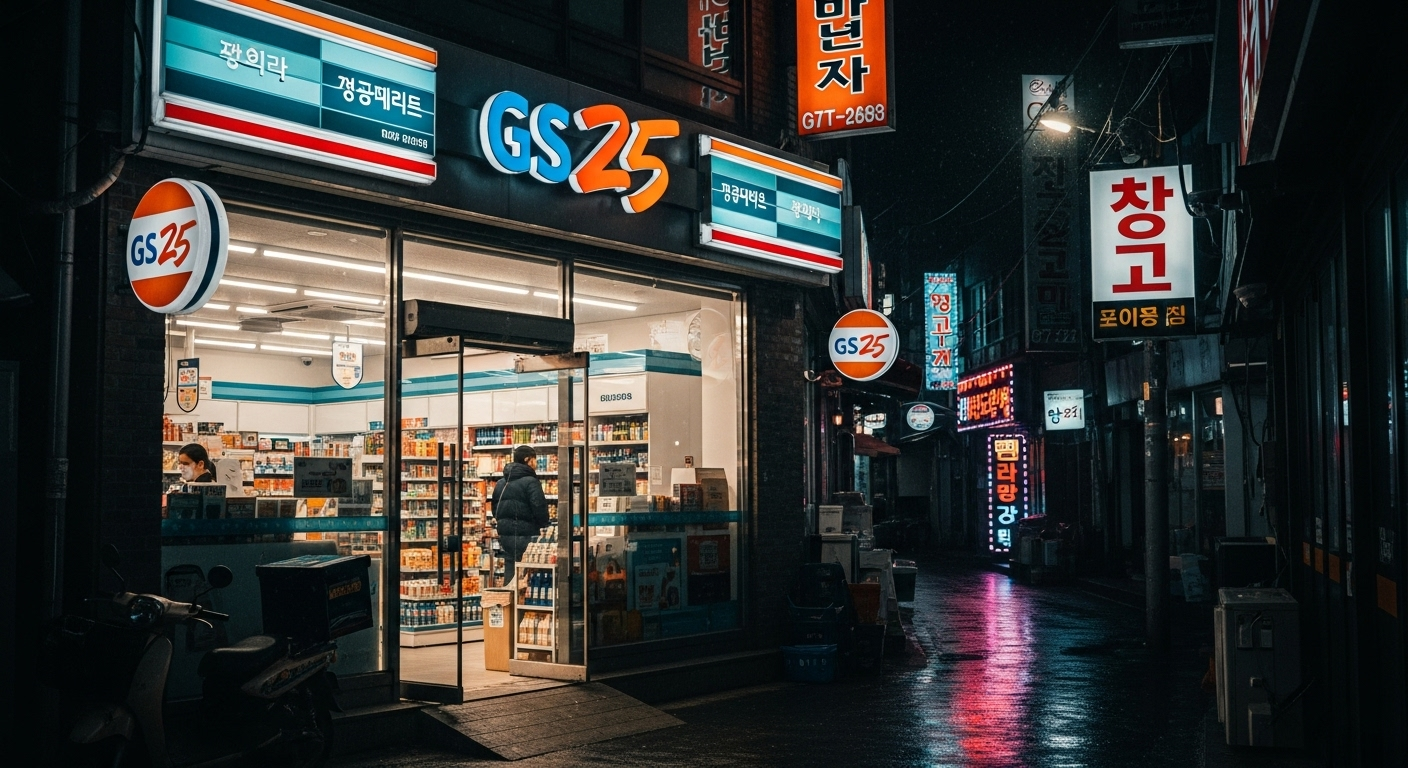
Losing in store count but holding on in revenue. I believe this asymmetry is the key to reading their 50-year history.
I have traced the journey from how these neighborhood lighthouses were born to how they transformed into logistics hubs within an app.
Why did GS Retail start as an electrical construction company?
Its roots are not in convenience stores, but in Goldstar Electric, founded in 1971.
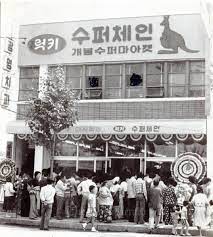
Looking at the official history of GS Retail, the company entered the retail business in 1974 by opening the first ‘Lucky Supermarket’ in the Euljiro Sampoong Shopping Center.
This was back when shelves with price tags were unfamiliar. It was essentially introducing a fixed-price supermarket next to traditional market baskets where people were used to haggling.
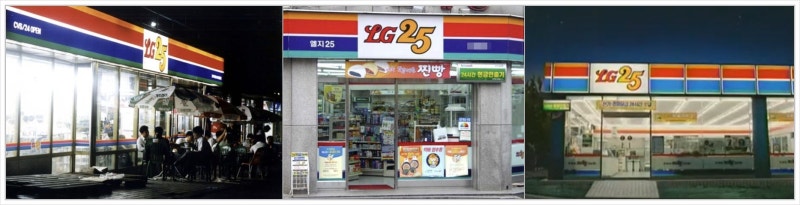
16 years later, in 1990, the ‘LG25’ sign was hung. It was a domestic convenience store brand, not one that relied on imported overseas licenses. Then, in 2005, when the LG Group and GS Group separated their lineages, this company received the name ‘GS Retail.’ The split saw LG taking electronics and chemicals, while GS took retail and energy.
What did the ‘Inhwa’ (Harmony) of the Koo and Huh families leave for GS Retail?
LG, the parent of GS Retail, was a group where two families without blood ties—the Koos and the Huhs—managed the business together for 57 years. This is a rare record, considering the common belief that business partnerships rarely last.
The division of roles was clear. The Koo family expanded the business, while the Huh family handled finance and operations. Underlying this was the principle of ‘Inhwa’ (harmony), and when the third generation took over, they chose to split the businesses and go their own ways rather than engage in management disputes. This is why it is often cited in the business world as a ‘beautiful farewell.’
I include this detail in the GS Retail story because a convenience store is, at its core, a business that runs on the relationship with franchisees.
If the headquarters and store owners don’t trust each other, strategies to boost revenue per store will never work. That strategy is exactly the next topic.
How did GS25 keep the #1 spot in revenue despite losing in store count?
GS25 chose to prioritize increasing the revenue of individual stores rather than rapidly expanding the total number of locations.
While CU forged ahead with the speed of opening new stores, GS25 held its ground through store efficiency, and the numbers reflect that choice.
Comparison of GS25 and CU store counts and revenue (GS25 based on the convenience store division, CU based on operator BGF Retail)
| Year | Category | GS25 | CU |
|---|---|---|---|
| 2019 | Store Count | 13,918 | 13,877 |
| 2019 | Revenue | 6.8564 trillion KRW | 5.9434 trillion KRW |
| 2023 | Store Count | 17,390 | 17,762 |
| 2023 | Revenue | 8.2457 trillion KRW | 8.1948 trillion KRW |
| 2024 | Store Count | 18,112 | 18,458 |
| 2024 | Revenue | 8.6661 trillion KRW | 8.6988 trillion KRW |
In 2023, CU had 372 more stores, and looking at the table, it seems as if CU surpassed them in revenue in 2024.
There is a catch. Since BGF Retail’s revenue includes about 1% from other businesses besides convenience stores, CEO Score Daily isolated only the CU convenience store revenue for comparison. Viewed that way, the gap narrowed from 913 billion KRW in 2019 to 114 billion KRW in 2023, and 54.3 billion KRW in 2024. This is why reports provide different gap figures depending on the criteria used.
Then, in Q2 2025, the lead was flipped for the first time. According to Point Daily, CU’s revenue for that quarter was 2.2383 trillion KRW, surpassing GS25’s 2.2257 trillion KRW by 12.6 billion KRW. It was the moment CU took all metrics for at least one quarter, following store count (since 2020) and operating profit (since 2022).
However, in the next quarter, GS25 pulled ahead again. According to Korea Report, the cumulative revenue for the first half of 2026 was 4.4707 trillion KRW for GS25 and 4.4424 trillion KRW for CU, a difference of 28.3 billion KRW. Conversely, during the same period, operating profit for CU was 114.7 billion KRW, while GS25 was 92.7 billion KRW.
Honestly, I was a bit surprised by these numbers.
Revenue goes to GS25, profit to CU. This means that the strategy of maintaining revenue through per-store efficiency does not necessarily guarantee profit. Furthermore, the combined number of stores of the four major convenience store chains fell to 53,266 in 2025. This is the first decrease since 1988.
If the era of widening gaps through aggressive store openings is over, the new battlefield is how effectively each store can be utilized. We have essentially returned to the same problem GS25 has been grappling with for over 30 years.
How did Kim Hye-ja lunchboxes and ‘My Own Refrigerator’ boost GS25’s per-store revenue?
To sell more in a single store, you need a reason for customers to visit and a reason for them to return. GS25 created two devices that fulfilled those roles.
The reason to visit was the lunchbox.
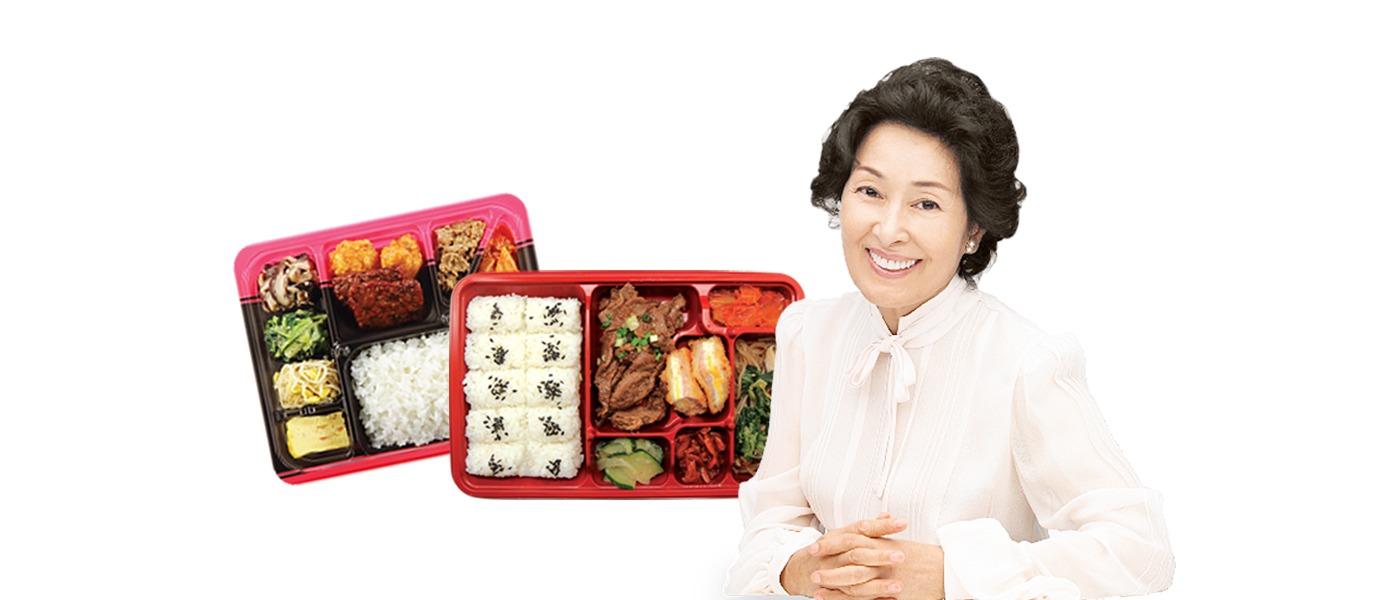
Released in September 2010, ‘Kim Hye-ja Lunchbox’ saw about 40 varieties released by the first half of 2017, generating cumulative revenue of approximately 1 trillion KRW (Money Today). The term ‘Hyeja-ropda’ (meaning great value for money) was coined during this time. It is a rare case where a product, rather than an ad copy, created a new slang term.
This lunchbox was re-released in February 2023 after a 6-year hiatus. High inflation fueled the demand, and the ‘Hyeja-rowoon’ PB brand surpassed 100 million cumulative sales within three years of its relaunch (Seoul Economic Daily, April 2026). Sales between 2010 and 2017 were 430 million units.
The reason to return is ‘My Own Refrigerator.’ It is a service that allows customers to store 1+1 or 2+1 promotional items in the app instead of taking them on the spot, to be picked up later. It was launched in late March 2011 as the industry’s first.
While it is often touted as ’the world’s first,’ the expression the company uses is ’the industry’s first.’
Stored promotional items must eventually be picked up at the store. Because it’s an O4O (Online for Offline) structure that stores items online and calls customers offline, customers who bought something once return to the same store. Cumulative storage transactions exceeded 150 million by the first half of 2026, and in September 2026, ‘Our Refrigerator’ was added, allowing up to five people to share stored products.
What was GS Retail’s criteria for folding Lalavla but keeping GS The Fresh?
Not every expansion worked. The criteria for the split were relatively clear. Expansions that utilized an existing store network survived, while those that entered markets already dominated by strong players without any differentiation died.
The side that survived was the supermarket.
In 2019, as they rebranded ‘GS Supermarket’ to GS THE FRESH, they began using stores nationwide as online order delivery hubs, which helped them maintain the #1 position in domestic supermarkets.
The side that folded was the H&B (Health & Beauty) store.
Although they rebranded ‘Watsons’ to ‘Lalavla’ in 2018 to give it another shot, they had no weapon to surpass Olive Young. As noted in the JobKorea Corporate Analysis Report, they wound down the business in 2022. The company learned firsthand that large scale doesn’t guarantee victory in every market, a lesson that competitive advantage is not eternal.
Will ‘Our Neighborhood GS’ transform GS Retail stores into logistics hubs?
The next stage is to tie all stores together into a single app.
In 2021, they merged with GS Home Shopping to bring online and offline businesses under one company and invested in the delivery app Yogiyo that same year. Then, in October 2022, they launched ‘Our Neighborhood GS,’ an integrated app combining convenience stores, supermarkets, quick commerce, and mobile payments (Byline Network).
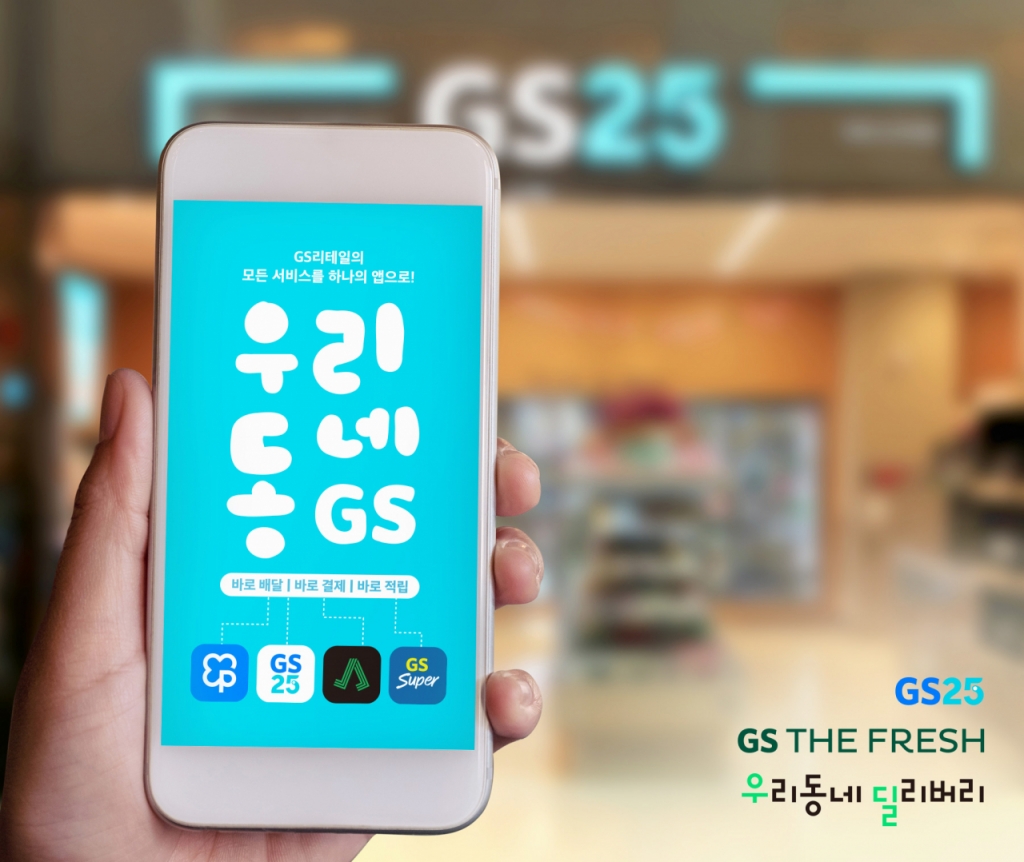
It is interesting that this is an extension of the per-store revenue strategy.
If you can’t increase the number of stores, you simply widen the radius that one store can reach. According to Korea Report, GS25’s quick commerce revenue increased by 75.4% in 2024 and 64.3% in 2025, and monthly active users of Our Neighborhood GS reached 4.3 million.
There are shadows, too. Franchisees complain about the burden of delivery fees of around 10% and the cost of free shipping.
The way the company, which began with the principle of ‘Inhwa’ (harmony), shares these fruits with store owners will determine whether over 18,000 stores can function properly as logistical hubs.
GS Retail 50-Year Major Milestones
| Period | Major Events |
|---|---|
| 1971~1990 | Founding of Goldstar Electric (1971) → 1st Lucky Supermarket (1974) → 1st LG25 (1990) |
| 2005~2011 | Launch of GS Retail (2005) → Kim Hye-ja Lunchbox (2010) → My Own Refrigerator (2011) |
| 2015~2019 | Acquisition of Parnas Hotel (2015) → Lalavla Rebranding (2018) → GS THE FRESH (2019) |
| 2021~2026 | GS Home Shopping Merger & Yogiyo Investment (2021) → Our Neighborhood GS (2022) → Lalavla Withdrawal (2022) → Kim Hye-ja Lunchbox Relaunch (2023) → First quarterly revenue reversal by CU (2025) |
From electrical work to Euljiro supermarkets, neighborhood convenience stores, and now apps on our phones. Throughout those 50 years, the question this company has held onto is surprisingly singular: How much more can we do with a single store?
References
- GS Retail Official History, GS Retail
- "GS25-CU Revenue Battle… Will the Rankings Change This Year?", Herald Business
- "Conflicting Perspectives on the Convenience Store Throne", Digital Daily, 2024.02.13
- "CU vs GS25, Who is the Winner in Convenience Store Count?", Aju Business Daily, 2021.03.18
- "GS25, Revenue #1 Threatened… Revenue Gap with CU down to 50 Billion KRW range last year", CEO Score Daily, 2025.02.12
- "More 'Hyeja' After 6 Years… GS25 Relaunches Kim Hye-ja Lunchbox", Etoday, 2023.02.06
- "GS25 Launches Ultimate Value-for-Money Kim Hye-ja Lunchbox", Money Today, 2023.02.15
- "Hyeja for High Inflation… GS25 Kim Hye-ja Lunchbox Hits 100 Million Sales in 3 Years Since Relaunch", Seoul Economic Daily, 2026.04.23
- "GS25 'My Own Refrigerator', Now Shareable with Family and Colleagues", Insight Korea
- "GS Retail App 'Our Neighborhood GS' MAU Surpasses 2.89 Million in 2 Years Since Launch", Byline Network, 2024.12.19
- GS Retail Corporate Analysis Report, JobKorea