
Prologue: Min-jun’s Day – The 24-Hour Rhythm of Convenience Stores

At 8 AM, Min-jun barely opens his eyes to the sound of his alarm, and his day begins as it always does: like a war. He tossed and turned thinking about the work he had piled up overnight, which made him oversleep. Dressed in a shirt and carrying his bag, he heads not to a café but to the familiar green sign of a CU convenience store. “Beep.” With the sound of his smartphone payment, he holds a triangle kimbap and a pouch coffee in his hand. The convenience store is the place that solves the urbanite’s morning, where there’s no time to wait for an order in a crowded café or the luxury of leisurely preparing breakfast.
At lunchtime, the team decides to pool money to celebrate a colleague’s promotion. Needing cash, Min-jun heads to the GS25 on the first floor of his office building instead of looking for a bank. He withdraws cash from a bank-affiliated ATM without any fees and pauses for a moment. Just a few years ago, he had to cut his lunch break to match bank hours, but now it can be easily resolved at a convenience store open 24 hours. The convenience store has become a small financial hub in the neighborhood, transcending its role as a mere shop.
At 7 PM, his Instagram feed from the subway ride home lingers in his mind. A limited edition beer released in collaboration between a famous craft beer brand and Seven-Eleven. He enters the nearby Seven-Eleven as if in a trance. Among the rows of beers in the fridge, he finds the beer he was looking for and smiles with satisfaction. Since he’s already there, he decides to pick up something for dinner as well. Going to a large supermarket feels burdensome, and ordering delivery seems excessive today. He chooses a steak meal kit for one and a small salad. The convenience store is responsible for stocking the refrigerators of single-person households and is the first place to experience the latest trends.
At 11 PM, he can’t resist the hunger that hits him during a climactic scene in a Netflix series where the protagonist eats ice cream. Lacking the energy to get off the sofa, he opens his smartphone delivery app. After ordering the newly released PB ice cream and a few snacks from a nearby Emart24, the delivery person’s bell rings at his door in less than 20 minutes. In the forefront of the on-demand economy, the solution that satisfies our most immediate desires is also the convenience store.
Min-jun reflects for a moment. All these moments—satisfying his morning hunger, resolving urgent lunchtime needs, providing small evening pleasures, and filling late-night cravings—are intricately woven around the space called ‘convenience store.’ His day, or perhaps all of our days, may flow in rhythm with these brightly lit little shops.
When did it start? When did these small stores come to dominate our daily lives so deeply, becoming companions in life and absolute rulers of the alleys? I am about to begin the chronicle of that grand and intimate story.
Chapter 1: The Dawn of Convenience – A Strange Yet New Beginning
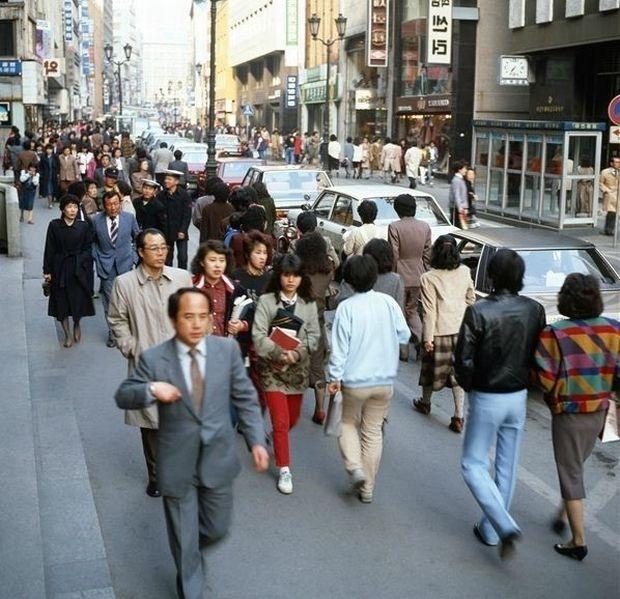
The story must begin not with success but with the memory of failure. In 1982, a store named ‘Lotte Seven’ opened in Sindang-dong, Seoul. This marked the beginning of convenience stores in Korea, according to records. However, the outcome was disastrous. To consumers at the time, this unfamiliar space that operated 24 hours and sold goods at fixed prices was merely a ‘pricey corner store.’ The concept of ‘convenience’ itself was foreign, and this ahead-of-its-time experiment quietly ended after two years. The market simply wasn’t ready.
Seven years passed. During that time, South Korea underwent the largest transformation in its history: the 1988 Seoul Olympics. Culture and capital from around the world flooded into the Korean Peninsula, and Koreans began to physically experience what ‘global standards’ meant. It was during this tumultuous time that a businessman decided to test the potential of convenience stores once again, inspired by his experiences studying in the United States. On May 6, 1989, the true first page of Korean convenience store history was finally turned.

Symbolically, the stage was set at the Seoul Olympic Village apartment complex. The first store, bearing the sign ‘Seven-Eleven,’ was a cultural shock. Everything was different from the dusty shelves and haphazardly displayed products of neighborhood corner stores, where prices varied depending on the owner’s negotiation. Under bright lights, neatly arranged products, cashiers accurately scanning barcodes, and, above all, the fact that it was always open at midnight and dawn signaled the dawn of a new era.
However, the flow of the times could not be resisted. The success of Seven-Eleven quickly attracted competitors. In 1990, a local brand armed with pure domestic technology and capital, ‘LG25’ (now GS25), opened its first store in front of Kyung Hee University, throwing down the gauntlet. Soon after, Japanese brands like FamilyMart and MiniStop followed suit, ushering South Korea into the era of convenience store wars.
The failure of 1982 and the success of 1989. The seven-year gap was evidence that Korean society was ready to transition from traditional consumer culture to modern consumer culture. The dawn of convenience was thus brightening, albeit a bit strange and clumsy, but clearly and powerfully.
Chapter 2: The Conqueror of Alleys – How ‘Supermarkets’ Gave Way to ‘Convenience Stores’
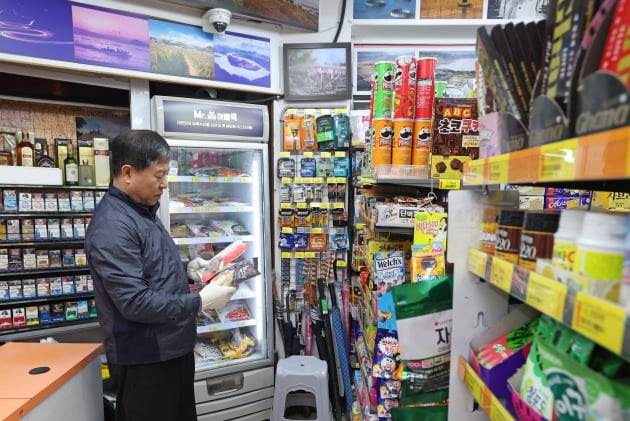
Once, at the heart of our alleys was always the ’neighborhood supermarket.’ Children would buy snacks on credit, and mothers would chat with the owner while buying dinner ingredients. Supermarkets were more than just shops; they were the heart of a community where neighborly affection and trust flowed. However, as the 1990s passed into the 2000s, the warm presence of these neighborhood stores began to fade. The new conqueror that took their place was the convenience store.
The weapons of convenience stores were powerful and systematic.
- The first weapon was the magic of ‘24 hours.’ In a city where working late is the norm, the neighborhood supermarket’s ‘closing at 6 PM’ no longer fit. The convenience store, always brightly lit, became a lighthouse guarding the city’s nights and the only alternative for busy modern people.
- The second weapon was the power of ‘systems.’ Unlike supermarkets run haphazardly by individuals, convenience stores were backed by large capital and advanced logistics systems. They managed inventory by analyzing real-time data from headquarters and supplied fresh products daily through a nationwide logistics network.
- Finally, convenience stores rode the wave of the explosive increase in ‘single-person households.’ People no longer needed a sack of onions or a bag of rice. Instead, they wanted small packages of vegetables, instant rice, and convenient lunch boxes for dinner. Convenience stores precisely targeted this demand.
Government policies also inadvertently favored convenience stores. Regulations to curb the indiscriminate expansion of large supermarkets provided an opportunity for small stores like convenience stores to perfectly seize the gaps in the alleys.
Ultimately, the defeat of neighborhood supermarkets is not merely a story of the ‘old’ being pushed out by the ’new.’ It symbolizes a change in the trust paradigm of Korean society. While supermarkets operated on human relationships like ‘Do you know who I am, boss?’ convenience stores are based on a cold trust in a system where ‘you can find the desired item at a fixed price at any location.’ Convenience stores did not just sell products; they also provided a more familiar and comfortable ‘way of relating’ for modern urbanites.
Chapter 3: The Republic of Convenience Stores – Oligopoly System and New Citizens
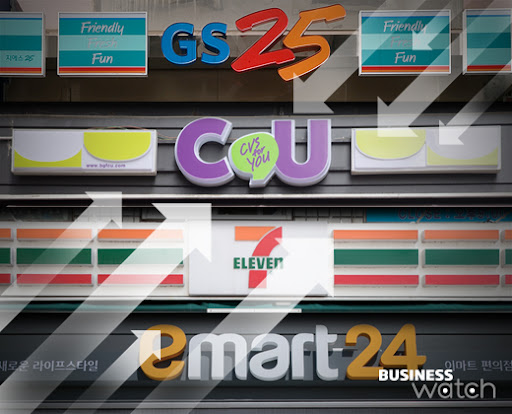
Having claimed the throne of the alleys, convenience stores have now established a massive ‘republic.’ As of the end of 2023, there are approximately 55,000 convenience stores densely packed throughout South Korea. This republic is governed by an oligopoly system dominated by four powerful forces: CU, GS25, Seven-Eleven, and Emart24.
In this republic of convenience stores, new ‘citizens’ reside. Their lifestyles determine the present and future of convenience stores.
- The first citizen, ‘Convenience Shoppers’ Most of them are single-person households who use convenience stores like their home refrigerators. To cater to them, convenience stores are competing to enhance their fresh food sections, including meat, fruits, and vegetables.
- The second citizen, ‘MZ Generation’ For them, convenience stores are not just places to buy goods but ‘hot places’ to consume and experience culture. They visit convenience stores in search of unique collaboration products or unusual experiences and willingly post ‘proof shots’ on social media, acting as viral marketers.
- The third citizen, ‘Active Seniors’ The most surprising yet powerful new citizens. Individuals in their 50s and 60s have chosen convenience stores as an alternative to the now-defunct neighborhood supermarkets. They prioritize accessibility and convenience over price, and their consumption patterns of preferring small purchases align perfectly with the characteristics of convenience stores.
Interestingly, the four major convenience stores are now diversifying their strategies to target different ‘citizens.’ The competition in the convenience store market has evolved from a land-grabbing ‘market share war’ to a ‘brand identity war’ representing specific lifestyles.
Chapter 4: Alchemy of 2 Pyeong – Creating Value in a Saturated Market
Convenience stores in South Korea have reached a physical saturation point. In this narrow land where finding new alleys is increasingly difficult, convenience stores are now utilizing their 2-3 pyeong spaces like alchemists’ laboratories to create new value. Their survival strategy can be summarized as ‘product innovation’ and ‘redefining space.’
The first alchemy is the gospel of private brand (PB) products. Initially, PB products were perceived as merely ‘cheap me-too products,’ but now they have become the identity and strongest weapon of convenience stores. With ‘value for money’ as their weapon, like CU’s ‘Duktem Series,’ they entice consumers to open their wallets and encourage ‘purposeful purchases’ where customers intentionally seek out these products.
The second alchemy is to reinvent the space itself as a ‘Life Platform.’ At the center of this revolution is financial services. By partnering with commercial banks to lower ATM fees, convenience stores have emerged as the center of national financial activities. Furthermore, ‘financial-specialized convenience stores’ have appeared, bringing bank branches into convenience stores. In an era where bank branches are decreasing, convenience stores are effectively playing the role of ’neighborhood banks.’
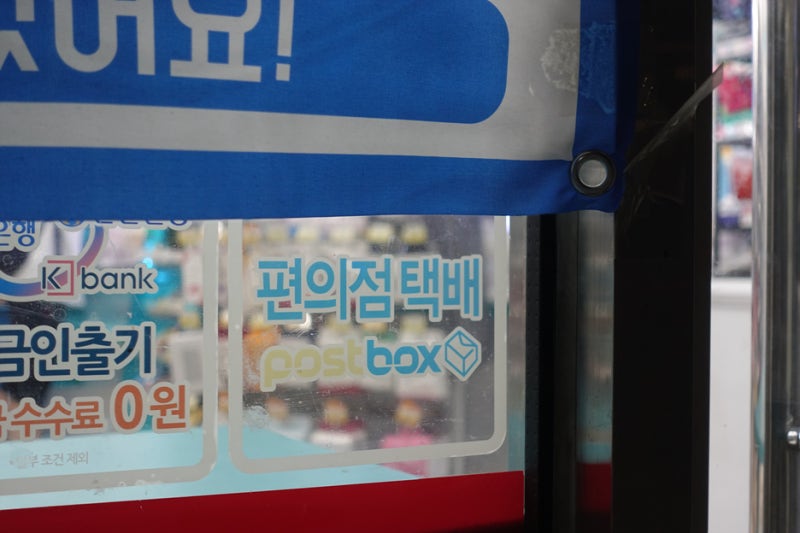
Not only that, but services that solve the minor inconveniences of modern urbanites, such as package receipt and pickup, laundry service, and electric vehicle charging, are also being absorbed into the space of convenience stores.
The core of all these strategies is ’trip stacking,’ which involves overlapping visit purposes. Customers are encouraged to visit not just to ‘buy a drink’ but to ‘send a package, withdraw cash, and buy dinner’ all in one trip. Convenience stores have evolved from mere shops selling products to service platforms that sell ‘convenience’ itself, saving urbanites’ time.
Chapter 5: The Next Chapter – Towards the Convenience Store of 2030
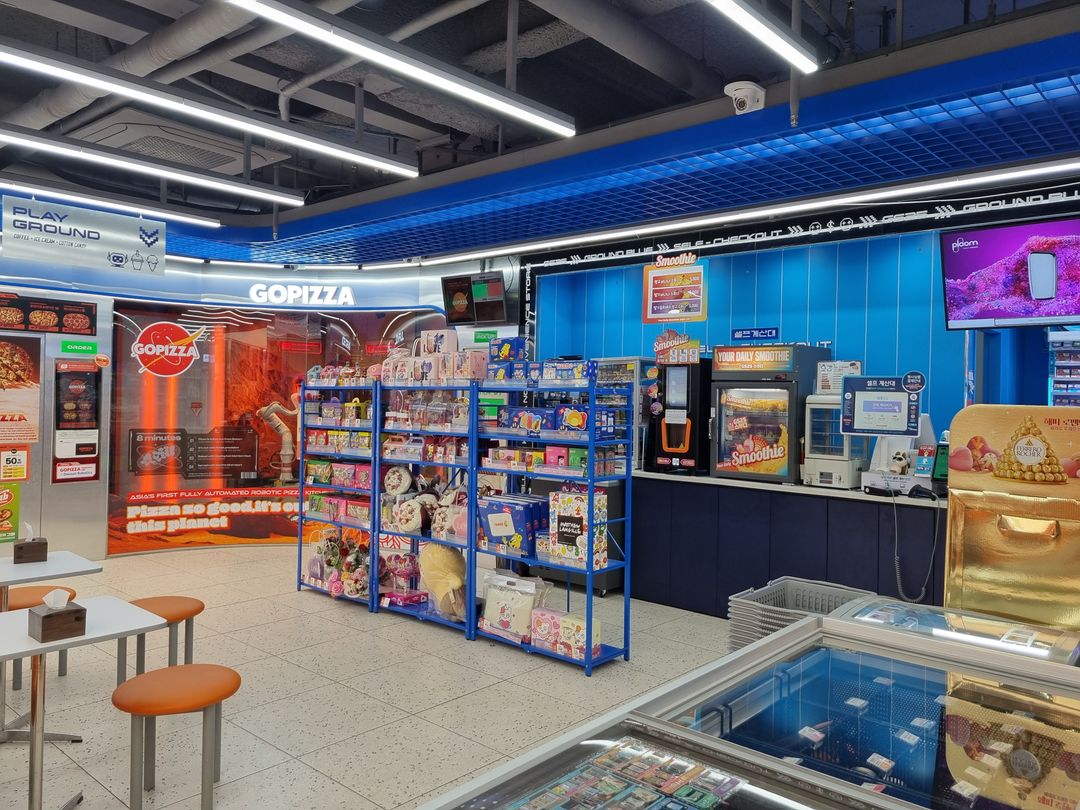
Faced with the massive wall of growth limitations, the convenience store industry has embarked on a bold journey toward the next chapter. What will convenience stores look like in 2030? The future is envisioned along two axes: ‘outward expansion’ and ‘internal innovation.’
- Outward expansion: ‘K-Convenience Stores’ going global The slowdown in domestic market growth has prompted convenience store giants to turn their gaze overseas. K-Convenience Stores, led by CU and GS25, are expanding their territories to various parts of the world, including Mongolia, Malaysia, and Vietnam. This is the process of exporting the ‘K-Convenience Store format,’ which encapsulates Korea’s unique operational know-how, as a successful cultural product.
- Internal innovation: Redefining space through technology At the forefront of this innovation are automation and unmanned operations. As labor costs rise, convenience stores are expanding hybrid and fully unmanned stores using artificial intelligence (AI) and advanced IT technologies.
Moreover, convenience stores have entered the technological competition to conquer the ’last mile’ with customers. Seven-Eleven and Emart24 are actively conducting pilot projects to deliver products using drones, while places like CU are testing autonomous delivery robots in preparation for the future delivery era.
The convenience store of the future will no longer be just a physical space where customers ‘go.’ It will become a service that ‘comes to’ customers through app-based orders and immediate delivery via drones and robots.
Epilogue: Min-jun’s Late-Night Snack and the Lighthouse of the Alley
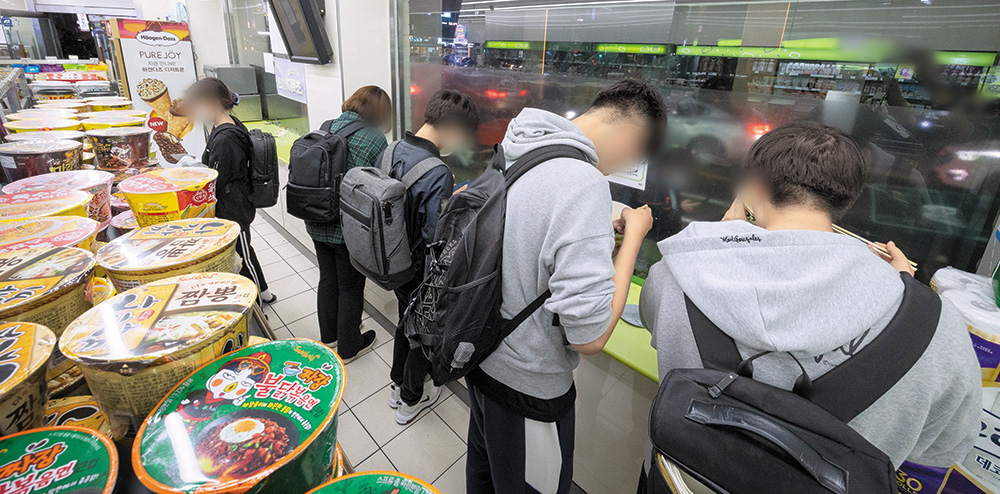
After midnight, unable to resist his hunger, Min-jun stands again under the light of the convenience store in front of his house. In his hand is a steaming cup of noodles. As he sits at a plastic table, slurping the noodles, he suddenly thinks of the vast world contained within this small space.
This cup of noodles in his hand is the result of a logistics network that connects the nation like a spider web and the efforts of IT professionals analyzing data behind the scenes. The shelves he casually passes by are battlefields where the fierce brand strategies of CU and GS25 collide, and the ATM in the corner compresses decades of changes in South Korea’s financial landscape.
The convenience store is no longer just a shop. It is a mirror reflecting the desires of our era, which values speed, efficiency, and individual preferences above all. It guards the city’s nights with its unquenchable light and quietly stands by the busiest and loneliest among us.
Thus, convenience stores in South Korea have become the lighthouses of the alleys, always standing in place amidst a constantly changing world.