
Two people sit by the riverside, looking at the water. One says:
“Is this really a river? It looks like a lake.”
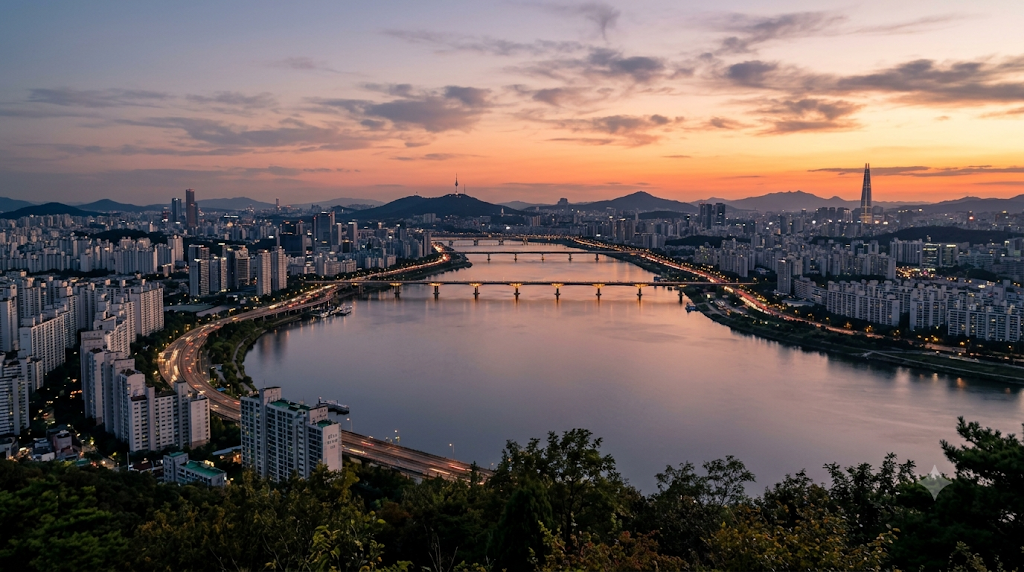
The secret behind this lake-like appearance is a hidden structure underwater: the Han River underwater weir.
In Seoul, these weirs were installed in Jamsil in 1986 and at the downstream Singok location in 1988, preventing water from draining away easily and maintaining a consistent water level.
Why were the Han River underwater weirs built? The origins of the 1980s Han River Comprehensive Development
Historically, the Han River looked very different depending on the season.
It is said that it would swell dangerously during summer monsoons, while sandbars would be exposed during dry periods. While exact figures for how shallow the river was in Seoul back then are unavailable, it is certain that the river’s shape was significantly altered during the Han River Comprehensive Development project in the 1980s.
The core component of this development was the underwater weir. According to a Seoul Media Hub article, the Jamsil Underwater Weir was installed in 1986. A Seoul Shinmun article discussing Seoul Metropolitan Council inquiries in 2024 states that the weir’s purpose was to prevent seawater from flowing upstream. The Singok Underwater Weir, located downstream, is described in a 2019 Newsis article as a 1,007m-long structure installed in 1988 below the Gimpo Bridge.
The distance between the two weirs is also noteworthy. A 2012 Weekly Kyunghyang article introduced the 41.5km stretch from the Jamsil weir to the Singok weir as a policy tour route. This long section, cutting through the heart of Seoul, effectively acts as a single, calm basin of water.
Think of it this way: if you place a low threshold in front of a bathtub drain, the water only drains once it rises above that threshold. Below the threshold, water remains pooled. The underwater weir is a massive threshold built across the riverbed.
How do these submerged weirs control the Han River’s water level?
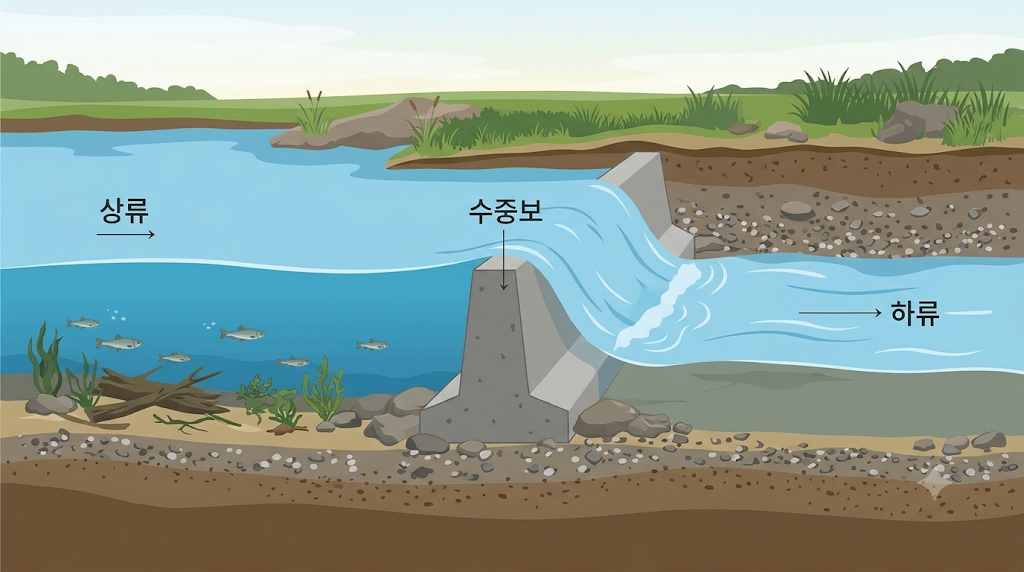
As the name suggests, the underwater weir is a weir submerged beneath the water. Let’s visualize the cross-section: a concrete ledge rises from the riverbed. Normally, the top of this ledge is below the water surface, and water flows thinly over it downstream. On the upstream side, the water is held at the height of the ledge, maintaining the water level, while the downstream side creates a stepped water surface that drops lower.
The third stage in the diagram below is the key. An underwater weir is not a structure like a dam that stores water and opens/closes gates. While the term “Han River water level control” might bring to mind images of opening sluice gates, a November 2025 Kyeongin Ilbo article notes that the Singok Underwater Weir is a closed concrete structure without gates to regulate water flow. It is a simple, sturdy method that relies solely on its height to maintain the water level.
However, this article does not provide the exact height of the weirs or the average depth of the Seoul section, as there were no official figures confirmed. I decided it was better to leave these blank than to invent numbers.
What happens during the flood season? When the water rises significantly, the threshold is deeply submerged and becomes almost invisible, with water flowing over it in a much thicker layer than usual. Conversely, during dry periods, the height of the threshold serves as the baseline for the water level. Instead of relying on precise gate operations, it maintains a minimum water level, though the shape of the threshold determines how the river flows under normal conditions.
The flow velocity of the Han River changes because of this structure. The section in front of the threshold acts like a pool until the water overflows, slowing the flow, while the water speeds up as it crosses the ledge. A 2004 Seoul Media Hub article states that the velocity at the steps of the new Jamsil fishway was designed at 0.4–0.8 m/s. The speed of the water flowing over the weir was calibrated for fish, not humans.
What is the role of the Singok Underwater Weir in the Han River estuary?
In short, the Singok Underwater Weir serves as the final threshold that holds water in the estuary. According to the 2019 Newsis article, this weir was installed to provide a stable supply of agricultural and industrial water and to allow cruise ships to operate. The 2025 Kyeongin Ilbo article summarizes its role in three points:
First, it secures agricultural water for the Gimpo Plain and reduces the infiltration of seawater during high tide.
Second, it maintains a water depth sufficient for vessels to navigate. The article mentions the Han River Bus and cruise routes from Yeouido to the Gyeongin Ara Waterway.
Third, it serves a security function, acting as a first line of defense against threats like wooden-box mines carried in by the tide from the West Sea. The 2012 Weekly Kyunghyang article also notes that the Singok Underwater Weir is a military-managed facility.
I should add a note about the upstream side of the Jamsil Underwater Weir.
According to the 2024 Seoul Shinmun article, the area upstream of this weir is designated as a water source protection zone under the Water Supply and Waterworks Installation Act, placing restrictions on shipping lanes and riverside development. The same article explains that both weirs widened the Han River and straightened its path. These two thresholds have essentially defined the entire water life of Seoul.
So, how does the Han River Bus operate now? A November 2025 Financial News article explains that a water depth of at least 2.8m is secured along the normal route of the Han River Bus. The underwater weir holds the water level, allowing a path for the ships. The same article also covers an incident where a Han River Bus stalled near Jamsil on the night of November 15 that year, illustrating why maintaining water depth is crucial.
There is one thing that is easy to confuse.
Unlike the weirs of the Four Major Rivers Project, the Singok Underwater Weir allows water to pass through during high and low tides. Therefore, it is inaccurate to view it as a wall that completely blocks seawater. It remains a threshold that maintains water level through its height.
Problems caused by the Han River underwater weirs: Flow velocity and fishway disconnection
The problem is that these thresholds are not only beneficial to humans.
Underwater thresholds are high walls for fish. While they look like a flat surface to human eyes, they are concrete barriers blocking the path for fish. The 2004 Seoul city article reports that a 2002 survey found eight species of fish downstream of the Jamsil Underwater Weir, while only eels were found upstream. A single threshold split the fish world in two.
The original fishway installed during the 1986 Han River Comprehensive Development was also problematic.
The existing fishway had step heights of 40cm, making it difficult for fish with poor jumping abilities to climb. A 40cm step is knee-high for a human, so for small fish, it is effectively a wall.
Safety issues also persist downstream.
According to a 2019 article, 12 capsizing accidents occurred between 2014 and 2018 related to the Han River underwater weirs, resulting in 6 casualties.
In August 2018, two firefighters died while attempting a rescue. This means that even if the water looks calm on the surface, safety regulations must be strictly followed near the weirs.
Water quality in areas with slower flow remains a subject of debate.
The 2019 Newsis article notes that the underwater weirs are cited as a major cause of ecosystem fragmentation and summer algal blooms. Conversely, the 2012 Weekly Kyunghyang article quotes an expert from the Korea Environment Institute as saying that because the Singok Underwater Weir is submerged, there is almost no change in water residence time. Opinions vary on the same structure.
Solutions for the Han River underwater weirs: Fishway steps and opening experiments
The most notable solution is the construction of new fishways.
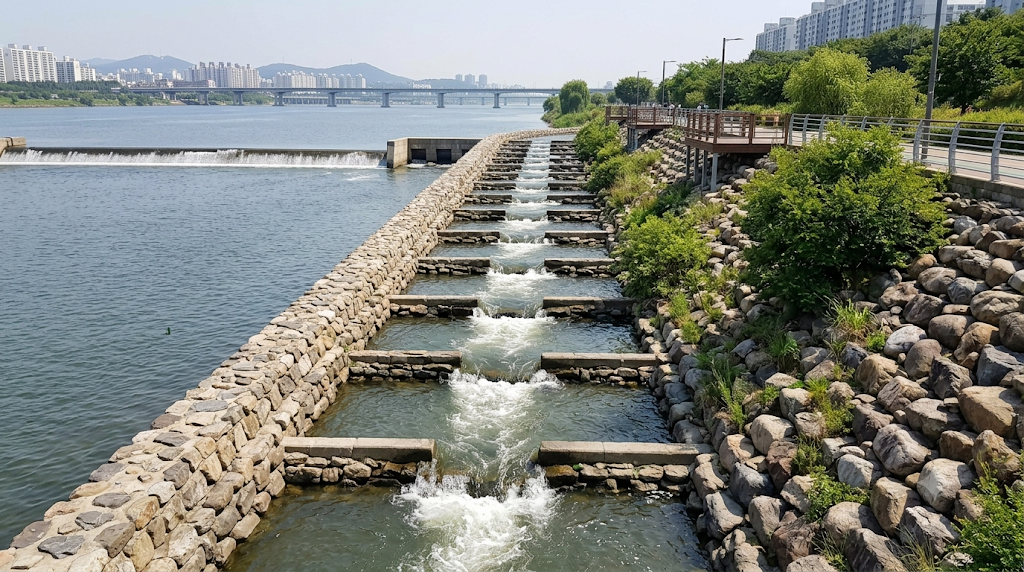
According to the Seoul Metropolitan Government in 2021, a new fishway was installed on the south side of the Jamsil Underwater Weir in 2006. It is 228m long and 4m wide, with 43 steps, each 10cm high. Since the existing 40cm steps were lowered to 10cm, for the fish, the high jump has turned into a staircase climb.
The 2004 article states that the new fishway has a slope of 5–6 degrees and is designed to automatically adjust to changes in the Han River’s water level, maintaining functionality for over 300 days a year. Because the Han River has a large water level difference between flood and dry seasons, a fixed set of steps was insufficient, so a system that opens according to the water level was chosen. These figures are based on 2004 plans and may differ from current operational data.
[IMAGE: Search | Search term: Jamsil underwater weir fishway / Jamsil weir fishway Han River — Image of a fishway where water flows down in layers along a stepped channel, showing the structure that allows fish to climb one step at a time.] (alt draft: “Stepped fishway built next to the Jamsil Underwater Weir”)
As for the Singok Underwater Weir downstream, the solution was an opening experiment. In 2019, the Seoul Metropolitan Government pushed for an opening experiment as a preliminary step toward demolition, but a research project concluded that full opening would lower the water level, causing over 80% of waterside facilities to hit the riverbed and suffer damage. It was also estimated that preventing this damage would cost 20–30 billion KRW. Ultimately, the opening plan was scrapped around February 2019.
What is happening with the Han River underwater weirs now?
As the title of the November 2025 Kyeongin Ilbo article suggests, discussions regarding the Han River underwater weirs—and the waterways themselves—are currently at a standstill. While it is possible to discuss opening sluice gates for the Nakdong, Yeongsan, and Geum Rivers, the Han River estuary lacks such gates, making the same method difficult to apply; therefore, the debate centers on whether to demolish the Singok Underwater Weir.
To break down the current issues: there is hope that demolition could improve water quality and ecology, while on the other side, there are concerns that if the water level drops, water quality could worsen or “scouring” (erosion of the riverbed) could occur. The 2012 Weekly Kyunghyang article introduces the same pros and cons. Because it is intertwined with local governments like Gimpo and Goyang, as well as the impact on the Janghang Wetland below the Singok Underwater Weir, it is difficult to settle on a single answer.
The same article suggests that while there is room to find alternatives for agricultural water and water-level maintenance, the security function is not a matter to be decided hastily. Thus, it was proposed that a government-level consultative body be formed promptly. As of October 30, 2026, when this article was written, I have not confirmed any data stating that demolition or opening has been finalized.
In summary, the fact that the Han River looks like a lake is a result of design, not nature. Two construction projects in 1986 and 1988 created the riverside scenery of Seoul that we see today. Thanks to this, waterways like the Han River Bus became possible, but the costs include the disconnection of fishways and debates over water quality. The trade-off between convenience and ecology is still ongoing.
Frequently Asked Questions about Han River Underwater Weirs
Q. When were the Han River underwater weirs built?
A. The Jamsil Underwater Weir was installed in 1986, and the Singok Underwater Weir was installed in 1988. Both are structures from the 1980s Han River Comprehensive Development project.
Q. What is the role of the Singok Underwater Weir?
A. It is used to secure agricultural water for the Gimpo Plain, reduce saltwater intrusion during high tide, maintain water depth for ship navigation, and provide military security. This is based on the November 2025 Kyeongin Ilbo article.
Q. Is the Han River water level controlled by opening and closing sluice gates?
A. The Singok Underwater Weir is a closed concrete structure that maintains the water level by its height, without sluice gates. It operates differently from a dam that opens and closes.
Q. What happens if the Han River underwater weirs are demolished?
A. According to a 2019 study, full opening could cause over 80% of waterside facilities to hit the riverbed. As of October 2026, demolition or opening has not been finalized.
References
- Is there a separate path for fish? Exploring the 'Jamsil Fishway'
- New fishway being built at Jamsil Underwater Weir on the Han River
- The reality of the Singok Underwater Weir revealed by the Han River Bus failure
- Han River underwater weir: Waterways and discussions both blocked (2025-11-05)
- Article on the shipping plan for the upstream area of the Jamsil Underwater Weir (2024-02-23)
- Han River underwater weir controversy surfaces (2012-06)
- Article on the Han River Bus stalling incident (2025-11-17)