
The Triffin Dilemma is a structural paradox where the more a reserve currency nation supplies money to the world, the more that currency’s credibility is eroded. This warning became a reality with the 1971 Nixon Shock, and today, it is re-emerging with U.S. Treasuries taking the place of gold. For Korean investors with hundreds of trillions of won in U.S. stocks and bonds, this is no longer a distant concern.
Figures as of September 2026
In 1960, Yale economist Robert Triffin published a book.
The title was Gold and the Dollar Crisis. At the time, the U.S. held over half of the world’s gold, and the idea that the dollar could be unstable sounded like a joke. Eleven years later, the U.S. President appeared on television to announce that the U.S. would no longer convert dollars into gold.
These days, his name appears in every article about dollar weakness, tariffs, and U.S. debt. I followed why a 65-year-old warning is being called back now, and what it means for those who accumulate assets in Korean won.

What is the Triffin Dilemma?
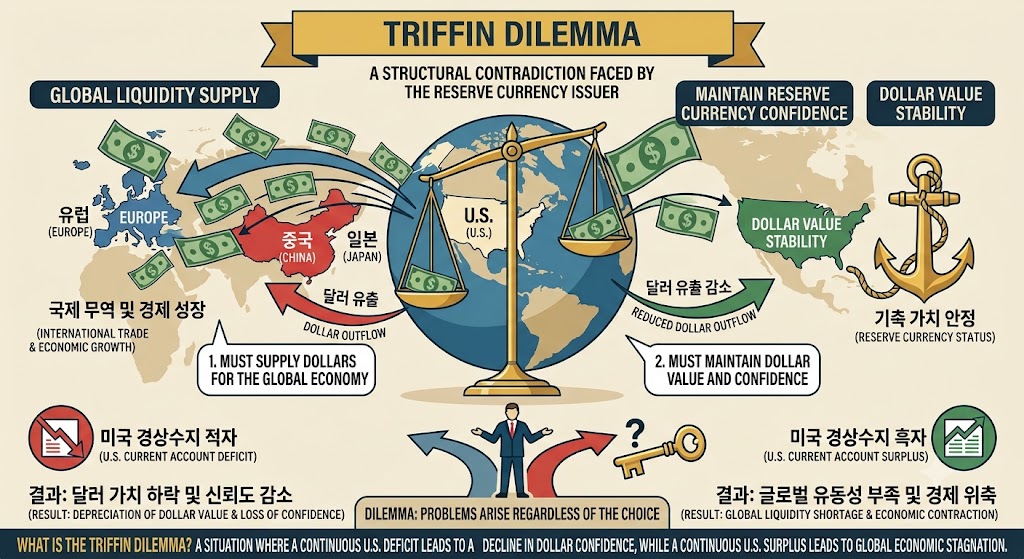
It is the contradiction that when a country’s currency becomes the world’s reserve currency, it must continuously supply money to the world, but doing so weakens confidence in that currency.
As global trade grows, more dollars are needed for settlement and reserves. There is effectively only one way for the U.S. to export those dollars: by importing more or by lending and investing abroad. Consequently, the U.S. current account deficit accumulates. Conversely, if the U.S. reduces its deficit, the world faces a dollar shortage, causing trade and finance to contract.
If the U.S. releases dollars, its credit is shaken; if it doesn’t, the global economy is shaken. Since both paths carry a cost, it is called a ‘dilemma.’
The Bretton Woods System: The Promise of $35 per Ounce of Gold
The stage where this contradiction first appeared was the 1944 Bretton Woods system.
As World War II was coming to an end, representatives from 44 Allied nations gathered in Bretton Woods, New Hampshire. There, a system was created where the dollar was fixed at $35 per ounce of gold, and other currencies were pegged to the dollar. Central banks of various countries could take their accumulated dollars to the U.S. at any time and exchange them for gold. It was a promise that the dollar was as good as gold.
At first, there was no problem. War-torn Europe and Japan were short on dollars, and the U.S. supplied them through the Marshall Plan and overseas military spending. However, from the late 1950s, the dollars accumulated abroad began to catch up with U.S. gold reserves. This was exactly what Triffin pointed out. The moment foreign dollars exceeded gold, the suspicion of “can they really convert all of it?” became inevitable.
From De Gaulle’s Gold Demand to the Nixon Shock: The End of Dollar-Gold Convertibility
Suspicion soon turned into action.
In the 1960s, French Finance Minister Valéry Giscard d’Estaing called the dollar’s status an ’exorbitant privilege.’ The criticism was that only the U.S. could print its own money to buy foreign goods, and that money would return to the U.S. as Treasuries. President Charles de Gaulle did not stop at words; he began converting France’s dollar holdings into gold. As other countries followed suit, U.S. gold continued to drain away.
As more dollars were printed to fund the Vietnam War and welfare spending, it became impossible to sustain. On August 15, 1971, President Richard Nixon announced the suspension of the dollar’s convertibility into gold. This is the event commonly known as the ‘Nixon Shock.’ As major countries shifted to a floating exchange rate system in 1973, the Bretton Woods system came to an end. Triffin’s prophecy had come true in 11 years.
Why Did the Dollar Survive Without Gold?
Even after the anchor of gold disappeared, the dollar maintained its position as a reserve currency. This is because U.S. Treasuries took over as the world’s safe asset in place of gold.
In the mid-1970s, the U.S. teamed up with Saudi Arabia to solidify the flow of oil payments in dollars. This is the structure commonly referred to as the ‘petrodollar’. One needed dollars to buy oil, and oil-exporting nations reinvested their earned dollars back into U.S. Treasuries. The basis for dollar demand shifted from “we will convert it to gold” to “the deepest and safest Treasury market in the world.”
The dilemma was not solved, only its form changed. The question merely shifted from “Can you convert this to gold?” to “Can you repay these Treasuries?” The answer remains a ‘yes’ for now, based on IMF statistics showing the dollar accounts for 57.13% of global foreign exchange reserves (Q1 2026).
The Current Triffin Dilemma: By the Numbers
The scale of the modern-day dilemma can be gauged by the net debt the U.S. owes the world.
According to the U.S. Bureau of Economic Analysis (BEA), the U.S. net international investment position at the end of Q2 2026 was -$22.42 trillion.
U.S. assets abroad are $46.97 trillion, while foreign assets in the U.S. are $69.39 trillion. This gap widened from -$21.27 trillion the previous quarter. The current account deficit for the same quarter was $246 billion, or 3.0% of GDP, up from 2.7% in Q1.
Government debt is moving in the same direction. [U.S. national debt has exceeded $40 trillion](/en/posts/us-national-debt-5-reasons/), and interest payments alone cost $1 trillion a year. Just as foreign dollars caught up with U.S. gold in the 1960s, foreign-held U.S. assets are now testing the U.S.’s ability to repay.
The U.S. Has Started Calling the Reserve Currency a ‘Burden’
The new aspect of this round is that it is the U.S. government that brought up the dilemma first.
Stephen Miran, nominated as chair of the Council of Economic Advisers for the Trump administration, released 《A User’s Guide to Restructuring the Global Trading System》 in November 2024. The argument is that because the world wants the dollar, the dollar is always overvalued, which has caused U.S. manufacturing to collapse and deficits to pile up. The direction of using tariffs and a weaker dollar to share that ‘burden’ with allies stems from this view, which is a stark contrast to the ‘privilege’ status of the De Gaulle era.
Counterarguments are also strong. A column in the CEPR points out that in the current system without gold convertibility, the U.S. does not necessarily have to run a trade deficit to supply dollars to the world. It argues that the root of the deficit lies in U.S. overconsumption and fiscal deficits, not the dollar’s status. If this counterargument is correct, creating a weak dollar will not reduce the deficit, and only those holding dollar assets will suffer losses.
Regardless of which interpretation is correct, the direction is the same:** the possibility that the U.S. might not bother to protect a strong dollar has, for the first time, been placed on the official table.**
The scene in August 2026, where the dollar fell to a 3-month low despite a doubling of Treasury buybacks, was a signal that the market is already pricing in this possibility.
Why the Triffin Dilemma Matters to Korean Investors
If the world after the dollar is one of a ‘slowly weakening dollar’ rather than a collapse, the first to be affected are those who convert dollar assets into won.
Individual Investors. According to Financial News, domestic investors’ holdings of U.S. stocks exceeded 300 trillion won for the first time in May 2026, reaching $200.3 billion. If U.S. stock prices rise 10% but the won/dollar exchange rate falls 10% in the same period, there is almost no won-denominated profit left. This is why it is easy to focus only on stock charts and ignore exchange rates.
National Pension Service (NPS). According to NPS Fund Management Headquarters data, overseas stocks accounted for 557 trillion won, or 36.5% of total assets, as of the end of March 2026. Most of these are dollar assets. The NPS has long conducted almost no currency hedging for its overseas investments, but in April 2026, it announced that it set a base currency hedging ratio of 15%. This policy reflects the recognition that exchange rate fluctuations can significantly impact pension returns.
Bank of Korea. Foreign exchange reserves at the end of August 2026 were $442.28 billion, the largest monthly increase since records began. A significant portion of these reserves are also dollar-denominated assets. The structure where won-denominated valuation decreases when the dollar weakens is no different from that of individuals.
There is one common question for all three.
It is not whether to abandon dollar assets, but how much exchange rate risk to bear. If we were in a world where the dollar would collapse in an instant, we would need to rush to move into real assets like gold, but the data so far points to a slow weakening. At that pace, adjusting currency hedging ratios and diversifying currencies is a more realistic approach.
How Will the Triffin Dilemma End?
If we look for hints in history, the dilemma has never been solved all at once; it has been resolved by changing the system.
In 1971, the world abandoned gold and moved to Treasuries. What the next transition will be is not yet visible. The BRICS payment network remains centered on sanctioned nations, and stablecoins are actually increasing demand for U.S. Treasuries. I have summarized the comparison of these variables by direction in 3 Variables of Dollar Hegemony.
It took 11 years from the publication of Triffin’s book to the Nixon Shock. While I don’t know at what speed this current dilemma will move, just like in the 1960s when gold was draining away, numbers like net international investment positions and term premiums are moving first. For those holding dollar assets, it seems necessary to make a habit of looking at those numbers more than just stock prices.
Notice: This article is general information based on public data available at the time of writing and is not a recommendation for specific investment or financial products. Figures and policies may change in the future.
References
- Robert Triffin, Gold and the Dollar Crisis: The Future of Convertibility, Yale University Press (1960)
- Federal Reserve History, Creation of the Bretton Woods System
- Federal Reserve History, Nixon Ends Convertibility of U.S. Dollars to Gold and Announces Wage/Price Controls
- U.S. Bureau of Economic Analysis, U.S. International Transactions and Investment Position, 2nd Quarter 2026
- Stephen Miran, A User's Guide to Restructuring the Global Trading System, Hudson Bay Capital (2024-11)
- CEPR VoxEU, Miran, we're not in Triffin land anymore
- IMF, Currency Composition of Official Foreign Exchange Reserves (COFER) Dashboard
- Seoul Economic Daily, August Foreign Exchange Reserves Increase by Record Amount... Ranking by Country Not to be Disclosed (2026-09)
- Financial News, Is the 'Seohak Ant' Revival Coming? U.S. Stock Holdings Exceed 300 Trillion Won (2026-05-17)
- NPS Fund Management Headquarters, Current Status by Asset Class — Overseas Stocks
- NPS Fund Management Headquarters, Investment Policy — Foreign Exchange Management