
They bought government bonds to suppress interest rates, but it was the dollar that collapsed.
On August 19, the U.S. Treasury announced it would double its long-term bond buyback program from $2 billion to $4 billion per session. Immediately, the 30-year yield dropped by 9bp.** **
It lasted exactly one day. By the next day, the yield had erased almost all those gains, climbing back to the 5.3% range. At the same time, the dollar index, which measures the greenback’s value against six major currencies, slid to its lowest level in three months.
Defending government bond yields is usually interpreted as a commitment to maintaining the credibility of a currency.
However, this time, the market interpreted it in the exact opposite way. It was taken as a signal that “the U.S. government, struggling to handle its debt interest, has begun to tolerate a decline in the value of the dollar.”
To understand why such a contradictory reaction occurred, we must first look at the actual position the Treasury holds in the market.
Why did the Treasury’s buyback last less than a day?
The answer is simple.
In the government bond market, the Treasury’s natural position is that of a ‘seller.’
It is a different story when the Federal Reserve buys bonds through Quantitative Easing or Operation Twist.
As an external entity with the power to print money, the Fed acts as a pure buyer; thus, the amount of bonds in circulation actually decreases, and yields structurally decline.
In contrast, the Treasury is an issuer plagued by chronic deficits. To buy back long-term bonds, it must raise funds from somewhere else, and the prevailing view among bond dealers was that the Treasury would finance this by issuing more short-term Treasury bills (T-bills) of less than one year.
Ultimately, this means the structure is one of ‘rolling over long-term debt with short-term debt’ while the total volume of debt in the market remains unchanged.
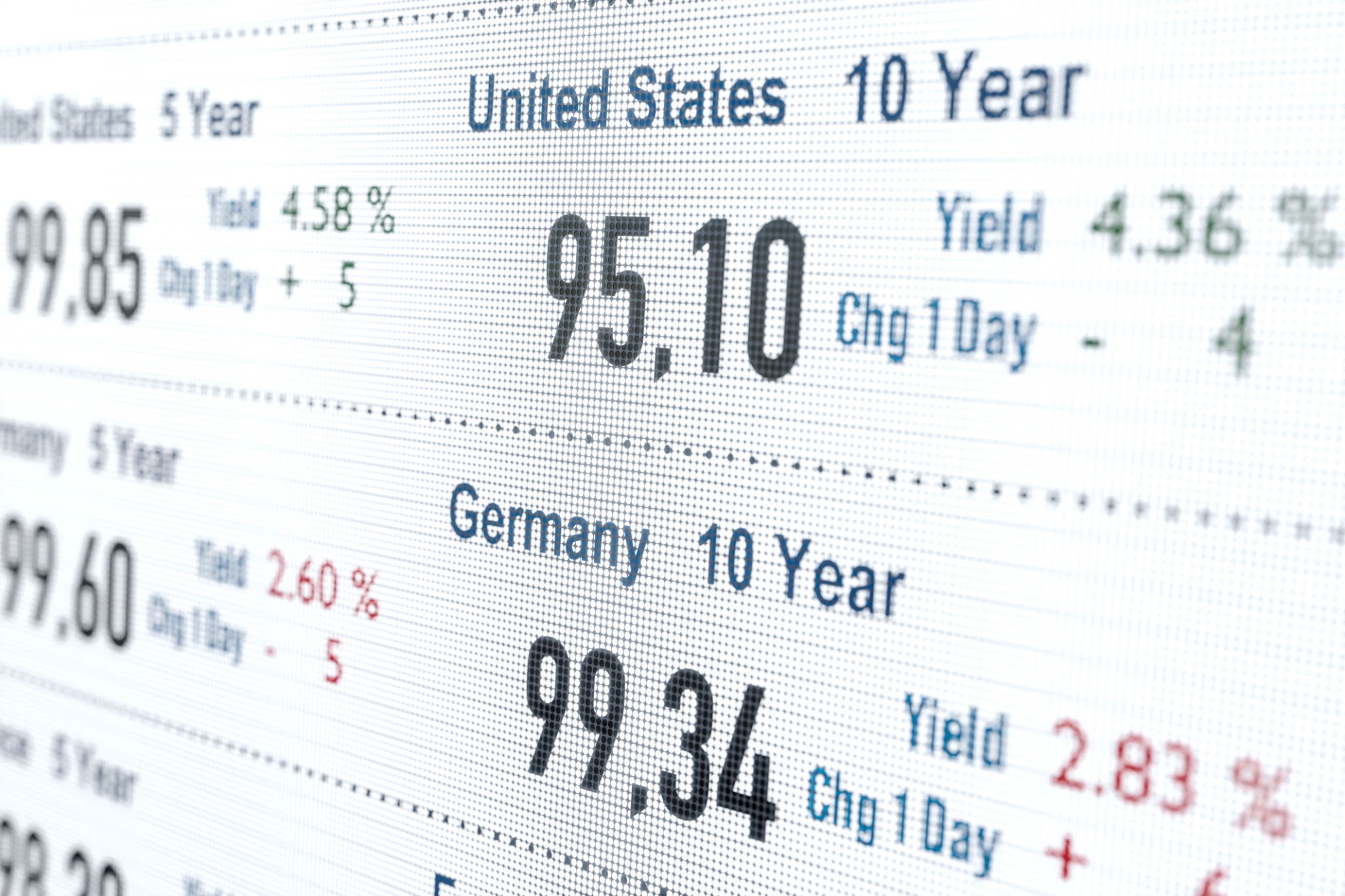
It wasn’t the yields that wavered after one day of intervention, but the currency’s credibility.
Treasury Secretary Scott Bessent stated in a CNBC interview that “current long-term Treasury yields do not properly reflect the fundamental economic conditions of the United States,” and insisted that the buyback scale could be increased beyond $4 billion at any time. In fact, he reiterated the next day, “We will increase the size of the buybacks.”
Yet, the bond market continued to sell. In the $32 trillion Treasury market—and specifically the $5.5 trillion long-term bond market—a buyback of $14 billion per quarter accounts for only 0.25% of the total. The market quickly realized that the amount itself was merely a stopgap measure.
An interesting development occurred a month later. According to reports in early September, when speculation arose that Secretary Bessent was using the Treasury General Account (TGA) for buybacks, he drew a line, stating, “We haven’t bought a single bond yet.” The announcement was loud, but it appears that no actual purchases had begun even a month later. This suggests the signal was nothing more than a signal.
$40 Trillion in National Debt: Interest Costs Surpass Defense Spending
Behind the abstract anxiety lie hard numbers.
According to a Seoul Shinmun report citing U.S. Treasury data, the total U.S. national debt reached $40.5 trillion as of August 19, crossing the $40 trillion mark for the first time in history. Compared to the $19.95 trillion in January 2017, it has doubled in less than a decade. The debt-to-GDP ratio has exceeded 124%, and net interest costs alone are around $1.2 trillion this year, already surpassing the entire defense budget.
Furthermore, the Congressional Budget Office (CBO)’s 2026~2036 Budget Outlook projects that the federal budget deficit will swell to $3.1 trillion by 2036, or 6.7% of GDP. Unless spending is cut, there is no clear way to reverse this trend.
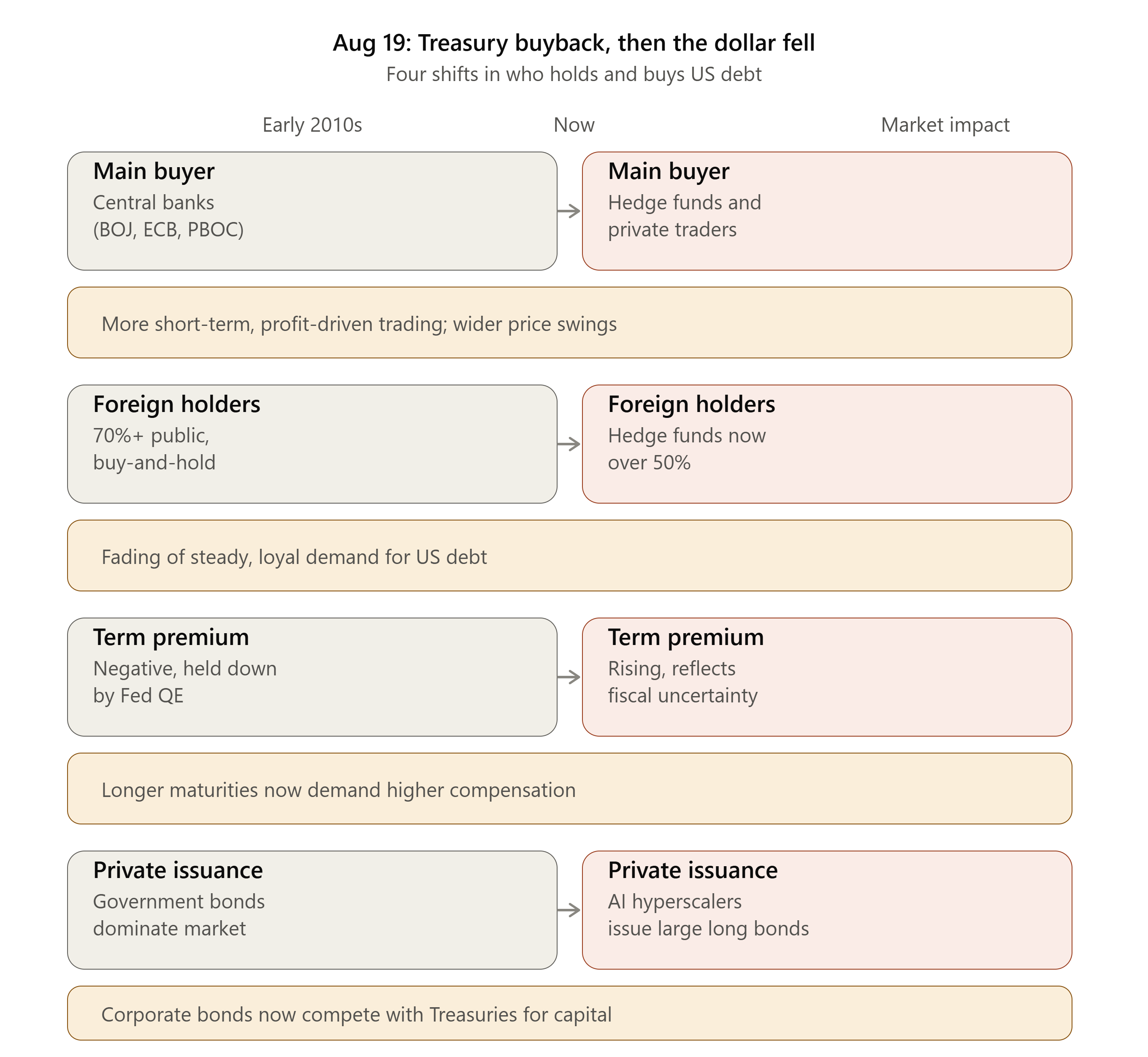
Bond issuance is increasing, but the hands willing to buy are decreasing.
Why are hedge funds demanding higher yields?
In the past, when the U.S. issued bonds, the central banks of allies and trading partners silently absorbed them as foreign exchange reserves. However, due to geopolitical conflicts and economic bloc formation, the purchasing power and willingness of foreign central banks have simultaneously declined.
Filling that void are private hedge funds that doubt the fiscal health of the nation. The market calls them ‘bond vigilantes’—entities that sell off government bonds and drive up yields themselves if they judge that the government is managing its finances recklessly.
What they demand in return are higher yields, known as the term premium. This is why outlets like The Hankyoreh and Digital Times repeatedly point out that methods involving only bond buying without fiscal tightening or spending cuts are unlikely to have lasting effects.
The Triffin Dilemma: The Contradiction of a Reserve Currency
All these flows can be explained by the ‘Triffin Dilemma,’ a concept articulated by economist Robert Triffin.
The logic is as follows: to maintain its status as a reserve currency, the U.S. must continue to supply dollars to the world through current account deficits or large-scale bond issuance. Once the released dollars and debt exceed a sustainable threshold, the creditworthiness of the issuer itself comes into question.
When a government begins to intervene directly in the market to lower interest rates that it can no longer afford to pay, the market reads this not as credit defense, but as a signal of currency devaluation, and sells off the currency instead.
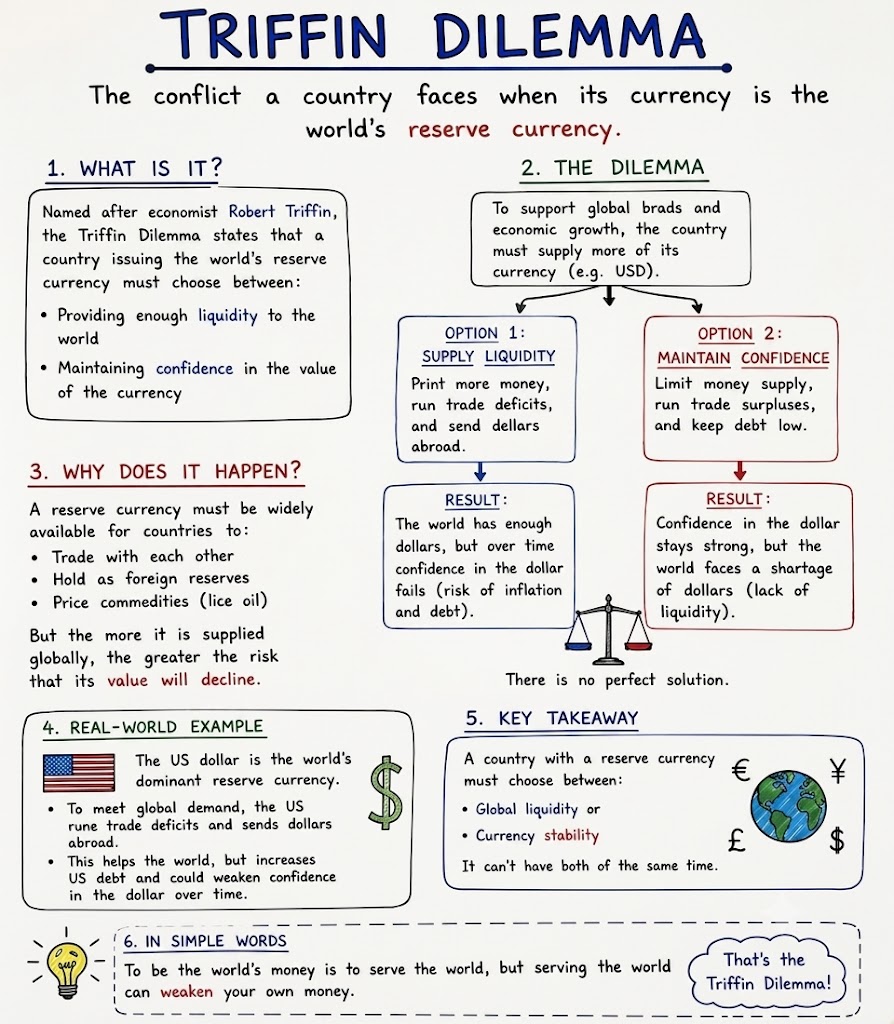
The status of a reserve currency and debt credibility sit on the same scale.
The most fundamental point is this: the credibility of a reserve currency does not come from the promises of the issuing country. It is maintained only when market participants are convinced that the borrowed money can actually be repaid. No matter how many times Secretary Bessent intervenes in the market, he cannot change this calculation. It is no coincidence that Moody’s downgraded the U.S.’s top credit rating in 2025, following Fitch in 2023. The bill for the ’exorbitant privilege’ enjoyed by the reserve currency is now slowly being returned to bondholders around the world.
Is my KRW bank account safe? The calculations of ‘Seohak Ants’ and the National Pension Service
This story doesn’t end with Wall Street headlines. It extends all the way to the bottom line of our asset allocation tables using the Korean Won.
For ‘Seohak Ants’ (individual Korean investors in foreign stocks) and overseas stock investors, even if U.S. big tech stock prices rise, if the dollar’s value falls sharply, the real return converted into won will be eroded by exchange rate losses.
One must distinguish whether a rise in stock prices is the result of true growth in corporate value or an illusion created by the decline in currency value.
Since a significant portion of the National Pension Service and the Bank of Korea’s foreign exchange reserves are held in dollar-denominated bonds, a weaker dollar and valuation losses on bonds directly lead to a burden on national asset health.
Gold prices soaring well past $4,000 per ounce and the simultaneous strength of Bitcoin are in the same context. When trust in the nominal fiat currency system wavers, capital moves toward real, scarce assets without a supply entity—a trend known as the currency devaluation trade.
Only two cards can stop this flow: AI productivity and the Fed
Scenarios are effectively narrowed down to two.
One is the path of lowering the debt ratio by increasing nominal GDP through an AI-driven productivity revolution. However, it will take considerable time for the capital expenditures of hyperscalers to translate into productivity and tax revenue across the industry.
The other is the path where the Treasury’s temporary measures run out, long-term yields spike to the 6~7% range, and mortgage defaults and a corporate bond market crunch become reality, forcing the Fed to undertake emergency Quantitative Easing or Yield Curve Control (YCC), despite the inflation burden. However, by that point, it is highly likely that significant volatility will have already swept through the financial markets.
Secretary Bessent still says, “We haven’t bought a single bond.”
If that is true, then the August announcement of expanded buybacks was nothing more than a signal to the market, and if the market doesn’t believe that statement, it means the market already knows the answer.
The weight of this sentence will be revealed when the Treasury’s actual purchase details for the next quarter are disclosed.
References
- Kim Myung-sil (IM Securities Macro/Bond Analyst), 《The Temperature of Exchange Rates》, 2026
- Robert Triffin, Gold and the Dollar Crisis: The Future of Convertibility, Yale University Press
- CBO, The Budget and Economic Outlook: 2026 to 2036 — https://www.cbo.gov/publication/62207
- U.S. Department of the Treasury, Daily Treasury Par Yield Curve Rates — https://home.treasury.gov/policy-issues/financing-the-government/interest-rate-statistics
- U.S. national debt surpasses $40 trillion for the first time... interest burden rises with high rates
- '$40 trillion' national debt melts Americans' wallets... "Chain impact on loans, taxes, and wages"
- U.S. Treasury Secretary hints at additional response to rebounding bond yields... "Buyback could exceed $4 billion"
- Hedge fund master steps in to defend the dollar... puts out the fire with bond buybacks but
- U.S. debt exceeds $40 trillion... warning of the greatest credit crunch in history
- U.S. Treasury hints at expanding bond buybacks... "Could exceed $4 billion per session"
- Regarding $935 billion in Treasury funds... Bessent says, "We haven't bought a single bond"
- Please Take Care of Kyoyang-i (YouTube), Discussion on U.S. Treasury yield runaway and Treasury buybacks