
The old man in the white suit in front of KFC stores is always smiling.
With his bow tie, white goatee, and cane, his gentle appearance leads many to remember him as a kindly, retired military chef.
However, if you follow Harland Sanders’ actual life story, this image doesn’t quite align with reality.
He was not a soldier, he was once involved in a shootout with a competitor, and after selling the company, he publicly criticized the chicken that bore his name. Even the famous ‘1,009 rejections’ story is different from what is commonly known when you put it in chronological order. The purpose of this article is to measure the distance between the smile on the bucket and the man himself.
Why Colonel Sanders Was Not a Soldier
‘Colonel’ is not a military rank, but an honorary title bestowed by the state of Kentucky.
In 1935, the Governor of Kentucky granted him the ‘Kentucky Colonel’ title in recognition of his contributions to the local community.
His real name was Harland David Sanders. Born to a poor farming family in Indiana in 1890, he lost his father around the age of five and learned to cook while preparing meals for his younger siblings in place of his mother, who was out working. He dropped out of school in the seventh grade.
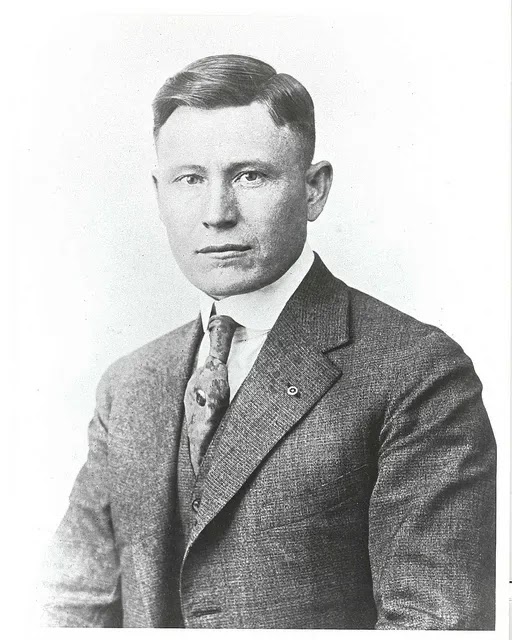
His resume thereafter is more of a list of failures and dismissals.
He worked as a steamboat pilot, insurance salesman, railroad fireman, lawyer, tire salesman, and operated an acetylene lamp business and a ferry service. He was fired from an insurance company for insubordination, quit a railroad job after fighting with a colleague, and his legal career ended after he got into a fistfight with his own client in court. His lamp business was outpaced by the spread of electricity, and his ferry business by the construction of bridges. He was more of a hot-tempered, itinerant businessman than the gentle elder of the myth.
KFC Recipes and Pressure Frying Born in a Gas Station Restaurant
KFC’s origin lies in a gas station in Corbin, Kentucky, in 1930.
When Shell Oil entrusted him with the gas station, Sanders began selling food to passing travelers. It started as serving a few customers at his own table behind the station, but as his Southern-style home cooking and fried chicken gained word-of-mouth popularity, it evolved into a proper restaurant called ‘Sanders Court & Café’.
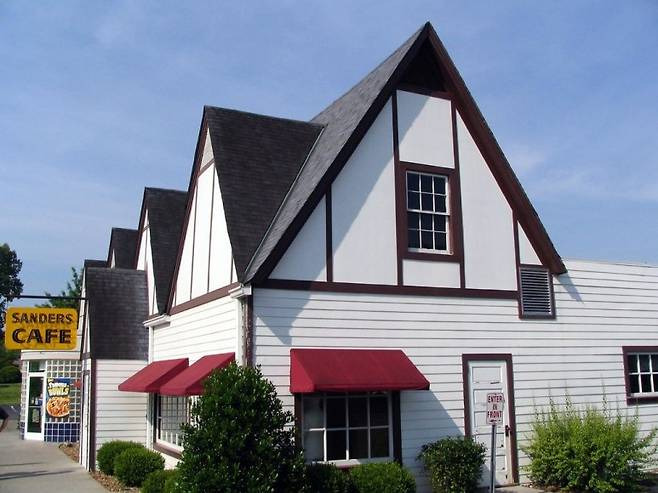
The problem was speed. Pan-frying fried chicken took nearly 30 minutes, making it impossible to keep up with the influx of customers.
Sanders discovered a way to use a pressure cooker, originally intended for cooking vegetables, to fry chicken. High heat and pressure reduced the cooking time to minutes while keeping the meat juicier. The ‘secret recipe’ featuring 11 herbs and spices also took shape in this kitchen around 1940.
Around the same time, an incident occurred that highlighted his volatile side.
When a competing gas station owner named Matt Stewart painted over Sanders’ advertising signs, Sanders rushed to the scene with Shell Oil employees. The argument escalated into a shootout, and one Shell employee was killed by Stewart. Sanders also fired his gun, hitting Stewart in the shoulder. Stewart was sentenced to 18 years for murder, while Sanders escaped punishment.
The ‘1,009 Rejections’ Myth: KFC Franchises Existed Before He Went Bankrupt
The story that a ‘bankrupt 65-year-old man succeeded after 1,009 rejections’ is a myth with a jumbled timeline.
His first franchise actually opened 3–4 years before he lost his restaurant.
In 1952, Sanders served his signature fried chicken to Pete Harman, who ran a restaurant in Salt Lake City, Utah. Impressed by the taste, Harman decided to sell the chicken using that recipe, which became the first KFC franchise.
The name ‘Kentucky Fried Chicken’ was also the idea of Don Anderson, a sign painter hired by Harman, not Sanders.
The trials came later.
In the mid-1950s, the new interstate highway I-75 bypassed the stretch of U.S. Route 25 where the Sanders Café was located, causing foot traffic to dry up.
When Sanders, then in his mid-60s, auctioned off his restaurant in 1956, all he had left was a $105 monthly Social Security check and his recipe. He loaded his pressure cooker and seasonings into his car, visited restaurants, and sold his cooking method in exchange for a royalty of a few cents per chicken.
While the number ‘1,009’ is often cited alongside stories of his hardships during this period of door-to-door sales, it is difficult to find records to support it. It is safer to treat it as a legend.
What is clear is that only after losing his physical restaurant did he pivot to a model of licensing his core asset—the ‘recipe’—separate from a brick-and-mortar shop.
This transition, of reallocating remaining assets rather than clinging to what was lost, resembles the cases of Slack and Instagram discussed in an article about sunk costs and pivoting.
Why Did Colonel Sanders Criticize KFC After Selling the Company?
After selling KFC, Sanders became both the face of the company and its harshest critic.
In 1964, at age 73, he sold the company for $2 million to a group of investors led by John Y. Brown Jr., remaining as a brand ambassador with a lifelong salary.
The new owners tweaked the recipe to reduce costs.
Sanders could not stand it. He would visit stores unannounced and fly into a rage in the kitchen if the taste didn’t meet his standards. In media interviews, he likened the new gravy to ‘pure wallpaper paste’ and disparaged the ‘Extra Crispy’ chicken as just chicken with lumps of fried dough stuck to it. His harsh criticism even led a franchisee to file a defamation lawsuit.
Scenes of a founder’s commitment to quality clashing with a corporation’s cost logic are common, but it is rare for this to happen while the founder’s face is printed on every bucket. The smile on the bucket became the company’s most valuable asset, while the living Sanders became its biggest headache. How to voice uncomfortable truths within an organization is explored from a different angle in an article on psychological safety.
From the 1984 Jongno Store to How Korean KFC Survived in the ‘Republic of Chicken’
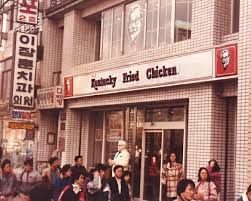
KFC Korea debuted in 1984 with its first store in Jongno, Seoul, as a taste of ‘American flavor’. During a period when Western culture was rapidly entering the country ahead of the Olympics, the Jongno branch became a popular meeting spot for young people and even appeared in the drama ‘Reply 1994’. That iconic first store closed in 2022 after 38 years.
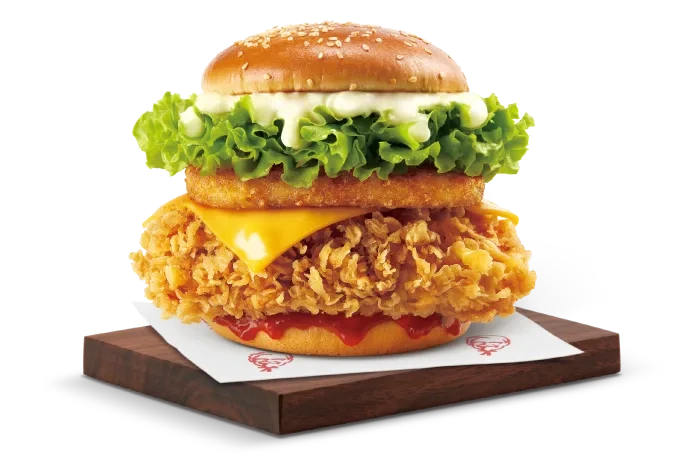
A masterpiece of localization is the Tower Burger, released in 2000. Its hearty composition of a whole breast fillet topped with a hash brown and cheese suited the Korean palate.
There is also consumer-driven localization, such as the ‘Chibap’ (chicken and rice) culture, where people eat salty KFC chicken as a side dish with rice. This is a case where a product permeated food culture without the company explicitly designing it to do so.
It also had to follow the rules of the ‘Republic of Chicken’. In Korea, the standard has become selling small, young chickens whole, a result of a vertically integrated structure where a few large corporations control everything from breeding to processing.
Comparison of domestic and international broiler breeding methods, why Korean chicken is small
| Feature | South Korea | USA / Europe |
|---|---|---|
| Average breeding period | 30–35 days | 45–55 days |
| Average slaughter weight (live) | Approx. 1.5kg | Approx. 2.5–3.0kg |
| Primary sales unit | Whole bird | Grams(g) or cuts |
| Key economic driver | Speed / Turnover | Meat yield / Quality |
The owners also changed frequently.
After being introduced by Doosan, KFC Korea passed through private equity firm CVC and KG Group before being acquired by Orchestra PE in 2023.
After driving up performance through aggressive promotions like ‘Chicken Night’ (1+1 chicken after 9 PM) and introducing a franchise model, Orchestra PE sold 100% of its stake in KFC Korea to the Carlyle Group in April 2026, three years after the acquisition.
The industry estimates the enterprise value of this deal at approximately 460 billion won.
Sanders passed away in 1980 at the age of 90.
KFC promotes that the original recipe he fought to protect until the end is still kept in a vault at the company’s headquarters in Louisville, Kentucky.
References
- HISTORY, 8 Things You May Not Know About the Real Colonel Sanders
- Food & Wine, The Real Colonel Sanders Hated Everything that KFC Became
- VOA Korea, Colonel Sanders' real name is...
- Wikipedia, KFC (Sanders Court & Café 1930, First Franchise 1952)
- Hankook Ilbo, Korea's 1st KFC Jongno Store, Enters History After 38 Years (Jan 2022)
- SBS News, Why are chickens so small... The reason you can't taste big chicken
- Seoul Economic Daily, KFC up for sale in 2 years [Signal]
- Smart Today, Orchestra PE, Successful Exit of KFC Dropped by KG Group (2026.04.17)