
Few people ordering fried chicken today realize that the chicken once stood at the very beginning of a royal dynasty’s lineage.
However, the symbolism of the chicken in Korean history has evolved significantly, starting as a divine messenger that announced the birth of Kim Al-ji in 65 AD, then expanding into a guardian that chases away evil spirits at dawn, a talisman for career advancement related to its comb, and a symbol of fertility and family harmony.
Why Did the Chicken Appear in the Myth of the Silla Kim Dynasty’s Origin?
The chicken first takes the stage in the royal genealogy.
The 『Samguk Sagi』 (History of the Three Kingdoms) records that on a night in the 9th year of King Talhae (65 AD), a chicken’s crowing was heard in Sirim, west of Geumseong. When dawn broke, Hogong went to investigate and found a golden chest hanging from a tree branch, with a white chicken crowing beneath it.
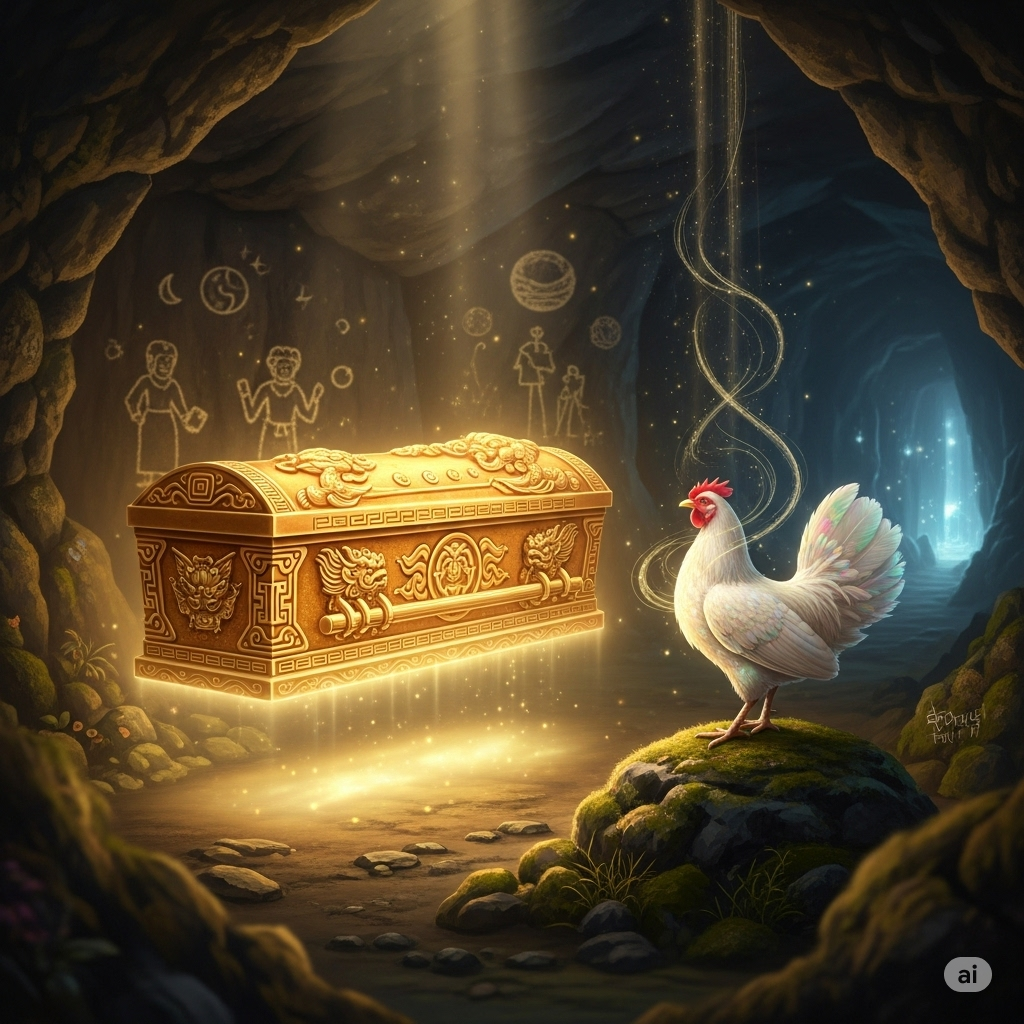
The baby boy found inside the chest was Kim Al-ji, the progenitor of the Silla Kim royal family. The forest was renamed Gyerim, or ‘Chicken Forest,’ and the name Gyerim was even used for a time to refer to Silla itself.
What is noteworthy here is the arrangement of props.
In ancient times, white animals were seen as messengers from heaven, and golden chests represented noble bloodlines. For the Kim clan, who ascended to the throne after the Park and Seok clans, a “certification” that their founder was sent by heaven was necessary, and the cry of the white chicken served as that seal. The chicken thus became more than just a good omen; it became a witness to the legitimacy of the dynasty.
The Guardian Chicken: The Belief That Its Morning Crow Chases Away Evil
Nights without electric lights were the time of ghosts, and the crowing of a chicken was an official declaration that those hours had ended. This is why the National Folk Museum of Korea calls the chicken a ‘symbol of dawn and the exorcism of evil.’ This belief became a custom in everyday life.
- Sehwa (New Year’s Paintings): Paintings of chickens were pasted on gates on New Year’s Day to ward off bad luck for the year.
- Chicken Blood: Red blood was believed to block evil spirits and was sometimes applied to doors or walls.
- Shaman Rituals (Gut): Chickens were used in rituals, such as retrieving the souls of those who drowned, acting as a medium between the living and the spirits.
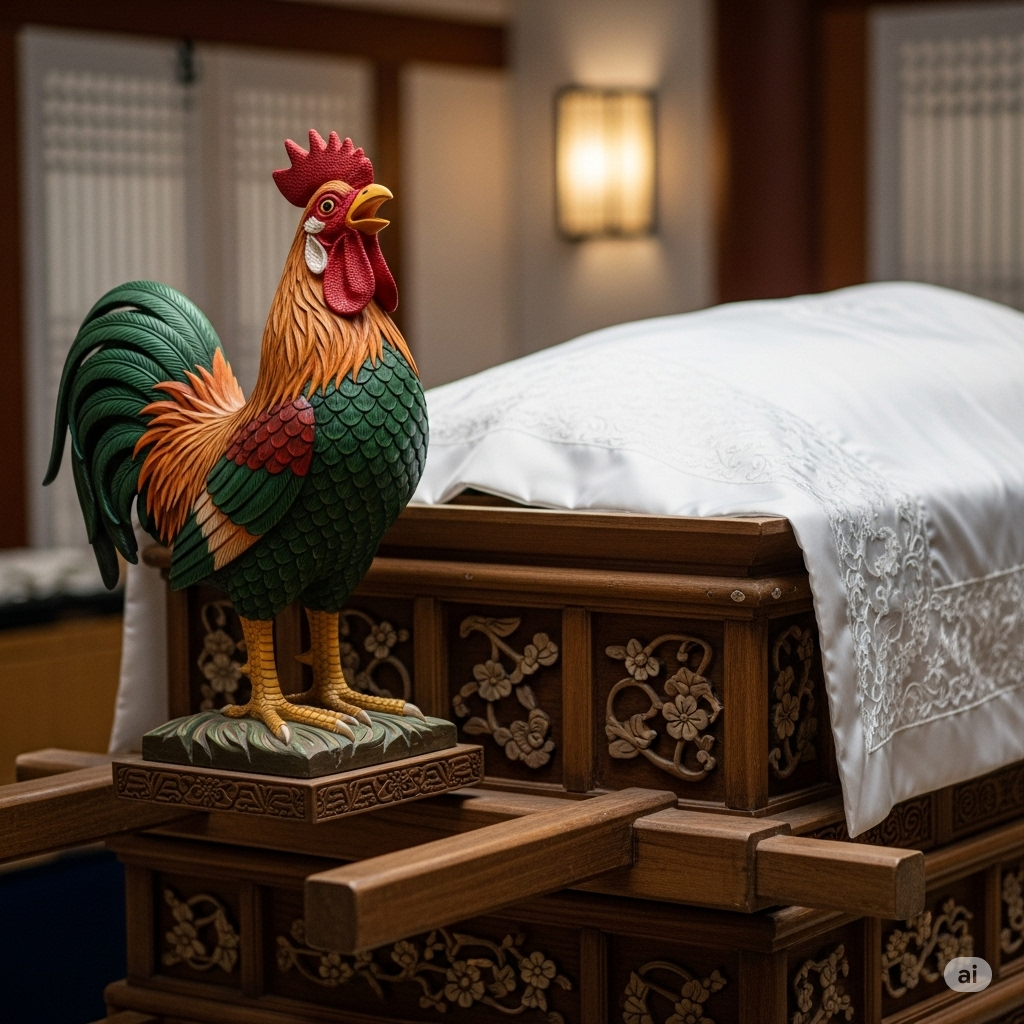
This protective role extended to funerals. The wooden ‘Kokdu’ chicken placed at the front of the funeral bier was a guide that protected the soul of the deceased from evil spirits and brought the dawn to the dark journey of the afterlife.
Wordplay on the Comb: How the Chicken Became a Talisman for Scholar Success
During the Joseon Dynasty, the chicken moved from the realm of the divine to the scholar’s study.
The connection was wordplay. The chicken’s comb is often called ‘byeoseul’ (comb) in Korean, which sounds identical to the word for a government post (‘byeoseul’). The shape of the comb (鷄冠) also resembled the cap (冠) worn by officials. In the Sinosphere, the crowing (鳴) of a rooster (公鷄) was read as a homophone for ‘gongmyeong’ (fame and merit). A painting of a rooster crowing vigorously was, in essence, a cheer of “Make a name for yourself!”
Folk art added other motifs to this wordplay to make specific wishes.
Adding cockscomb flowers (resembling the comb) meant ‘Gwan-sang-ga-gwan’ (adding a cap upon a cap), and adding peonies symbolized ‘Gong-myeong-bu-gwi’ (fame and wealth).
What is interesting is the shift in direction.
In Silla, the chicken was a symbol that only the royal family could possess, but in Joseon, where one could dream of rising in status through the civil service examination, it became a talisman that any scholar with a brush could hang in their study. The symbolism descended from the royal family to the individual.
Fertility and Harmony: Chickens in Wedding Tables and Paintings
Chickens were also called upon for the continuity of the family line.
Traditional wedding tables featured a rooster and a hen wrapped in blue and red silk, representing harmony between spouses, warding off evil, and the hope for prosperous descendants, much like a hen that lays many eggs. If you place the wedding chicken alongside the funeral ‘Kokdu’ chicken, it shows that the chicken followed a person from birth to death.
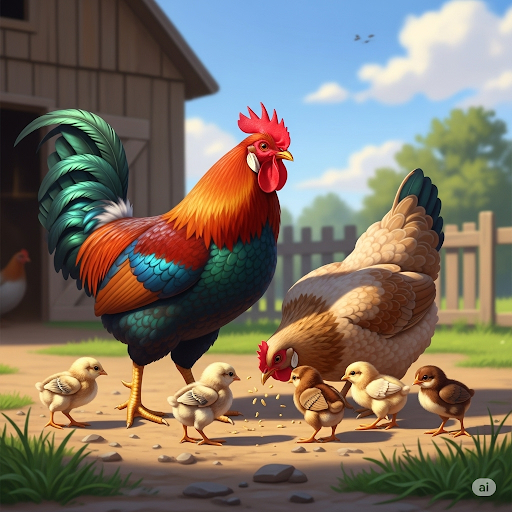
A painting of a rooster and hen with a brood of chicks was essentially a family portrait reflecting the era’s ideal of a multi-generational family.
I find the contrast in this aspect quite profound.
The same animal that was depicted so sacredly was also the most precious food served to a son-in-law by sacrificing a prized broody hen. Sacredness and the dinner table existed within a single bird.
Gye-yu-o-deok: The Five Virtues Scholars Saw in Chickens
Scholars identified five virtues of a gentleman from the habits of the chicken, known as Gye-yu-o-deok (The Five Virtues of a Chicken). The origin comes from the words of Tian Rao in the Chinese text 『Hanshi Waizhuan』. As Joseon scholars frequently cited this, the chicken earned the nickname ’the feathered gentleman.’
Five virtues of the chicken:
| Virtue | Derived from the chicken’s… |
|---|---|
| Mun (Literary) | The comb on the head resembles a scholar’s cap |
| Mu (Martial) | The spurs on its feet are like weapons |
| Yong (Courage) | It does not retreat when encountering an enemy |
| In (Benevolence) | It calls its flock to share when it finds food |
| Sin (Trustworthiness) | It never fails to signal the dawn |
However, the chicken in folk proverbs was not always so noble.
Terms like ‘chicken-headed’ (stupid) or the saying, “If the hen crows, the house falls,” reflect the patriarchal gaze that sought to suppress women’s voices. The ideals of the study and the realities of the yard spoke very differently about the same animal.
Chickens in Royal Tables and Proverbs
For kings in the Annals, the chicken was a food with emotional significance. According to Hwang Gwang-hae’s ‘Korean Food in History’ from the Dong-A Ilbo, King Taejong, unable to forget his son Prince Seongnyeong who passed away early, had a chicken, the boy’s favorite, offered on the memorial table every five days. During the Manchu invasion, King Injo, trapped in Namhansanseong Fortress, heard the sound of chickens in the fortress fading; believing the people were slaughtering them to offer to the King’s table, he ordered that no chicken be served to him.
Chickens are also deeply embedded in the language.
- Instead of pheasant, chicken: Meaning to use something similar when you cannot get what you want.
- Better to be the beak of a chicken than the tail of an ox: From the 『Records of the Grand Historian』 (Gye-gu-u-hu), meaning it is better to be the head of a small group than the tail of a large one.
- The Promise of Gye-seo (Chicken and Millet): Referring to a story about preparing chicken and millet rice for a friend, signifying a simple but sincere friendship.
Why Did Chicken Symbolism Descend from the Sacred to the Mundane?
To summarize: the Silla chicken guaranteed the legitimacy of the dynasty, the folk chicken was a guardian against darkness, and the Joseon chicken became a personal talisman for success and fertility. The flow is one where the ability to possess the symbol expanded from the royal family to the scholar, and finally to the common household.
What made this possible is that the chicken was an animal that was simply too close to home.
Because it was an animal they heard crow every dawn, raised chicks in the yard, and served to precious guests, it was easy to imbue it with meaning.
For the same reason, the imaginary bird that became the symbol of the President, like the phoenix, remained tied to royal power, while the chicken descended into the yard.
References
- Poultry Myth / The Chicken on Earth - History and Value (Part 1), Chuksannews | http://www.chuksannews.co.kr/news/article.html?no=61270
- Kim Al-ji Myth, Woori History Net | https://contents.history.go.kr/front/nh/view.do?levelId=nh_007_0020_0010_0030
- Kim Al-ji Legend, Encyclopedia of Korean Culture | https://encykorea.aks.ac.kr/Article/E0009727
- Chicken, Symbol of Dawn and Exorcism, National Folk Museum of Korea Webzine | https://webzine.nfm.go.kr/2016/12/29/%EB%8B%AD-%EC%97%AC%EB%AA%85%EA%B3%BC-%EC%B6%95%EA%B7%80%EC%9D%98-%EC%83%81%EC%A7%95/
- Symbolism of Our Chickens, LampCook | http://www.lampcook.com/food_story/chicken_story_view.php?idx_no=1-4
- "Cock-a-doodle-doo~" Fun Chicken Stories in Legends, Yonhap News | https://www.yna.co.kr/view/AKR20170125176100805
- Chicken, Encyclopedia of Korean Culture | https://encykorea.aks.ac.kr/Article/E0013763
- [Hwang Gwang-hae's Korean Food in History] Chicken, Dong-A Ilbo | https://www.donga.com/news/Culture/article/all/20160112/75847033/1