
Even with the MI300X offering 192GB of memory, why can’t developers seem to leave CUDA?
The roots of Nvidia’s CUDA monopoly lie not in the chips themselves, but in the “CUDA moat” built since its announcement in 2006. As of October 19, 2026, I’ve re-examined how AMD’s pursuit and regulatory pressures have shaken that moat.
Updating my August 2025 post, I have refreshed my analysis of roadmaps, benchmarks, regulatory status, and the latest news on Run:ai.
Let’s head back to 2006, when the first stone of the CUDA moat was laid.
What is CUDA, and where did the Nvidia CUDA monopoly begin?
Early developers who wanted to use GPUs for calculations beyond graphics had to force-feed them through graphics APIs like OpenGL or Direct3D. Since they had to translate computational problems into graphics terminology, it required significant expertise and made it difficult to fully harness the GPU’s parallel processing power.
In response, Nvidia released CUDA (Compute Unified Device Architecture) in 2006, with the first SDK publicly released on February 15, 2007.
It allowed developers to directly manipulate the GPU’s massive parallel processing units using a language similar to C. This was a watershed moment that lowered the barrier to entry for GPGPU (General-Purpose computing on Graphics Processing Units) and served as the first brick in building Nvidia’s developer-centric ecosystem. The broader trajectory of Nvidia’s evolution from a gaming graphics company to an AI powerhouse is summarized in Nvidia’s 30-Year History: How GPUs and CUDA Became the Heart of the AI Era.
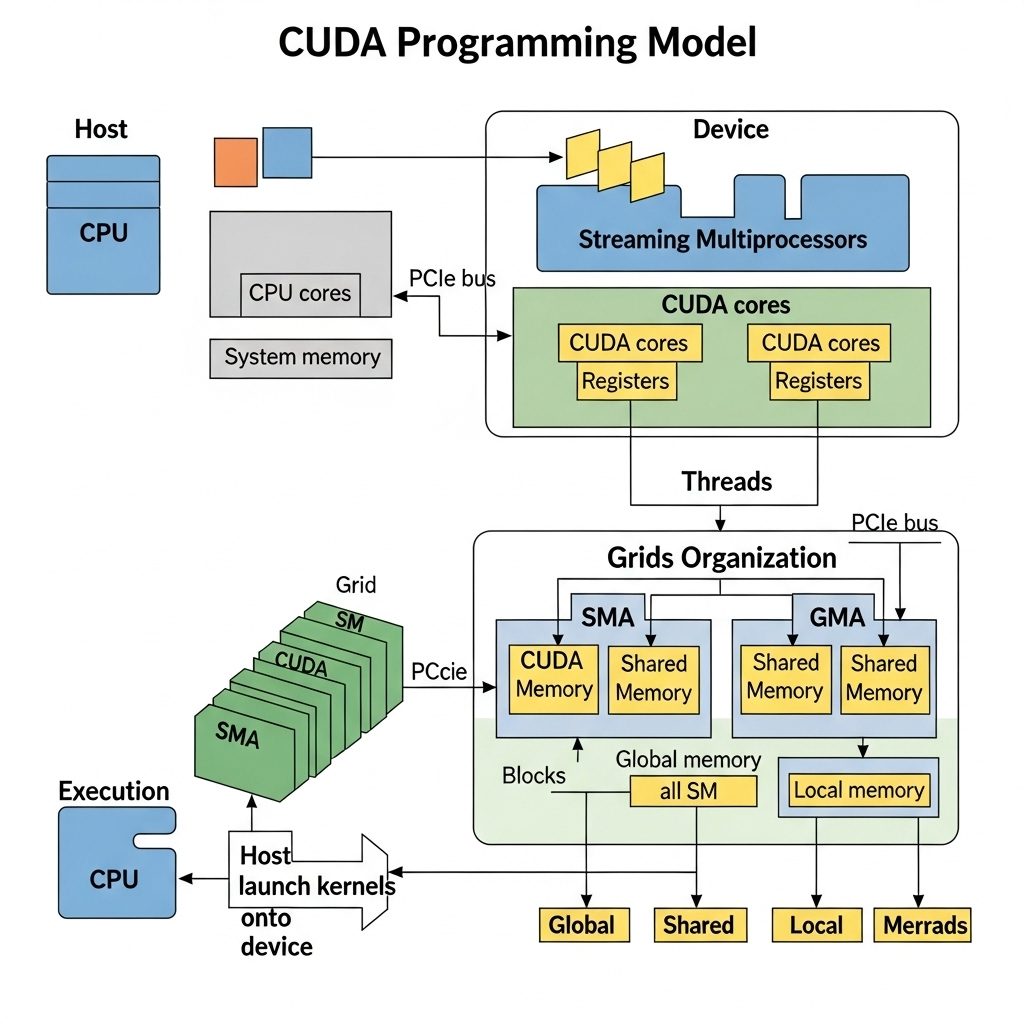
CUDA’s division of labor is simple.
The system’s main processor, the CPU, is the “Host,” and the GPU, which handles parallel computation, is the “Device.”
Functions intended to run in parallel on the GPU are defined with the __global__ keyword, and these functions are called kernels. A typical calculation follows this sequence:
- Copy data from host memory (RAM) to device memory (VRAM).
- The CPU instructs the GPU to execute a kernel.
- Thousands of GPU cores execute the same kernel code simultaneously.
- The results are copied back to the host memory.
Without needing to understand the intricacies of complex graphics APIs, understanding these four steps is enough to utilize the GPU’s computational power. This low threshold is the primary reason why researchers and developers flocked to AI and high-performance computing (HPC).
Why is the CUDA moat so deep: Parallel models, memory structures, and the battle with OpenCL
The reason CUDA is called a software “moat”—and why it is difficult to leave once you start using it—is baked into its design.
It provides developers with sophisticated tools to extract performance while ensuring those tools are perfectly tuned for Nvidia hardware.
- Parallel Processing Model: Threads are the smallest unit of calculation; multiple threads form blocks, and multiple blocks form grids. This method of breaking tasks into tens of thousands of pieces to be distributed across GPU cores requires a shift in mindset; developers accustomed to this model must change not just their code, but their design habits when moving to other architectures.
- Memory Hierarchy: Shared memory, which allows for fast data sharing within a block, acts like a developer-managed cache. It is the key lever for algorithm optimization. Unified memory makes the CPU and GPU memory spaces appear as one, reducing the burden on programmers.
- Compiler and Development Tools: NVCC splits CUDA code into CPU and GPU parts for optimization, while debuggers and profilers run on top of it. Andreas Klöckner’s comparison of CUDA and OpenCL also points to the maturity of debuggers, profilers, and libraries like CUBLAS and CUFFT as major advantages of CUDA.
So, why did the open standard OpenCL, which runs on various manufacturers’ hardware, lose out?
According to Modular’s analysis of CUDA alternatives, OpenCL was released as a specification without a common reference implementation, leading to fragmented implementations across manufacturers. Its committee-driven development made it slow to evolve, and it lacked standard support for AI libraries and tensor cores. For these reasons, it is estimated to be 5–10 times slower than CUDA for AI workloads. I believe this is where the battle was won; portability is a long-term benefit for developers, but the immediate benefit of accessing new hardware features is far more compelling.
Then there is the network effect. More developers mean more libraries, and more libraries attract more developers. As AI researchers released code and papers based on CUDA, it became the lingua franca of the field. Subsequent researchers were forced to learn CUDA to build upon existing work. This is a classic example of platform economics, where investing heavily in developer experience captures market dominance.
The full stack built on CUDA: Libraries, DGX, Mellanox, and Run:ai
Nvidia has layered AI-optimized libraries on top of CUDA.
cuDNN is a library optimized for core deep learning operations like convolution. As noted in the Nvidia Developer Blog (June 2024), PyTorch, TensorFlow, and XLA use it as a performance engine. TensorRT is an inference optimization tool that shrinks and refines trained models for production environments. Thanks to these two libraries, developers can achieve high performance without low-level coding, which in turn binds them even deeper into the Nvidia ecosystem.
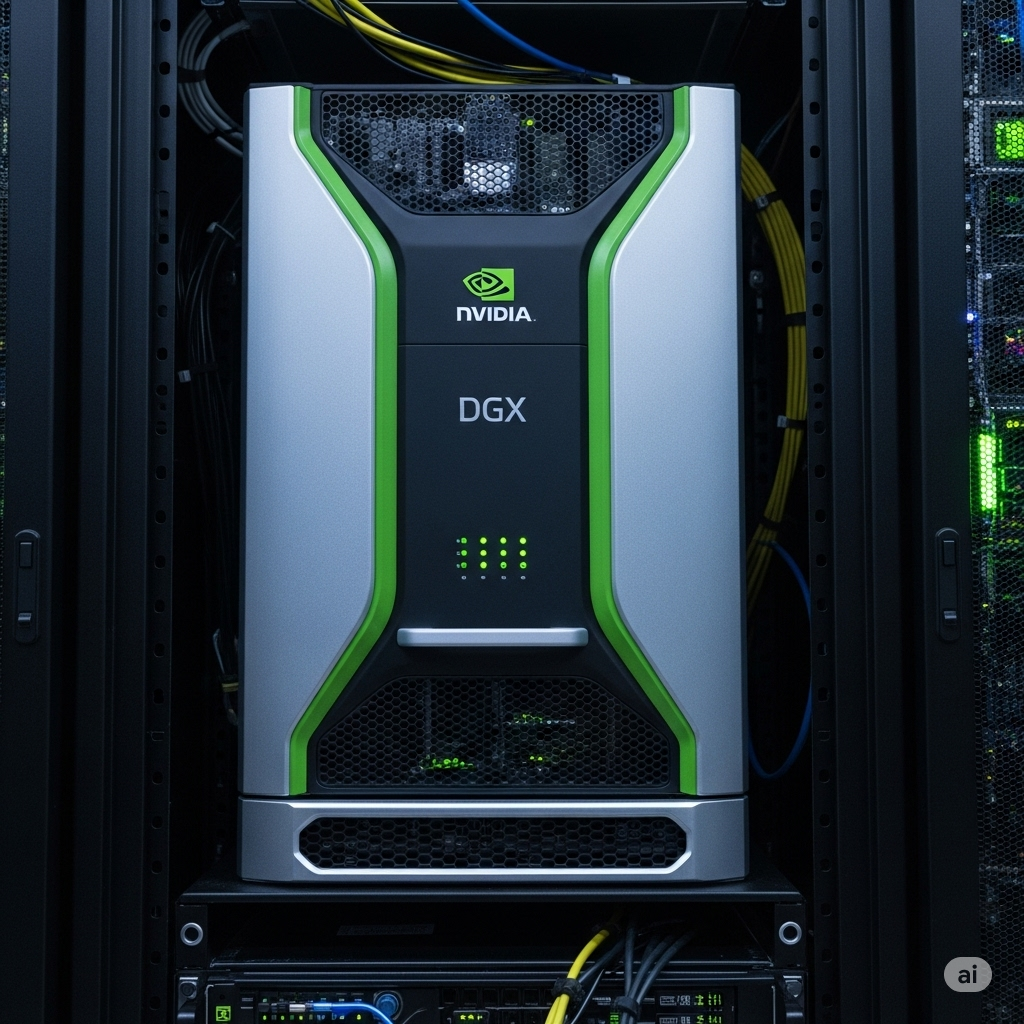
Nvidia doesn’t just sell hardware as individual chips, either.
DGX is a server product line that bundles GPUs with NVLink, high-performance storage, and an optimized software stack. Customers accept higher prices and strong vendor lock-in in exchange for skipping the effort of assembling and stabilizing the infrastructure themselves.
A similar logic applies to software and services.
NVIDIA AI Enterprise, a suite of enterprise software, is sold via per-GPU pricing (subscriptions, perpetual licenses, and cloud usage fees), and DGX Cloud offers DGX infrastructure as a service on top of data centers operated by major cloud providers. Omniverse (digital twins) and Isaac (robotics) are attempts to extend this ecosystem into the physical world.
Networking follows the same trajectory.
Nvidia acquired Mellanox for $6.9 billion, and the State Administration for Market Regulation (SAMR) in China conditionally approved the deal in 2020. Mellanox was a leader in InfiniBand, the standard network technology for high-performance computing. This enabled Nvidia to design not just the communication between GPUs within a server, but also the data paths for clusters connecting hundreds of servers. GPUDirect RDMA, which allows GPUs in different servers to exchange data directly over the network without passing through the CPU, is a prime example. This is a system-level advantage that a company selling only GPU chips would find difficult to replicate.
The story of Run:ai is quite different in 2026 compared to 2024.
Run:ai is a software company that virtualizes GPU resources for efficient sharing. Nvidia pushed to acquire it for approximately $700 million in April 2024 and completed the acquisition on December 30, 2024, following EU approval. At the time of acquisition, Run:ai stated that they would open-source their software so that competitors like AMD and Intel could adapt it for their own hardware. On October 13, 2026, Nvidia released the entire Run:ai platform as open source. It consists of four modules, including the KAI Scheduler. The repository code follows the Apache 2.0 license, while enterprise support remains a paid service.
How one interprets this acquisition is a matter of perspective.
Since software that improves GPU utilization could potentially reduce GPU sales, holding that layer allows Nvidia to ensure that even when customers try to economize, they do so within the Nvidia ecosystem. However, since it has been open-sourced, it is now closer to setting a standard than acting as a gatekeeper. Which view is correct will likely depend on how much this scheduler is actually used on AMD or Intel GPUs.
Three prongs challenging the CUDA moat: AMD ROCm, Intel oneAPI, and abstraction layers
Challengers are divided into three groups based on their strategy: those following CUDA (AMD), those aiming to change the landscape with open standards (Intel), and those building software layers to make hardware swappable (Triton, Mojo).
The first group, AMD, promotes the open-source platform ROCm as an alternative similar to CUDA. The HIP API is designed to allow existing CUDA code to run on ROCm with minimal changes, lowering the barrier to switching. In terms of hardware specs, the MI300X’s 192GB HBM3 and 5.3TB/s outperform the Nvidia H200’s 141GB HBM3e, 4.8TB/s. It is a configuration favorable to Large Language Models (LLMs) that consume a lot of memory. That memory bandwidth and capacity aren’t the whole story is shown by actual measurements. Why HBM has become so important is covered in The HBM War: The Future of the Nvidia and SK Hynix Alliance.
Training benchmarks released by SemiAnalysis on December 22, 2024, quantified the software gap. The conclusion of that article was: while AMD struggles to fill the CUDA moat, Nvidia engineers dig it deeper.
Table 1. Measuring the CUDA Moat: Comparing MI300X and Nvidia H100/H200 (SemiAnalysis, measured Dec 2024)
| Item | Nvidia H100/H200 | AMD MI300X |
|---|---|---|
| BF16 Matrix Multiplication (Actual) | ~720 TFLOP/s | ~620 TFLOP/s (~14% lower) |
| FP8 Matrix Multiplication (Actual) | ~1,280 TFLOP/s | ~990 TFLOP/s (~22% lower) |
| 2-node Training | H100 is 10~25% faster | Gap expected to widen as nodes increase |
| Scale-out Network | InfiniBand | RoCEv2 is ~half speed at 16~256MiB messages |
| Single-node training (Public releases) | >2.5x advantage for some models | Gap narrows with custom builds |
AMD is not standing still while this gap exists.
In the MLPerf Inference 6.0 results announced by AMD on April 1, 2026, the successor product MI355X was on par with the Nvidia B200 in Llama 2 70B single-node offline mode, reaching 97% for server and 119% for interactive. Compared to the newer B300, the figures are 92%, 93%, and 104%, respectively. In a multi-node setup with 11 nodes and 87 GPUs, they exceeded 1 million tokens per second, with scale-out efficiency reported at 93~98%.
Table 2. MI355X Inference Performance against CUDA Monopoly: MLPerf Inference 6.0 Single Node (AMD Announcement, as of April 1, 2026)
| Workload | vs Nvidia B200 | vs Nvidia B300 |
|---|---|---|
| Llama 2 70B Offline | Equal | 92% |
| Llama 2 70B Server | 97% | 93% |
| Llama 2 70B Interactive | 119% | 104% |
| GPT-OSS-120B Offline | 111% | 91% |
| GPT-OSS-120B Server | 115% | 82% |
We must consider that this table contains numbers compiled by AMD from their own submissions. Still, the narrative that “hardware is good but software is lacking” from late 2024 is difficult to maintain for single-node inference. Conversely, there is no recent primary data to verify current training performance and large-scale scalability. It is impossible to conclude that the December 2024 measurements represent today’s ROCm, nor that they are obsolete.
Intel’s oneAPI, the second group, is an attempt to handle CPUs, GPUs, and FPGAs with a single code base built on open standards like SYCL. Intel claims in their own benchmarks (H100 and MI250) that performance remains similar even when moving CUDA code to SYCL.
However, their AI accelerator strategy is shaky. On January 31, 2025, Intel canceled Falcon Shores and pivoted to its successor, Jaguar Shores, without announcing a release date. Open standards with uncertain hardware roadmaps are difficult to sell to developers on the promise of portability alone.
The third group might be the most fundamental threat. It could emerge from the software layer that treats hardware as a commodity. If Python code can perform highly on any GPU, the developer habits that sustain lock-in lose their power.
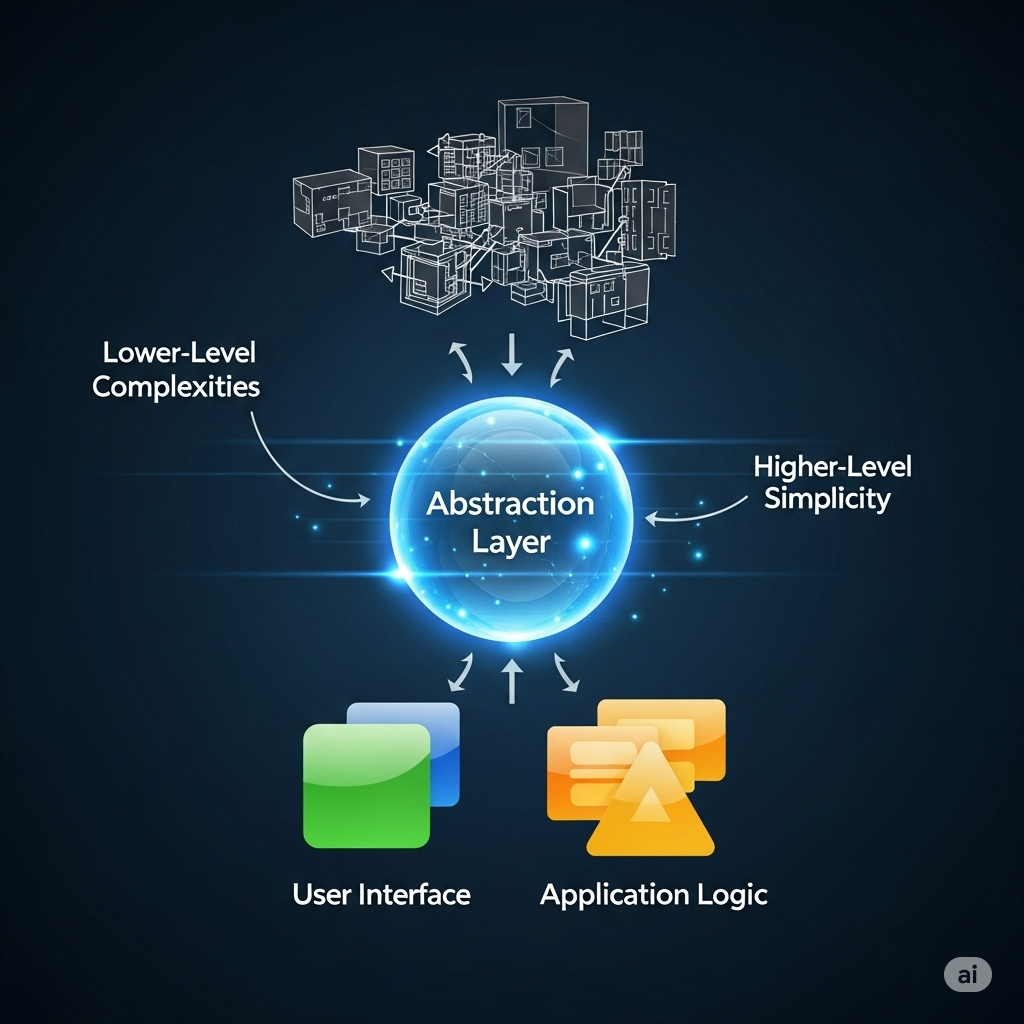
OpenAI’s Triton is an open-source language that writes GPU kernels in a syntax similar to Python. The compiler automatically handles memory coalescing, shared memory management, and scheduling within streaming multiprocessors. When 1.0 was released in July 2021, it only targeted Nvidia GPUs, but now the GitHub documentation lists both NVIDIA (Compute capability 8.0+) and AMD (ROCm 6.2+) as supported targets.
Modular’s Mojo was designed from the ground up on MLIR without relying on CUDA, aiming for the convenience of Python and the performance of C++/Rust. It aims to solve the “two-language problem” where one must use C++/CUDA for low-level optimization. In my 2025 post, I described this language as “early stage,” but at the August 18, 2026 ModCon, Mojo 1.0 was released, and the entire compiler and toolset became Apache 2.0 open source. Modular Cloud services operational workloads on NVIDIA and AMD GPUs, and has added support for AWS Trainium, Google TPU, and Qualcomm accelerators. Qualcomm’s acquisition of Modular, announced on July 29, 2026, has also been completed.
Table 3. Comparing CUDA and Challenger Platforms (As of October 19, 2026)
| Attribute | CUDA | ROCm (HIP) | oneAPI (SYCL) | Triton | Mojo |
|---|---|---|---|---|---|
| Programming Model | C++ extension, Proprietary | C++ based, CUDA-like | C++ based, Open | Python based | Python superset oriented |
| Hardware Support | NVIDIA only | AMD focused | Vendor-neutral | NVIDIA, AMD | NVIDIA, AMD, others |
| Open Source | Proprietary | Open source | Open standard | Open source | 1.0, Apache 2.0 |
| Key Strength | Mature tools/libraries | CUDA code porting (HIP) | Vendor-neutral | High productivity | Single language, Portability |
| Key Weakness | Vendor lock-in | Lack of recent scalability data | Uncertain AI roadmap | Kernel-only focus | 1.0 release, lack of adoption |
I believe the Mojo row in this table has changed the most. A year ago, the cells were “Very Low,” but now they are filled with stable versions, open source, and large corporate acquisitions. However, the name “1.0” does not automatically equate to mass adoption. All I have verified are Modular’s own announcements. There is also competition attempting to carve a path through AI-specific chips outside of the GPU, which I have summarized separately in What is an NPU? Principles of AI-Specific Semiconductors and Global/Korean Competition.
Regulations targeting the Nvidia CUDA monopoly: US, France, and China as of October 2026
In the reports below, the issue is not market share itself, but practices like bundling, exclusive dealing, and strategic acquisitions. I have only recorded what can be verified through the materials I opened; items not directly confirmed in official documents are noted as such.

In the US, it became known in 2024 that the DOJ San Francisco office had issued a subpoena.
The issues include whether Nvidia makes it difficult for customers to switch to other chip suppliers, whether it provides supply and pricing benefits to customers who use only Nvidia products, and the Run:ai acquisition. Nvidia has countered that it “wins on merit” through quality and performance. According to a New York Times report on September 9, 2026, the DOJ sent a request for information to see if the Groq licensing deal, known to be worth about $20 billion, was structured to avoid antitrust review, but no concrete conclusions have been released.
French competition authorities conducted on-site investigations of the graphics card industry in September 2023 and expressed concerns about dependency on the CUDA ecosystem in a 2024 Generative AI report. As of July 2026, the investigation is in the final stages of deciding whether to issue a formal statement of objections, and the possibility of closing the case without charges remains open. Specific charges have not been officially disclosed. The description of “price fixing” in previous versions of this post was removed as I could not verify the basis. At the EU level, the acquisition of Run:ai was approved in December 2024, but I could not find an EU Commission case addressing CUDA bundling.
China’s SAMR launched an investigation in December 2024 into whether the conditions for the Mellanox acquisition were met, and announced in a preliminary probe on September 15, 2025, that Nvidia violated antitrust laws. They did not disclose which conditions were violated, and penalties will be decided after further investigation. Fines range from 1 to 10% of the previous year’s revenue. Given that the announcement came during US-China trade negotiations, it was interpreted as a bargaining chip. As of October 2026, I could not verify the final disposition.
Table 4. Status of Regulations Related to the Nvidia CUDA Monopoly (As of October 19, 2026)
| Jurisdiction | Verified Facts | Reference Date | Unverified |
|---|---|---|---|
| USA (DOJ) | 2024 subpoena, 2026 Groq deal RFI | 2024-09 / 2026-09-10 | Conclusion of 2024 probe |
| France | Decision on formal objections imminent | 2026-07-12 | Specific charges, outcome |
| EU | Run:ai acquisition approved | 2024-12 | CUDA bundling case |
| China (SAMR) | Preliminary antitrust violation found | 2025-09-15 | Final penalties |
Views that the Run:ai acquisition was for “competition suppression” are supported only by reports that the acquisition was part of the DOJ investigation. Furthermore, since the entire software was open-sourced in October 2026, the suppression hypothesis has become harder to justify.
How Nvidia protects the CUDA moat: 1-year cycle roadmaps and selective openness
Nvidia announced at the GTC 2025 in March 2025 that it would reduce its new product cycle from two years to one. The disclosed flow proceeds to Hopper (2022), Blackwell (2024), Blackwell Ultra (2H 2025 system), Vera Rubin (2026), and Rubin Ultra is known to be the second half of the year after Rubin, with Feynman as the next generation. When the cycle shortens, competitors are constantly chasing an opponent whose target keeps moving. It also creates an effect where the entire market moves in line with Nvidia’s roadmap.
Whether the schedule has become reality is the key point to watch in the autumn of 2026. At Computex on June 1, 2026, Nvidia announced that Vera Rubin is in full production and shipping begins this autumn. Jensen Huang denied rumors of delays on July 15, but a brokerage analyst mentioned unverified risks related to SK Hynix HBM4 certification. As of the time of writing, the customer delivery schedule has not been disclosed.
What Nvidia is trying to sell is not just a chip, but a vision. It is the concept that just as companies build factories to make products, in the future, they will have data centers—AI factories—to produce intelligence. Because it is a story that makes DGX and AI Enterprise seem like essential equipment, it can also be read as a marketing narrative that justifies the scale of investment.
Openness is also part of the strategy. Nvidia announced in a blog post on July 17, 2024 that it would transition to open GPU kernel modules starting with R560 drivers, and Grace Hopper and Blackwell require open modules. Maxwell, Pascal, and Volta continue to use proprietary drivers. Added to this is the full open-source release of Run:ai in October 2026. One could interpret this as a calculation to reduce the impression of being a closed-door company under antitrust pressure, but that is just an interpretation. The scope of open source I verified is limited to Linux kernel modules and Run:ai; I found no evidence that CUDA itself or GPU design has been opened.
Will the CUDA moat hold in the future: Three scenarios and signals to verify
Based on the evidence so far, the scenarios are as follows:
- Moat Maintained: In the April 2026 MLPerf, the B300 outperformed the MI355X in some single-node items, and Nvidia continues to lead with a 1-year cycle. If Vera Rubin shipping goes as planned, this scenario gains strength.
- Moat Eroded: The MI355X delivers inference performance similar to the B200, Triton supports AMD, and Mojo 1.0 has been released as open source. These are signals that the software gap is narrowing. The key is whether the same happens in training and large-scale scalability.
- Moat Collapse: This is the case where regulations directly block bundling. I have not verified any of the potential outcomes from the French statement of objections, the final SAMR disposition, or the conclusion of the DOJ investigation, so this remains in the realm of possibility.
In the medium term, Nvidia’s dominance is likely to be largely maintained, and the long-term variable is the open-source abstraction layer rather than regulation. However, the weak link in this judgment is the lack of recent comparisons of training performance and large-scale scalability. The three signals to watch over the next three months are: the actual shipping time of Vera Rubin in the autumn of 2026, whether French competition authorities issue a statement of objections, and the final SAMR disposition.
References
- CUDA
- NVIDIA H200 Tensor Core GPU
- AMD Instinct MI300X
- MI300X vs H100 vs H200 Benchmark Part 1: Training (SemiAnalysis, 2024-12-22)
- MLPerf 6.0: AMD Instinct MI355X GPUs Surpass 1M Tokens/Sec (AMD, 2026-04-01)
- CUDA vs OpenCL (Andreas Klöckner)
- Democratizing AI Compute, Part 5: What about CUDA C++ alternatives? (Modular)
- Accelerating Transformers with NVIDIA cuDNN 9 (NVIDIA Developer Blog, 2024-06-12)
- Nvidia completes acquisition of AI infrastructure startup Run:ai (TechCrunch, 2024-12-30)
- NVIDIA Run:ai Is Now Open Source as Part of NVIDIA DSX AI Factory Platform (NVIDIA Developer Forums, 2026-10-13)
- Nvidia Run Is Now Open Source: What's Free and Paid (TechRepublic)
- NVIDIA Released the Complete Run:ai Platform as Open Source (NeoTeo, 2026-10-16)
- China finds Nvidia violated antimonopoly law in preliminary probe (JURIST, 2025-09-16)
- Nvidia gets DOJ subpoena in escalating antitrust probe (Bloomberg report, 2024-09-04)
- Nvidia reportedly under DOJ investigation over Groq deal (PC Gamer, 2026-09-10)
- France nears decision on potential antitrust charges against Nvidia (PYMNTS, 2026-07-12)
- Intel axes Falcon Shores amid market challenges (TechTarget, 2025-01-31)
- oneAPI: A Viable Alternative To CUDA Lock-in (Intel)
- Introducing Triton: Open-source GPU programming for neural networks (OpenAI, 2021-07-28)
- triton-lang/triton (GitHub)
- ModCon 2026 announcements (Modular, 2026-08-18)
- GTC 2025 Highlights (NVIDIA Blog Korea, 2025-03-20)
- NVIDIA Computex 2026 news bytes: Vera Rubin now in production (ServeTheHome, 2026-06-01)
- Nvidia CEO says Vera Rubin is in production, denies delay (WinBuzzer, 2026-07-18)
- NVIDIA Transitions Fully Towards Open-Source GPU Kernel Modules (NVIDIA Developer Blog, 2024-07-17)
- Nvidia no longer just a chip company... Platform strategy? (Edaily, 2024-03-26)