
A friend of mine recently sold all of his Nvidia stock.
When I asked him why, he said, “It’s not a semiconductor company anymore.” Why would someone call a company that still derives most of its revenue from chips anything else?
The answer was in the announcement on August 10. Nvidia announced it would partner with Apollo, BlackRock, Blackstone, Brookfield, Goldman Sachs, and KKR to create an independent financing platform to mobilize $500 billion in third-party capital for AI infrastructure.
The announcement contained a strange sentence: Nvidia’s compute is an investable asset.
A company that builds chips and a company that defines those chips as investment assets and designs structures to fund them are two different things. The latter is closer to a financial firm than a semiconductor company.

We typically evaluate semiconductor companies based on specific risks: How well are they selling? What are the production costs? Are they ahead of their competitors?
The debate surrounding Nvidia has now shifted to different questions: Who is lending the money to buy these chips? If the money isn’t paid back, who absorbs the loss? These are not questions for a semiconductor company; they are questions for a bank.
If this feels like someone else’s problem, that’s a mistake. Nvidia is one of the largest market cap stocks in the S&P 500. If you own even a single index fund in your 401(k) or national pension, you are already carrying the results of this financing structure.
The names of the six financial firms are also familiar. Goldman Sachs, BlackRock, and KKR are asset managers that handle retirement savings and insurance premiums for individual investors. If they misjudge, the losses eventually return as lower returns on someone’s retirement fund.
Why They Started Acting Like a Bank
Nvidia’s customers lack the capital to handle the ever-increasing demand for GPUs. The cost of building a single data center has already exceeded what individual companies can afford with their own cash.
Morgan Stanley estimated hyperscaler spending from 2026 to 2028 at $3.5 trillion. Apollo views total AI infrastructure capital requirements at over $8 trillion.
This scale cannot be met with equity alone. Debt is required, but banks have long been reluctant to accept GPUs as collateral, as the common wisdom in the semiconductor industry is that the value of old chips drops as new ones are released.
Nvidia wants compute to be treated not as depreciating hardware, but as an investable asset. That way, banks and institutional investors can design loans backed by GPUs, and customers can continue to buy chips using someone else’s money.
New cloud companies like CoreWeave already show the answer. This company has bought GPUs with debt far exceeding its equity. A significant portion of that debt is a loan collateralized by the Nvidia chips themselves. If the collateral value wavers, the entire loan structure shakes with it.
This consortium is not a single integrated fund. The August 10 announcement describes six separate financing platforms. Each financial firm gathers money in its own way and lends it in its own way.
The nature of the six firms is also diverse. Blackstone and Brookfield are strong in data center real estate and infrastructure assets. Apollo and KKR are firms that have designed loans in the private credit market. BlackRock is famous for index funds but has also long operated infrastructure-specific funds. Goldman Sachs is more of a structured finance designer weaving this capital together. While grouped under the name of a single consortium, they are actually six separate businesses operating in different markets in different ways.
It has not been disclosed how much has been raised or exactly how much each company plans to contribute. The partnership remains subject to final contract execution.
At this point, one term must be clarified. The $500 billion mentioned in the announcement is a target, not committed capital. It is not an actually signed contract or a fully executed loan, but rather an upper limit that the six firms have stated they intend to fill. No one can yet answer how large the gap between the target and execution will be.
The numbers themselves are real. The six companies, the $500 billion target, and the condition that it is pre-final contract are all facts. But the fact that the numbers are real and the fact that this structure is safe are two different things.
A Picture We’ve Seen Before
I need to bring up an unfamiliar story—what happened to the telecommunications industry in the late 1990s.
At the time, telecommunications equipment manufacturers like Lucent and Nortel lent money directly to startup telecom companies. With that money, the startups bought the manufacturers’ equipment.
This method inflated reported demand. When customers couldn’t pay back the debt, it was revealed that there was far more capacity than the market actually needed. The market soon collapsed explosively.
The list of companies that went under back then is long. Global Crossing, WorldCom, and NorthPoint Communications filed for bankruptcy one after another. While some involved accounting fraud, the root cause was not misconduct, but the fake demand created by vendor financing.
Today’s AI infrastructure financing and the telecom vendor financing of 30 years ago stand on the same question:
Is this demand real, or is it demand created by the lender themselves?
Nvidia provides capital or guarantees, the customer buys Nvidia hardware with that capital, Nvidia records revenue, and the customer pays it back with future AI revenue the hardware will generate. This is the essence of circular financing.
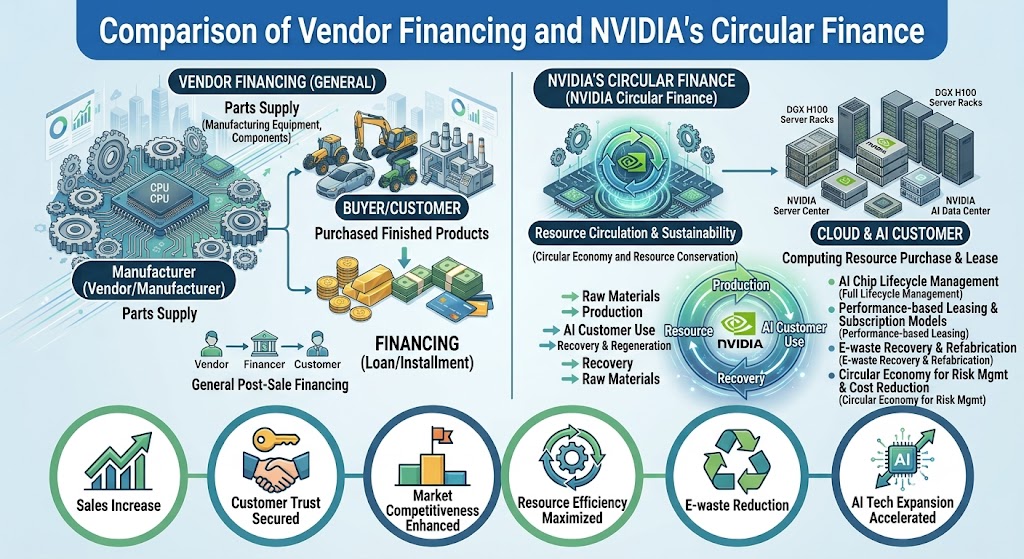
There are differences. In this consortium structure, instead of the old method where Nvidia gave $1 directly to a customer like CoreWeave, who then borrowed $5 to buy $6 worth of chips, the method has shifted to Blackstone giving $5 directly to CoreWeave to buy Nvidia chips.
Bank of America analyst Vivek Arya evaluated this as a pivot intended to move away from the traditional vendor financing that sparked circular financing controversies.
The hand providing the debt has changed. Whether that hand actually took on the risk as its own share is a separate question.
Forbes called this $500 billion “the risk investors aren’t watching.” This is because off-balance-sheet commitments are revealed later and much more opaquely than the revenue and profit numbers reported in earnings releases. Pyxis Investment Management even described this structure as Nvidia’s money-printing machine. If a company that generates revenue also provides the money to create that revenue, it is difficult to verify its own performance.
The Number 25 Percent
Jensen Huang knew of this concern. On the day of the announcement, he stepped forward to explain.
He stated that in some cases, Nvidia could provide residual value support for up to 25% of the opportunity after careful project-by-project evaluation. He added that this support is limited, based on residual value, and serves to supplement—not replace—independent audits.
The wording was cautious. But no one yet knows exactly what this number refers to.
Nvidia has not disclosed the legal form of this support, the fees to be charged, payment conditions, duration, or the calculation criteria for the 25% ratio. The collateral issue also remains unresolved. Until the initial contract is signed and its contents are revealed, this number remains a concept on a term sheet.
What happens if the actual loss exceeds 25%? The answer is nowhere in the announcement. Who absorbs the remaining loss in a scenario where residual value falls significantly more than expected is the most important—and simultaneously the most empty—question in this structure.
The direction of the numbers has changed once before. In a separate data center project between Nvidia and OpenAI, The Wall Street Journal reported that Nvidia reduced its financial backstop from $250 billion to less than $120 billion, and that this guarantee now only covers the first phase of the project.
When the figures were first known, investors reacted strongly. It was only after Nvidia’s stock price fell 5% that management revised it.
The fact that the numbers shrunk can be read in two ways: either it is a sign that the company is flexible enough to respond to shareholder pressure, or it is a sign that the originally proposed number exceeded the amount of risk it could actually handle.
The Old Question of Depreciation
Underlying this structure is an old accounting question: How many years does a GPU hold its value?
Jensen Huang’s answer is clear. He argues that the A100, released in 2020, is still being used commercially six years later, and thanks to continuous improvements via CUDA software, its economic life is approaching 10 years.
He cites rental rate trends as market evidence to support this claim. The annual contract rental rate for H100 rose from $1.70 per hour in October 2025 to $2.35 per hour in March 2026. B200 capacity currently trades between $5.30 and $7.05 per hour.
Other market research confirms the same direction. H100 rental rates, which were under $2 per hour in January 2026, are now approaching $3. The B200, which was slightly under $5, has risen to between $5.50 and $5.80.
Rising rental rates do not necessarily prove durability. If demand outstrips supply, even old chips can be rented out at high prices. This data alone doesn’t distinguish whether the price increase is due to value preservation or simply a shortage of compute.
However, this argument conflicts with Jensen Huang’s own previous remarks. He said as recently as 2025 that once Blackwell shipped, Hopper chips would become worthless.
It also conflicts with depreciation estimates of two to five years suggested by figures like Michael Burry and the IBM CEO. The numbers on the accounting books and the rental rates actually trading in the market are telling different stories.
The same person, regarding the same chip, presented diametrically opposite timetables within a year. One of them is wrong. The $500 billion financing structure is currently standing on the more optimistic timetable.
The 25% residual value guarantee is a mechanism designed to target this very uncertainty. It is a promise that even if chip values fall faster than expected, Nvidia will cover a certain portion. The logic is the same as the residual value guarantees used in the aircraft leasing industry for a long time. The difference is that the aircraft industry has decades of accumulated, agreed-upon data on depreciation curves. There is no such consensus for GPUs.
In the End, Risk Doesn’t Disappear
Nvidia’s financial structure itself has the capacity to handle commitments of this scale. It has a balance sheet that can absorb these commitments in the near term without the risk of insolvency.
The problem is not the financial capacity of one company.
According to Nikkei, the off-balance-sheet obligations of the top five hyperscalers amount to $1.65 trillion. The Wall Street Journal pushed this figure up to $3 trillion.
Even if the term “off-balance-sheet obligations” sounds unfamiliar, the meaning is simple. They are debts the company has taken on that are not captured in the liability section of the financial statements. Long-term lease agreements, long-term purchase commitments, and payment guarantees fall under this category. It also means that investors cannot gauge this scale by looking only at quarterly earnings reports.
This entire massive structure stands on one assumption: that companies like OpenAI and Anthropic can continue to grow and keep raising prices per token.
There is a paradoxical aspect. The very premise that makes this entire financing structure work—the continuous increase in AI revenue—is a subject for which the market does not yet have a reliable way to verify.
Credit rating agencies also have mixed views. Some see this structure as a normal expansion of the private credit market. Others worry that as this debt piles up outside traditional bank balance sheets, problems could grow out of the sight of regulators when a crisis hits. The memory that debt built up outside of oversight helped fuel the 2008 financial crisis is the background for this concern.
If this debt wavers, it won’t end in the GPU market. It will chain-react to construction companies involved in building data centers, utility companies providing power, and credit funds holding those bonds. When the 90s telecom bubble burst, the damage didn’t stop at a few telecom companies; it spread to equipment suppliers and the bond market as a whole.
What happens if companies shift toward cheaper open-source models or self-built models?
Lease payments, credit guarantees, and chip financing don’t just slow down gradually. As maturities arrive against revenue that never appeared, this entire structure could unravel all at once.
Of course, there are counterarguments. The decisive difference between the 90s telecom bubble and now is actual usage. A significant portion of the fiber optic cables laid back then were placed before demand followed. Today, GPU utilization is already high. Companies like OpenAI, Anthropic, and Google are actually consuming compute every month, and revenue is being generated on top of it. The real question is whether this revenue will grow fast enough to handle the debt that has accumulated, not whether the demand itself is a fiction.
Michael Burry calls this entire structure a Wall Street shell game. He compares it to the circular financing and complex structures seen in past bubbles.
But one question he poses is worth chewing over, even for those who don’t agree with his conclusion:
Where does the risk go? Risk does not disappear just because it moves away from Nvidia’s balance sheet.
There is a part of the story about Lucent and Nortel from 30 years ago that is most often forgotten. Their downfall was not a scam.
The reason telecom vendor financing collapsed was that the demand assumptions were wrong. The vendors who financed that demand simply had to bear the results; it wasn’t due to misconduct.
The $500 billion structure we are watching now is not a scam either. It stands on actually existing data centers, actually existing chips, and actually existing demand.
However, the assumptions supporting that structure are essentially the same as the ones they believed in 30 years ago, just in a different form: the belief that future demand will be as certain as the money being borrowed today.
The reason Nvidia appears to be moving from a semiconductor company to a financial firm is simple. A semiconductor company has no responsibility for what happens after it sells a product. A financial firm must hold the risk until the money returns even after it has lent it out.
What Nvidia is promising with the 25% figure is exactly that latter responsibility.
How heavy this responsibility is will be revealed the moment the initial contracts are made public. Until then, the 25% figure and the $500 billion target remain unverified promises.
I think I understand why my friend cleared out his stock. He knew how to calculate the risk of a semiconductor company, but he didn’t know how to calculate the risk of a financial firm.
Perhaps even the six financial firms that agreed to join this consortium haven’t yet calculated exactly how much risk they have taken on.
On the day that calculation ends, the person most likely to receive the results first is not a consortium executive, but an ordinary investor holding an index fund.
This article is not an investment recommendation, and the cited figures and projections are based on the timing of each source. Please make investment decisions carefully at your own responsibility.
References
- NVIDIA Newsroom, 'NVIDIA Partners With Apollo, BlackRock, Blackstone, Brookfield, Goldman Sachs and KKR...', 2026.08.10
- NVIDIA Investor Relations, Same press release version
- CNBC, 'Nvidia is trying to quiet circular financing accusations. Wall Street is unsure it will', 2026.08.11
- Invezz, 'Nvidia stock stabilizes after Monday's fall: are circular financing fears fading?', 2026.08.11
- MLQ News, 'Nvidia's $500 billion AI financing plan is a platform target, not committed capital'
- BigGo Finance, 'Nvidia's $500 Billion Compute Financing Push Draws Skepticism Over Depreciation Math'
- Built In, 'What Does Nvidia's Latest Circular Financing Plan Mean for the Economy?'
- Yahoo Finance, 'Nvidia's Circular Financing Web Gets Even Wider'
- Forbes, 'Nvidia AI Financing Is The $500 Billion Risk Investors Aren't Watching', 2026.08.16
- Investing.com, 'Nvidia Circular Financing: Should the Markets Panic?'
- Pyxis Investment Management, 'Nvidia's Money Machine: Should You Worry About Circular Financing?'
- CloudZero, 'Nvidia H100 price in 2026: buy, rent, and what Blackwell did to the market'
- WCCFTech, 'What GPU Depreciation? NVIDIA A100, H100, And H200 GPU Rental Rates Continue To Price Upwards'
- Digital Citizen, 'NVIDIA A100, H100, and B200 Rental Prices Rise as AI Demand Stays Strong'
- Globaldatacenterhub, 'Nvidia's $500B AI Infrastructure Financing Platform'