
Beyond the Screen, Into a New World
For a long time, artificial intelligence (AI) has been like a smart ghost beside us. It wrote texts, created images, and performed complex calculations in an instant. However, it has never brewed a cup of coffee or organized scattered books by itself. This is because it did not exist in the physical world like us.
Now, everything is about to change. AI is finally leaving its comfortable home in the digital realm and beginning to step into the real world, where it can breathe alongside us. We are entering an era where AI has ‘hands and feet,’ marking the dawn of the Physical AI revolution.
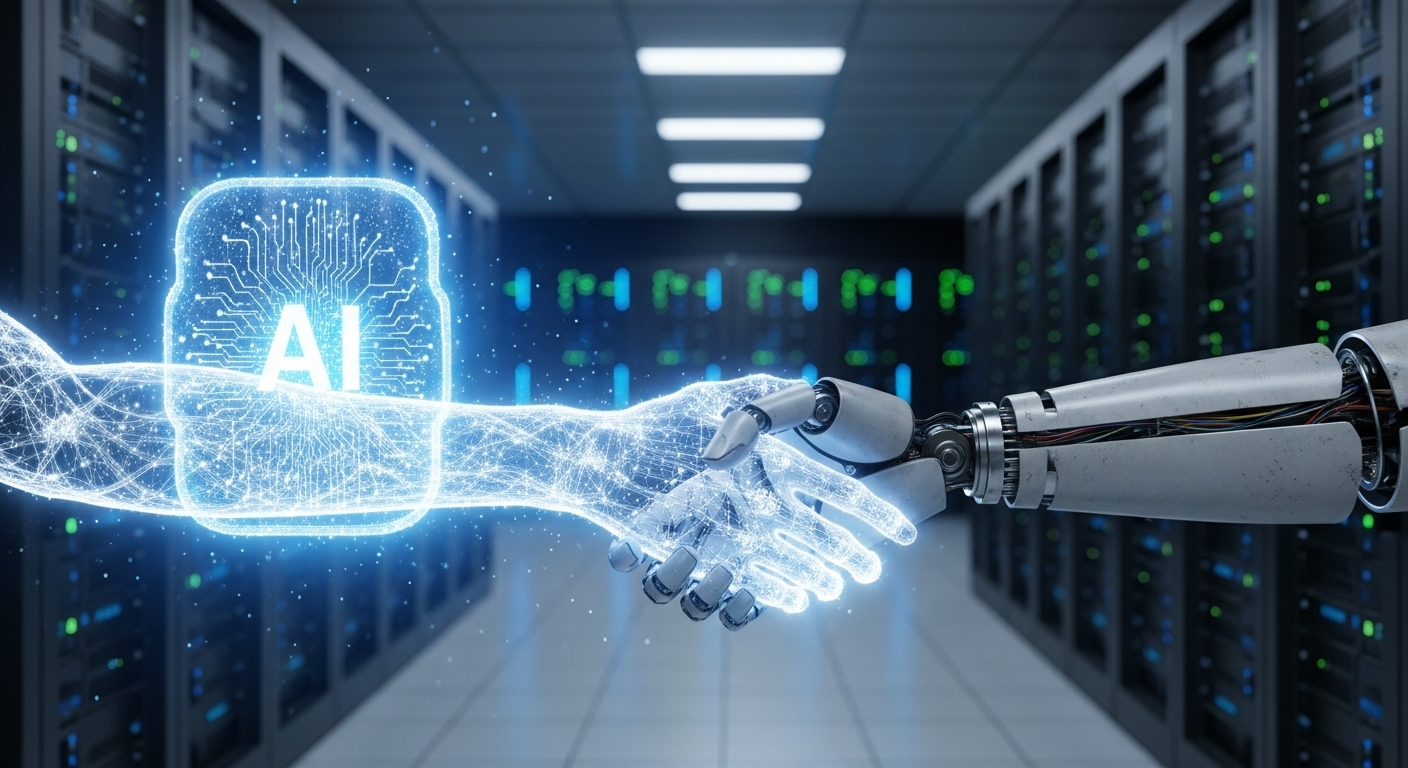
This does not simply mean the emergence of ‘smarter robots.’ It signifies the moment when the robotics industry, which has developed slowly for decades, receives a powerful heart in the form of AI and is reborn as a multi-trillion-dollar market. In this wave of massive change, declared by NVIDIA’s CEO Jensen Huang as ’the next chapter of AI,’ where should wise investors set their sails?
This narrative will unfold the map of a new continent called Physical AI, serving as a guide to explore where future treasures are buried.
Chapter 1: The Rebirth of Giants, From ‘Robotics’ to ‘Physical AI’
Can changing a name change one’s destiny? The name ‘Physical AI’ carries such magical power.
For decades, the term ‘robotics’ has been associated with images of large, clunky robotic arms in factories or automation machines that only repeat predicted paths. It sounded attractive but somewhat cold and like a story from a distant future.
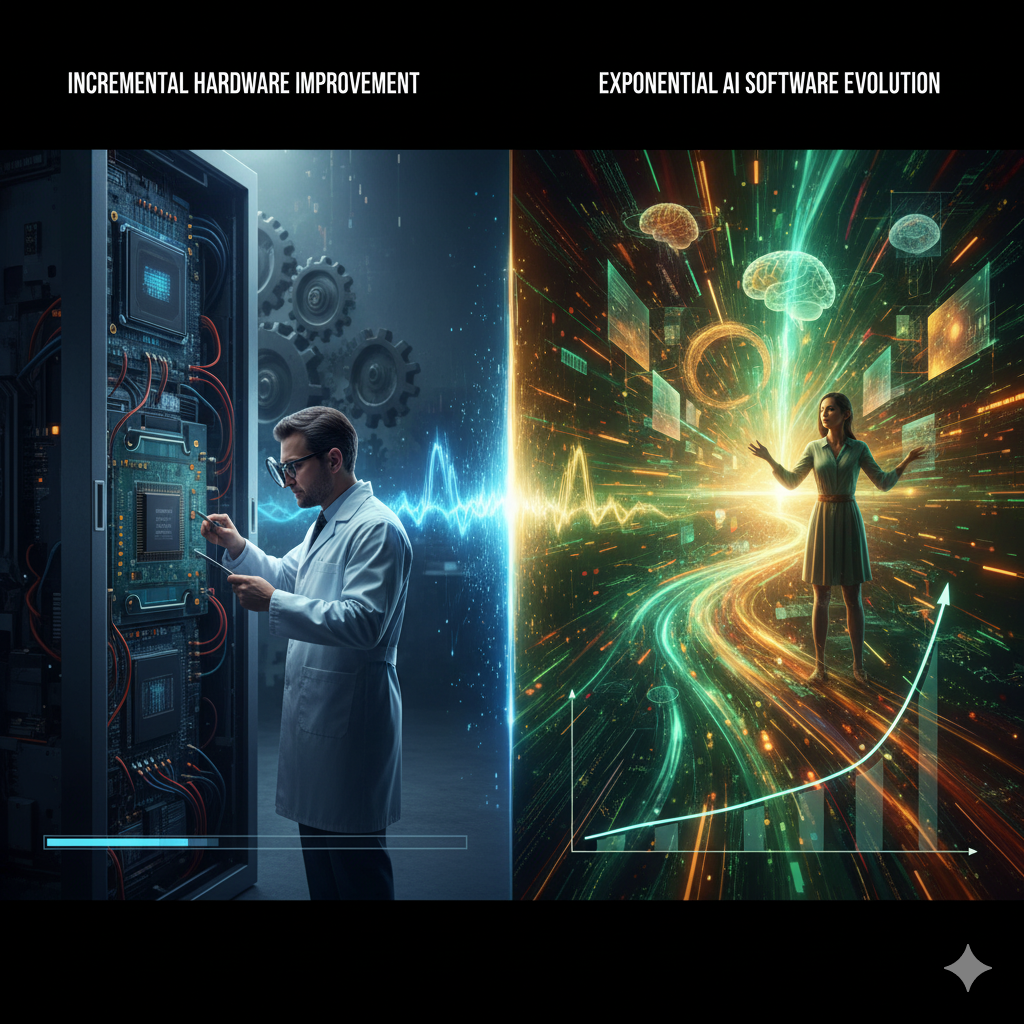
However, NVIDIA has replaced this old sign with a dazzling neon sign that reads ‘Physical AI.’ The moment the two letters ‘AI’ are attached, this field receives the direct glow of the hottest AI industry in the world. Massive capital and the best talents in the world began to flock, saying, ‘Ah, that is the new territory AI will pioneer!’
Chapter 2: The Architect of the World, NVIDIA’s Grand Plan
During the gold rush of the 19th century, the people who amassed the greatest wealth were not the miners digging for gold. They were the ones selling sturdy jeans and pickaxes to those miners. In this new gold rush era of Physical AI, NVIDIA is taking on the overwhelming role of creating those ‘jeans and pickaxes.’
Instead of focusing on creating a specific robot, NVIDIA is designing a vast ecosystem that will power all robots in the world.
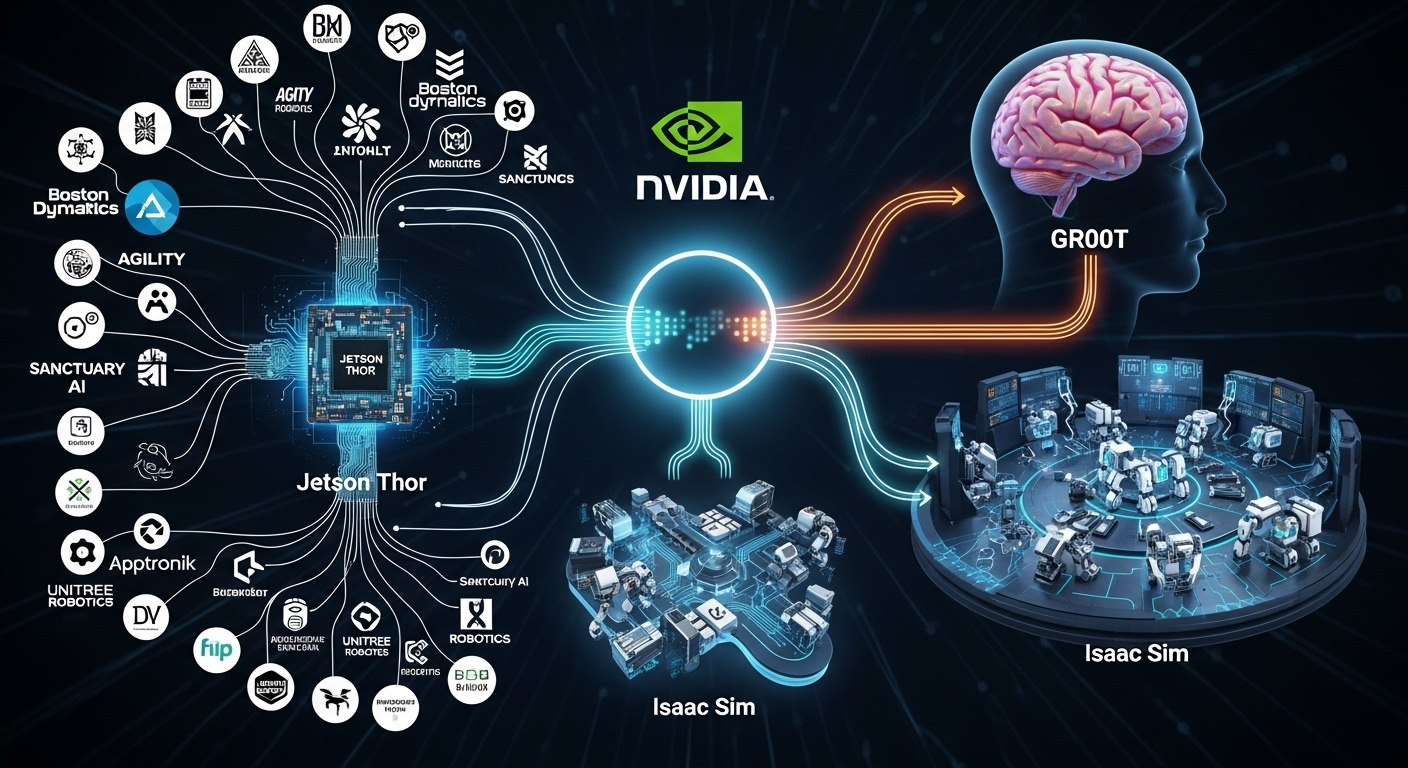
- One Mind (Brain): Project GR00T
- A foundational model that dreams of a ‘universal operating system (OS)’ to be embedded in all humanoid robots, akin to how Android or iOS operates on smartphones. It represents the common soul of robots that understand human speech and learn from observing actions.
- Dream Training Ground (Virtual World): Isaac Sim & Lab
- A virtual world where robots can safely learn by falling and making mistakes millions of times before entering reality. Thanks to this ‘digital twin,’ which replicates the laws of physics in reality, the costs and time of robot development are dramatically reduced.
- Lightning-Fast Nervous System (Chipset): Jetson Thor
- A chip that acts like the heart, enabling the massive brain (GR00T) to respond instantly and without delay within the robot’s body. It is the key to perfectly unfolding the wisdom learned in the cloud into the real world.
It is still uncertain which robot company will emerge as the ultimate winner. However, regardless of who wins, it is highly likely that NVIDIA’s technology will be deeply embedded in the heart, brain, and nervous system of that robot. NVIDIA represents the most reliable and stable ‘infrastructure’ investment in this revolution.
Chapter 3: Two Paths, How is the Soul of a Robot Created?
The biggest mountain in the journey of creating smart robots is ‘data.’ For robots to learn about the real world, they need countless experiential data from interactions with humans and the environment. However, obtaining this data is an incredibly expensive and time-consuming task.
To solve this ‘data dilemma,’ two giants in the market are engaged in a fierce ideological battle, each presenting different philosophies.
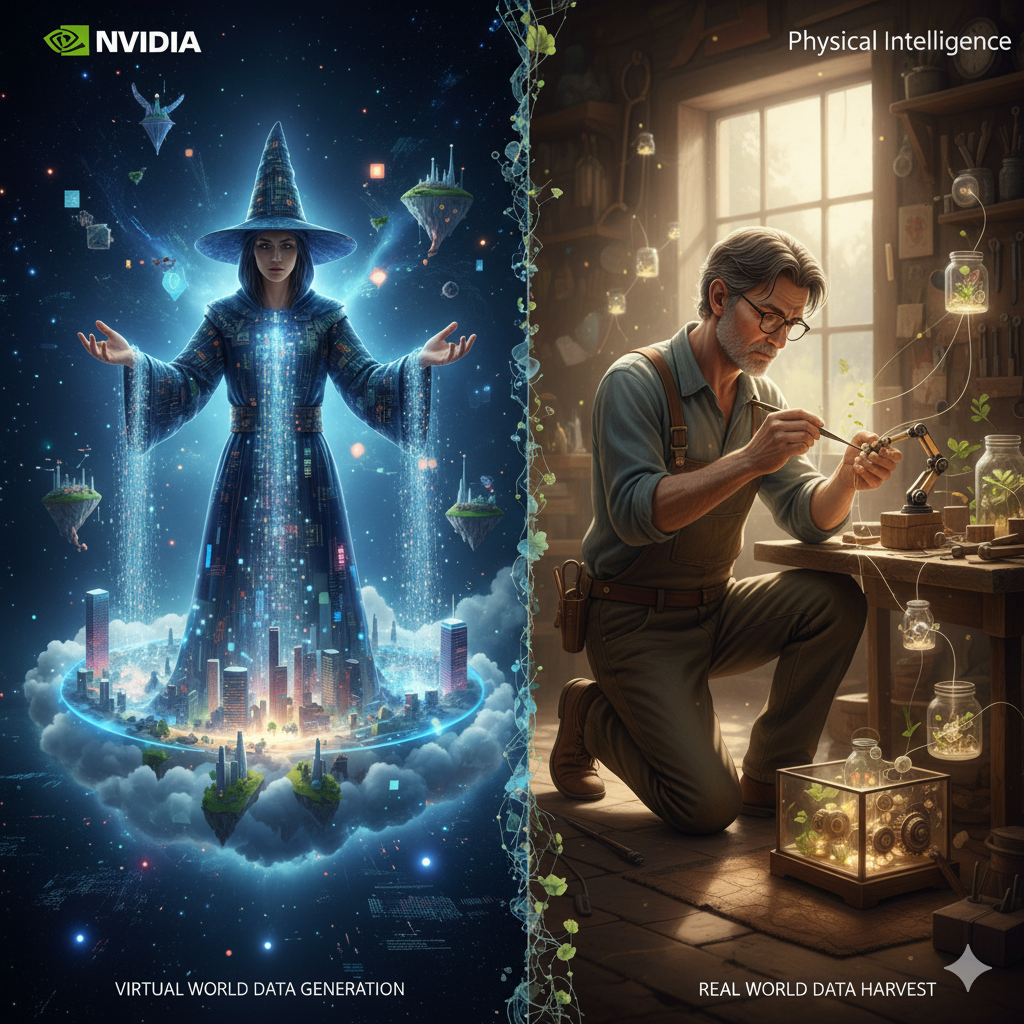
Approach 1: Perfecting in the Virtual Realm (NVIDIA & Skild AI)
NVIDIA finds its answer in ‘Synthetic Data.’ In a sophisticated virtual world called Isaac Sim, it ‘creates’ data that is almost identical to reality in near-infinite quantities. It trains robots by generating hundreds of thousands of variations of actions that a human would demonstrate in just 10 hours, a true magic of data.
- Advantages: Overwhelming speed and scale. Capable of learning even in dangerous situations that are impossible in reality.
- Limitations: ‘Sim-to-Real Gap.’ No matter how sophisticated the virtual world is, there remains a fundamental question of whether it can capture the subtle differences of the real world 100%.
Approach 2: Only Real Experience is Truth (Physical Intelligence)
On the other hand, challengers like ‘Physical Intelligence (π)’ argue that virtual data is merely ‘fake.’ They believe that only ‘real-world data’ collected by humans directly controlling robots can teach them true physical senses. Like artisans crafting luxury goods stitch by stitch, they build robots’ intelligence with the highest quality data.
- Advantages: Extremely high quality of data, potentially leading to stronger performance in the real world.
- Limitations: Slow data collection speed, high costs, and difficulty in scaling.
The winner of this data war will determine the future of the Physical AI industry. This is a key variable that investors must closely monitor when evaluating companies.
Chapter 4: Four Players, Each Betting on the Future in Their Own Way
On the grand stage of NVIDIA, players are pioneering the future with different survival strategies. Investors can discover various opportunities by understanding their strategic differences.
| Category | NVIDIA | Skild AI | Figure AI | Physical Intelligence (π) |
|---|---|---|---|---|
| Strategic Archetype | Ecosystem Designer | Platform Expert | Vertically Integrated Product | Data Purist |
| Core Metaphor | ‘Levi’s’ of the Gold Rush | ‘Killer App’ on Robot OS | ‘Apple iPhone’ of Robotics | Owner of Exclusive Oil Fields |
| Business Model | Platform/Chip/SW License | Specialized AI Software License | Complete Robot Sales/Services | Data-Driven AI Model License |
| Core Competence | Full-Stack Infrastructure | Specialized ‘Brain’ for Specific Industries | HW/SW Integration Optimization | Irreplicable Real-World Data |
| Investment Appeal | Stability: Growth of the entire market | Growth: High-Margin SW Business | Dominance: Strong Brand in Specific Markets | Potential: High-Risk, High-Return |
Case 1: Selling a Smarter ‘Brain’ (Skild AI)
Skild AI takes NVIDIA’s universal brain (GR00T) and fine-tunes it for very sophisticated tasks, much like semiconductor processes. Instead of a general-purpose doctor, it creates and sells specialized AI optimized for specific fields, akin to a ’neurosurgeon.’ This marks the beginning of the robot industry’s ‘app store’ business.
Case 2: Selling the Perfect ‘One’ (Figure AI)
Figure AI develops its own robot (Figure 01) and operating system (Helix) from start to finish. By closely integrating hardware and software, it achieves the best performance and stability, employing a strategy similar to ‘Apple.’ It is gaining market trust by providing complete product solutions that can be immediately deployed in BMW factories.
Chapter 5: Into Our Lives, A Journey Towards the Future
Before these smart robots can enter our living rooms beyond factories, several mountains must still be crossed.
- Mountain of Technology: Technology must be perfected to overcome the subtle differences between virtual and real, make judgments in complex situations, and ensure absolute safety alongside humans.
- Mountain of Society: The spread of Physical AI will bring significant changes to the manual labor market. While it could be the key to solving labor shortages in an aging society, social consensus and preparation for job transition issues that may arise in the process are essential.
Commercialization will unfold as follows:
- Stage 1 (Present~3 years): Performing clear tasks in predictable spaces like factories and logistics centers.
- Stage 2 (3~7 years): Expanding activity into spaces with slight variables, such as retail stores and hospitals.
- Stage 3 (7 years and beyond): Becoming true partners that assist us in unpredictable everyday spaces like homes and public places.
Final Playbook for Investors
The grand voyage of the Physical AI revolution has just begun. The era of fragmented technological experiments is fading, and a new era is dawning where entire industries operate on massive platforms. Here are three key compasses for investors to succeed in this transitional period:
- Get on the Platform: The most stable investment that won’t be swayed by the rise and fall of individual robots is to invest in the foundation that makes all this possible, namely NVIDIA’s ecosystem.
- Find Gems in the ‘App Store’: Specialized software companies (e.g., Skild AI) that solve high-value problems in specific industries on NVIDIA’s OS have the potential to lead the second wave of growth.
- Read the Data Strategy: When evaluating all Physical AI companies, the first question to ask is, ‘What data are they collecting, how are they collecting it, and how are they utilizing it?’ The data strategy is the very essence of that company’s future competitiveness.
As intelligence takes its first steps into the real world, investors who read the flow of change and board the right ship will be the first to grasp the vast map of wealth that the next industrial revolution will create.