
As I peel a roasted egg and sip on icy sikhye, the scene sometimes feels surreal.
When did it become so natural to enter a communal bath with strangers and sweat together in the same sauna?
There is a standard sentence that almost always accompanies the claim that ‘Koreans have always loved bathing.’
It is often said that Goryeo people bathed three or four times a day. You can find this in encyclopedias and countless blogs. However, the original text of the Goryeo Dogyeong (Illustrated Account of Goryeo) by the Song Dynasty envoy Xu Jing, which is the source of this claim, does not contain those numbers.
So, I want to change the question this time.
Koreans have been washing in every era.
What changed over time is something else entirely: in front of whom you were allowed to reveal your body.
Why is the first scene of Korean bathing culture a myth?
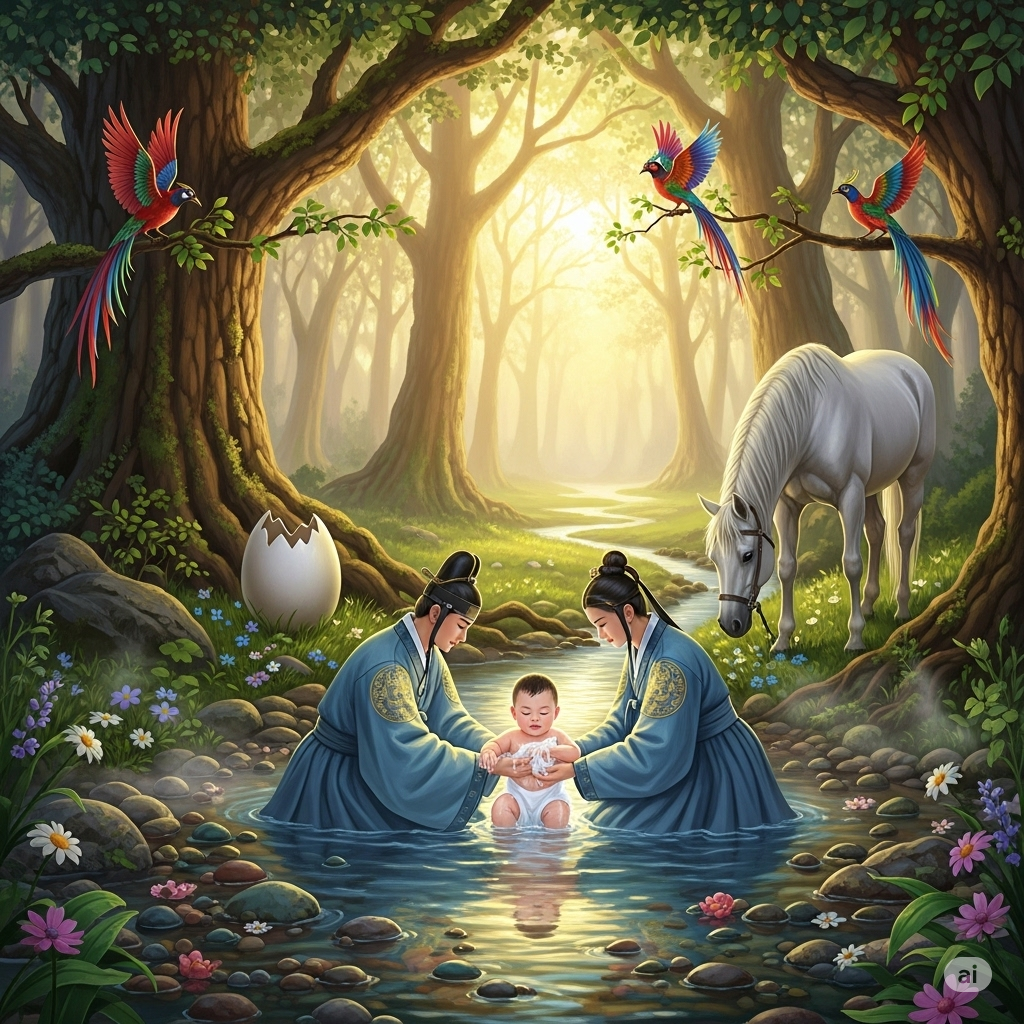
The oldest recorded instance of bathing in Korea was not for hygiene, but a ritual for creating kings.
According to the Samguk Yusa, when the newborn Park Hyeokgeose was bathed in Dongcheon (East Spring), his body glowed, and when Aryeong, who was born with a beak-like mouth, bathed in Bukcheon (North Stream), the beak fell off.
It is a belief that once you enter the water, you become a different being.
This belief solidified into a lifestyle rule with the arrival of Buddhism.
As mokyok-jaegye (bathing and fasting before ancestral rites or prayers) became a religious precept, Silla people bathed more frequently. The Encyclopedia of Korean Culture’s entry on ‘Bathing’ explains that as a result, large public baths were built in temples, and bathing facilities appeared in homes.
What caught my eye in the same entry was a record of bathing used as a punishment.
When a Silla official named Ikseon abducted a nangdo (youth group member) named Deugo and refused to return him, Jukji-rang attempted to punish him. When Ikseon fled, they caught his son instead and forcibly bathed him.
The encyclopedia interprets this as a trace of the belief that cleansing the body also cleanses the heart. It was an era where washing someone was synonymous with washing away their sins.
Goryeo bathing culture in Goryeo Dogyeong: ‘Three or four times a day’ is not in the original text
What Xu Jing actually wrote was, “They bathe first thing in the morning before stepping out, and in summer, they wash twice a day.”
Visiting Gaegyeong in 1123 as part of an envoy and staying for about a month, he recorded this scene in the 23rd volume of Goryeo Dogyeong, titled ‘Han-tak’ (Washing and Laundering). A translation introduced by the Kyeongin Ilbo even mentions that Goryeo people used to mock the Chinese for being dirty.
Since a foreign envoy reported, “These people make fun of us for being dirty,” the Goryeo people’s pride in bathing was not an exaggeration.
So, the number is what’s incorrect. Once in the morning, twice in summer. Even that is a surprising frequency by 12th-century standards, but ’three or four times’ is not found in the original translation.
One must read the section on mixed bathing with caution.
Xu Jing wrote that men and women gathered in streams without distinction, leaving their clothes on the bank and exposing their bodies without considering it strange. Translations of the term ‘seollo’ (褻露) used here vary between ’naked’ and ‘in undergarments.’ Either way, the fact remains that exposing one’s body in front of others was outside the realm of shame.
Bathing for the upper class went a step further into beauty care.
Children were bathed in peach blossom water to brighten their skin, and adults—not just women, but men as well—used nantang (orchid-infused water) to soften their skin and impart a scent to their bodies.
I have detailed how bustling the international port of Byeongnando at the mouth of the Yesung River was—where Xu Jing’s party docked—in a separate post about the history of trade on the Korean Peninsula. It doesn’t seem like a coincidence that a nation open to the outside world was also open about the body.
Did Joseon bathing culture disappear, or did it hide under clothes?
People of the Joseon Dynasty did not stop washing; they just stopped undressing.
As Neo-Confucianism became the state ideology, exposing one’s bare body became a violation of etiquette, and people washed their bodies in parts while keeping their clothes on. This is why large tubs and basins were made rather than giant bathtubs.
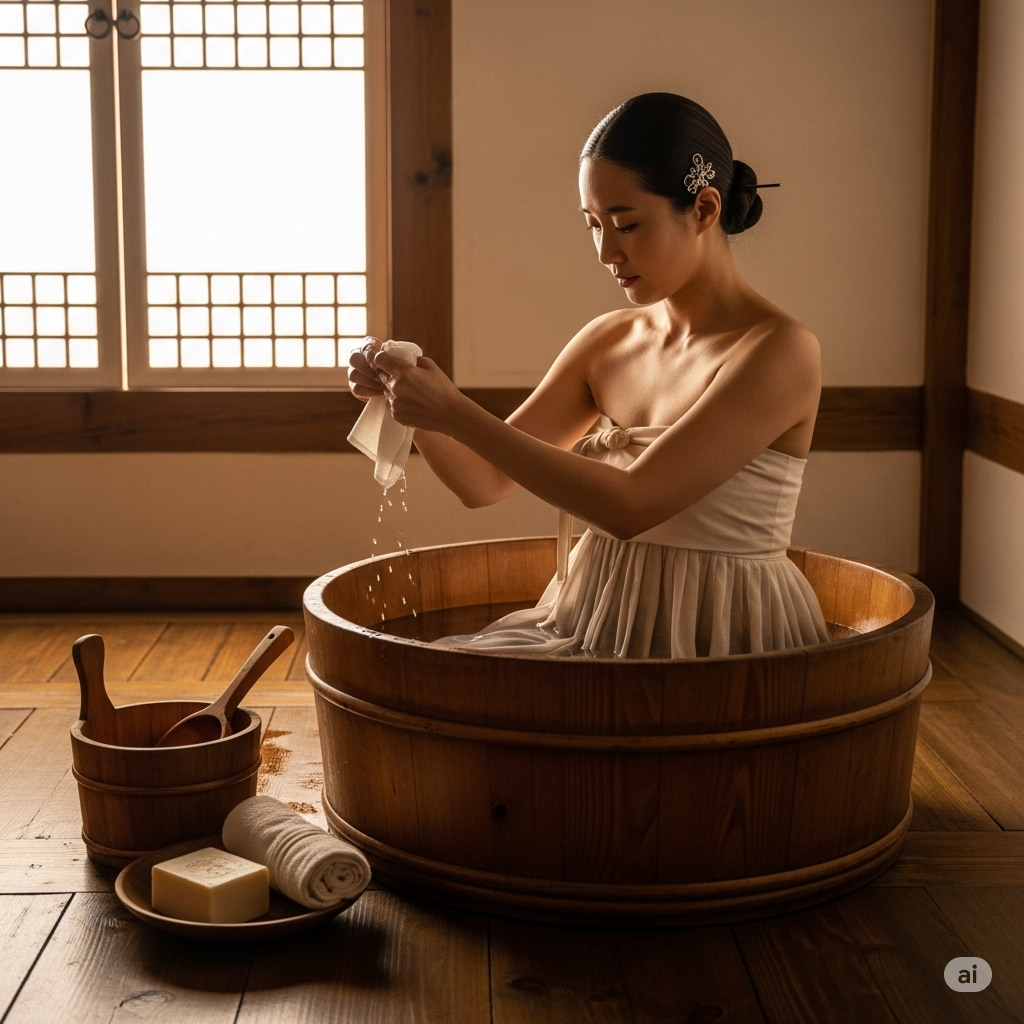
It is interesting that the same encyclopedia describes bathing in Joseon as ‘flourishing’.
Mokyok-jaegye before rituals remained an essential custom, and the preference for pale skin also encouraged bathing.
Wealthy households had separate bathing spaces called jeongbang, and they stocked up on cleansing powder called jodu, made from ground red beans or mung beans.
Brides-to-be chose between samtang (ginseng leaf infusion), iris water, and rice bran water for their baths.
Bathing itself continued to flourish; it just moved to the privacy of the home, away from prying eyes.
For the King, the justification for full-body bathing was medical treatment. King Sejong traveled to Onyang Hot Springs to treat a long-standing eye ailment, and records regarding the kings’ hot spring visits in the Annals of King Sejong show that these trips were recorded strictly as medical procedures. In Joseon, hot springs and saunas were treated as medicine.
Among the common people, seasonal customs kept ‘outdoor bathing’ alive.
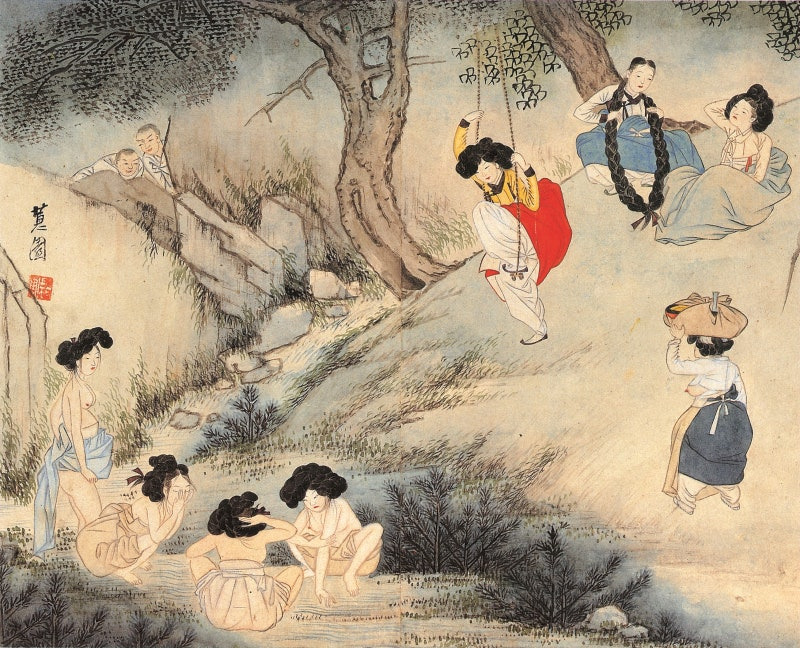
On Dano (the 5th day of the 5th lunar month), they washed their hair in boiled iris water to ward off bad energy, and on Yudu (the 15th day of the 6th lunar month), they washed their hair and bodies in streams flowing eastward to wash away summer illnesses and bad luck. For a few days a year, open spaces like valleys and streams were permitted.
Why the first public bathhouses were shunned
It was because the sense that undressing in front of others was a vulgar act had been ingrained for hundreds of years.
The Encyclopedia of Korean Culture’s entry on ‘Bathhouse’ notes that stripping down and washing in a place where many people gathered was considered something only the lower class would do.
The year of the first public bathhouse varies slightly by source.
This encyclopedia cites the early 1920s—around 1921 in Pyongyang—as the first, where the local government operated the bath and even employed a manager. 1924 is generally cited as the year they became more widespread in Pyongyang. Public baths arrived in Seoul in 1925. All sources agree that their origin lies in Japanese-style bathhouses from the colonial period.
Full-scale popularization occurred long after liberation.
According to a JoongAng Ilbo report, the number of public baths in Seoul increased from 146 in 1960 to 1,768 in 1985, thanks to the boom in private bathhouse businesses as water and sewage systems were installed in major cities. Since most homes lacked bathing facilities, the neighborhood bathhouse became an essential facility and a community hub.
Bathhouses were not the only thing that changed during that period of rapid growth leading up to the ‘88 Olympics; the process by which homemade dumplings became factory-made frozen food was also covered in my story on the 30-year war of frozen dumplings.
When did the culture of ’ttamiri’ (professional scrubbers) begin?
There is no precise record.
According to a report introducing a lifestyle culture report from the National Folk Museum of Korea, researchers estimate from 1970s newspaper articles that professional scrubbing started in men’s baths before women’s. The habit of scrubbing spread with the introduction of the so-called ‘Italy towel’ in the late 1960s, and that was also when professional scrubbers appeared as a profession.
Why do Koreans scrub so hard in bathhouses? The researcher’s explanation in the JoongAng Ilbo article cited earlier is surprisingly simple: Bathing was still expensive, so once you went, you had to scrub off one or two weeks’ worth of dead skin at once.
I would like to add one more factor: the habits of hundreds of years of the Joseon Dynasty. People who used to wash partially while clothed at home were suddenly entering communal baths, so bathing became an ‘occasional event’ rather than a daily routine. Since they went rarely, they had to finish it thoroughly in one go. I believe the scrubbing culture is more of a remnant of a time when bathing was a rare event, rather than because Koreans are exceptionally clean.
This profession only received its official name relatively recently. According to a Hankook Ilbo report, Statistics Korea changed the job title from ‘bathroom worker’ to ‘bath manager’ in 2007 during an update to the Korean Standard Classification of Occupations. This came after decades of enduring the derogatory term ’ttamiri’.
Where do jjimjilbangs fit in Korean bathing culture?
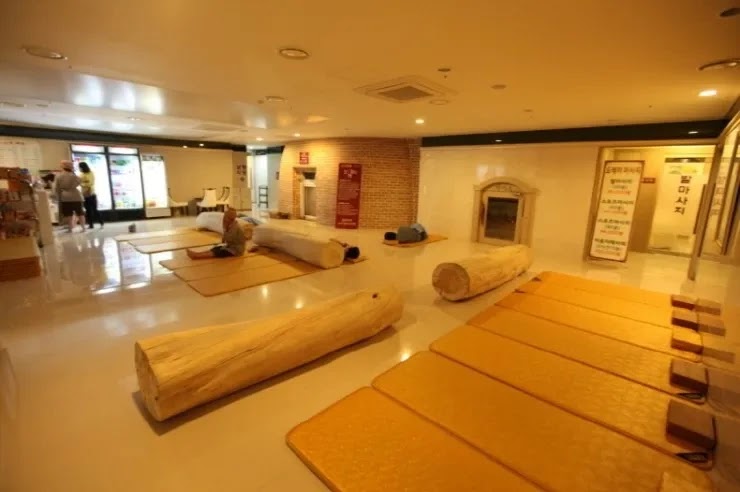
Jjimjilbangs are spaces that brought back the communal bathing that Joseon had closed off.
Like the Goryeo streams, people of all genders and ages gather in one space; they highlight the benefits of hot springs and saunas that the Joseon royal family sought for treatment; and they even incorporated the professional scrubbers of modern bathhouses under one roof.
If you line up Korean bathing culture by era based on the criterion of ‘in front of whom you revealed your body,’ the flow becomes clear.
| Era | Core Purpose | Key Characteristics |
|---|---|---|
| Three Kingdoms | Religious purification | Mythical bathing proving the King’s divinity, temple-centered mokyok-jaegye |
| Goryeo | Cleanliness, beauty | Bathing every morning/twice a day in summer, mixed bathing in streams, orchid baths |
| Joseon | Etiquette, treatment | Partial bathing while clothed, jeongbang and jodu, royal hot spring trips, Dano/Yudu customs |
| Modern | Hygiene, leisure | Emergence of public baths, Italy towel and professional scrubbers, jjimjilbangs |
It is as if the open bathing of Goryeo was closed off into the home during Joseon, only to be opened again through bathhouses and jjimjilbangs.
For me, too, the jjimjilbang was a place to mingle freely with family and friends rather than just a place to wash.
Knowing that this is a landscape that emerged in just a hundred years in a country where hiding one’s body was a sign of courtesy, the people sitting side by side with towels on their heads in front of the kiln overlap with the Goryeo people at the Gaegyeong stream a thousand years ago.
References
- Bathing (沐浴) - Encyclopedia of Korean Culture
- Bathhouse - Encyclopedia of Korean Culture
- Mixed bathing culture without a care [Finding Goryeo in Ganghwa] - Kyeongin Ilbo (2026.7)
- How did we bathe? - National Folk Museum of Korea Webzine
- Why did Korean bathhouses start scrubbing so hard? - JoongAng Ilbo
- There was a time when scrubbing made a fortune... Professional scrubbers who have lived through glorious years - Hankook Ilbo (2023.1)
- Diving into bathhouse culture as seen by foreign media - Policy Briefing
- Where did all those bathhouses go? - Hankyoreh
- Bathhouse, from entertainment to hygiene to cultural space! - Seoul Archives
- Bathing, embracing the hidden skin of history - Aladin Book Information