
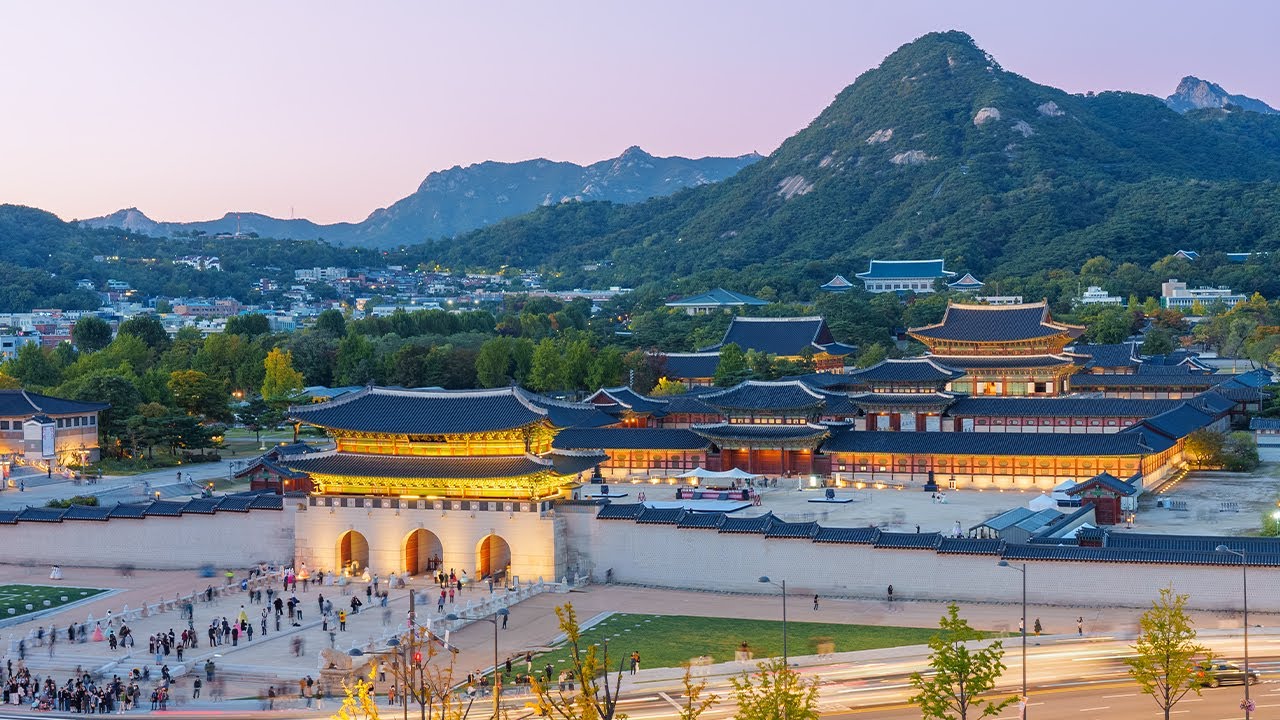
Inwangsan Mountain, imposing and majestic, looms behind Gyeongbok Palace. Some see a history of bloodshed in the mountain’s formidable presence.
Over 600 years ago, as the capital of Hanyang (Seoul) was being planned to become the heart of the new Joseon dynasty, the opinions of Joseon’s planner, Jeong Do-jeon, and the era’s foremost geomancer, Monk Muhak, clashed dramatically.
Jeong Do-jeon argued, in accordance with Confucian classics, that the palace (Gyeongbok Palace) should face south, with Bukaksan Mountain, the jusans (main mountain), at its back. It was a rational choice prioritizing the king’s authority and the Neo-Confucian order.
However, Monk Muhak, reading the land’s energy, was horrified. He observed that when the king faced south, the left Azure Dragon (좌청룡, representing the eldest son/legitimacy), Naksan, was too weak, while the right White Tiger (우백호, representing the second son/powerful minister), Inwangsan, was too large and ferocious. With a heavy heart, he prophesied:
“If a palace is built on this site, the might of the White Tiger will oppress the Azure Dragon, weakening the eldest son’s energy and allowing the younger siblings and ministers to covet power. Soon, a blood wind will blow between brothers!”
Ultimately, Joseon sided with Jeong Do-jeon, and Gyeongbok Palace majestically faced south. Was Monk Muhak’s prophecy merely an old superstition? Or was it the prelude to an inescapable fate? From this point on, we follow the blood-soaked history that the land remembers.
The First Blood: The White Tiger’s Claws, The Princes’ Rebellion
Barely six years after Joseon’s founding, in 1398, Monk Muhak’s ominous prophecy became a horrific reality. When King Taejo, bypassing the sons of his first wife, appointed his youngest son by his second wife, Yi Bang-seok, as crown prince, those embodying the ‘White Tiger’ energy stirred.
It was Yi Bang-won (later King Taejong), Taejo’s fifth son. He led his private army to raid Gyeongbok Palace, killing all his political rivals, including Jeong Do-jeon and Crown Prince Bang-seok. (The First Princes’ Rebellion)

The First Princes’ Rebellion. This event, where the ambitious ‘second son’ trampled upon the crown prince symbolizing legitimacy, was the moment Monk Muhak’s prophecy was perfectly realized.
A fratricidal conflict where the strong White Tiger (Yi Bang-won) overpowered the weak Azure Dragon (Crown Prince), it was a tragedy that seemed to mirror the very topography of Hanyang. Gyeongbok Palace’s history was stained with blood from its very inception.
The Second Blood: The Tiger Devours the Young King, The Coup of Gye-yu
The curse of Gyeongbok Palace repeated itself in an even more brutal form a generation later. The protagonists of this act were Sejong’s second son, Grand Prince Suyang (later King Sejo), and his young nephew, King Danjong.
An uncle resembling the strong and fierce energy of Inwangsan (the White Tiger), and a young king born with the destiny of the weak Naksan (the Azure Dragon). The outcome was predetermined.
In 1453, Suyang launched a surprise coup, eliminating all the elder statesmen who protected Danjong, such as Kim Jong-seo, and seized power (The Coup of Gye-yu). The weakened young King Danjong was eventually forced to abdicate his throne to his uncle and met a tragic end.
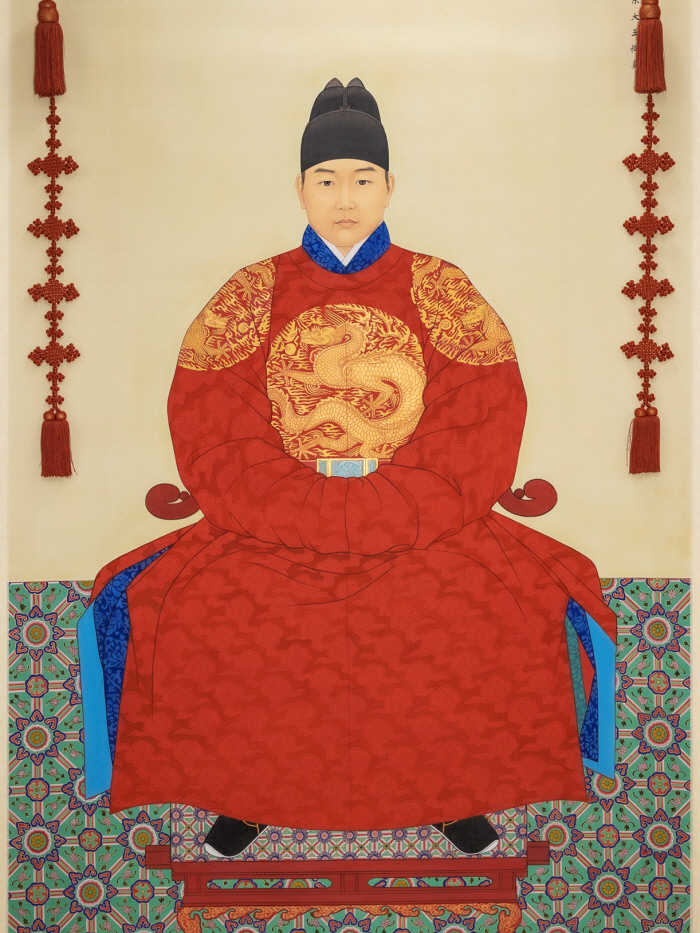
The ill-fated King Danjong. His short life remains a symbol of the tragic geomancy of Gyeongbok Palace.
After enduring two dreadful bloodbaths, Gyeongbok Palace began to be perceived as an ‘ominous palace.’ Subsequently, kings preferred to reside in Changdeokgung Palace, built in harmony with the natural terrain, leaving Gyeongbok Palace empty. This is clear evidence that geomancy had a practical influence on the kings’ psychology and politics.
The Struggle to Overcome the Land’s Curse: Protective Geomancy (Bibo Pungsu)
So, is Seoul truly a ‘cursed land’? Surprisingly, our ancestors recognized the land’s flaws and constantly strove to ‘heal’ them.
Sungnyemun Gate (숭례문): To ward off the strong fire energy (火氣) of Gwanaksan Mountain to the south of Seoul, the character ‘Ye’ (禮), meaning ‘propriety’ and associated with fire, was incorporated into its name, and the signboard was hung ‘vertically,’ like a flame, to counteract the fire.
Heunginji Gate (흥인지문): To reinforce the weak energy of the Azure Dragon (Naksan), the character ‘Ji’ (之), meaning ’to go’ or ’to connect,’ was added to its name, signifying the artificial strengthening of the land’s veins, as if connecting mountain ranges.
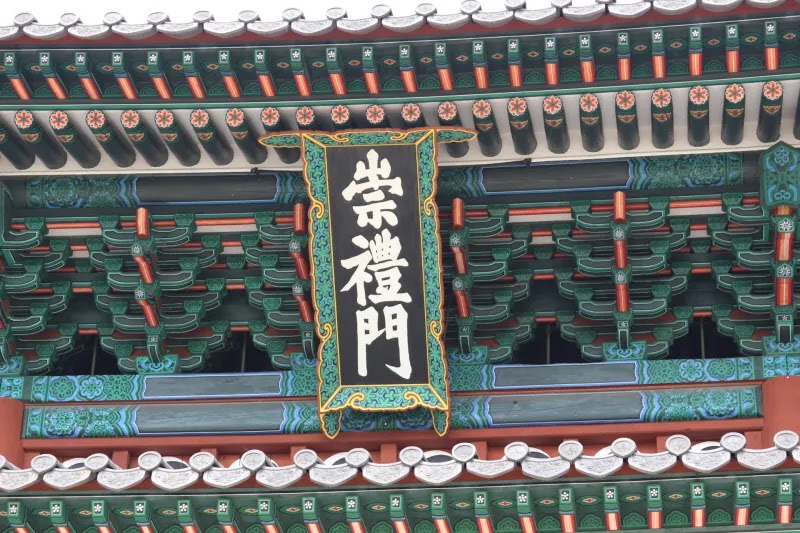
The vertical signboard of Sungnyemun, a stratagem to ward off Gwanaksan’s fire energy. It symbolizes the will to defy fate.
This protective geomancy (Bibo Pungsu) shows that the city of Seoul itself was a giant amulet, a product of human will striving to overcome destiny.
Conclusion: The Land’s Prophecy, Human Desire
The geomancy of Hanyang and the tragedies of royal succession cannot be dismissed as mere superstition; they are crucial keys to understanding Joseon’s history.
Monk Muhak’s prophecy might not have been a supernatural phenomenon. Perhaps he perceived in the imposing figure of Inwangsan the endless human desire for power, and in the low-lying Naksan, the precarious legitimacy of a newly established nation.
Ultimately, geomancy has, at times, functioned as a prophecy warning of the future, as a fatalistic explanation for tragedy, and as a “political justification” to legitimize ambition.
Seoul is not a ‘cursed city,’ but ‘a city that has constantly reflected upon and healed its own wounds.’ The mountains, waterways, and ancient structures of this city are layered with the anxieties and wisdom of a 500-year dynasty. Today, as you gaze upon Gyeongbok Palace and Inwangsan Mountain, why not lend an ear to the whispers of the land? There, we will gain a deeper understanding of the choices made by the figures in history.