

What is weighing on your mind right now? 🤯 Perhaps it’s the ever-rising cost of living, an uncertain future, a social system that’s hard to trust, or a persistent sense of unease about potential crises. Paradoxically, we live in an age of unprecedented abundance, yet I feel that anxiety about the future is only deepening. If, at the end of all this chaos, a brilliant new world is promised, and there’s a secret map leading to that world, would you dare to open that book?
Here, in the twilight years of the dynasty of Joseon, centuries ago, there was a book that shook people’s hearts to their core. It was branded a dangerous forbidden book (금서) by the government, yet it was also a secretly beloved bestseller. Merely possessing this book could lead to charges of treason and the extermination of one’s entire family, but for the people drowning in despair, it was like a sole beacon of hope. That book is “Jeonggamrok” (정감록).
This is not just an old tale. It’s a record of the deep anxieties and fervent desires of people who lived through a turbulent era of crumbling old systems and the dawn of new orders, and their fierce struggle to forge their own future. To us, living in the 21st century, “Jeonggamrok” quietly but clearly asks: “What is the new world you dream of, and what map of hope are you drawing for that world?”
The Birth of Prophecy: A Narrative of Hope Forged by a People on the Brink
Prophecies, you see, don’t just pop into existence out of thin air. They always sprout and grow, nurtured by the deep pain of their times. To truly understand why “Jeonggamrok” spread like a virus through Joseon society in the late period, we must first look into the truly horrific reality experienced by the people of that era.
The two massive wars, the Imjin War and the Byeongja War in the 17th century, literally turned this beautiful land into ashes. The nation could not properly protect its people, and those who miraculously survived had to rebuild their lives from the ruins with their own strength. But the suffering didn’t end there. As the 18th and 19th centuries dawned, Sedo politics (세도정치) began, where a handful of powerful families monopolized all state power. Their greed knew no bounds, and the state system devolved into a tool solely for their personal gain, rather than for the benefit of the people.
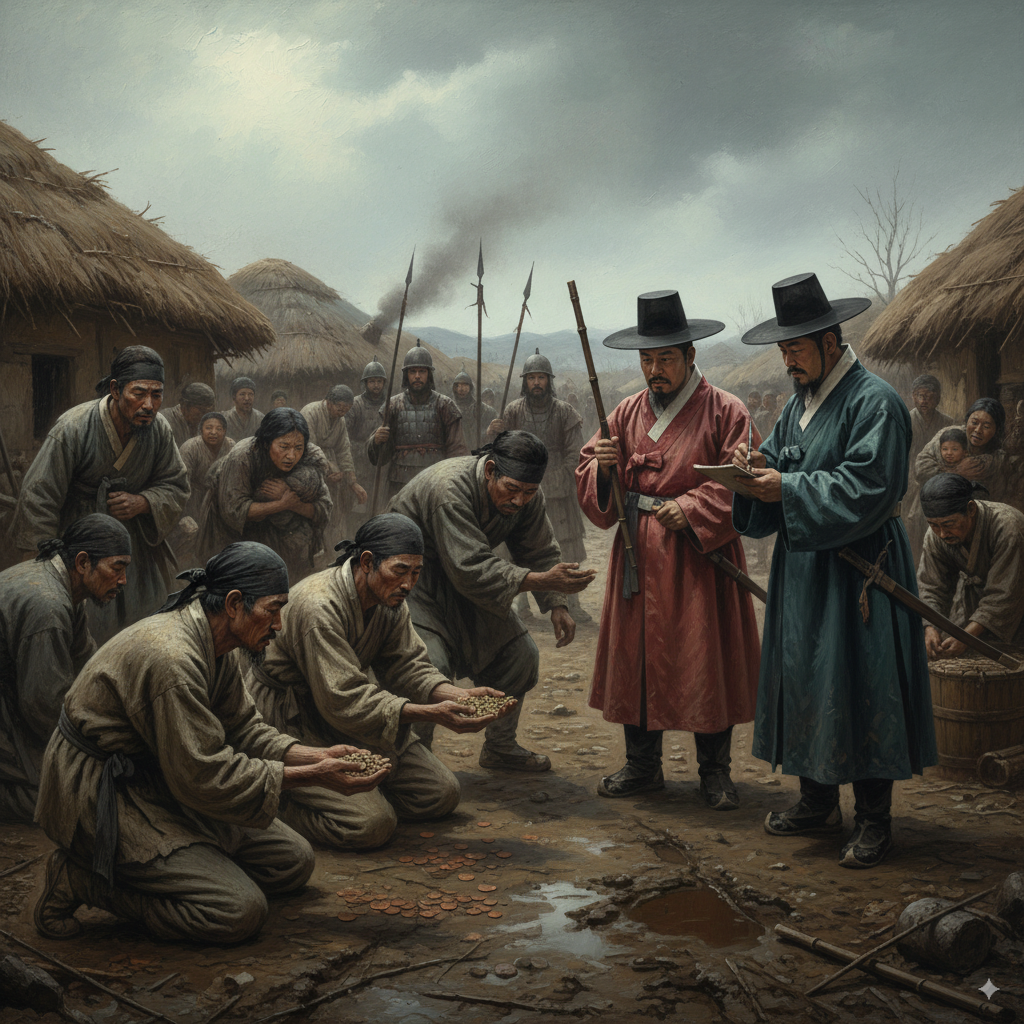
Farmers were subjected to harsh exploitation known as the “Samjeong’s corruption” (삼정의 문란). They had to pay taxes on land they didn’t even possess (land tax). They even had to pay military service tax (Goonpo) for newborns and the deceased. If they borrowed grain from the government during a famine, they were forced to repay it with interest multiplied several times over (Hwan-gok), making it utterly suffocating. Furthermore, the recurring devastating famines and epidemics uprooted people’s livelihoods.
Neo-Confucianism (성리학), the official ideology of Joseon, offered no answers anymore. The teachings of “be loyal to the king and filial to your parents” were merely empty echoes in the face of corrupt kings and rapacious officials who bled the people dry. A society where trust had collapsed, an era where hope had vanished. It was into this vast ideological vacuum that “Jeonggamrok” penetrated like much-needed rain on parched land. “Jeonggamrok” diagnosed the cause of all this suffering with remarkable clarity: “The fortunes of the Lee (이씨) dynasty have run their course.” And it presented a truly revolutionary alternative: “A Jeong (정씨) will emerge to open a new world.” This must have been like a gospel to the ears of the people floundering in despair.
The Secret of the Bestseller That Became Forbidden
In truth, “Jeonggamrok” is not a single book written by one author, as we might commonly imagine. Rather, it’s more accurate to see it as an “open-source prophecy” or, more precisely, a “collective creative project” that has continuously evolved with the times, with dozens or even hundreds of different versions (異本) existing. While being secretly circulated as handwritten copies to evade strict crackdowns, people added and modified its content, imbuing it with their own thoughts and the earnest wishes of their era.
However, there is a core worldview that pervades most versions. It’s a remarkably intricate fusion of Feng Shui, Dócham (prophecy), and Maitreya belief.
- Dócham (Prophecy of the Future): This provides the temporal logic for “Why must the world change?” Just as cosmic energies circulate, one dynasty cannot last forever, and it is heaven’s will that the Lee dynasty’s fortune has ended.
- Feng Shui (Spatial Logic): This offers the spatial answer to “Where will the new era begin?” The geomantic energy of the capital, Hanyang, has waned, and Gyeryongsan Mountain (계룡산), overflowing with new energy, is prophesied to become the capital of the new dynasty. Ah, this elevated its persuasiveness by linking abstract fatalism to the concrete evidence of “earth’s power.”
- Maitreya Belief (Messianic Idea): This promises a figure, a savior, for “Who will save us?” It states that when the suffering of the end times reaches its peak, a savior, ‘Jeong Do-ryeong’ (정도령) or ‘Jin-in’ (眞人), will appear to judge all evil and build a paradise on Earth. This can be considered a Korean adaptation of the Maitreya Buddha belief, which had long held a deep place in the hearts of the people.
These three elements created a perfect synergy. “Jeonggamrok” established a powerful and systematic “counter-ideology” against Neo-Confucianism by presenting the end of the existing order (why), the stage for the new era (where), and the agent of change (who). The message “The Lee dynasty will fall, and the Jeong dynasty will rise (李氏亡 鄭氏興)” was hidden using cryptic codes like Pahja (파자), such as “wood-child (목자=李) will fall and settled-village (전읍=鄭) will rise,” adding an aura of mystique and enhancing its authority as secret knowledge accessible only to those who knew.
The Life of a Prophecy: The Unseen Hand That Moved History
“Jeonggamrok” was never a dead text confined to bookshelves. Instead, it was a truly living force that unhesitatingly leaped into the lives of the common people and changed the course of history.
Igniting the Flames of Rebellion
In the 19th century, as peasant uprisings blazed across Joseon like a burning thirst, the shadow of “Jeonggamrok” always loomed behind them.
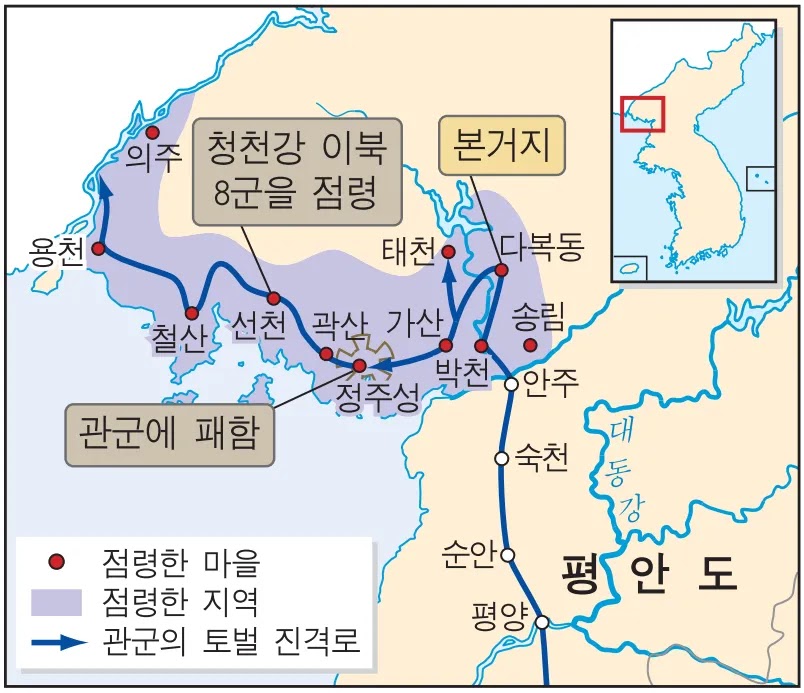
A prime example is the Hong Gildong Rebellion (홍경래의 난) in 1811. Hong Gildong, from a fallen yangban family, revolted against the deep-seated discrimination against the Pyeongan Province region and the harsh exploitation by the Sedo regime. He presented himself as a pioneer who would help ‘Jeong Do-ryeong’ usher in a new era, proclaiming to the world that their uprising was not a mere private rebellion but heaven’s will to end the old world. “Jeonggamrok” was a powerful ideological weapon that strongly united the scattered discontent of the common people and gave their anger the legitimacy of a “righteous revolution.”
This trend culminated in 1894 with the Donghak Peasant Revolution (동학농민혁명), the largest popular uprising in modern Korean history. Donghak’s egalitarian philosophy of “People are Heaven (人乃天)” and the concept of “Hucheon Gaebyeok” (후천개벽 - the opening of a new era after the current one) were deeply intertwined with the worldview of “Jeonggamrok.” The Donghak leadership developed the vague expectation of a new era presented by “Jeonggamrok” into concrete political goals of “anti-feudalism” and “anti-foreign influence.” In simple terms, if “Jeonggamrok” sowed the seeds of revolution, Donghak provided the fertile soil of organization and ideology to nurture them into a mighty tree of revolution.
Becoming the Womb of New Religions
The influence of “Jeonggamrok” was not limited to political revolutions. It deeply comforted the souls of the oppressed people and offered a new path to salvation, becoming the ideological origin for numerous new religions. Various sects derived from Donghak, as well as religious groups in the Jeungsan (甑山) sect, centered around Kang Il-soon (강일순), actively adopted and reinterpreted the prophetic system of “Jeonggamrok” in their own ways.
In particular, Gyeryongsan Mountain, designated as the land of prophecy, literally became the “Mecca” for new religions. From the Japanese colonial period to the post-liberation era, countless religious leaders called themselves ‘Jeong Do-ryeong’ and gathered at the foot of Gyeryongsan Mountain, striving to build their own utopian worlds. Ah, this serves as vivid evidence of the powerful and immense yearning for salvation and an ideal land promised by “Jeonggamrok.”
The Mirror of the Times: How Prophecies Evolve
What is most astonishing about “Jeonggamrok” is its remarkable vitality and flexibility. As times changed, the meaning of the prophecy also evolved.
In 1910, when the Korean Empire was forcibly annexed by Imperial Japan, the prophecy of “Lee dynasty’s fall” sadly became a reality. People’s attention naturally shifted to “Jeong dynasty’s rise,” the advent of a new era. During the Japanese colonial period, “Jeonggamrok” was remarkably reborn as a prophecy of national liberation. The Japanese, who had taken the place of the Lee dynasty, were naturally a new oppressive force to be overthrown, and ‘Jeong Do-ryeong’ was seen as the embodiment of independence who would reclaim the nation.
After liberation, even more fascinating interpretations emerged. The passage in “Jeonggamrok” stating “A Jin-in (眞人) will come from across the sea to save the people” was interpreted as referring to the then-U.S. President Harry S. Truman. The fact that “Truman” sounds similar to “True Man” (Jin-in) and that he decided to drop the atomic bombs, thus bringing about Korea’s liberation, was ingeniously combined. Wow, this is a truly dramatic example demonstrating how the prophecies of “Jeonggamrok” expanded their meaning to encompass not only events on the Korean peninsula but also world-historical events.
The 21st Century: Why Do We Read “Jeonggamrok” Again?
“Jeonggamrok” was not merely a prophecy foretelling the future. It was like a mirror, reflecting the deep suffering and anxiety of its time without filtration. It is another historical record, engraved with the voices of the common people, their tears, and their earnest hopes, which the official historical records of the ruling class so deliberately ignored.
The prophecies of “Jeonggamrok” did not actually come true. A Jeong dynasty did not emerge, and Gyeryongsan Mountain did not become the capital. However, the true value of this book does not lie in whether its prophecies were correct or incorrect. I believe its value lies in the remarkably persistent spirit of the people who resolutely said ‘NO’ to the old world and never gave up their earnest longing for a better one.

Today, we do not wait for a superhuman savior like ‘Jeong Do-ryeong.’ However, we still yearn for a just and competent leader who will solve our society’s problems. We do not wander in search of Sipseungji (십승지), a refuge to escape disaster. Yet, we still dream of a stable place to live amidst soaring real estate prices and economic crises.
Perhaps “Jeonggamrok” is, in some ways, an “unfinished prophecy” that poses a question to us. When we feel that the system is failing to protect us, when the future is completely uncertain, what should we believe in, and where should we place our hope? “Jeonggamrok” does not provide a direct answer. It simply tells the story of people who stubbornly created their own narratives of hope even at the edge of a precipice. I dare to say that it is now our turn, as people living in the 21st century, to fill in the next page.
**References**
- Jeonggamrok - Wikis [https://wikis.krsocsci.org/index.php?title=%EC%A0%95%EA%B0%90%EB%A1%9D]
- [Column] Jeonggamrok - JS Magazine [https://m.jsmagazine.net/1191251]
- Jeonggamrok - Wikipedia [https://ko.wikipedia.org/wiki/%EC%A0%95%EA%B0%90%EB%A1%9D]
- [Baek Seung-jong’s Jeonggamrok Stroll] (16) Jeonggamrok, When and Who Wrote It - Seoul Shinmun [https://www.seoul.co.kr/news/life/series/bsj/2005/04/28/20050428026001]
- Jeonggamrok: The Prophecy Book Representing Late Joseon and Its Influence - YouTube [https://www.youtube.com/watch?v=xzJq9qHlVU8]
- Jeonggamrok Belief [http://webzine.idaesoon.or.kr/board/readcnt.asp?bno=4790&win=new]
- Jeonggamrok (鄭鑑錄) - Encyclopedia of Korean Culture [https://encykorea.aks.ac.kr/Article/E0049900]
- Jeonggamrok (r156 Version) - Namu Wiki [https://namu.wiki/w/%EC%A0%95%EA%B0%90%EB%A1%9D?uuid=a0592041-7b17-455b-ab95-4f5584e25a2e]
- Study on the Calligraphy Aesthetics of Four Korean Versions of Jeonggamrok’s Diffusion - Pusan National University Institute of Korean Cultural Studies [https://pncc.pusan.ac.kr/bbs/pncc/11985/886313/download.do]
- The Story of Sipseungji (十勝地) - Seorabeol News [http://m.srbsm.co.kr/view.php?idx=24755]
- KBS History Special – Jeonggamrok, Speaking of Joseon’s Destiny - YouTube [https://www.youtube.com/watch?v=bKYFRpGcnRc]
- Did the Lee Dynasty Fall and a New Leader Emerge? - Sejong Post [https://www.sjpost.co.kr/news/articleView.html?idxno=13572]
- Korean Studies Materials Center [https://kostma.aks.ac.kr/Contents/HistorySpecial/Default.aspx?Body=07]
- Jeonggamrok Belief (鄭鑑錄信仰) - Encyclopedia of Korean Culture [https://encykorea.aks.ac.kr/Article/E0049901]
- Search ‘Jeonggamrok’ - Encyclopedia of Korean Culture [http://encykorea.aks.ac.kr/Article/Search/%EC%A0%95%EA%B0%90%EB%A1%9D?alias=false&body=false&containdesc=false&type&field]
- The Modern Historical Significance of the Donghak Peasant Revolution [https://www.e-donghak.or.kr/data/archive/data/hs1428.pdf]
- Jeonggamrok - Geumsung Publishing :: Teaching Encyclopedia [http://dic.kumsung.co.kr/web/smart/detail.do?headwordId=2861&pg=48&findCategory=B002005&findBookId=23&findPhoneme=]
- Jeonggamrok - Namu Wiki [https://namu.wiki/w/%EC%A0%95%EA%B0%90%EB%A1%9D]
- Who is the True Messiah Savior Jeong Do-ryeong? | Kim Jin-sil - Aladin [https://www.aladin.co.kr/shop/wproduct.aspx?ItemId=370809739]
- Jeong Do-ryeong, Whom Bukak Mountain God Seeks! Who is this Messiah-like Figure? - JoongAng Ilbo [https://www.joongang.co.kr/article/8827099]
- Gyeokam Yurok - Yes24 [https://m.yes24.com/Goods/Detail/7350903?reviewyn=y]
- Jeong Do-ryeong - Namu Wiki [https://namu.wiki/w/%EC%A0%95%EB%8F%84%EB%A0%B9]
- Korean History I 248 Hong Gildong Rebellion, The Influence of Jeonggamrok on the Donghak Peasant Movement - YouTube [https://www.youtube.com/watch?v=MCVHJ3GPi0Q]
- Let’s Learn About Sipseungjiji (十勝之地) & Sipseungji (十勝地) - Daum Cafe [https://m.cafe.daum.net/yongwoofamily/NVLw/231?svc=cafeapp]
- Sipseungjiji (十勝之地) - Encyclopedia of Korean Culture [https://encykorea.aks.ac.kr/Article/E0034001]
- The Story of Punggi in Yi Jung-hwan’s Taekjiji (擇里志) - Daum Cafe [https://m.cafe.daum.net/54cheongun/58sL/3176]
- Sipseungjiji (十勝之地) - Places to Visit for Feng Shui [https://www.pacher.co.kr/m_view.php?ps_db=freeboard&ps_boid=243&ps_page=1&ps_sele=&ps_ques=&ps_line=asc&ps_choi=&ps_divi=]
- The Spread of Jeonggamrok < Korean History Seen Through Sources - Our History Net - National Institute of Korean History [https://contents.history.go.kr/mobile/mid/hm_108_0030?tabId=e]
- Donghak Peasant Revolution - Namu Wiki [https://namu.wiki/w/%EB%8F%99%ED%95%99%20%EB%86%8D%EB%AF%BC%20%ED%98%81%EB%AA%85]
- Late Joseon’s Greatest Forbidden Book and Representative Prophecy Book ‘Jeonggamrok’ - Seoul Shinmun [https://www.seoul.co.kr/news/life/publication-literature/2012/08/11/20120811016001]
- Donghak Peasant Revolution and Practical Modernity [https://archeology.tistory.com/entry/%EB%8F%99%ED%95%99-%EB%86%8D%EB%AF%BC%EC%A0%84%EC%9F%81%EA%B3%BC-%EC%A1%B0%EC%84%A0%EC%9D%98-%EC%8B%A4%EC%B2%9C%EC%A0%81-%EA%B7%BC%EB%8C%80%EC%84%B1]
- Donghak Peasant Revolution, the Rebellion of Joseon People in the Late 19th Century - Platform C [https://platformc.kr/2024/04/donghak-peasant-movement/]
- Jeonggamrok (r54 Version) - Namu Wiki [https://namu.wiki/w/%EC%A0%95%EA%B0%90%EB%A1%9D?uuid=051d6e19-bacd-4291-abc0-52acf1d08005]
- The Mystery of Jeonggamrok | Baek Seung-jong - Aladin [https://www.aladin.co.kr/shop/wproduct.aspx?ItemId=18778415]
- New Religions (新宗敎) - Encyclopedia of Korean Culture [https://encykorea.aks.ac.kr/Article/E0033382]
- Jeungsan Sect Lineage (1): The Mysticism of Kang Jeungsan - Monthly Haein [http://haein.or.kr/m/index.php?contents=default_view&seek_no=7&webzine_no=86]
- New Religions: The Reality in Korea | The Core is ‘Gyeryongsan’ and ‘Jeonggamrok’ | Ministry of Culture and Public Information Survey, 260+ Sects Nationwide - JoongAng Ilbo [https://www.joongang.co.kr/article/1213254]
- “We are the Jin-in who came from across the sea to save Joseon!” The Japanese Imperialists Who Tried to Rule Joseon Using
#NakedKoreanHistory EP.128 | tvN STORY 241002 Broadcast - YouTube [https://www.youtube.com/watch?v=H4fsDPzRIDU] - [Historical Days/Full Version] Koreans’ Secret Manual Part 2: Jeonggamrok, Dreaming of Change | KBS 160214 Broadcast - YouTube [https://www.youtube.com/watch?v=orXpGnZD_r0]