
A young girl of five or six stood before a senior court lady; if the lady gave a single nod, that was it.
Joseon court ladies were specialized professionals who entered the palace this way, underwent about 15 years of training as ‘Saeng-gak-si’ (apprentice court ladies) to become ‘Na-in’, and after another 15 years, rose to the rank of ‘Sang-gung’ (Senior Court Lady, Rank 5). In exchange for a stable salary, they had to give up marriage and life outside the palace forever.
Who were Joseon court ladies selected from?
In principle, they were the daughters of public slaves (Gong-no-bi).
The Sokdaejeon (Supplement to the National Code) prohibited the entry of commoners’ daughters into the palace as court ladies, and those who violated this or recommended such candidates faced heavy punishments of 60 strokes of the cane and one year in prison. The regulations were this strict because there was a strong intent to prevent court ladies from becoming conduits for maternal relatives’ influence. If a girl was the daughter of a state-owned slave, she had no family to rely on, so her loyalty would be directed solely toward the throne.
Reality was not as tidy as the regulations.
It was common for existing court ladies to bring in their nieces or relatives, and among the public, the custom of jo-hon (early marriage) emerged as families rushed to marry off their daughters to prevent them from being selected. Conversely, for impoverished families, it was a way to reduce a mouth to feed while securing a position that provided a salary.
For some families, the same system was a conscription to be avoided, while for others, it was a last resort for survival.
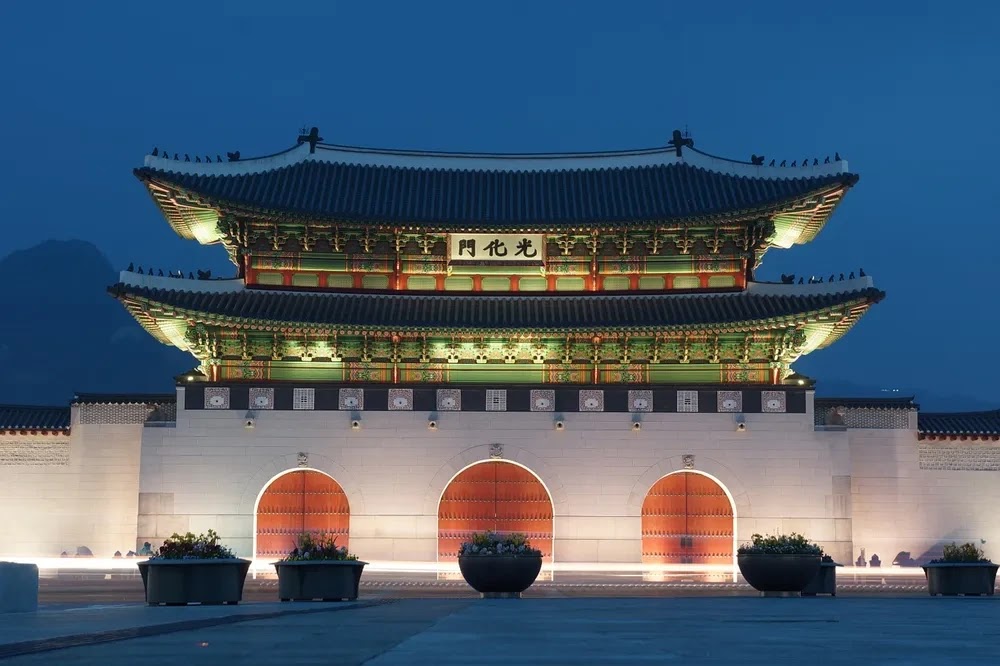
15 years as a ‘Saeng-gak-si’: What did Joseon court ladies learn?
Girls who entered the palace were called Saeng-gak-si.
Those destined for the highest-ranking Jimil (King’s private quarters) were brought in at ages 4–8, while those for the Chimbang (sewing room) and Subang (embroidery room) were brought in at ages 6–13. The belief was that the younger they were, the easier it would be to instill the palace’s laws into their bodies.
Their curriculum included Confucian texts like the Sohak (Elementary Learning) and Naehun (Instructions for Women), as well as the Gung-che (Palace Script), a Korean calligraphy style refined by the court ladies.
However, the education that likely remained in their memories the longest was not academic. On the night of the Lunar New Year’s Eve, there was a ritual called ‘Jwi-buri Geul-ryeo’, where senior court ladies held torches near the faces of the apprentices and chanted the phrase. By holding fire right in front of their noses, they were teaching a warning: if you leak what you have seen and heard in the palace to the outside, your mouth will be burned.
This single ritual reveals that the primary quality required of a court lady was not sewing or writing, but ‘keeping one’s mouth shut.’
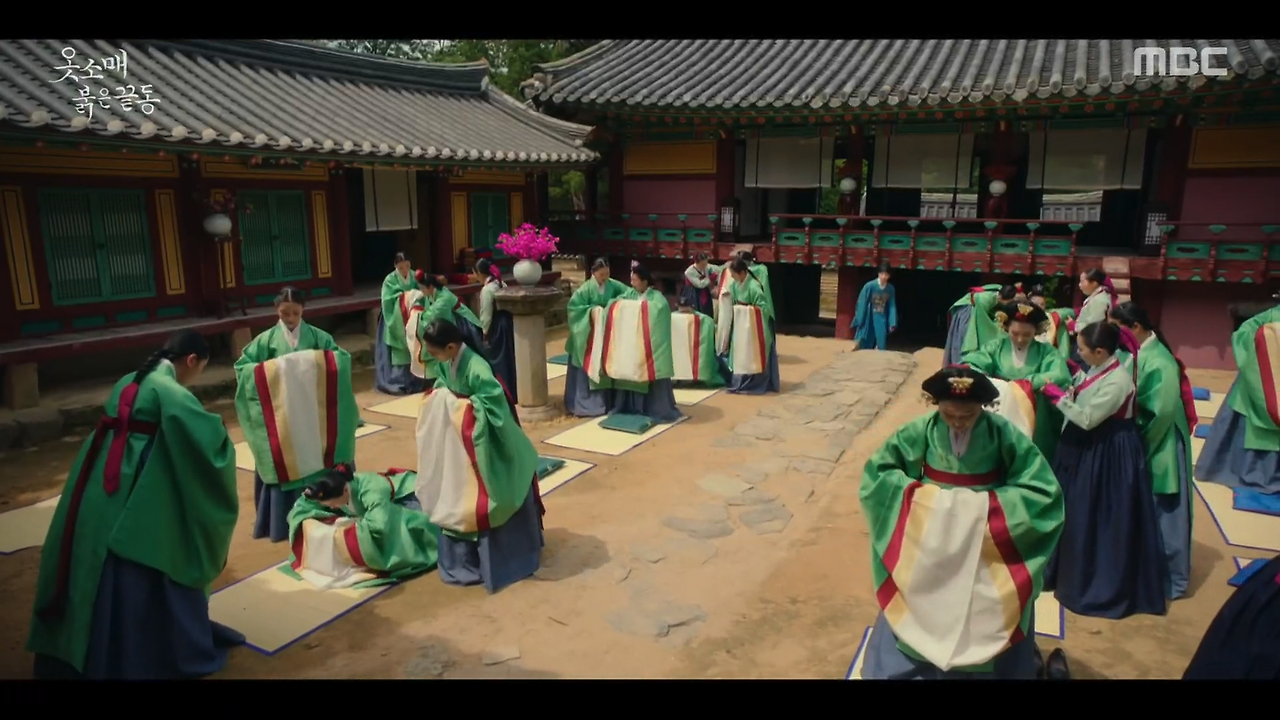
Around the age of 20, when their training concluded, they performed the Gwan-rye (Coming-of-age ceremony).
This was a ritual where they pinned up their braided hair into a bun, marking the official transition into a Na-in. It was considered a wedding without a groom—a vow to dedicate one’s entire life to the King.
How was the Joseon court lady organization divided by department?
There were roughly 500 to 700 female personnel in the palace.
They were divided into Yeo-gwan (female officials with rank) and maids who handled menial tasks; the female officials worked in specific departments (Cheoso). Since the structure was divided by the royal family’s needs for food, clothing, and shelter, it was akin to an organization with specialized departments by modern standards.
Here is a summary of the seven departments where Joseon court ladies worked and their primary duties:
| Department | Primary Duties | Characteristics |
|---|---|---|
| Jimil (至密) | Assisting the daily lives of the King and Queen | Highest rank; most opportunities for royal favor |
| Chimbang (針房) | Making royal garments | Second only to Jimil; required high sewing skills |
| Subang (繡房) | Embroidery for clothing and ornaments | Required artistic sense |
| Sojubang (燒廚房) | Royal meals and banquet food | Divided into Nae-sojubang (daily meals) and Oe-sojubang (banquets) |
| Saenggwabang (生果房) | Desserts, rice cakes, and beverages | Required expertise in confectionery and drinks |
| Sesugan (洗手間) | Preparing washing and bath water | Required meticulousness due to proximity to royalty |
| Sedapbang (洗踏房) | Laundry for the entire palace | The most arduous department with the most personnel |
The highest position a court lady could reach: Sang-gung
After serving as a Na-in for about 15 more years, one could become a Sang-gung (Senior Court Lady, Rank 5).
Counting from their entry into the palace, it was a path that took over 30 years. There were different types of Sang-gung as well.
- Jejo Sang-gung (提調尙宮): The head of the court lady organization. Held power over personnel and finance.
- Bu-jejo Sang-gung (副提調尙宮): The second-in-command who managed the inner palace storehouses.
- Jimil Sang-gung (至密尙宮): Closest aides who guarded the side of the King and Queen.
- Gamchal Sang-gung (監察尙宮): Monitored the discipline of court ladies and administered punishments.
- Bomo Sang-gung (保姆尙宮): Responsible for raising the princes and princesses.
Salary and celibacy: What court ladies gained and lost
Court ladies were officials who received salaries in kind, such as rice, beans, and dried pollack.
By the time they reached the rank of Sang-gung, they were provided with their own living quarters and even personal maids, and even the newly arrived baby apprentices received a monthly stipend. Considering that it was rare for women at the time to have a fixed income in their own name, this was quite exceptional treatment.
There was only one condition.
Lifelong celibacy. Because all court ladies were considered ’the King’s women,’ having an affair with an outside man was punishable by death via decapitation.
What is interesting is that this shackle ironically created economic autonomy.
With no husband or in-laws to answer to, the salary they received was entirely their own. Among senior court ladies who served for a long time, some even managed to accumulate significant wealth. In exchange for losing the option of marriage, they became the masters of their own wallets. It was a combination that most Joseon women could not enjoy, so when I first read about this, I realized it shouldn’t be viewed solely as a tragedy.
Was becoming a ‘Seung-eun Sang-gung’ an opportunity or a danger?
An event that could flip a court lady’s life upside down was Seung-eun (Royal Favor), which meant catching the King’s eye and spending the night with him.
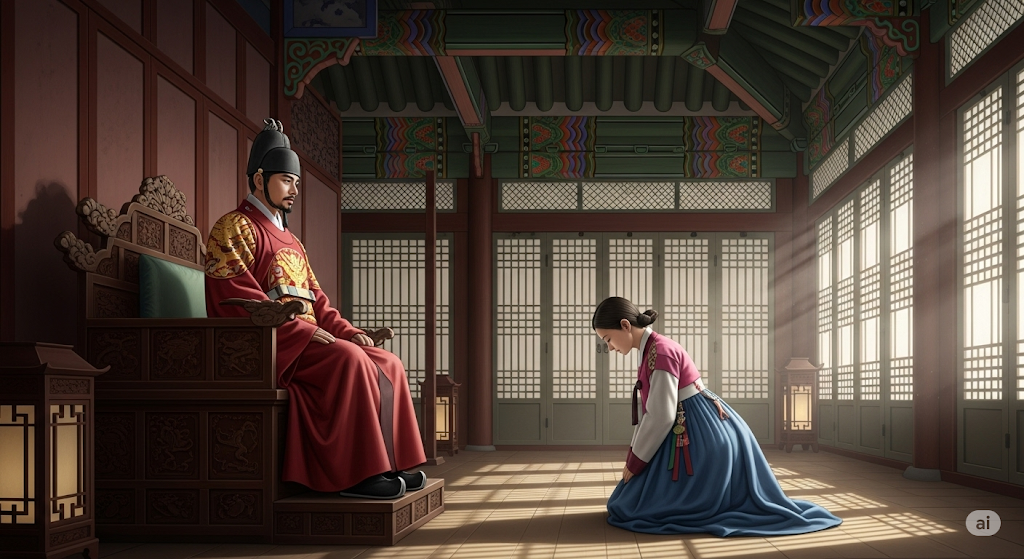
A Na-in who received the King’s favor was called a Seung-eun Sang-gung and was treated as a senior court lady. It was essentially gaining a position that usually took 30 years in a single night. She was relieved of her previous duties to focus solely on serving the King, and even the Jejo Sang-gung could not treat her lightly.
True social advancement came when she gave birth to the King’s child.
From then on, she would receive the rank of Suk-won (Rank 4) or higher, becoming an official royal concubine. Hui-bin Jang, who gave birth to King Gyeongjong while a court lady, and Suk-bin Choi, who gave birth to King Yeongjo while a musuri (low-level maid), show the end of that path. If you look into the daily life of a Joseon King, you can see how packed the daily lives of the Kings they served were.
Comparing the lives of ordinary Sang-gung and Seung-eun Sang-gung highlights the pros and cons of the Joseon court lady system.
| Classification | Ordinary Sang-gung | Seung-eun Sang-gung |
|---|---|---|
| Gaining Status | Over 30 years of training and service | Overnight via the King’s favor |
| Primary Role | Overseeing operations as department head | Devoted to serving the King |
| Power Base | Experience, skill, trust within the organization | The King’s affection |
| Stability | Relatively stable as a member of the organization | Unstable status that fades if affection wanes |
| Final Goal | High-ranking positions like Jejo Sang-gung | Becoming a concubine, entering royal family via children |
Looking at the table, while royal favor is a fast track, its foundation rests solely on the heart of one person: the King. Just as Jang Hui-bin was eventually forced to drink poison, the distance they could fall was as long as the height they had climbed. This is why the court lady society both dreamed of and feared this path. The fact that the hierarchy built over decades could be overturned in a single night if the King willed it was a device that demonstrated the King’s power more than it did the individual court lady’s status.
Where did court ladies go after leaving the palace?
When they grew old or fell ill, they left the palace. This was called Chul-gung (Exiting the palace). Some also left when the master they served passed away or when the palace reduced personnel due to disasters like droughts.
Even after leaving, marriage was prohibited. Therefore, they often lived together with others in similar situations or sought refuge in temples to spend their remaining days. Because they had no children, many court ladies were buried in the area of Imalsan in Eunpyeong-gu, Seoul, alongside eunuchs in the same situation. The tombstone of ‘Sang-gung Ok-gu Im-ssi’ found there stands as a witness to the existence of court ladies who did not leave even a single line of their names in official records.

A 30-year career as a Joseon court lady usually ended with a single tombstone.
It leaves a lingering, strange feeling that all that remained of people who began with a single nod as young girls and had to live their entire lives with their mouths shut was that single line on a tombstone. When placed alongside the story of Joseon-era toilets, where class lines were drawn even in palace latrines, or the evolution of traditional weddings held by women outside the palace, the place of the court ladies who lived and died without ever having a wedding becomes even more distinct.
References
- Wikipedia, Court Lady
- Woori History Net, Court Ladies Serving the Royal Family
- Woori History Net, Coming-of-age Ceremony and Titles
- Woori History Net, Duties of Court Ladies
- Korea Heritage Service, Gukyu-jeongdam (Court Lady 1)
- Korea Heritage Service, Gukyu-jeongdam (Court Lady 2)
- KBS WORLD, 500 Years of Joseon Dynasty! How Court Ladies Lived
- K-Gonggam, History Makes Movies Fun <The Concubine>
- Munhwa Ilbo, 'Night Shift' Jimil Court Lady