
At dawn, before the darkness has lifted, tens of thousands of people swarm in front of the palace gates.
Jipchunmun, Wolgeunmun, Tonghwamun, and Honghwamun. The moment the gates open, sturdy men carrying stakes and bamboo poles push and shove their way inside. What they are after is not a place to compete in academic prowess, but simply to secure a prime spot before anyone else.
Written in 1844 (the 10th year of King Heonjong’s reign), the long gasa poem Hanyangga (Song of Hanyang) captures this chaos.
“At Jipchunmun, Wolgeunmun, Tonghwamun, and Honghwamun / They arrive at the gates, the sturdy ‘Seonjeopgun’ (advance-guard troops) / With their short jackets tucked up, carrying umbrellas and straw mats / Holding stakes, poles, and bamboo lanterns, they find their spots by looking for the marked signs.”
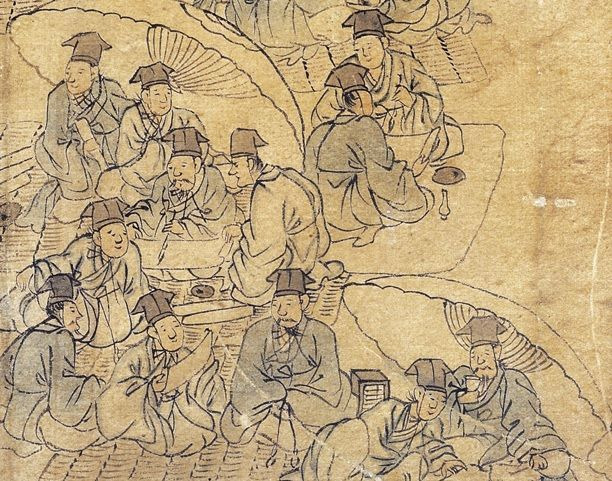
‘Seonjeopgun’ were not the examinees.
They were hired placeholders who would rush in early to secure a good spot at the exam site for a fee. The characters written on their lanterns were markings to identify which ’team’ they belonged to.
Why did civil service exams in the late Joseon Dynasty begin with a fight for seating rather than the answers themselves?
When tens or hundreds of thousands of people flocked to the site at once, examiners would customarily skim only the first few hundred papers submitted to select the successful candidates. Therefore, physical strength to secure a spot visible to the examiners decided the outcome more than literary talent.
Under Umbrellas and Curtains, How Cheating Became an Industry
Once the Seonjeopgun secured a spot through sweat and blood, the well-organized ‘main unit’ would move in.
When we think of cheating in the Joseon Dynasty, it is easy to imagine simply hiding answers in one’s sleeves, but the scene depicted in Hanyangga is far more organized.
“Beneath the exam question board, they drive in stakes and set up umbrellas / They hang curtains and stick up lanterns, with assistants standing in lines / Guarding every connection, the threats are fierce / Each finds their own spot and opens their book-carrying bags / Thinking through the questions, they write as fast as wind and rain / The ‘Geobyeok’ (master writers) recite phrases one by one / The ‘Sasu’ (scribes) write them down without a moment’s rest.”
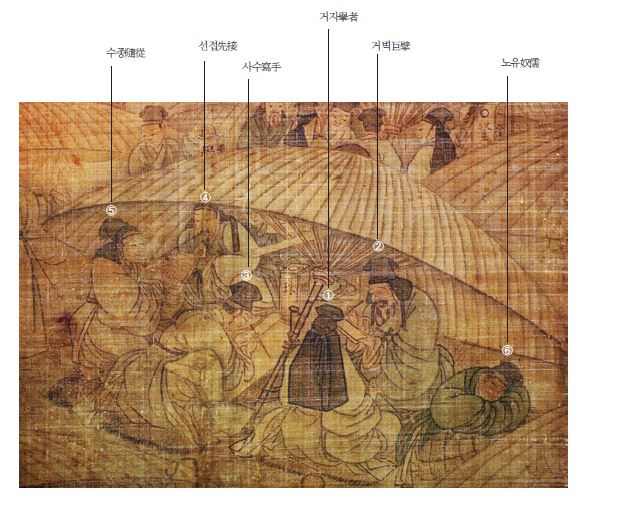
Once the exam topic is posted, a ‘cheating base’ is established under umbrellas and curtains, and a perfect division of labor begins.
- Geobyeok (Master Writers): Poor scholars who were highly learned but barred from official positions. They were ‘hired writers’ who, for a fee, would compose high-quality answers on the spot. It is said that the legendary Geobyeok Yu Gwang-eok would ‘custom-make’ answers ranging from top-ranker quality to passing-grade quality, depending on the client’s payment.
- Sasu (Scribes): ‘Substitute scribes’ who transcribed the text composed by the Geobyeok into beautiful handwriting to catch the examiner’s eye.
- Seonjeopgun/Sujonggun: ‘Security personnel’ who guarded the spots and the people to ensure the entire process remained uninterrupted.
If you think about why this flow—securing a spot (Seonjeopgun) → creating content (Geobyeok) → completing calligraphy (Sasu)—was split into three distinct roles, the answer is clear.
It was a structure designed to distribute the risk of detection and maximize the success rate by letting each person focus on what they did best. It wasn’t just a simple act of cheating; an entire ‘admissions fraud industry’ was already established at the late Joseon exam sites.
When I first read this passage, I was quite surprised by its sophistication, which far exceeded my imagination of simple cribbing.
Why Couldn’t the Law Stop the Cheating?
It is not as if the state stood idly by watching this fiasco.
Strong punishment clauses for substitute exams appeared as early as the Annals of King Sejong (1447). The principle was to “severely punish anyone who uses another’s talent to write an answer, writes on behalf of another, or acts as an intermediary, with 100 lashes and 3 years of imprisonment,” and this principle was inherited and refined in various subsequent Joseon legal codes.
| Charge | Description | Punishment |
|---|---|---|
| Chasul/Daesul | Substitute exam using Geobyeok/Sasu | 100 lashes, 3 years of forced labor, permanent disqualification |
| Hyeopseo | Bringing in cheat sheets | 3-year suspension of exam eligibility |
| Ampyo | Secret marking in collusion with examiners | Cancellation of pass, exile of examiner |
| Gwajarangsoran | Violent behavior at the exam site | On-site arrest, disqualification |
However, the blade of the law often grew dull in the face of corrupt reality.
In the 25th year of King Sukjong (1699), it was discovered that examiners had colluded with supervisors to rewrite answer sheets after the fact, leading to the cancellation of all 15 successful candidates and the exile of the involved examiners. This was the so-called ‘Gimyo Gwaok’ (Gimyo Exam Scandal).
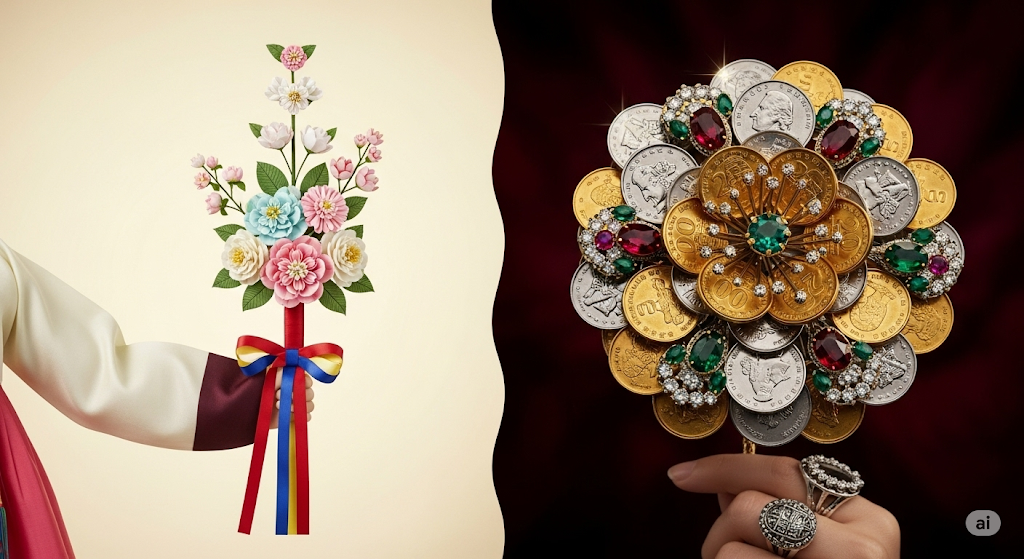
As such incidents repeated, a song echoed throughout the capital: “Is it Eosahwa (Royal Flower) or Geumeunhwa (Money Flower)?” It was a blatant mockery, implying that the honorable flowers bestowed by the King were actually bought with money.
When cheating reached an uncontrollable level, the state resorted to the extreme measure of ‘Pabang’ (nullifying the entire exam list). Since this measure also harmed the innocent examinees who had stayed up all night writing their own answers, it was less a victory of control and more a confession of limitations.
It Wasn’t Just Meritocracy That Collapsed
The 19th-century civil service exam sung of in Hanyangga is a scene showing how the pillar of meritocracy slowly crumbled under the rule of the Sedongjeongchi (in-law politics).
In a system where official positions were traded for money and connections, the clauses in the law books meant to protect fairness gradually hardened into empty phrases.
The physical struggle of the Seonjeopgun at the palace gate at dawn, and the Geobyeok and Sasu quietly brushing ink under their umbrellas, are ultimately telling the same story: the gateway to demonstrating talent had already been replaced by a gateway to competing for positions and money.
Hanyangga is both a hymn to a bustling capital and a funeral song for a dynasty that was silently rotting from within.
There, the Eosahwa could no longer bloom, and only the Geumeunhwa bloomed in the name of desire.
I also recommend reading the stories of the peddlers (Bobusang) who led the market economy in the late Joseon Dynasty.
References
- Encyclopedia of Korean Culture - Hanyangga: https://encykorea.aks.ac.kr/Article/E0061807
- National Gugak Center Dictionary - Hanyangga: https://www.gugak.go.kr/ency/topic/view/2073
- Korea Heritage Service - The Illegitimate Children of Corrupt Exams, Seonjeopgun and Geobyeok/Sasu: https://www.khs.go.kr/cop/bbs/selectBoardArticle.do?nttId=26278&bbsId=BBSMSTR_1008
- Region N Culture - Substitute Exam Expert, Geobyeok: https://ncms.nculture.org/unique-job/story/9885
- National Hangeul Museum - Let's Go See Seoul, Hanyangga: https://www.hangeul.go.kr/webzine/202401/sub1_1.html
- Kyunghyang Shinmun - Kim Kyung-soo's Legal Talk, Exam Cheating Means 100 Lashes: https://www.khan.co.kr/article/201810311559001