
A young Silla aristocrat met his lover while circling a pagoda, whereas a daughter of a Joseon noble family saw her groom for the first time only on their wedding day.
Traditional Korean weddings shifted from the ‘Seookje’ (son-in-law house) system of Goguryeo, where the groom lived with the bride’s family, to the arranged marriages and ‘Chinyeong’ (the custom of the bride moving to the groom’s house) pushed by Joseon Neo-Confucianism. However, this transition did not happen overnight with the change of dynasties and took until the 17th century to fully take hold.
Was courtship free before Goryeo? The marriage of Kim Chunchu and Munhui
Stories that look like free love often have hidden calculations behind them.
Such is the case with the marriage of Kim Chunchu, who would later become King Taejong Muyeol, and Munhui, the younger sister of Kim Yusin.
According to the Samguk Yusa, Kim Yusin was playing chukguk (a traditional ball game) with Kim Chunchu when he intentionally stepped on and tore Chunchu’s coat string. He brought him to his house under the guise of having it mended, intending to entrust the task to his eldest sister, Bohee. She declined, and it was the second sister, Munhui, who picked up the needle. The two grew close, and Munhui became pregnant.
Kim Yusin’s next move was even bolder.
He announced that his unmarried sister had become pregnant, declared he would “burn his sister to death for dishonoring the family,” and lit a bonfire in the courtyard. Queen Seondeok, seeing the smoke from Namsan, heard the story and told Kim Chunchu, “It is your doing, so go and save her.” That was how the marriage was secured.
As a side note, King Munmu, born to Munhui, was born in 626, which was during the reign of King Jinpyeong. The ‘Queen Seondeok’ in the legend does not match the timeline.
Why was such a theatrical performance necessary? The Kim Yusin family were descendants of Gaya royalty who had surrendered to Silla, meaning their roots within the ‘Jingol’ (true-bone) rank were weak.
Making Kim Chunchu, who was close to the line of succession, his brother-in-law was a move that gambled on the family’s future.
In summarizing this, the scene I have fixated on most is this bonfire. If read as a love story, it is romantic; if read as politics, it is a public opinion campaign.
Pagoda circumambulation and Seodongyo: Where did Silla and Baekje men and women meet?
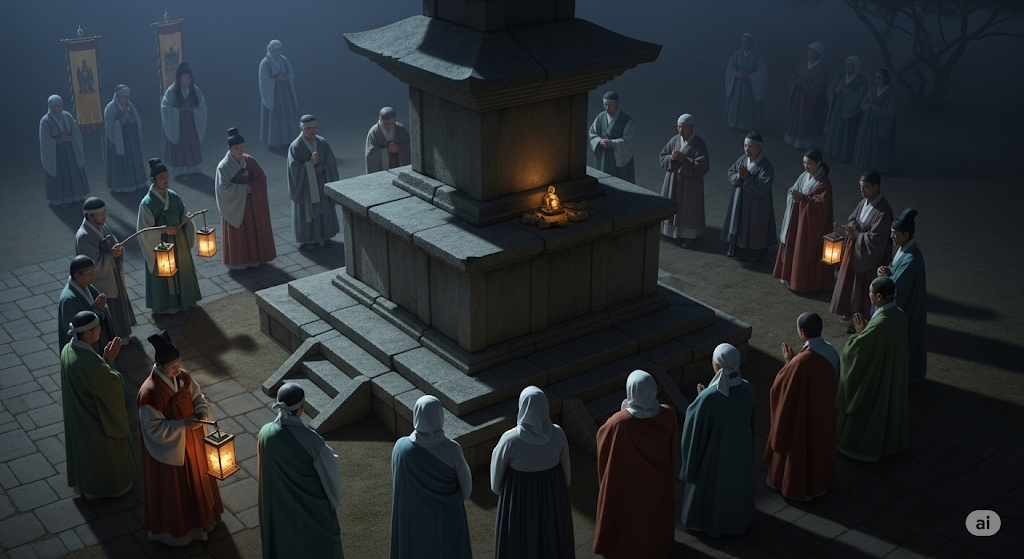
There were spaces where such encounters were possible.
‘Pagoda circumambulation’ (Tapdori) at large temples like Heungryunsa, where people circled pagodas all night, was a place where men and women could mingle naturally.
The story of Kim Hyeon and the tiger maiden in the Samguk Yusa also begins at a Heungryunsa pagoda circumambulation.
The fact that Silla’s religious events were social hubs is as intriguing as other mysteries surrounding Gyeongju.
Baekje legends are even more daring.
Seodong, who dug and sold yams, heard rumors that Princess Seonhwa, the third daughter of Silla’s King Jinpyeong, was beautiful. He went to Seorabeol and spread a song while handing out yams to children:
Princess Seonhwa / Secretly married / Seodong the groom / Takes her away secretly at night
When the rumor reached the palace, the king exiled the princess, and Seodong appeared before her on her way to exile and took her as his wife.
Legend says he became the 30th King of Baekje, King Mu. The idea that a single song could change reality resembles modern SNS public opinion campaigns. However, the relic deposit record found in the stone pagoda of Mireuksaji Temple in Iksan in 2009 states that King Mu’s queen was the daughter of Sataek Jeokdeok. Whether Princess Seonhwa was a real person remains inconclusive.
Goguryeo’s Seookje and uxorilocality: Marriage customs that supported women’s status
Marriage in Goguryeo began with the groom entering the bride’s home.
This is the Seookje (son-in-law house system) reported in the Records of the Three Kingdoms (Sanguozhi) in the section on the Eastern Barbarians.
Once both families verbally agreed to the marriage, the bride’s family would build a small annex called a ‘Seook’ behind the main house. On the wedding evening, the groom would kneel outside the gate of the bride’s house and ask to stay with her; once granted, the newlyweds began their life in the Seook. They lived at the bride’s home until they had children and the children grew up, only then returning to the groom’s family. Many interpret the Korean term ‘Jangga-deulda’ (to enter the father-in-law’s house) as being rooted in this tradition of uxorilocality.
This method of the groom going to the bride’s home is called ‘Namgwi-yeogahon’.
The key point is that women remained within the protection of their natal home even after marriage. By the Goryeo period, daughters inherited property equally with sons, could become heads of households, and siblings took turns performing ancestral rites. Uxorilocality was the living foundation that supported this status. It was also the background that enabled Goryeo’s free-spirited culture.
Why did marriage in the Joseon Dynasty become arranged? ‘Namnyeochilse-budongseok’ and ‘Saju-danja’
What Joseon changed was not just the wedding procedure, but the encounter itself. The phrase from the Book of Rites (Liji), “At seven, boys and girls should not sit together,” became a social norm known as ‘Namnyeochilse-budongseok’.
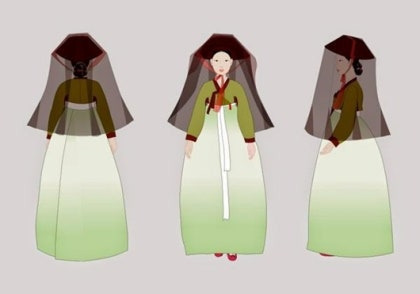
Noblewomen covered their faces with veils or cloaks when going out.
Venues for meeting, like pagoda circumambulation, disappeared.
So, who chose the spouse? The head of the family. From the perspective of a Neo-Confucian state, the separation of men and women was both moral education and a mechanism to strip individuals of the right to choose a spouse and transfer it to the family patriarch.
Thus, Joseon marriages began with the legwork of a matchmaker.
In the first stage, ‘Uihon’ (marriage discussion), the families checked each other’s status, family reputation, and assets. Once the talk progressed, the groom’s side sent a ‘Saju-danja’ (paper with the four pillars: year, month, day, and hour of birth).
The bride’s side used this to check marital compatibility and pick a wedding date, which they sent back as ‘Yeongil’. Then, the ‘Napchae-seo’ (engagement letter) and ‘Nap-pye-seo’ (gift letter) were exchanged.
It was a structure where marriage was confirmed through documents without the parties ever seeing each other’s faces.
Order of traditional wedding ceremonies: The meaning of Jeonan-rye, Gyobae-rye, and Hapgeun-rye
The first time the bride and groom face each other is during the ‘Daerye’ (main ceremony) on the wedding day.
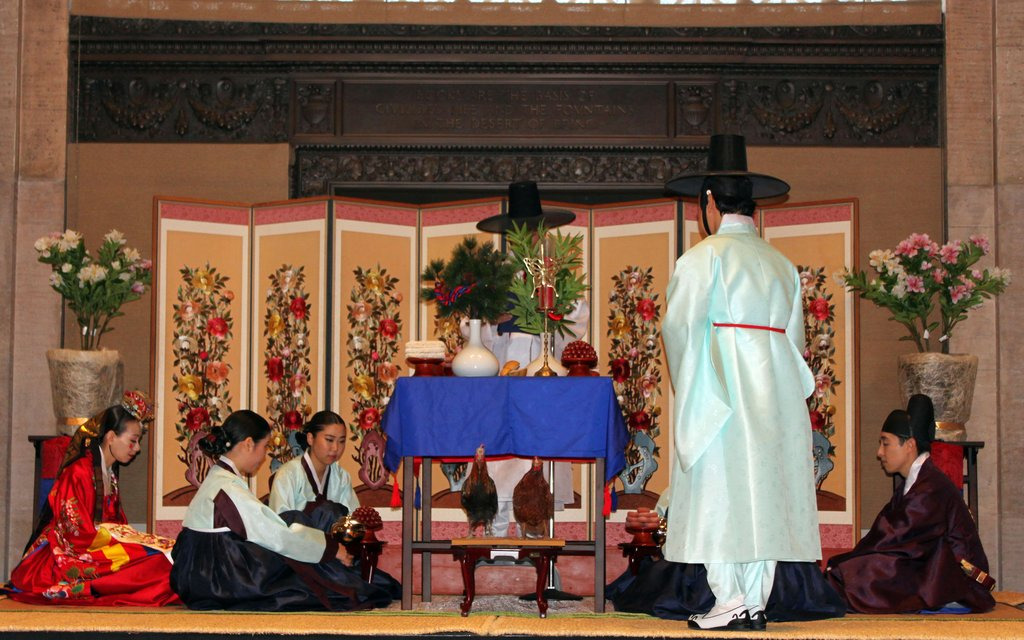
In the traditional wedding ceremony of ‘Jeonan-rye’, the groom offers a wooden goose to the mother-in-law and vows to live together for a hundred years.
- Jeonan-rye (Ceremony of the Wild Goose): The groom comes to the bride’s house, places a wooden goose on a table, and bows. The mother-in-law accepts it. Geese were believed to mate for life, so they became a symbol of the vow for a lifelong union.
- Gyobae-rye (Exchange of Bows): The groom and bride stand facing each other for the first time and exchange bows.
- Hapgeun-rye (Ceremony of Joining Cups): They drink wine from two halves of a split gourd. It symbolizes that the two are originally one body.
This ritual was also a procedure where the entire neighborhood watched and bore witness to the union of the two.
However, there is a fact often overlooked here.
Although the ‘Chinyeong’ (bringing the bride directly to the groom’s house) was the ideal for Joseon, in reality, the practice of holding the wedding at the bride’s house and staying there for a while persisted for a long time.
The court compromised with ‘Banchinyeong’ (half-Chinyeong), where the groom held the wedding at the bride’s house and took her away after three days. The practice of uxorilocality only faded after the 17th century. This is why the maternal side played such a significant role in the lives of figures like Yulgok Yi and Shin Saimdang.
In-law life and the ‘Seven Evils’: What Joseon-era marriages left for women
Moving the bride into the groom’s family is called ‘Ugui’.
Upon arrival, she would perform deep bows to her in-laws and offer dates and chestnuts as part of the ‘Pye-baek’ (formal greeting). These foods contained wishes for many descendants. The norms governing the following life with the in-laws were strict.
- Chilgojiak (Seven Evils for Divorce): Disobeying parents-in-law, failure to bear a son, adultery, jealousy, chronic illness, excessive talking, and theft. These were the seven grounds for a husband to send his wife away. However, there were the ‘Sambulgeo’ (Three Exceptions) that acted as a safeguard: if she had no natal home to return to, if she had observed the three-year mourning period for parents-in-law, or if the family had become wealthy after her arrival.
- Law prohibiting descendants of remarried women from holding office: I originally wrote ‘remarriage ban’ in my draft, but that is inaccurate. The clause added to the Gyeongguk Daejeon during King Seongjong’s reign did not punish the widow’s remarriage itself, but rather barred her descendants from taking the civil service exams (Mun-gwa) or holding public office. In noble families, this effectively acted as a ban on remarriage.
The same system existed in an even more extreme form within the palace. The lives of court ladies who could never marry are another face of this order.
Love outside the norms: King Gongmin and Queen Noguk, Hwang Jini and the Gisaengs
Systems could not control all emotions.
At the end of the Goryeo period, King Gongmin and his Yuan-born Queen Noguk met through an arranged marriage, but Queen Noguk was a close partner who even supported her husband’s anti-Yuan reforms. When she passed away from a difficult childbirth in 1365, King Gongmin distanced himself from state affairs and focused on mourning her. It reads like the last scene before the Joseon era where passionate love within marriage was openly recorded.
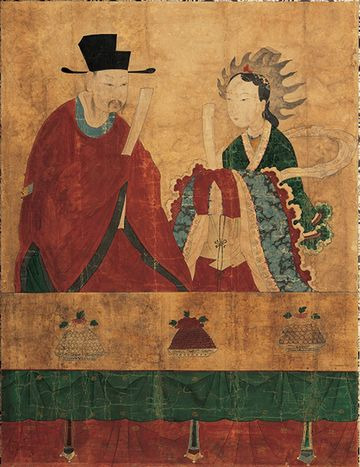
In Joseon, the Gisaengs filled that void.
As the separation of men and women became stricter, women who could converse with literati through poetry, calligraphy, and painting were rare, and Gisaengs were almost the only exception. This is why the stories of the spiritual connection between Hwang Jini and Seo Gyeong-deok, or Hongrang and Choi Gyeong-chang, remain. Marriage became a duty for the family, and romantic love was relegated to outside of marriage.
Comparison table of pre-Goryeo and Joseon marriage customs
Here is a summary of how Korean marriage customs differed between the two eras:
| Features | Pre-Goryeo (Three Kingdoms/Goryeo) | Joseon |
|---|---|---|
| Meeting | Public venues like pagoda circumambulation, strategic meetings | Namnyeochilse-budongseok, arranged marriage via matchmaker |
| Marriage Procedure | Focused on verbal promises, Goguryeo’s Seookje | Documentary procedures according to six rites (Saju-danja, Honseo) |
| Residence | Uxorilocality (Namgwi-yeogahon) was common | Chinyeong was the principle, though half-Chinyeong and uxorilocality persisted until the 17th century |
| Women’s Status | Equal inheritance, could be heads of households, relatively free remarriage | Subordinate to husband’s family, Chilgojiak, ban on descendants of remarried women holding office |
| Marriage & Love | Passion within marriage recorded and celebrated | Marriage as duty, romantic love outside of marriage |
| Purpose of Marriage | Family alliance, labor, political strategy | Maintaining patrilineal bloodline, social hierarchy, ancestral rites |
Looking at the table, I think that matchmaking services have taken the place of matchmakers, and SNS has taken the place of the Seodongyo song.
The tools have changed, but the strategic maneuvering to meet people and build relationships is not much different from the time of Kim Yusin’s bonfire.
References
- Hankyung, Anecdotes related to Kim Yusin
- JoongAng Ilbo, The marriage of Kim Chunchu and Munhui
- Wikipedia, Queen Munmyeong
- Local N Culture, Marriage customs of the Three Kingdoms period
- Our History Net, Customs of marriage and courtship
- KBS WORLD, The story of Seodong and Princess Seonhwa
- Encyclopedia of Korean Folk Culture, Seookje (Son-in-law house system)
- Hankyoreh 21, The history of uxorilocality
- Our History Net, Namnyeochilse-budongseok
- Encyclopedia of Korean Folk Culture, Arranged Marriage
- Encyclopedia of Korean Folk Culture, Saju-danja (Four pillars paper)
- Encyclopedia of Korean Culture, Wedding Ceremony
- YTN Science, Wedding stories
- Encyclopedia of Korean Folk Culture, In-law life
- Our History Net, Joseon society and women
- Our Culture News, King Gongmin and Queen Noguk