
The Glimmering Surface of Joseon and Its Dark Shadows
- The gap between the ideals of the ruling class and the crumbling reality
- The corruption of the social system in late Joseon, including the collapse of the examination system
- The real reason why Jeonggamnok captivated the hearts of the despairing populace
1. Light and Shadow: The Two Faces of Joseon Where Jeonggamnok Emerged
Before we begin the story, we must first examine the stage of the era we are traveling to. The country of Joseon seemed to shine with the lofty ideals of Confucianism, but beneath that surface lay a deep shadow. One was the perfect and orderly world presented by the ruling class, while the other was the decaying reality experienced by the common people. It was precisely this massive fracture that allowed the forbidden book Jeonggamnok to become a ‘bestseller of the underground world’ that shook the times.
The Distortion of the Ideal Space: The Decline of Seowon
Thinking of Seowon (書院) during the Joseon era as just a school is a misunderstanding. This place was a sacred space that not only nurtured elite bureaucrats to lead the future of the country but also honored and held rituals for respected Confucian scholars. Thanks to these two roles, Seowon held tremendous moral authority. Even when constructing the buildings, they clearly distinguished between the lecture hall (講堂) for academic pursuits and the shrine (祠宇) for rituals.
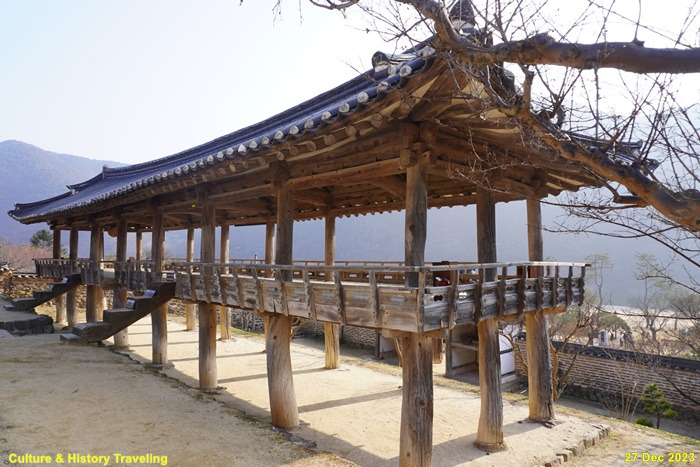
It was no coincidence that Seowon was built harmoniously with nature, often nestled among mountains and rivers. This was a visible manifestation of the Confucian ideal that humans and the universe are one. The arrangement of the dignified and elegant lecture halls and pavilions reflects the values of order and propriety that were emphasized in society at the time. The fact that nine Seowons, such as Dosan Seowon and Byeongsan Seowon, are listed as UNESCO World Heritage Sites is a testament to the world’s recognition of the “outstanding universal value” of this tradition.
Initially, Seowon resembled a humble study room for local scholars, but it gradually transformed into a stronghold of powerful political forces. Especially when it became a Siaek Seowon (賜額書院), named directly by the king, its status soared.
However, problems began to arise. Acts of honoring specific scholars, such as venerating Yi I (李珥) at Jaun Seowon, became a means for political factions like the Westerners (西人) to assert their academic legitimacy and consolidate power. Disputes over whose tablet would be placed in a higher position within the shrine were akin to proxy wars manipulated by central political forces.
This was the contradiction of Seowon. Originally, Seowon was supposed to be a bastion of pure scholarship, free from the dirty power struggles of the secular world. Ironically, as the prestige of Seowon grew, it became a powerful political symbol. Seowons, which had become the headquarters of various factions, had plunged themselves into the very power struggles they sought to transcend. The sight of even the most respected institution being shaken by secular conflicts bred deep disappointment and distrust among the people.
The Promise of Eternal Glory: The Contradiction of Bulcheonwi
In the Joseon era, the highest honor a family could achieve was to have their ancestors enshrined in the Bulcheonwi (不遷位) ritual. The term Bulcheonwi, meaning ’the spirit that does not move’, broke the principle of ancestral rites typically conducted only for four generations, allowing the spirits of ancestors who had made significant contributions to the country to be honored “forever” in the shrine.
The Bulcheonwi ritual was not merely a family event; it served as a significant social event where local Confucian scholars gathered, showcasing the family’s power. There were even different grades of this honor.
Table 1: Types of Bulcheonwi
| Type | Designating Authority | Status |
|---|---|---|
| National Bulcheonwi (國不遷位) | King | Highest authority (e.g., Toegye Yi Hwang, Yulgok Yi I) |
| Local Bulcheonwi (鄕不遷位) | Local Confucian scholars | High local prestige |
| Private Bulcheonwi (私不遷位) | Clan | Recognized mainly within the clan |
However, there was a dark shadow behind this glorious system. The ideal of Bulcheonwi was to honor virtues that transcended time, but in reality, it was often politically exploited. The ruling factions would elevate their ancestors to Bulcheonwi status to rewrite history in their favor. This resembles the debates we have today about how to evaluate and honor certain historical figures, illustrating how history can be reinterpreted by current powers.
If even the highest spiritual honor of the nation is used for political gain, can the entire official value system truly be fair? Such deep cynicism and disillusionment created fertile ground for stories like Jeonggamnok, which prophesied the collapse of the existing order and the advent of a new world.
2. The Crumbling Order: The Sighs of the People that Called for Jeonggamnok
In stark contrast to the ideal image seen in Part 1, the reality of late Joseon was bleak. As the system that should have supported the nation rotted away, a longing for a new world began to grow in the hearts of the people, accompanied by anxiety.
The Ladder of Hope: The Corruption of the Examination System
Originally, the Gwa-ge (科 ‘) examination was the only ladder of hope that allowed one to rise above social class barriers. However, by the late Joseon period, this ladder had turned into a chaotic scene stained by money and power.
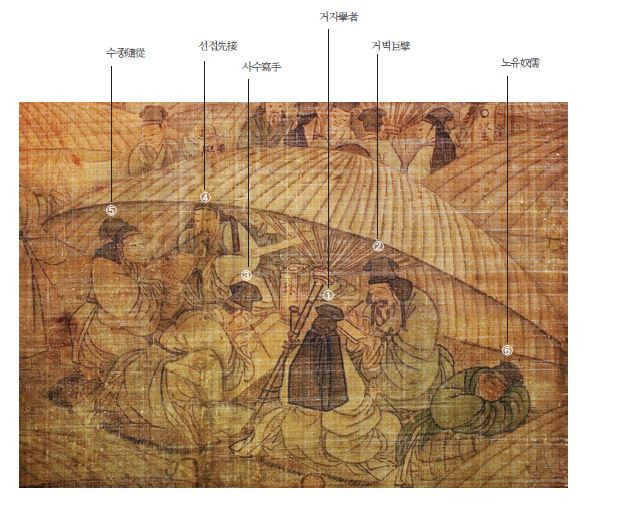
Records from that time describe the examination hall as a “complete mess.” Violence and brawls over seating were commonplace, and there were even incidents where people were trampled to death. Cheating had become so systematic that it was beyond imagination.
Table 2: Types of Cheating in Late Joseon Examinations
| Term | Description | Role |
|---|---|---|
| Geobyeok (巨擘) | ‘Proxy writer’ who writes answers for others | Composes examination answers |
| Sasu (寫手) | ‘Proxy calligrapher’ who copies the answers of the geobyeok | Provides elegant handwriting for final answers |
| Seonjeopgun (先接軍) | Hired thugs to secure good seating | Secures space for cheating teams |
Such corruption spread deep cynicism throughout society. The popular song of the time, “Is it the royal flower (어사화) or the gold and silver flower (금은화)?” painfully illustrated the public’s resignation that the glory of passing (어사화) was determined not by skill but by money (금은화). What do you think about the fact that the examination, once a symbol of fair opportunity, has collapsed to this extent?
The collapse of the examination system signified the collapse of the nation. When the official path to success was filled with fraud and trickery, people began to seek other avenues. It was into this gap that Jeonggamnok penetrated.
The Naked Truth of the Capital, Hanyangga
The lyrics Hanyangga, written in the 19th century, vividly depict the state of the capital, Hanyang. In this work, Hanyang is portrayed as a splendid yet chaotic city. It shows that new powers, such as money and brute force, began to exert influence outside the strict social hierarchy.
The author subtly points out the corrupt examination system and severe wealth disparity hidden behind the grand royal events, suggesting that “the Joseon dynasty was in decline.” Amidst the vast gap between official ideals and reality, Jeonggamnok offered a shocking explanation: ‘This is not a temporary problem. An era is coming to an end, and the current dynasty has already lost the mandate of heaven (天命).’
3. The Whisper of a New World: The Secrets of Jeonggamnok
Now, it’s time to delve into the secrets of Jeonggamnok, the centerpiece of our story. Who wrote this book, why, and what content captivated the hearts of the people?
The Forbidden Book: Its Origins and Spread
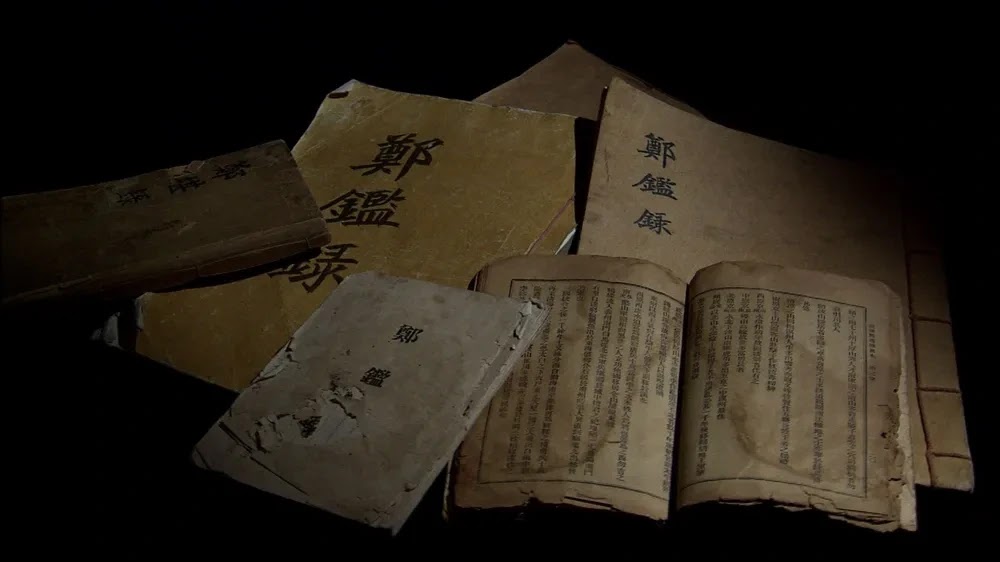
Jeonggamnok (鄭鑑錄) is not merely a single book written by one person. It is more like a collection of various prophetic texts written over different eras. Since it was a book banned by the state, it spread in the form of handwritten copies made secretly. In this process, the content was slightly altered or new stories were added, which only enhanced the book’s mystique.
The Core Message of Jeonggamnok: Doom and Salvation
The core prophecy of Jeonggamnok is simple yet shocking. It states, “The fall of the Yi dynasty and the rise of the Jeong dynasty (李氏亡 鄭氏興)”. This new dynasty is promised to be established by a savior known as Jeongdoreng (鄭道令).
However, it warns that before the new era arrives, terrible disasters will strike, and it reveals Sipsungji (十勝地) as a refuge for survival. The most intriguing part when I first learned about Jeonggamnok was this ‘Sipsungji’. The fact that it provided a concrete survival guide beyond a simple prophecy suggests how realistically hopeful it must have seemed to the people of that time.
The Power that United the Beliefs of the People
The strength of Jeonggamnok lay in its ability to cleverly weave together the various beliefs that were prevalent among the people at the time.
- Geomancy (風水地理): It presented Sipsungji as a safe refuge.
- Dojam (圖讖): It inherited the tradition of predicting the rise and fall of the nation.
- Maitreya Belief (彌勒信仰): The figure of Jeongdoreng as a savior connects with the Maitreya Buddha belief that would save the chaotic world.
In this way, Jeonggamnok blended various existing thoughts, creating a very familiar yet completely new message of salvation for the people of that time.
4. Why Did Jeonggamnok Become a ‘Bestseller’?
To put it simply, the explosive popularity of Jeonggamnok was perhaps an inevitable result. The ideology of the ruling class lost its authority, and the nation’s system rotted from the roots, causing only suffering for the people. In such a desperate situation, Jeonggamnok told the story that people desperately longed for.
- Explanation: It explained that the suffering of the people was part of a grand cosmic plan.
- Villain: It clearly identified the source of the problem as the Yi dynasty, which had lost the mandate of heaven.
- Hero: It presented Jeongdoreng as the messiah who would save the world.
- Survival Plan: It provided practical hope in the form of Sipsungji, a refuge to survive the end times.
Ultimately, Jeonggamnok became a powerful and persuasive alternative that could replace the outdated ideologies that could no longer explain reality, thus becoming the ‘bestseller’ of its time.
The Echo of Unfinished Prophecies
The story of Jeonggamnok did not end with the Joseon era. Its ideas directly influenced the Donghak Peasant Revolution at the end of the 19th century and were reinterpreted as messages of hope predicting liberation during the Japanese colonial period. Even today, the ideas of salvation and apocalyptic worldview resonate faintly in some new religions and conspiracy theories.
Appendix: The Secret in Numbers, The Two Faces of Four
To understand the power of Jeonggamnok, it is necessary to glimpse the worldview of the people at that time. The contrasting perceptions of the number four serve as a good example.
- Perspective of the Ruling Class: Four symbolized stability, order, and completeness, as seen in the four seasons, four directions (四方), and four virtues (仁義禮智).
- Perspective of the People: On the other hand, among the common folk, four was feared because it sounded like the word for death ‘사(死)’.
This is where the power of Jeonggamnok emerges. It takes the stable symbol (4) presented by the ruling class and overlays it with the darker, instinctual meaning of death hidden within. This is the key to how Jeonggamnok interprets the world. It deconstructs official symbols and fills that space with secret meanings, teaching its followers a new way to view the world.
Conclusion
The reasons why Jeonggamnok became a bestseller that shook late Joseon society are clear.
- Loss of Authority: As the Confucian ideals and morality of the ruling class crumbled, the official ideology lost its power.
- Collapse of the System: Social systems like the examination system became corrupt, bringing despair instead of hope to the people.
- Emergence of Alternative Narratives: Jeonggamnok provided a powerful alternative narrative that explained the pain of reality, presented clear enemies and saviors, and offered concrete survival plans.
The story of Jeonggamnok shows us that history is not just a record of the victors. In times of despair, people sought hope in any way possible, and that yearning created a massive current.