
In Chinese mythology, the giant Pangu broke out of a chaotic egg and pushed the sky and earth apart. When he died, his breath became the wind, and his body became the mountains and rivers. The version offered by science is slightly different. The blood in your veins appears blue, but it is red because of iron; that iron was forged inside a star before the Sun even existed, then scattered across the universe as atoms. The hydrogen in your body’s water molecules is even older, created in the first few minutes after the Big Bang.
Stories of a giant’s body forming the world and stories of my body being made from stellar remnants—though their forms differ, both answer the same question: “Where did we come from?” The modern origin story that answers this question with evidence is Big History. It cuts 13.8 billion years into eight thresholds, asking at each one, “What were the ingredients, and what conditions were just right?” Following this path, we can also see that three commonly cited Big History points need updating by current standards: the origin of gold, whether our galaxy will truly collide with Andromeda, and whether the Anthropocene is officially a new geological epoch.
Why do humans create origin stories: From Pangu’s egg to Big History
Humans are animals that find comfort in weaving scattered experiences into narratives of cause and effect. This is why humans are sometimes called Homo Narrans, or “storytelling beings.” Stories compress complex information to make it easier to remember and allow us to feel others’ experiences as our own. For a species that had to survive in groups, this was a quite useful tool.
There is a deeper motive as well. Psychology’s Terror Management Theory suggests that to cope with the fact that we will eventually die, humans construct cultural worldviews that explain how the world began and what life is for. An origin story is the first chapter of that worldview. If you know the beginning of the world, you can define your place within it.
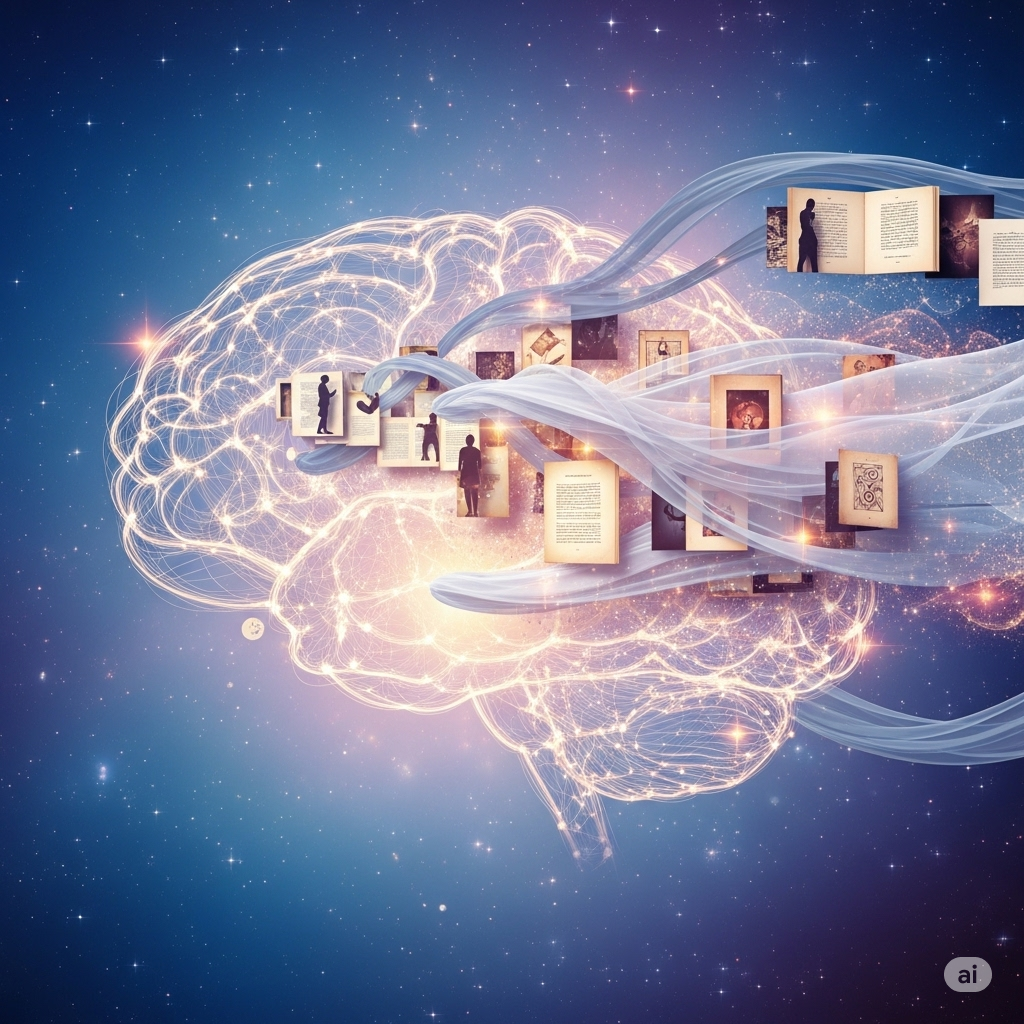
Interestingly, origin stories from cultures that had no contact with each other converge on a few patterns. The archetypal origin stories of world creation myths can be summarized as follows:
| Culture | Archetype | Story |
|---|---|---|
| Greek | Creation from Chaos | Gods emerge spontaneously from the empty void of Chaos, and the world is established after generational conflict |
| Egyptian | Creation from the Abyss | A hill rises from the primordial waters of Nun, and Atum gives birth to gods to establish order (Ma’at) |
| Abrahamic | Creation ex nihilo | A single God creates the world with words, clearly separating the Creator from the created |
| Chinese | Cosmic Egg/Giant’s Sacrifice | Pangu emerges from an egg, separates sky and earth, and his body becomes all things upon death |
| Norse | Giant’s Sacrifice | Gods kill the giant Ymir and use his remains to build the world |
| Indian (Hindu) | Sacrifice of the Primordial Human | Purusha is offered as a sacrifice, creating the universe and the four social classes (Varna) simultaneously |
| Korean | Separation of Heaven/Earth | Mireuk separates heaven and earth, but the world becomes imperfect after he is tricked by Seokga |
These stories didn’t just end with explaining the past; they were used as blueprints for organizing society. The explanation that the four classes emerged from Purusha’s mouth, arms, thighs, and feet made the caste system seem like a cosmic order. Chinese dynasties claimed legitimacy through the Mandate of Heaven (Tianming). The Genesis verse “subdue and rule the earth” remains a subject of debate, cited by historian Lynn White in 1967 as the root of Western attitudes of environmental exploitation. Carl Jung viewed myths as expressions of the collective unconscious shared by humanity, while Joseph Campbell argued that world myths repeat the hero’s journey of “separation-initiation-return.”
It is notable that David Christian, who created Big History, titled his 2018 book Origin Story. He presented Big History as the latest version of this ancient genre. The only difference is that it demands evidence for every sentence.
Who created Big History, and why weave 13.8 billion years into one thread?
Big History is a perspective first introduced in 1989 by historian David Christian at Macquarie University in Australia. It treats the time from the Big Bang to today as a single narrative, mapping cosmology, geology, biology, and history onto one chart. It is well known that Bill Gates was captivated by this lecture, leading to the creation of the educational “Big History Project.”
I like this framework for a specific reason: nuclear fusion learned in physics and the agricultural revolution learned in history are explained using the same grammar.
That grammar is simple.
**Ingredients + Goldilocks Conditions** = New Complexity
Ingredients are the components available at that point in time. Just after the Big Bang, hydrogen and helium were all there was. The term “Goldilocks Conditions” is borrowed from a fairy tale, meaning an environment that is “just right”—not too hot and not too cold. When the two meet, properties emerge in the whole that were not present in the parts; this is called Emergence. The simplest example is water. Hydrogen and oxygen are gases at room temperature, but water, their combination, flows as a liquid. No matter how closely you inspect individual atoms, you won’t find “wetness.”
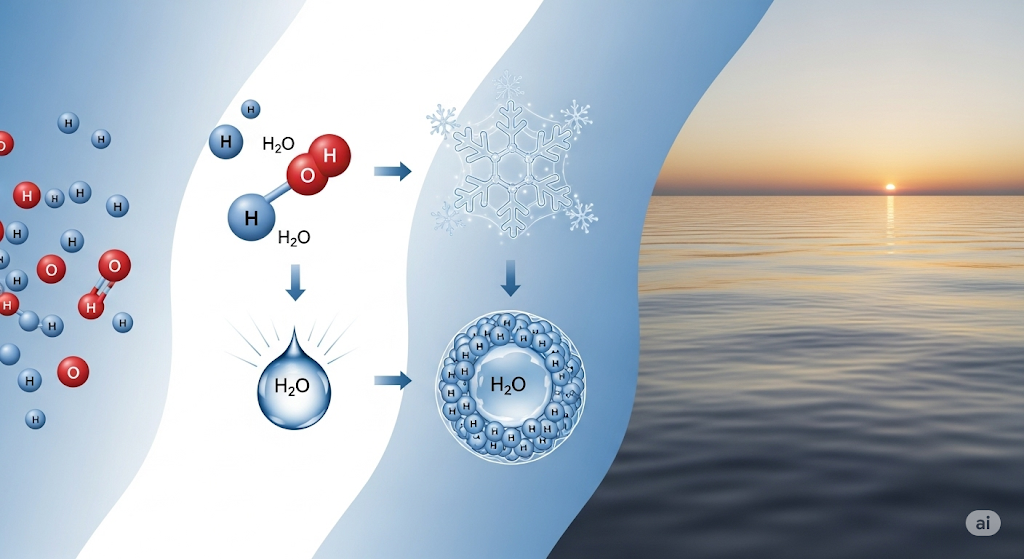
Here are the eight thresholds of Big History and their ingredients/conditions:
| Threshold | Time | Ingredients/Goldilocks Conditions | New Complexity |
|---|---|---|---|
| 1. Big Bang | ~13.8 billion years ago | Unknown | Time, space, energy, matter |
| 2. Stars Appear | ~13.6 billion years ago | Hydrogen/helium, gravity, tiny density fluctuations | Stars, galaxies |
| 3. New Elements | After first giant stars die | Extreme heat/pressure in old giant stars, supernovae | Heavier elements of the periodic table |
| 4. Solar System/Earth | ~4.6 billion years ago | Various elements, gas/dust clouds, accretion | Sun, planets, moons |
| 5. Life Emerges | ~3.8 billion years ago | Complex chemicals, energy, liquid water | Self-replicating life |
| 6. Collective Learning | ~300k-200k years ago | Powerful brains, symbolic language | Homo sapiens, cumulative knowledge |
| 7. Agriculture | ~11,000 years ago | Post-glacial warm climate, population growth | Settlement, cities, states |
| 8. Modern Revolution | ~250 years ago | Global exchange networks, fossil fuels | Industrialization, planetary human impact |
The first two thresholds: The Big Bang created space-time, and the first stars created light
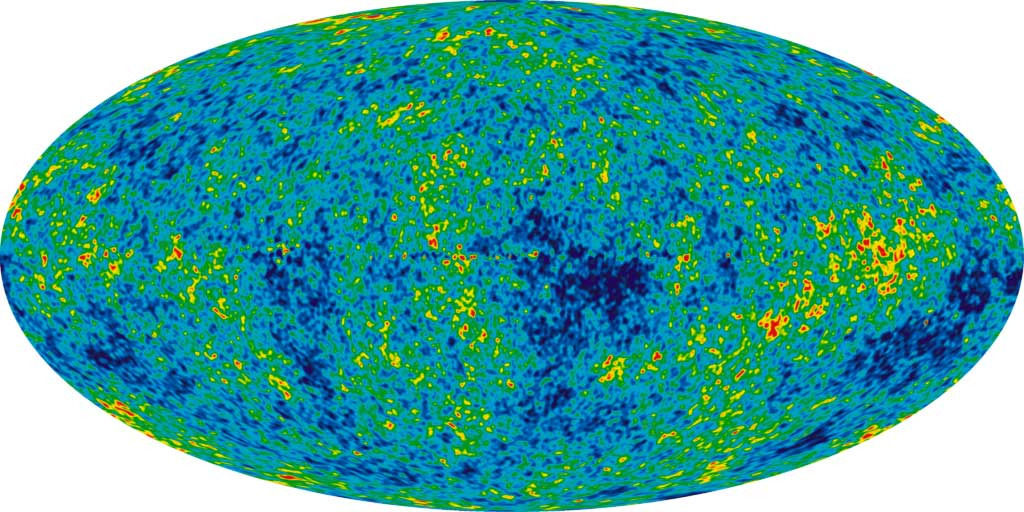
The first threshold, the Big Bang, was not an explosion in empty space. Time, space, matter, and energy themselves began together about 13.8 billion years ago in a hot, dense state. The evidence is twofold: the redshift—the observation that more distant galaxies are shifted toward the red end of the spectrum, meaning the universe is expanding—and the Cosmic Microwave Background (CMB), the residual heat from the Big Bang that arrives evenly from all across the sky.
This threshold’s Goldilocks condition is often described as “fine-tuning.” If gravity had been slightly stronger, the universe would have collapsed back on itself immediately; if it had been slightly weaker, matter wouldn’t have clumped together, and stars would never have formed.
However, the newborn universe was chemically very poor. Between 3 and 20 minutes after the Big Bang, as the universe cooled, atomic nuclei were synthesized (Big Bang nucleosynthesis), resulting in about 75% hydrogen and 25% helium by mass. There was no carbon, oxygen, or iron. It was a warehouse of materials that couldn’t yet build planets or life.
| Time after Big Bang | Event | State of the Universe |
|---|---|---|
| 10⁻⁶s to 1s | Quarks bind to form protons/neutrons | Quark-gluon plasma |
| ~3-20 min | Big Bang nucleosynthesis, helium nuclei formation | Plasma of nuclei and electrons |
| ~380,000 years | Recombination, CMB release | Transparent universe, neutral H/He gas |
| 380k to millions of years | Cosmic Dark Ages | Dark universe with no light-emitting objects |
After about 380,000 years, the temperature dropped to about 3,000K, and nuclei captured electrons to become neutral atoms. This is called recombination. Before this, light could not travel straight because it kept hitting free electrons; from this point on, it spread freely. That light, cooled over 13.8 billion years, is the CMB we observe today. This light contains tiny temperature fluctuations at the level of 1 in 100,000. These fluctuations represented density differences, which became the seeds for galaxies and stars.
But time was short for seeds alone. The density differences in ordinary matter were too slow to clump together on their own. This is where an invisible architect appears: Dark Matter, which makes up about 85% of the universe’s matter but does not interact with light. Since Dark Matter is not hindered by light pressure, it clumped together before ordinary matter, building the gravitational skeleton of the “cosmic web” that connects the universe like a spiderweb. Just as road networks are laid first and buildings follow at intersections, hydrogen and helium gas flowed into the gravitational wells of this skeleton after recombination.
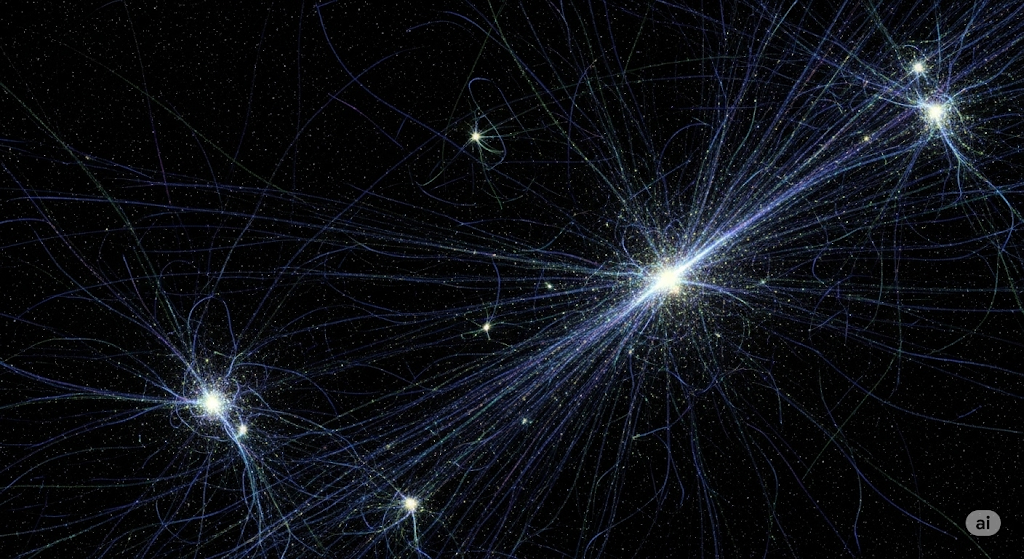
The second threshold was crossed at those nodes. The ingredients were hydrogen, helium, and gravity; the condition was a region where gas was sufficiently dense. The moment the central temperature exceeded 10 million degrees, hydrogen began fusing into helium, the first stars turned on, and the Dark Ages ended. Astronomers call these first-generation stars “Population III stars.” Theory predicts they were giants, tens to hundreds of times heavier than the Sun, because they consisted only of hydrogen and helium and could not cool down easily. They have not been directly observed yet. The intense ultraviolet light emitted by these stars re-ionized the surrounding hydrogen, making the universe a space through which light could pass, as it is today.
Stars were the universe’s first self-regulating systems, balancing themselves by burning fuel. Galaxies, where stars gathered, became hotspots where all sorts of interesting things would happen later.
Third threshold: Did the elements of our body really come from supernovae?
“We are made of star-stuff.” This phrase, popularized by Carl Sagan in Cosmos, is now a sentence with measured values. In 2017, the APOGEE team of the Sloan Digital Sky Survey (SDSS) measured the amounts of carbon, hydrogen, nitrogen, oxygen, phosphorus, and sulfur—the so-called CHNOPS—in the spectra of 150,000 stars in our galaxy. These six elements make up over 97% of the human body’s mass. The proportions are not the same; while oxygen is about 65% of the human body, it is less than 1% of the elements measured in starlight. We are built from the same bricks, but using a completely different blueprint.
Every time I look at the night sky, I feel awe at the fact that the atoms in my body were once burning inside those stars. So, did those atoms really come from supernovae? That is only half true. The Big Bang created effectively only hydrogen and helium, while carbon, oxygen, and iron were created sequentially by nuclear fusion inside stars. Borrowing from the summary by KIAS HORIZON, there are three element factories in the universe: the Big Bang, the centers of stars, and cataclysms like the death of heavy stars or the merger of two stars.
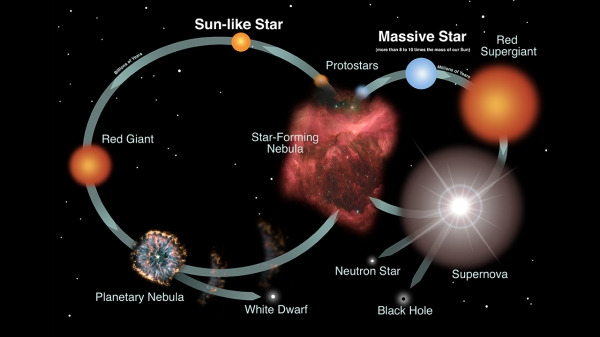
There is a reason the furnace inside a star stops at iron. Converting hydrogen to helium and helium to carbon releases energy, but iron is the most stable state among atomic nuclei, so further fusion does not release energy. Instead, it consumes it. When iron accumulates at the center of a massive star, the fire supporting the exterior goes out, and the star collapses under its own weight before exploding outward. This is a supernova. The carbon, oxygen, and iron that the star spent its life making are scattered into the universe by this explosion, becoming the ingredients for the next generation of stars and planets.
The problem is elements heavier than iron. For a long time, textbooks explained that gold or uranium were made in an instant during supernova explosions. However, in August 2017, when gravitational waves (GW170817) from the collision of two neutron stars and the subsequent light were observed, the picture changed. Analysis showed that the material ejected from this collision assembles into heavy elements like gold and platinum, and neutron star mergers are now seen as the primary source of heavy elements. Research on how much supernovae contribute is still ongoing.
| Element | Process | Location |
|---|---|---|
| Hydrogen, helium, some lithium | Big Bang nucleosynthesis | Early universe |
| Carbon, nitrogen, oxygen | Stellar nucleosynthesis | Inside stars |
| Neon to iron | Stellar nucleosynthesis, supernova | Inside/explosion of heavy stars |
| Gold, platinum, uranium, etc. | Rapid neutron capture (r-process) | Mostly neutron star mergers, some supernovae |
So, saying “we are made of star dust” is still not a poetic exaggeration. However, the gold in a ring is more likely a legacy of colliding neutron stars than exploding stars.
Fourth and fifth thresholds: Why didn’t Earth become Venus?
For star dust to become a planet, it first needed a city to stay in. Today’s large galaxies were not that size from the beginning. The “hierarchical merger” model suggests that small primordial galaxies collided and merged over billions of years to grow. When gas clouds are compressed during collisions, “starbursts” occur, where stars are born in abundance.
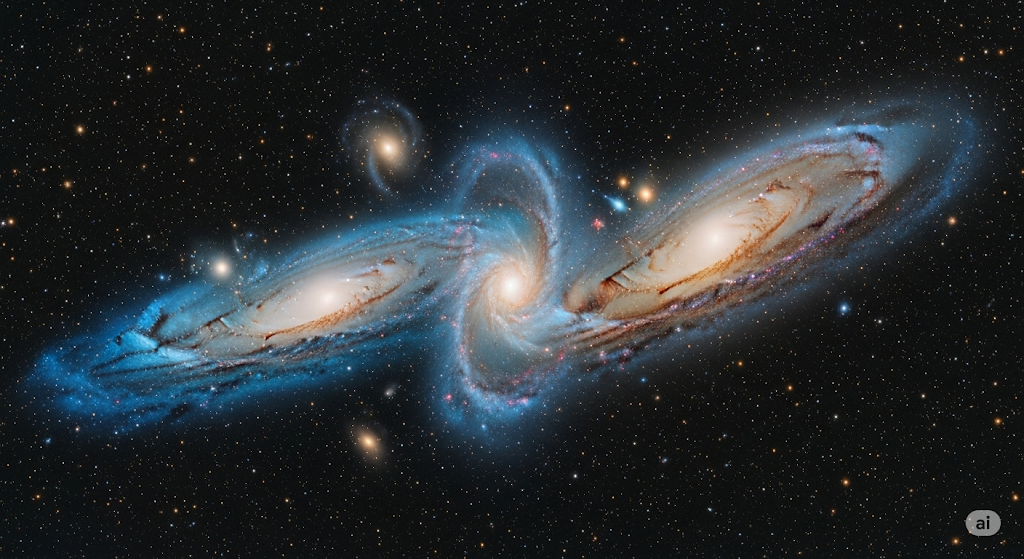
It was long believed that our galaxy would eventually merge with neighboring Andromeda. The figure of a collision in about 4.5 billion years was repeated like a textbook fact. However, in June 2025, a study that recalculated the probability by including the gravity of surrounding galaxies using Hubble and Gaia data put the probability of the two galaxies colliding within the next 10 billion years at about 50%. What was considered almost certain has become a coin toss. The textbook’s “collision in 4.5 billion years” is no longer a definitive statement.
About 4.6 billion years ago, the Sun and Earth formed as element clouds left by previous generations of stars clumped together (accretion). In the rotating disk, there was a boundary called the frost line where water could remain as ice due to the Sun’s heat. Inside, only rock and metal remained solid, becoming small, rocky planets, while outside, where ice could be used as an ingredient, giant planets like Jupiter and Saturn grew rapidly. This process is summarized in the Solar System formation article. The decisive condition for Earth was its location. It was within the habitable zone, where it was neither too close to nor too far from the Sun, allowing water to remain liquid. The Moon was also born around this time. The most widely accepted explanation is the giant impact hypothesis: a celestial body the size of Mars, “Theia,” collided with the early Earth, and the debris became the Moon.
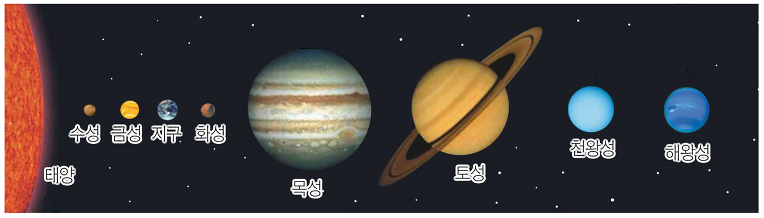
Why specifically liquid water? This point is the core of the fifth threshold. Molecules in solids are locked in place and cannot meet. Molecules in gases are too scattered to collide often. Liquid is in between. As molecules move freely yet encounter each other frequently, complex chemical reactions can be repeated countless times. Life is the result of reactions being run many times over a long period, and water was the testing ground. About 3.8 billion years ago, the first life appeared in these oceans, processing energy and self-replicating.
Exactly where and how is still unsolved. Science explains this process as chemical evolution, where inorganic matter turns into organic matter, and organic matter into self-replicating systems; deep-sea hydrothermal vents, which constantly spew energy and chemicals, are considered a likely candidate for the stage. There is also the “chicken or egg” dilemma. DNA, which holds genetic information, requires protein enzymes to replicate, and those proteins require DNA to be made. A hypothesis that breaks this loop is the “RNA World hypothesis.” It suggests that RNA, which both holds information and acts as a catalyst, appeared first.
Looking at neighboring Venus makes one realize how precarious this condition was. Whether Venus once had oceans is still debated, but it is clear that because it was closer to the Sun, a runaway greenhouse effect occurred, turning its surface into a hellish heat. It was like kneading dough with the same recipe, but the oven temperature was different, turning one into bread and the other into charcoal.
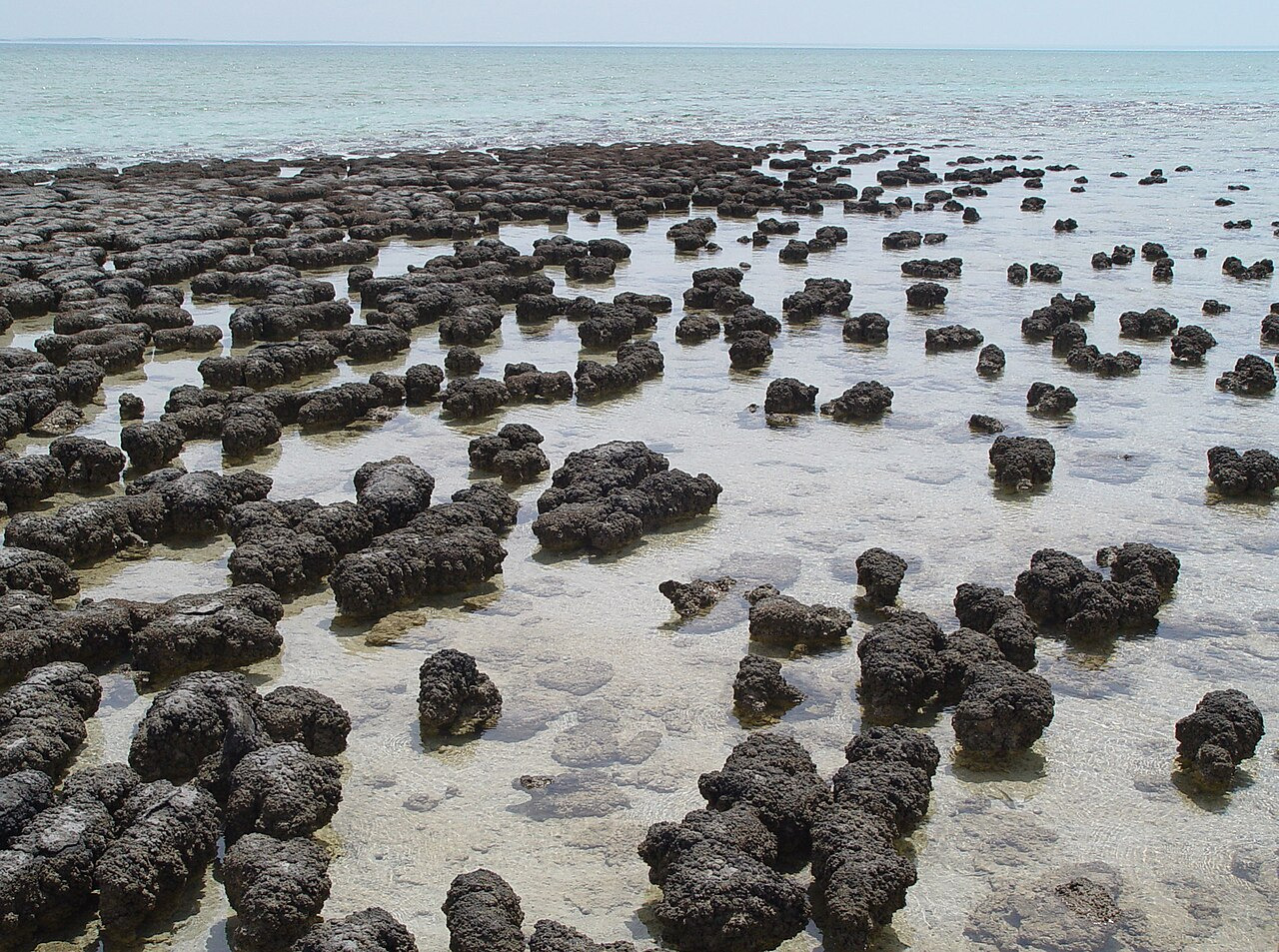
Evidence of early life remains in stone. These are stromatolites, layered structures built by microbial colonies about 3.5 billion years ago. As these microorganisms pumped out oxygen through photosynthesis, the atmospheric composition changed entirely, opening the way for the evolution of oxygen-breathing organisms.
Sixth threshold: Collective Learning, why Big History treats humanity specially
In Big History, the reason humanity occupies a different threshold than stars or bacteria is Collective Learning. It is the ability to accurately pass on what one person has learned to others, so that it accumulates across generations.
For Homo sapiens, who appeared about 300,000 to 200,000 years ago, the decisive condition was symbolic language. Human speech carries things not immediately present—yesterday’s events, tomorrow’s plans, and abstract concepts. Thanks to this, knowledge began to accumulate in the community instead of dying with the individual. Adaptation through genes takes tens of thousands of generations, but knowledge compounds like interest even within a single generation. This is the starting point where humanity broke free from the slow pace of genetic evolution and accelerated into cultural evolution.
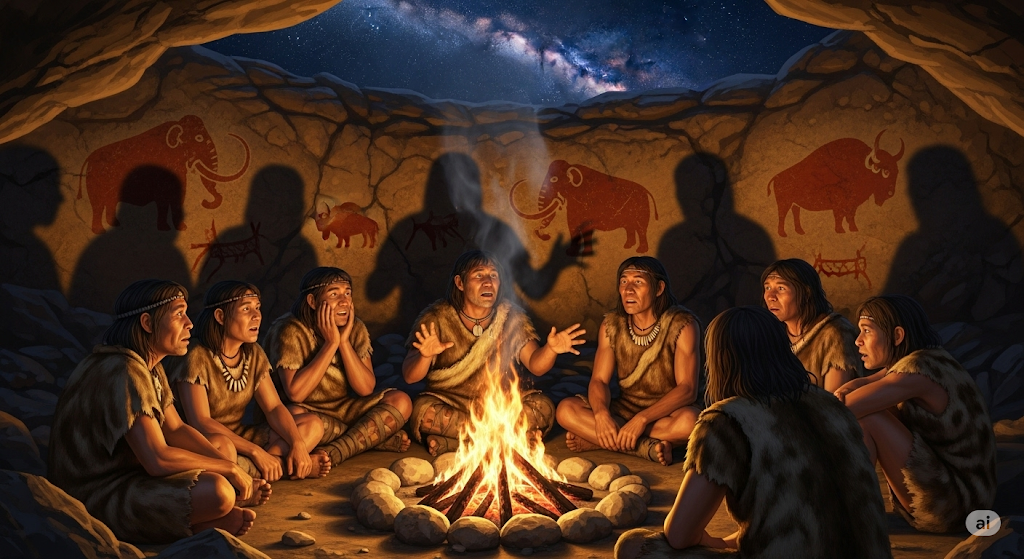
When I first encountered this concept, I thought of open-source software and Wikipedia. I felt a thrill at the idea that the way many people fix and build on things together has been driving humanity for tens of thousands of years. Come to think of it, this article is the same. I couldn’t have written a single line without the books and internet materials accumulated by countless people over many generations.
Seventh and eighth thresholds: Agriculture, fossil fuels, and the rejected Anthropocene
About 11,000 years ago, when the last ice age ended and the climate became warm and stable, humanity began to stay in one place and grow crops. This is the seventh threshold: agriculture. Individual life may have been harder than in the hunter-gatherer days, but it could feed far more people on the same land. As surplus food appeared, not everyone needed to farm, and professionals like soldiers, priests, and artisans emerged. Cities arose where people gathered, followed by writing, laws, and states.
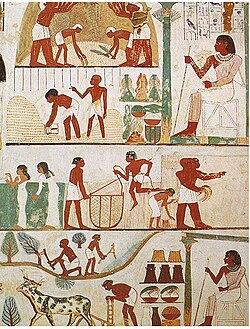
The eighth threshold arrived about 250 years ago. It was a loop where global exchange networks and a new energy source, fossil fuels, grew each other. As energy increased, networks became denser, and denser networks spurred further innovation. Thanks to this engine, humanity became a single global civilization and gained the power strong enough to change the planet’s appearance.
That power is called the “Anthropocene.” It was a proposal to officially designate a new geological epoch because humans have become the greatest driver of Earth’s changes. Here comes the last point that needs updating. In March 2024, the subcommittee under the International Commission on Stratigraphy voted 4 in favor, 12 against, and 3 abstentions, rejecting the proposal, and the International Union of Geological Sciences (IUGS) confirmed that decision on March 20. Officially, we still live in the Holocene. The term “Anthropocene” itself continues to be used to refer to the impact humans have left on the Earth system, but the sentence “scientists have declared the entry into the Anthropocene” is now incorrect.
The higher the threshold, the more expensive it gets: Big History’s energy bill
If you line up the eight thresholds, one rule becomes visible: the more complex something is, the more energy it must flow through to maintain its form. Astrophysicist Eric Chaisson measured this as “energy rate density,” the amount of energy passing through 1 gram per second.
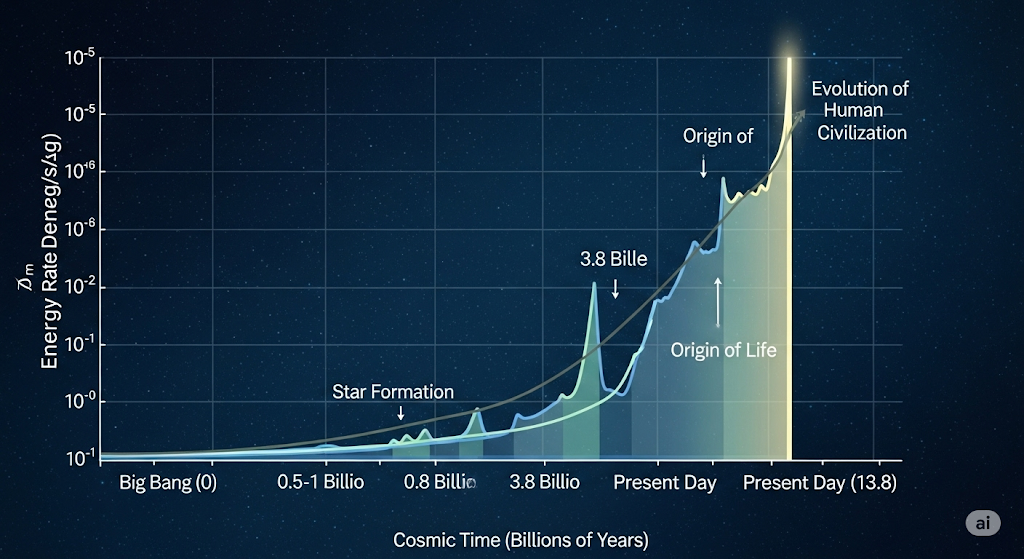
The numbers flip intuition. According to Chaisson’s calculations, the Sun emits tremendous light, but because its mass is so large, the energy flowing through 1g per second is only about 2 ergs. A leaf undergoing photosynthesis is thousands of ergs per gram, and the gray matter of a thinking brain is close to 1 million ergs. The energy rate density of humans and modern society is about 1 million times that of a star or galaxy. While the absolute amount of the Sun is overwhelming, in terms of density, we are the most “tightly” energy-consuming beings in the universe.
This acceleration has side effects. Futurologist Alvin Toffler called this “Future Shock.” As he defined it, it is “the shattering stress and disorientation that individuals feel when they experience too much change in too little time.” It took over 10,000 years from agriculture to the modern revolution, but the changes since the modern revolution have spread across the entire planet in just 250 years. The speed at which humans perceive change has become faster than anything seen in the cosmic chronicle.
Even the way we create origin stories is still evolving. This is seen in the SCP Foundation, an internet creepypasta universe built collectively, or the Marvel Cinematic Universe, which established superheroes as new gods. I was reminded of ancient myths where destruction and creation are one body by the scene where Thanos in the MCU tries to wipe out half of life to balance the universe.
All the thresholds so far were crossed without anyone intending them. Humanity is the first being to understand that process and potentially design the next conditions itself. CRISPR gene editing has allowed us to edit the blueprint of life, and the multiverse hypothesis—that our universe might be one of many—shakes the premise of a “single origin.”
That is why the proposal added by the International Commission on Stratigraphy when rejecting the Anthropocene is interesting. They suggest viewing the Anthropocene not as a geological “epoch,” but as an “event,” like the Great Oxidation Event that changed the atmosphere 2.4 to 2.1 billion years ago. Just as photosynthetic microorganisms changed the planet with oxygen, a species burning fossil fuels is currently changing the planet.
References
- David Christian, Maps of Time: An Introduction to Big History — https://scholarsarchive.byu.edu/cgi/viewcontent.cgi?article=2228&context=ccr
- KIAS HORIZON, From the Big Bang to Humans: What is Big History? — https://horizon.kias.re.kr/21643/
- KIAS HORIZON, From the Big Bang to Humans (PDF) — https://horizon.kias.re.kr/wp-content/uploads/2022/06/2206_%EB%B9%85%EB%B1%85%EC%97%90%EC%84%9C-%EC%9D%B8%EA%B0%84%EA%B9%8C%EC%A7%801.pdf
- KIAS HORIZON, From the Big Bang to Humans [4]: History of the Universe Part 2 — https://horizon.kias.re.kr/23184/
- ASU News, Forged in the hearts of stars — https://news.asu.edu/20151116-discoveries-forged-hearts-stars
- PBS NOVA, The Star In You — https://www.pbs.org/wgbh/nova/article/star-in-you/
- Kasen et al., Origin of the heavy elements in binary neutron-star mergers from a gravitational-wave event (Nature, 2017) — https://pubmed.ncbi.nlm.nih.gov/29094687/
- E. J. Chaisson, The Natural Science Underlying Big History — https://arxiv.org/pdf/1406.2730
- Nature, It's final: the Anthropocene is not an epoch (2024-03-20) — https://www.nature.com/articles/d41586-024-00868-1
- Comment to the ICS Anthropocene decision: From stratigraphy to storytelling (ScienceDirect, 2024) — https://www.sciencedirect.com/science/article/pii/S2950236524000343
- Wikipedia, Habitable zone — https://ko.wikipedia.org/wiki/%EC%83%9D%EB%AA%85%EC%B2%B4_%EA%B1%B0%EC%A3%BC%EA%B0%80%EB%8A%A5_%EC%98%81%EC%97%AD
- Wikipedia, Big History — https://ko.wikipedia.org/wiki/%EB%B9%85_%ED%9E%88%EC%8A%A4%ED%86%A0%EB%A6%AC
- Aladin, [eBook] Origin of Existence — https://www.aladin.co.kr/shop/wproduct.aspx?ItemId=368992882
- TEDxBusan, Convergence of Natural and Human Sciences, Big History (Kim Seo-hyung) — https://www.youtube.com/watch?v=PcgOcVtbFuA
- Psychology Today, Why We Tell Stories — https://www.psychologytoday.com/us/blog/what-is-a-human/202411/why-we-tell-stories
- Wikipedia, Terror management theory — https://en.wikipedia.org/wiki/Terror_management_theory
- Wikipedia, Big Bang — https://ko.wikipedia.org/wiki/%EB%8C%80%ED%8F%AD%EB%B0%9C
- Wikipedia, Origin of life — https://ko.wikipedia.org/wiki/%EC%83%9D%EB%AA%85%EC%9D%98_%EA%B8%B0%EC%9B%90
- Wikipedia, SCP Foundation — https://en.wikipedia.org/wiki/SCP_Foundation
- Wikipedia, Multiverse — https://en.wikipedia.org/wiki/Multiverse
- Sawala et al., No certainty of a Milky Way–Andromeda collision (Nature Astronomy, 2025-06-02) — https://www.nature.com/articles/s41550-025-02563-1
- NASA Science, Hubble Casts Doubt on Certainty of Galactic Collision — https://science.nasa.gov/missions/hubble/apocalypse-when-hubble-casts-doubt-on-certainty-of-galactic-collision/
- SDSS Press Release, The Elements of Life Mapped Across the Milky Way by SDSS/APOGEE (2017-01-05) — https://astrobiology.com/2017/01/05/the-elements-of-life-mapped-across-the-milky-way-by-sdssapogee/
- Space.com, Humans Really Are Made of Stardust, and a New Study Proves It — https://space.com/35276-humans-made-of-stardust-galaxy-life-elements.html
- Seoul Shinmun, 'Are humans made of stardust?' Astronomers reveal the origin of the human body — https://nownews.seoul.co.kr/news/newsView.php?id=20170111601019
- Hankyoreh, From dust to cosmic dust, you are children of the stars — https://www.hani.co.kr/arti/science/science_general/727471.html
- Lee Myung-hyun, Carl Sagan's Cosmos Lecture 5: Thinking Stardust (YouTube) — https://www.youtube.com/watch?v=s4lfe1iJyt4
- Wikipedia, History of the Universe — https://ko.wikipedia.org/wiki/%EC%9A%B0%EC%A3%BC%EC%9D%98_%EC%97%AD%EC%82%AC
- Wikipedia, Cosmic Microwave Background — https://ko.wikipedia.org/wiki/%EC%9A%B0%EC%A3%BC_%EB%A7%88%EC%9D%B4%ED%81%AC%EB%A1%9C%ED%8C%8C_%EB%B0%B0%EA%B2%BD
- Wikipedia, Dark Matter — https://ko.wikipedia.org/wiki/%EC%95%94%ED%9D%91%EB%AC%BC%EC%A7%88
- Wikipedia, Stellar nucleosynthesis — https://ko.wikipedia.org/wiki/%ED%95%AD%EC%84%B1_%ED%95%B5%ED%95%A9%EC%84%B1
- Wikipedia, Supernova — https://ko.wikipedia.org/wiki/%EC%B4%88%EC%8B%A0%EC%84%B1
- Wikipedia, Formation and evolution of galaxies — https://ko.wikipedia.org/wiki/%EC%9D%80%ED%95%98%EC%9D%98_%ED%98%95%EC%84%B1_%EB%B0%8F_%EC%A7%84%ED%99%94
- Wikipedia, Nebular hypothesis — https://ko.wikipedia.org/wiki/%EC%84%B1%EC%9A%B4%EC%84%A4
- Wikipedia, Frost line (astrophysics) — https://en.wikipedia.org/wiki/Frost_line_(astrophysics)