
From the mockery that birthed the ‘Big Bang’ theory to the mystery of dark matter and dark energy that makes up 95% of the universe, we follow humanity’s great intellectual exploration.
- Four key pieces of evidence supporting the Big Bang theory, which explains the origin of our existence
- The identity of dark matter and dark energy, which make up 95% of the universe
- The new horizons of cosmology opened by the James Webb Space Telescope
The Great Beginning Born from Mockery: The Big Bang Theory
Did you know? The name of the Big Bang theory, which explains the origin of our existence, actually started from mockery and derision. In 1949, astronomer Fred Hoyle was a proponent of the ‘steady state theory,’ which claimed that the universe is eternal and without a beginning. He derisively dismissed the competing theory that the universe began from a single point by saying, “This ‘big bang’ idea…”.
However, history ironically adopted the name he mocked. It was simply too intuitive and easy to remember. In the end, the strongest opponent of a theory unknowingly became its best marketer.

Yet, this name led to one critical misunderstanding. I too initially imagined the Big Bang as a bomb placed in empty space going ‘boom!’. But this is the first misunderstanding that needs to be corrected. The Big Bang was not an explosion that occurred ‘in’ already existing space. The Big Bang was an event where space ‘itself’ began to expand simultaneously at every point.
This article aims to clarify that misunderstanding and follows the grand ‘detective story’ of the universe’s 13.8 billion year history. Shall we embark on a journey to find the fingerprints left at the crime scene of the universe?
The Definitive Evidence of the Big Bang: Four Fingerprints Left by the Universe
Like all great detective stories, the Big Bang theory revealed its essence through decisive clues, or ‘fingerprints,’ left throughout the universe.
Clue #1: The Whisper of Receding Galaxies (Cosmic Expansion)
In the 1920s, American astronomer Edwin Hubble proved that the ‘spiral nebulae’ in the night sky were actually other massive galaxies outside our own.
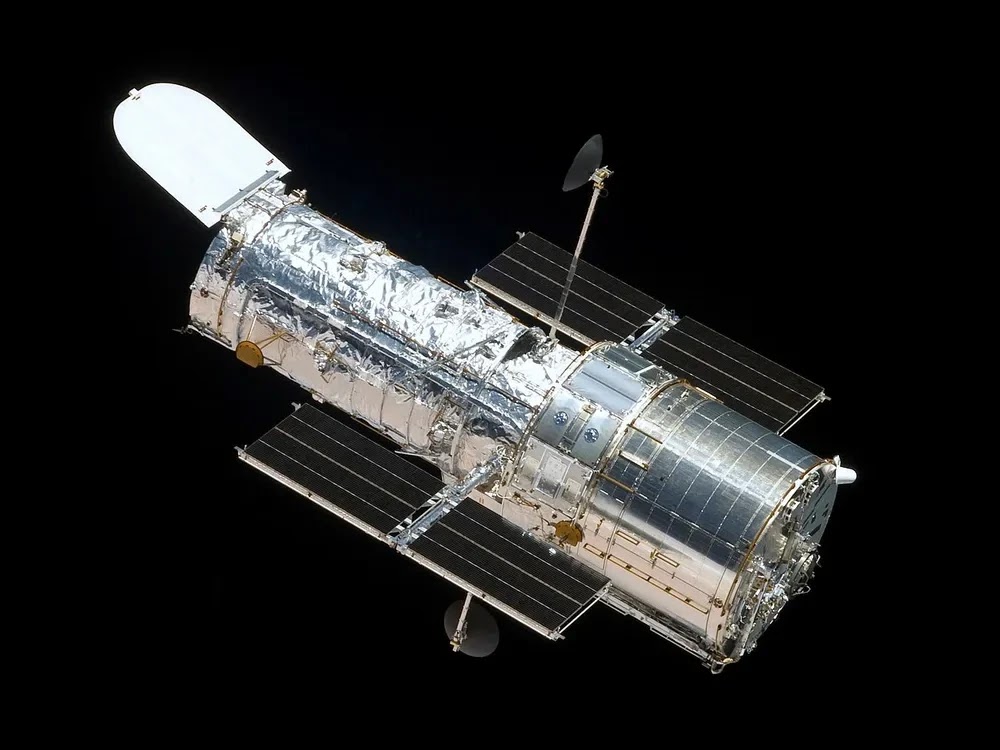
His true revolution began when he analyzed the light coming from these external galaxies. He discovered that almost all galaxies exhibited a phenomenon called ‘redshift’, meaning their light waves were stretching, indicating they were moving away from us.
Furthermore, he found the astonishing law that “the farther away a galaxy is, the faster it is receding”. This was the first observational evidence that the universe is expanding uniformly in all directions.
Clue #2: The Light of Creation, the Universe’s First Cry (Cosmic Microwave Background)
The decisive evidence for the Big Bang theory, the ‘smoking gun,’ was accidentally discovered in 1964 by Arno Penzias and Robert Wilson at Bell Labs.
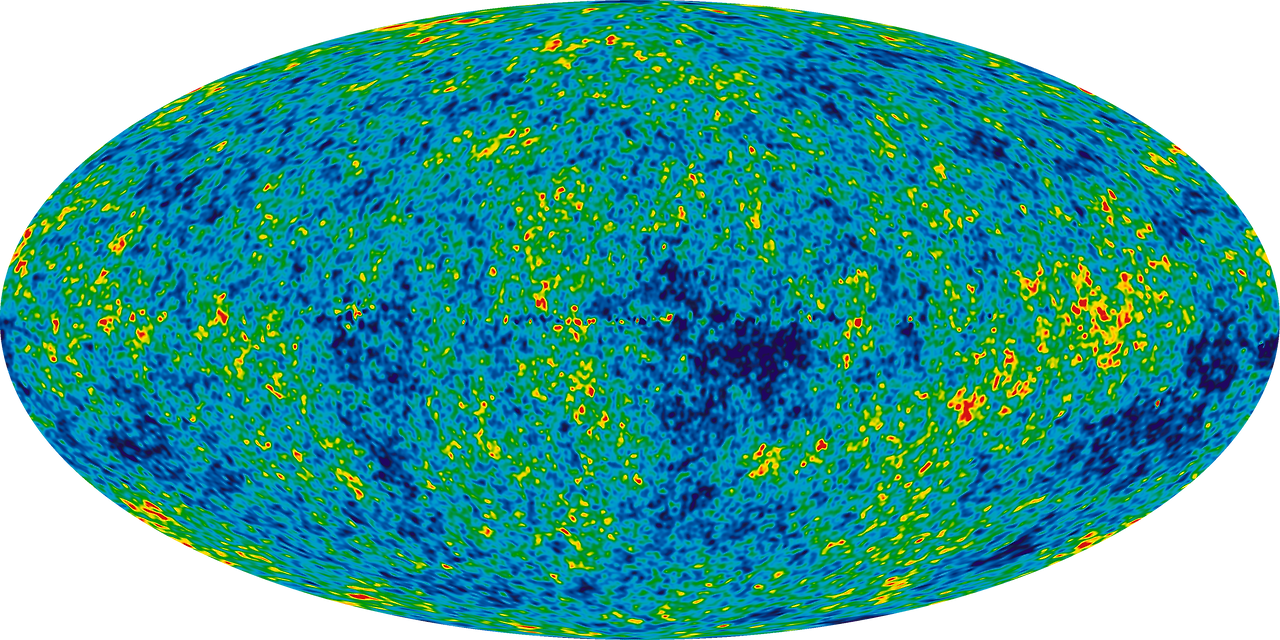
While trying to eliminate mysterious noise picked up by their large antenna, they realized that this noise was actually the ‘relic radiation’ left over from the hot early universe after the Big Bang, known as Cosmic Microwave Background (CMB).
About 380,000 years after the Big Bang, light that had been trapped in a fog of matter finally began to spread freely, marking the ‘first light’. This light has cooled over 13.8 billion years of cosmic expansion and is now observed as cold microwaves at an absolute temperature of about 2.7K.
Clue #3: The First Three Minutes, the Recipe for the Universe’s Elements (Big Bang Nucleosynthesis)
In just three minutes after the Big Bang, the entire universe became a massive nuclear fusion factory, creating the basic materials of the matter we see today. This is known as ‘Big Bang Nucleosynthesis’.
According to the theory, during these three minutes, the lightest elements, hydrogen and helium, were primarily formed, with a mass ratio of about 3:1 predicted. Remarkably, the elemental ratios observed in the oldest gas clouds today match this prediction exactly.
Clue #4: Recreating the ‘Primordial Soup’ in the Laboratory
While we cannot travel back in time to 13.8 billion years ago, we can recreate that moment on Earth. The Large Hadron Collider (LHC) at CERN is the place for that.
Here, scientists collide protons and other particles at the speed of light to recreate the state of ‘quark-gluon plasma’, a ‘primordial soup’ from just one millionth of a second after the Big Bang. Through this experiment, they directly verify the physical laws of the early universe and refine the Big Bang theory.
| Evidence | Observation / Experiment | What It Means |
|---|---|---|
| Cosmic Expansion | The farther away a galaxy is, the faster it is receding (redshift phenomenon). | In the past, the universe was concentrated in a smaller, hotter point. |
| Cosmic Microwave Background | Microwaves of nearly uniform temperature are observed in all directions of the sky. | This is the ‘relic radiation’ or ‘first light’ left by the hot universe right after the Big Bang. |
| Elemental Ratios | The mass ratio of hydrogen and helium in the universe is observed to be about 3:1. | This matches exactly with the results of nucleosynthesis during the first three minutes after the Big Bang. |
| Particle Accelerator Experiments | Proton/ion collisions recreate the state of ‘quark-gluon plasma’ right after the Big Bang. | This experimentally verifies that the physical laws of the early universe align with current theories. |
The Mysteries of Modern Cosmology: The Invisible 95% of the Universe
While the Big Bang theory has been a great success, this detective story has led us to deeper and darker mysteries. All the stars, galaxies, planets, and all matter, including ourselves, make up only 5% of the entire universe. What about the remaining 95%?
Searching for the Invisible Glue: Dark Matter
Galaxies are rotating so quickly that they cannot be explained solely by the gravity of visible matter. This means that something with powerful gravity that we cannot see is holding galaxies together like an ‘invisible glue’. This is dark matter, which makes up about 27% of the universe.
For a long time, a particle called ‘WIMP’ was a leading candidate but has not been discovered, and recently, Professor Kim Jin-woo from Korea has theoretically proposed ‘axions’ as a new hope. Currently, the Institute for Basic Science (IBS) in Korea is leading world-class axion search research.
The Unknown Force Pushing the Universe Apart: The Reversal of Dark Energy
In 1998, astronomers discovered the shocking fact that the expansion of the universe is actually accelerating, contrary to expectations that it would gradually slow down due to gravity. This implies the existence of a force similar to ‘antigravity’ that spreads throughout the universe, which makes up about 68% of the universe: dark energy.
Recent initial data from the Dark Energy Spectroscopic Instrument (DESI) project suggests that this dark energy may not be a constant, raising new questions for standard cosmology.
Humanity’s New Eye: The Dawn Unveiled by James Webb
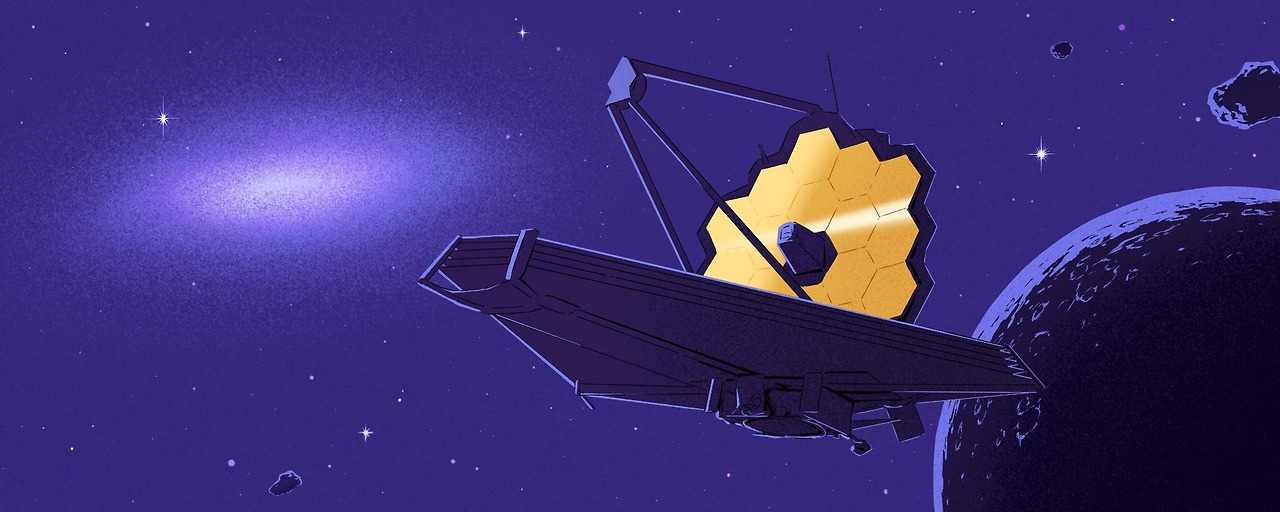
In 2021, humanity sent a great gift to space: the James Webb Space Telescope (JWST). Following in Hubble’s footsteps, this telescope observes the universe in ‘infrared’, which is invisible to our eyes, allowing us to glimpse the dawn of the early universe.
The ‘Baby Galaxies’ That Were Larger Than Expected
James Webb discovered ‘baby galaxies’ in the early universe, just 500 to 700 million years after the Big Bang, that are much larger, brighter, and heavier than predicted by existing theories. This does not deny the Big Bang theory itself but suggests that our understanding of how stars and galaxies formed and grew after the Big Bang needs to be revised.
The Deepening Mystery: Hubble Tension
James Webb also verified the ‘Hubble Tension’ problem, a major challenge in modern cosmology. This issue arises from two different methods of measuring the universe’s expansion rate (Hubble constant) yielding different values. James Webb confirmed that Hubble’s observations were accurate, proving that this problem is ‘real’ and not just a measurement error. This strongly suggests the existence of ’new physics’ that we do not yet understand.
Comparison: Steady State Theory vs. Big Bang Theory
Let’s briefly compare the two theories that were at the center of the early cosmological debate.
| Category | Steady State Theory | Big Bang Theory |
|---|---|---|
| Beginning of the Universe | No beginning or end; it is eternal. | Began about 13.8 billion years ago from a hot, dense point. |
| Appearance of the Universe | The overall appearance (density) does not change over time. | Continues to change as it expands, cools, and density decreases. |
| Core Evidence | Lack of observational evidence | Numerous evidences such as cosmic expansion, cosmic microwave background, and elemental ratios exist |
| Current Status | Now remains a minority theory. | Established as the standard model of modern cosmology. |
Conclusion
From Fred Hoyle’s cynicism to a grand journey spanning 13.8 billion years, this entire story is also about ourselves.
- Key Point 1: The Big Bang theory is a well-supported paradigm backed by various observational evidence. Numerous ‘fingerprints’ such as cosmic expansion, cosmic microwave background, and the ratios of light elements point to a massive beginning 13.8 billion years ago.
- Key Point 2: 95% of our universe remains an unknown entity yet to be identified. Dark matter and dark energy are the greatest challenges for modern physics and hold the key to the fate of the universe.
- Key Point 3: James Webb is fundamentally changing our understanding of the universe. The discovery of early galaxies and the confirmation of Hubble tension challenge existing theories and herald a new era of ’new physics’.
The great astronomer Carl Sagan once said, “We are made of star stuff.” The hydrogen and helium created by the Big Bang formed stars that produced carbon, oxygen, and iron, and the dust from those stars came together to create us. The history of the universe over 13.8 billion years is contained within you as you read this.
How about reflecting once again on the meaning of our existence in this vast universe?