
Part 1: The Great Question Mark Etched in the Universe
The Mystery of 95%
Can you believe that all the stars we see in the night sky, the planets we stand on, and all the matter in our world combined make up only 5% of the entire universe? It’s like walking into a vast library and thinking you know everything just by reading the table of contents of one book. The greatest question posed by modern cosmology is this: “Then what is the remaining 95%?”
Scientists have given names to these invisible entities. About 27% is a cosmic adhesive called ‘dark matter’ that binds the universe together, and about 68% is an unknown force known as ‘dark energy’ that accelerates the expansion of the universe.
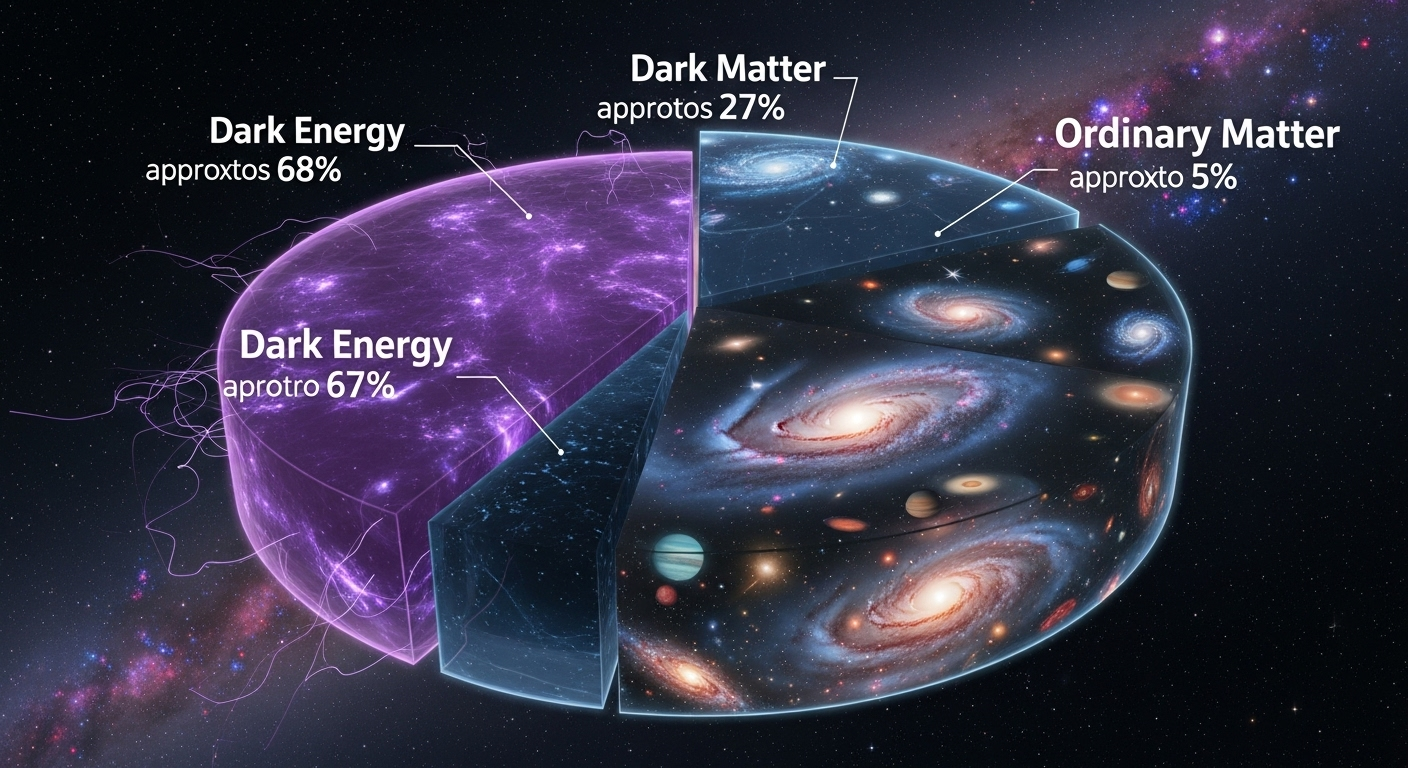
The word ‘dark’ might evoke images of something black and evil, but it actually means ‘unknown.’ These entities neither emit, reflect, nor block light; they simply allow it to pass through, making them literally ‘transparent entities’ that cannot be seen by our eyes or any instruments.
This story follows detectives tracking the traces of the invisible architect, dark matter, which designed the vast structure of the universe and created the galaxies we see today.
The First Whispers of a Ghost: In Search of Evidence
Scientists became convinced of the ghostly existence of dark matter due to consistent whispers heard from different times and places.
The Too Fast Spinning Carousel, Galaxies
The first whisper was about the rotation speed of galaxies. In the 1970s, astronomer Vera Rubin discovered something strange. Just as planets slow down as they move away from the sun in our solar system, stars in a galaxy should also rotate more slowly the farther they are from the center. However, the galaxies she observed had outer stars rotating just as fast as those near the center, as if something invisible was holding them tightly.
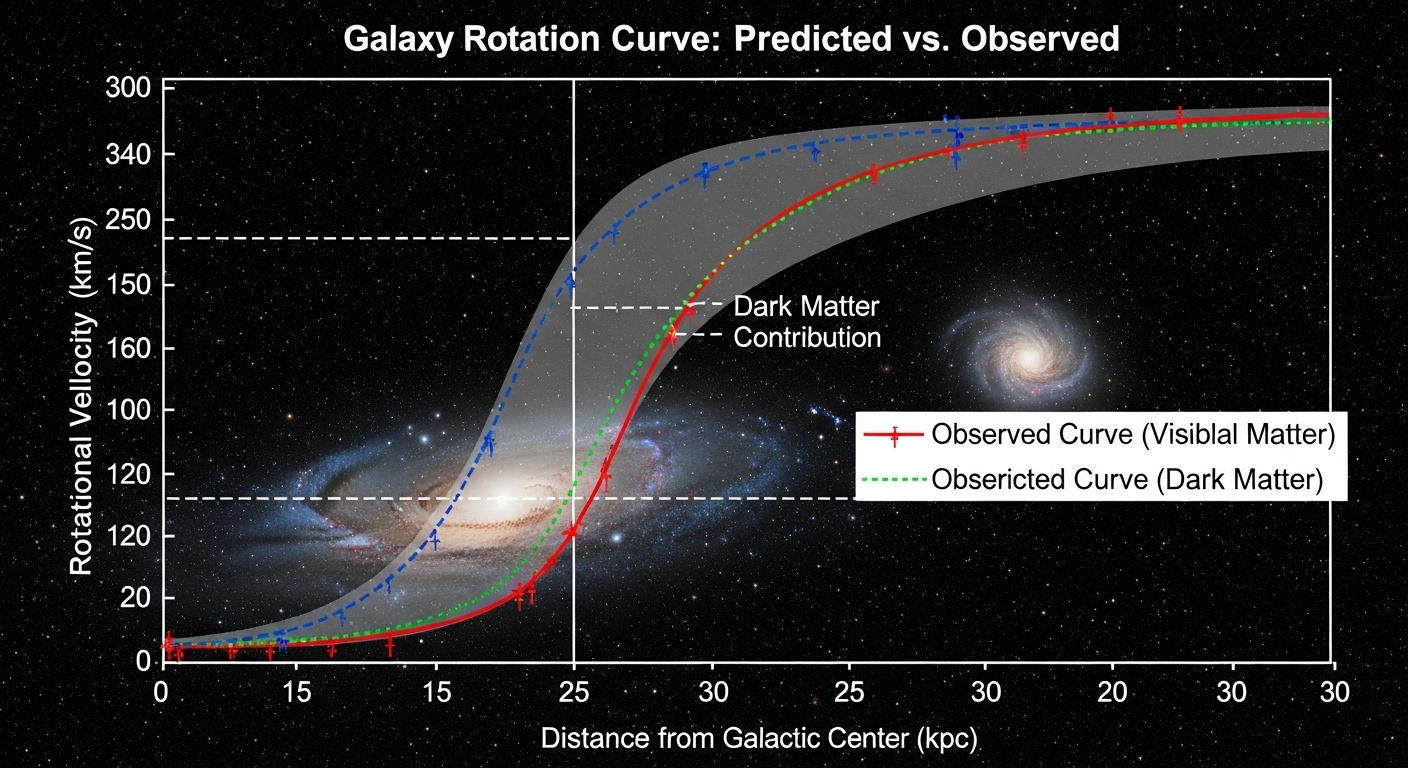
The only way to solve this mystery was to hypothesize that a massive ‘dark matter halo’ enveloped the entire galaxy, far beyond the visible stars and gas. This invisible mass, five times greater than the visible matter, was what kept the massive spinning carousel of the galaxy from scattering.
The Magnifying Glass that Curves Spacetime, Gravitational Lensing
Einstein said that mass curves the surrounding spacetime, much like a heavy bowling ball pressing down on a rubber sheet. Light passing through this curved space also follows a bent path. This is known as the ‘gravitational lensing effect,’ and the important point is that it occurs regardless of whether the mass emits light or not. This has given us a powerful tool to ‘see’ the existence and distribution of dark matter, which does not interact with light.
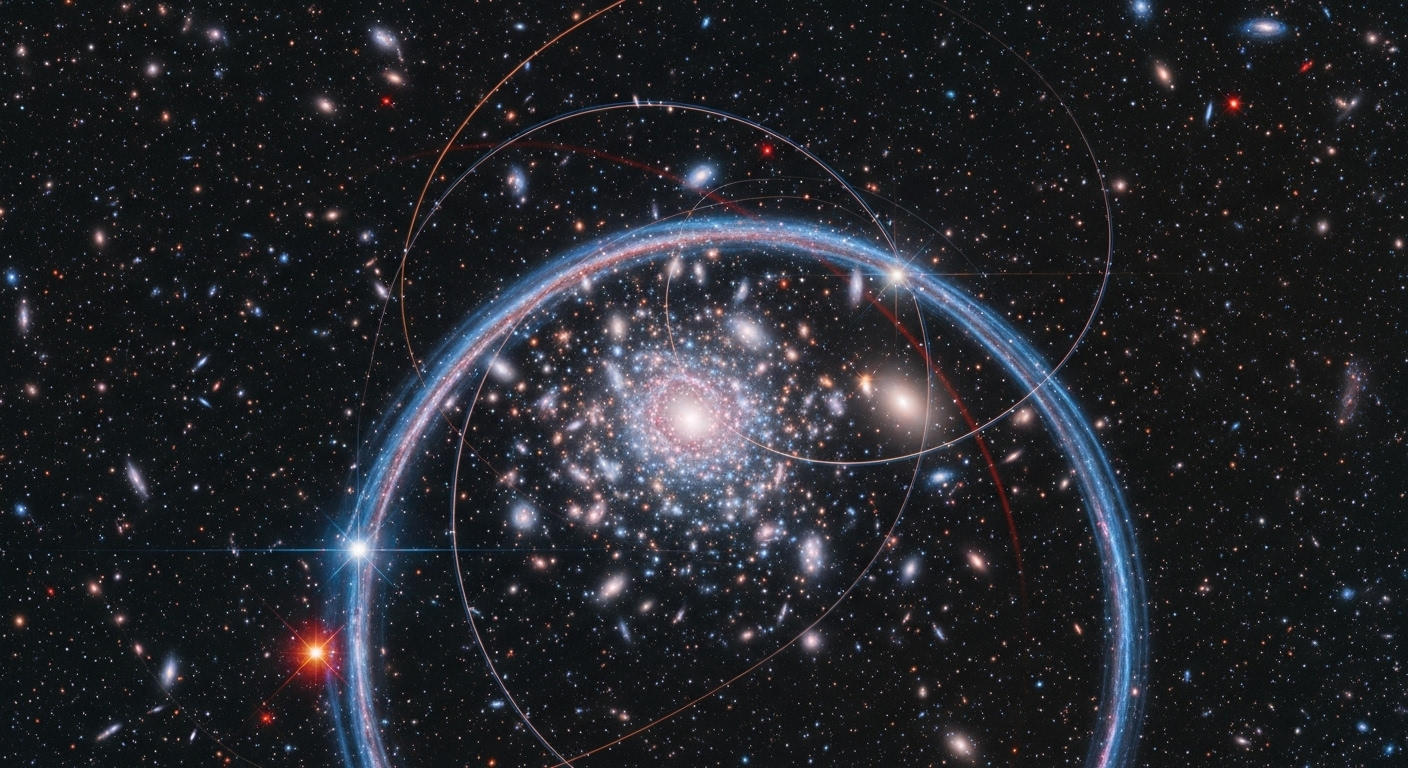
Sometimes, the light from distant galaxies appears as elongated arcs, and sometimes, by statistically analyzing the slightly distorted shapes of galaxies across the universe, we can draw a 3D map showing where and how much dark matter is concentrated. This map revealed that dark matter spreads throughout the universe like a massive spider web.
The Universe’s First Cry, The Primordial Light
When the universe was about 380,000 years old, the hot universe cooled down, and light began to spread freely. This ‘primordial light’ has reached us today under the name ‘Cosmic Microwave Background Radiation (CMB).’ This light is like a ‘baby photo’ of the entire universe.
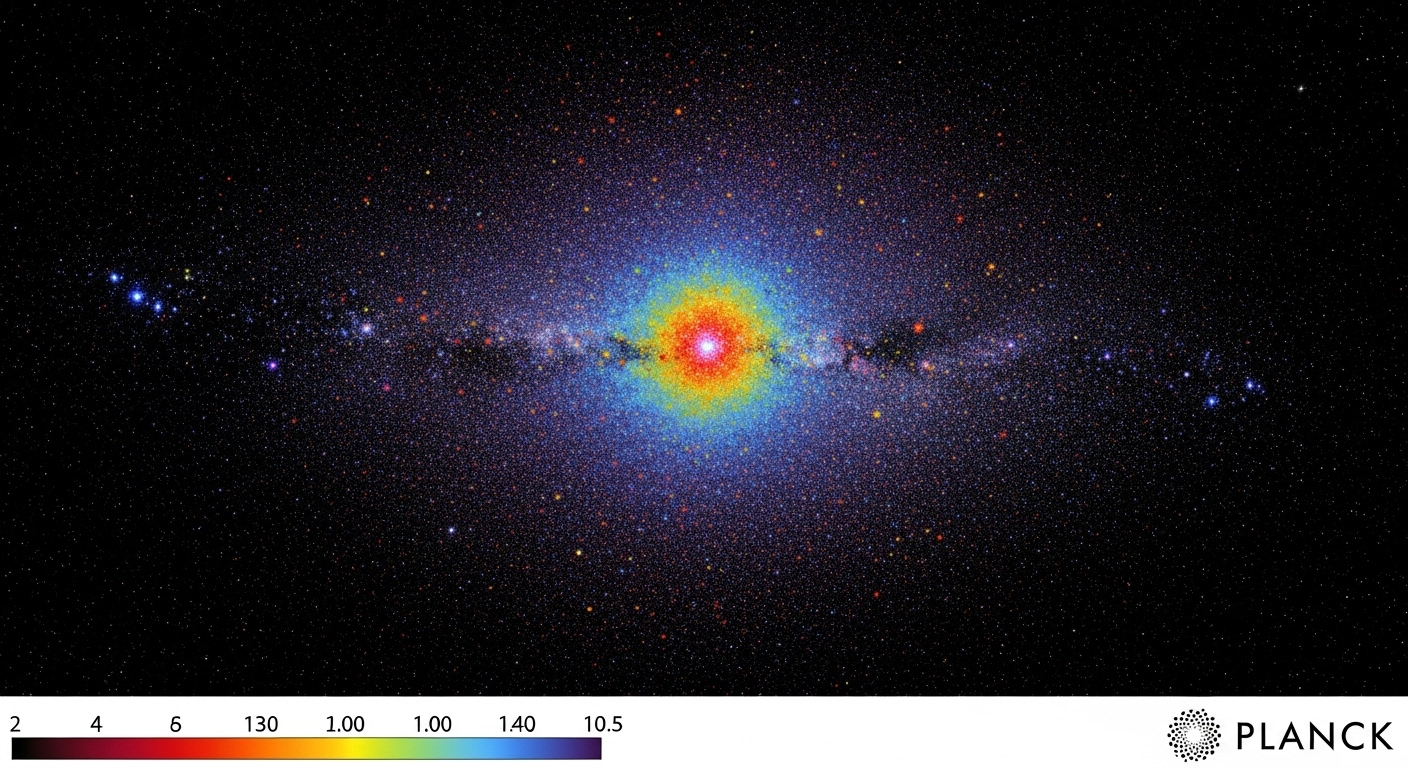
This baby photo contains patterns of slight temperature variations, and by analyzing these patterns, we can determine what the materials of the universe are. The results were astonishing. It was concluded that this pattern could not have been created without dark matter being five times more abundant than ordinary matter. From the very beginning of the universe, dark matter was already there.
The Framework of a Great Architecture, Cosmic Large Scale Structure
Today, galaxies are not scattered randomly across the universe; they are distributed along a web called ‘cosmic large scale structure’ intertwined with massive filaments. How did such a grand structure come to be?
Immediately after the Big Bang, ordinary matter could not clump together easily due to the pressure of light. At this time, dark matter, which was not affected by light, began to clump together and dug a ‘gravitational well.’ It was like setting up a framework before building a structure. Later, as the universe cooled, ordinary matter was drawn into this dark matter framework, allowing stars and galaxies to form.
These four pieces of evidence point to the same suspect, dark matter, from different times and places. Now, we scientists, the detectives, embark on a full investigation to uncover the identity of this ghost.
Part 2: The Story of Ghost Hunters
In the face of strong evidence for the existence of dark matter, the next question for scientists was naturally, “So, what is it?” To answer this question, scientists around the world launched a massive ghost-hunting operation.
Likely Suspects
Dark matter cannot be an ordinary particle that we know. If it were, it would have been discovered by now. Therefore, scientists think it must be a new particle that we do not yet know and have narrowed down several likely suspects.
WIMP
For decades, the most likely suspect has been ‘WIMP (Weakly Interacting Massive Particle).’ It means ‘a heavy particle that interacts weakly.’ WIMPs are thought to be tens to thousands of times heavier than protons and interact only through very weak forces, as the name suggests.
What made WIMPs special was the remarkable coincidence known as ‘the WIMP miracle.’ Complex calculations showed that if particles like WIMPs existed in the early universe, they would naturally leave behind just the amount of dark matter we observe today as the universe cooled. The fact that a particle predicted by entirely different theories could explain the mystery of the universe so perfectly was enough to excite scientists.
Axion
However, after decades of searching for WIMPs without any success, a new suspect emerged: ‘Axion.’ In stark contrast to WIMPs, axions are very light particles, trillions of times lighter than electrons.
The appeal of axions, like WIMPs, lies in the fact that they were not originally created to explain dark matter. Axions were proposed to solve other challenges in particle physics, but it turned out that they perfectly satisfied the conditions for dark matter. It was like creating a key for the front door of a house, only to find out it also opens the secret vault of a bank.
A Global Investigation Network
To catch these suspects, scientists cast a massive net using three different approaches.
-
Direct Search (Waiting Traps): This method captures the moment when dark matter drifting through our galaxy collides with detectors installed deep underground, creating a ’thud.’ To catch these rare collisions, which might happen only a few times a year, scientists create an extremely quiet environment that blocks out all other noises from the universe, waiting for the whispers of dark matter.
Inside a massive liquid xenon detector installed deep underground -
Indirect Search (Finding Residual Traces): When two dark matter particles collide and annihilate, they can leave traces like gamma rays. This method involves focusing on areas where dark matter is likely to be abundant, such as the centers of galaxies, using space telescopes to search for the traces (smoke) they leave behind to track down the culprit (fire).
-
Accelerator Search (Creating the Culprit): Instead of just waiting or looking for traces, this approach aims to artificially recreate the conditions of the universe right after the Big Bang to directly create dark matter. At places like the Large Hadron Collider (LHC) in Europe, particles are collided at tremendous speeds to find evidence of dark matter in the form of invisible particles (lost energy) that are born in that moment.

Part 3: The Ongoing Debate
While the idea of dark matter has been highly successful in explaining the universe as a whole, it does not perfectly account for everything. Some observational results have contradicted existing thoughts, leading to new debates.
Small Cracks in the Standard Model
Dark matter simulations predicted a sharply peaked (’spike’) structure in the density at the center of galaxies, but many observed galaxies show a flat ‘core’ structure at their centers. Additionally, simulations predicted that there should be hundreds of small satellite galaxies surrounding our galaxy, but only a few dozen have actually been discovered.
Do these ‘small-scale crises’ provide evidence that dark matter theory is wrong? Not necessarily. Perhaps the energy released when stars are born and explode (ordinary matter feedback) has influenced the distribution of dark matter, flattening the center. Or it could be a clue that dark matter has slightly different properties than we thought.
No Ghost? New Gravity Theories
“What if the ghost of dark matter doesn’t exist at all?” This bold idea gave rise to the theory of ‘Modified Newtonian Dynamics (MOND).’ This theory claims that instead of assuming unknown matter, the laws of gravity behave differently in environments where only very weak forces act.
Surprisingly, MOND accurately explained the rotation speeds of many galaxies without dark matter. However, it failed to explain the dynamics of galaxy clusters or the evolution of the universe as a whole, hitting its limits.
Decisive Evidence: The Bullet Cluster
A decisive piece of evidence that could put an end to the long debate between dark matter and MOND has been discovered: the ‘Bullet Cluster.’ This is a massive cosmic traffic accident site where two giant galaxy clusters have collided head-on.
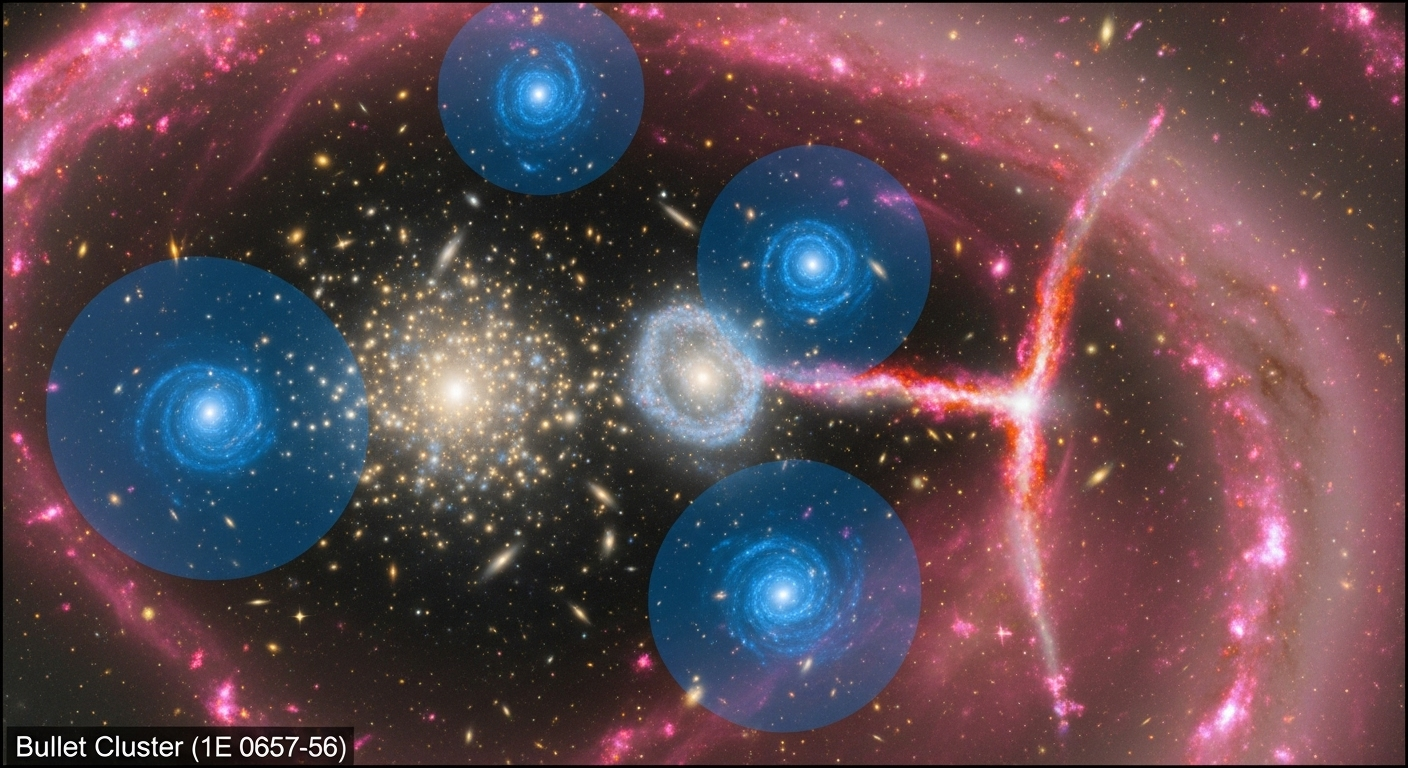
During this collision, something remarkable happened:
- Ordinary Matter (Hot Gas): The gas, which makes up most of the mass of the cluster, collided and slowed down, remaining in the center. (Pink area in the image)
- Stars and Galaxies: They passed through almost unscathed without colliding.
- Center of Total Mass: The center of mass measured by gravitational lensing did not align with the center where ordinary matter is concentrated but matched exactly with the galaxies that passed through the collision on both sides. (Blue area in the image)
This clearly indicates that the center of gravity is separated from where most of the matter (gas) is located. This is strong evidence that something invisible, which does not interact with each other, moved along with the stars. This phenomenon, which cannot be explained by MOND theory, is accepted as the most direct evidence that dark matter exists.
Part 4: Exploration into the Unknown
Despite decades of searching, we have yet to directly discover dark matter particles. However, this is not a failure. The result of ‘finding nothing’ itself becomes valuable information indicating that ’the suspect is not here,’ refining our investigative direction.
# News from the Frontlines
Recently, the LUX-ZEPLIN (LZ) experiment conducted in the United States searched for WIMPs with unprecedented sensitivity but found no signals. This result suggests that if WIMPs exist, they must be much deeper and interact with us far less than we thought.
As the possibility of WIMPs diminishes, the scientific community’s interest naturally shifts to other suspects like axions. Research teams worldwide, including the Institute for Basic Science (IBS) in Korea, continue to challenge the search for axions using new technologies.
The Great Question That Will Never End
We have confirmed strong and consistent evidence that the invisible entity known as dark matter designed the universe. Its existence is certain, but its identity remains shrouded in deep fog.
The journey to uncover the identity of dark matter means more than just discovering a new particle. It is humanity’s great intellectual exploration to understand where we came from, how this universe was created, and what the most fundamental laws of nature are.
In the detectors deep underground, in telescopes navigating the universe, one day, when a decisive signal arrives, humanity will finally complete the true blueprint of the universe. Until that day comes, the 95% of the universe remains a vast unknown territory waiting for us. And it is this mystery that will keep our exploration ongoing.