
The Majestic Echoes of the Universe Flowing Through Our Veins
- Understand the 13.8 billion-year history of the universe from the Big Bang to the birth and death of stars.
- Learn how the elements that make up our bodies were created inside stars.
- Confirm the origins of our existence through the processes of galaxy and solar system formation.
The Story of ‘Stardust’, Our Common Origin
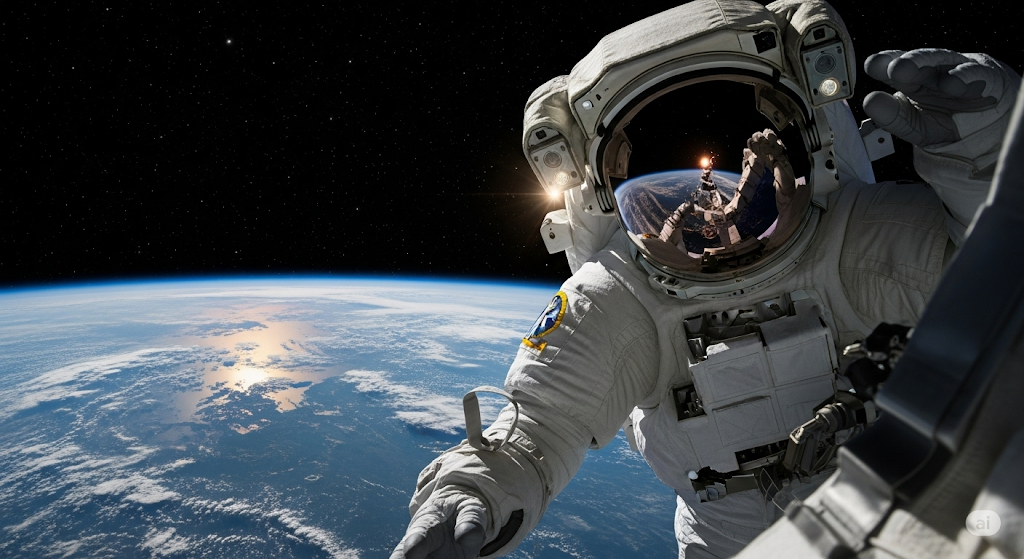
“We are made of star stuff.” This famous quote by astronomer Carl Sagan is not just a poetic expression. Every time I look at the night sky, I feel awe at the fact that the atoms that make up my body once burned within those stars. This article embarks on a grand 13.8 billion-year epic of stardust in search of our common origins.
According to scientific research, 97% of the elements that make up the human body are the same as those that make up the stars in our galaxy. The core elements of life—carbon (C), hydrogen (H), nitrogen (N), oxygen (O), phosphorus (P), sulfur (S)—are all the result of massive cosmic events that were born and scattered. Now, let’s trace back to that moment when everything began.
About 13.8 billion years ago, the Big Bang explosion gave birth to time, space, and matter. Within about 3 to 20 minutes after the explosion, the universe was filled with about 75% hydrogen and 25% helium through ‘Big Bang nucleosynthesis’. However, there was a critical problem from the perspective of life: heavy elements essential for life and planets, such as carbon, oxygen, and iron, did not exist at all. The key to solving this ‘chemical poverty’ lay with the yet-to-be-born entities, the ‘stars’.
The Light of Creation and the Long Darkness: The Blueprint of the Universe
About 380,000 years after the Big Bang, as the temperature of the universe cooled to 3,000K, atomic nuclei and electrons combined to form the first stable atoms. This event, known as ‘recombination’, allowed light to spread freely, making the universe transparent. The primordial light released at this time is still observed today as ‘Cosmic Microwave Background (CMB)’ radiation, which represents the oldest view of the universe that humanity can see.
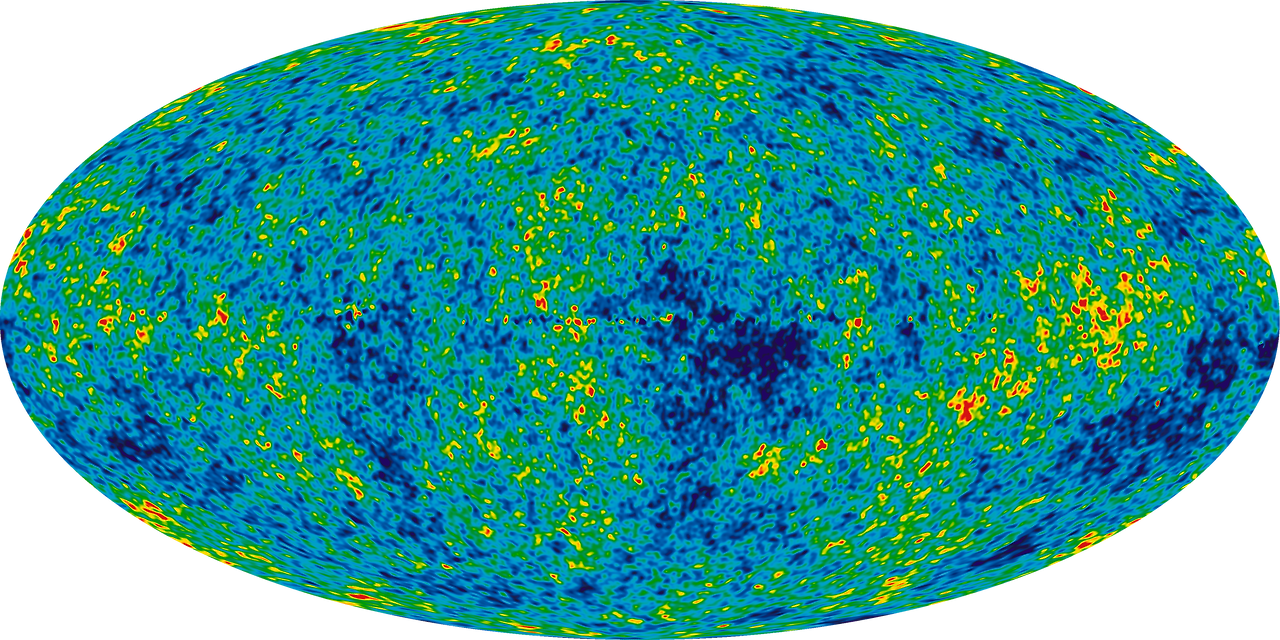
Paradoxically, after recombination, the universe entered a ‘cosmic dark age’ for hundreds of millions of years, as there were no new stars or galaxies emitting light yet. However, the minute temperature fluctuations of one part in 100,000 etched in the CMB were the seeds of everything. These slight inhomogeneities indicated differences in matter density, and gravity began to pull surrounding matter toward slightly denser regions. These small seeds grew to become the cosmic blueprint that would later create massive galaxies and stars.
Table 1: Timeline of the Early Universe
| Time (Post-Big Bang) | Major Events | State of the Universe |
|---|---|---|
| 10⁻⁶ seconds ~ 1 second | Quark combination, formation of protons/neutrons | Quark-gluon plasma |
| 3 minutes ~ 20 minutes | Big Bang nucleosynthesis (formation of helium nuclei) | Plasma of hydrogen and helium nuclei and electrons |
| 380,000 years | Recombination, release of cosmic background radiation | Transparent universe, neutral hydrogen/helium gas |
| 380,000 years ~ 400 million years | Cosmic dark age | Dark universe without luminous celestial bodies |
The Invisible Architects: Dark Matter and the Cosmic Web
The slight density differences in the early universe were not enough to create today’s massive structures in a timely manner. Here, the invisible architect known as ‘Dark Matter’ comes into play. Dark matter does not interact with light but makes up about 85% of the total matter in the universe and drives structure formation through its strong gravity.
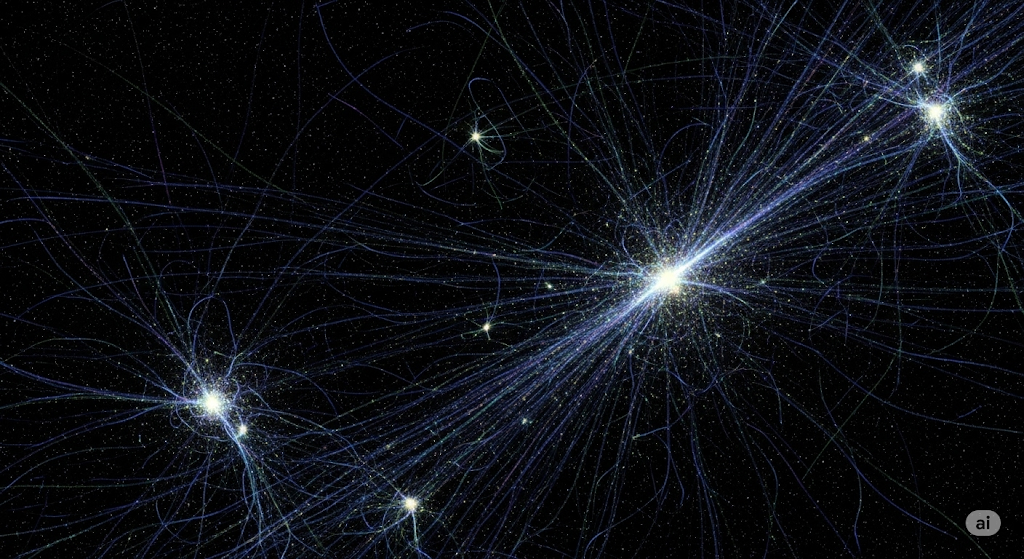
Dark matter began to clump together before ordinary matter, creating a vast gravitational framework known as the ‘Cosmic Web’, which spreads throughout the universe like a spider’s web. This is akin to how buildings are constructed along the intersections and roads of a city after the road network is built. After recombination, hydrogen and helium gas, liberated from the pressure of light, poured into the gravitational wells of the already formed dark matter, setting the stage for the birth of the first stars and galaxies.
The Birth and Death of Stars: The Creation of Life’s Elements
The First Stars: Giants of Dawn
At the densest nodes of the Cosmic Web, the first stars, ‘Population III’ stars, finally emerged, ending the dark age. These stars were composed solely of pure hydrogen and helium and could only be born as giants, hundreds of times the mass of the Sun, due to their very low cooling efficiency. The powerful ultraviolet light emitted by these stars re-ionized the universe, making it transparent and bright like today.
The Stellar Forge and the Gifts of Supernovae
Stars are the chemical factories of the universe. Under immense temperature and pressure in their cores, they create heavier elements through ‘stellar nucleosynthesis’, converting hydrogen into helium, helium into carbon, and ultimately reaching iron (Fe).
However, iron is the most stable element, and when an iron core accumulates in a star’s center, it can no longer produce energy through fusion. Eventually, the star collapses under its own gravity and ends its life in a magnificent explosion known as a ‘supernova’.
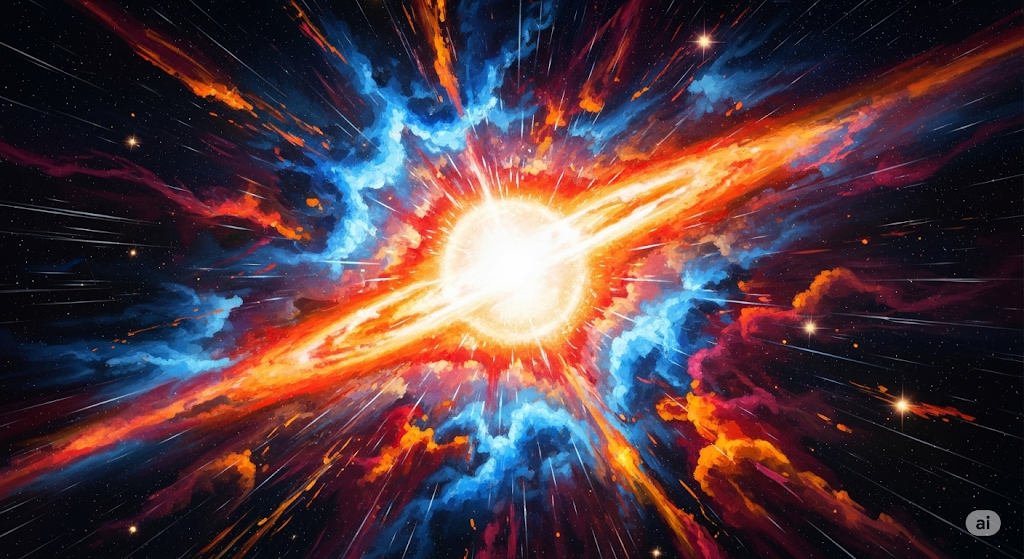
This explosion scatters elements like carbon, oxygen, and iron, which the star created throughout its life, across the universe. Simultaneously, in the tremendous energy of the explosion, all elements heavier than iron, such as gold, silver, and uranium, are created in just a few seconds. Thanks to this ‘cosmic recycling’, the next generation of stars and planets could have the abundant materials necessary for the birth of life. Our Sun is a third-generation star born from the stardust left behind by the deaths of several generations of stars.
Table 2: The Cosmic Origins of Elements Around Us
| Element | Major Formation Process | Formation Location |
|---|---|---|
| Hydrogen, Helium, Lithium | Big Bang nucleosynthesis | Early universe |
| Carbon, Nitrogen, Oxygen | Stellar nucleosynthesis | Inside stars |
| Neon ~ Iron | Stellar nucleosynthesis | Inside massive stars |
| Gold, Silver, Uranium, etc. | Supernova nucleosynthesis (r-process) | Supernova explosion |
Galaxies and the Solar System: Our Cosmic Home
The Construction of Galaxies as Cities
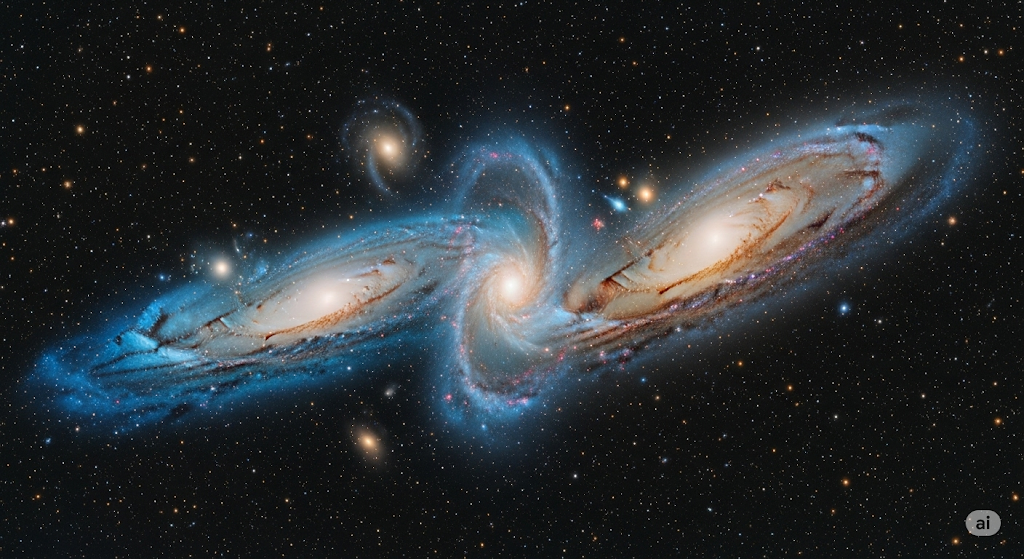
The massive galaxies we see today did not exist from the beginning. According to the ‘hierarchical merging model’, small primordial galaxies have collided and merged over billions of years to grow. This process was very dynamic, compressing gas clouds between galaxies and triggering explosive star formation events known as ‘starbursts’. Our galaxy is also destined to collide with the Andromeda galaxy in about 4.5 billion years, becoming one massive elliptical galaxy.
The Story of Our Neighborhood, the Solar System
About 4.6 billion years ago, the solar system formed from a nebula made of the abundant stardust and gas left by previous generations of stars. According to the ’nebular hypothesis’, the fate of the rotating protoplanetary disk was determined by a hypothetical boundary known as the ‘frost line’.
- Inside the Frost Line: The high temperatures allowed only rocks and metals to exist as solids. Due to the scarcity of materials, small, dense terrestrial planets like Mercury, Venus, Earth, and Mars were formed.
- Outside the Frost Line: The lower temperatures allowed for abundant ice, such as water and methane. Based on this vast material, massive gas giants like Jupiter and Saturn could grow rapidly.
Thus, the frost line acted as a ‘resource distribution line’ that determined the fates of the planets in the solar system.
Comparison of Planet Types: Terrestrial vs. Jovian
| Feature | Terrestrial Planets (Inside Frost Line) | Jovian Planets (Outside Frost Line) |
|---|---|---|
| Main Composition | Rock, metal | Hydrogen, helium, ice |
| Size and Mass | Small and light | Large and heavy |
| Density | High | Low |
| Rotation Speed | Slow | Fast |
| Moons and Rings | Few or none | Many, with distinct rings |
| Representative Planets | Earth, Mars | Jupiter, Saturn |
Step-by-Step Guide: The Journey from the Big Bang to Us
- Big Bang (13.8 billion years ago): Time, space, and matter are born, filling the universe with hydrogen and helium.
- Cosmic Dark Age: Darkness persists for hundreds of millions of years until the first stars are born.
- Birth of the First Stars: Massive stars are born, illuminating the universe and beginning to create heavy elements through fusion.
- Supernova Explosion: The death of stars scatters the elements necessary for life across space.
- Formation of Galaxies and the Solar System (4.6 billion years ago): The enriched stardust from several generations comes together to form galaxies, the Sun, and Earth.
- Birth and Evolution of Life: On the planet Earth, stardust finally evolves into a self-aware being, namely us.
Conclusion
The 13.8 billion-year history of the universe is, in fact, the story of our own origins. Through this grand journey, we reaffirm several key facts:
- We are the legacy of living stars: The carbon in our DNA and the iron in our blood are all stardust created in the hearts of nameless stars.
- The universe evolved from simplicity to complexity: Starting from the simple particles of the Big Bang, complex structures like stars, galaxies, planets, and finally life emerged.
- We are the way the universe contemplates itself: After 13.8 billion years, stardust has finally transformed into an intelligent being that reflects on itself and explores its origins.
Now, when you look at the stars in the night sky, do you not feel that they are not just distant lights but the majestic forges that created us and our home? I encourage you to share this story of wondrous cosmic connections with those around you.
(Related article suggestion: What is Dark Matter? The Invisible Ruler of the Universe)
References
- Carl Sagan’s ‘Cosmos’ (9) Link
- [Carl Sagan’s Cosmos] Chapter 9: The Lives and Deaths of Stars - We Are All Children of Stars Link
- ‘Is the Human Body Stardust?’ The Origins of the Human Body Revealed by Astronomers Link
- From Dust to Cosmic Dust, You Are the Children of Stars - Hankyoreh Link
- Lee Myung-hyun Carl Sagan’s Cosmos - Lecture 5 Thinking Stardust - YouTube Link
- The History of the Universe - Wikipedia Link
- Universe/History - Namuwiki Link
- Cosmic Microwave Background - Wikipedia Link
- Dark Matter - Wikipedia Link
- Stellar Nucleosynthesis - Wikipedia Link
- Supernova - Wikipedia Link
- Formation and Evolution of Galaxies - Wikipedia Link
- Nebular Hypothesis - Wikipedia Link
- Frost line (astrophysics) - Wikipedia Link