
How did a palm-sized watch draw the map of empires and open the door to 13.8 billion years of cosmic history?
- Understand the essence of the ’longitude problem’ that plagued 18th-century navigators.
- Explore the great challenge of watchmaker John Harrison over 40 years and its outcomes.
- Discover the profound impact of the chronometer on human history and worldview.
In Search of the Chronometer Revolution
Imagine a lone ship lost at sea, unable to tell whether it is heading east or west. This terrifying reality was faced by 18th-century navigators. What changed the fate of this era was not a massive steam engine, but a palm-sized marine chronometer. The advent of this small machine not only conquered space beyond time but also determined the rise and fall of empires, marking the beginning of the ‘chronometer revolution’ that led to the exploration of ‘Big History’ over 13.8 billion years of cosmic history.
The Nightmare at Sea: What is the ‘Longitude Problem’?
For sailors during the Age of Exploration in the 18th century, determining their position was a matter of survival. Position was determined by latitude (north-south) and longitude (east-west), with latitude relatively easy to ascertain using the North Star or the sun’s altitude.
The Link Between Time and Space: Longitude
The real issue was longitude. Longitude is fundamentally a time problem. The Earth rotates 360 degrees in 24 hours, so knowing the time at a starting point (e.g., London) and the current location allows for the calculation of longitude based on the time difference. However, at that time, it was impossible to create a watch that could maintain accurate time while enduring the changes in temperature and humidity on a rocking ship. I found it fascinating that the principle of GPS, which I took for granted, was a daunting challenge that determined the fate of nations centuries ago.

National Disaster and a Huge Reward
In 1707, a British naval fleet miscalculated its longitude and collided with a reef, resulting in nearly 2,000 deaths. Alarmed by this incident, the British Parliament enacted the ‘Longitude Act’ in 1714, offering a staggering reward of £20,000 for a solution.
The ‘Longitude Committee’, which included Isaac Newton, supported the ’lunar distance method’ using the positions of the moon and stars, expressing skepticism about the potential of mechanical devices like watches. Newton even asserted that “a watch that works accurately at sea is impossible.”
The Country Watchmaker Who Changed the World: John Harrison’s Challenge
While the mainstream scientific community looked to the heavens, self-taught British watchmaker John Harrison believed the essence of the problem lay in ’time’. He resolved to create a perfect machine, a chronometer, that would provide accurate time in any environment.
40 Years of Dedication: The Birth of H4
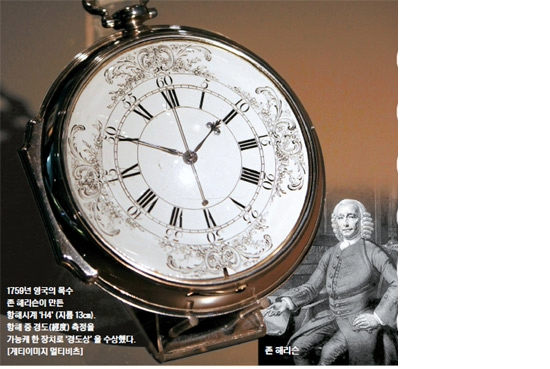
Harrison’s challenge was an epic saga that lasted over 40 years. He invented innovative technologies like the bimetallic strip to overcome the ship’s rocking and temperature changes, creating prototypes from H1 to H3. Finally, in 1759, his masterpiece, the pocket watch known as H4, was born.
The performance of H4 was astonishing. In a 1761 navigation trial, it demonstrated remarkable accuracy with an error of only 5 seconds over 81 days. However, the astronomy-focused Longitude Committee dismissed the watchmaker’s success as ‘coincidence’ and refused to award the prize. This bitter struggle only ended in 1773, when Harrison, at the age of 80, petitioned directly to King George III.
James Cook and the Chronometer: Mapping the Unknown World
Since Harrison’s H4 was too expensive, a replica known as K1 was produced. This K1 accompanied the era’s greatest explorer, Captain James Cook, on his second voyage (1772-1775), proving its worth.
During the three-year voyage, Cook was able to determine accurate longitude daily thanks to K1, allowing him to chart the South Pacific with unprecedented precision. The maps he created remained in use until the mid-20th century. Captain Cook praised K1 as “my reliable friend and unfailing guide”, and his endorsement quelled all doubts about the chronometer.
A New World Created by ‘Accurate Time’
The invention of the chronometer transcended mere technological advancement; it changed the course of history.
- Foundation of Empires: It provided the British Navy with a strategic advantage, laying the groundwork for the ’empire on which the sun never sets’.
- Growth of Global Trade: Safe navigation led to explosive growth in global trade.
- Birth of a Global Standard: The Greenwich Observatory in London, which served as the reference point for solving the longitude problem, naturally became the Prime Meridian (0° longitude), reorienting time and space worldwide around London.
From Chronometer to Big History: The Measurement Revolution
The most profound legacy of the chronometer revolution is a new ‘way of thinking’ about measuring and understanding the world. This opened the door to ‘Big History’, which seeks to understand the 13.8 billion years of cosmic history as a single narrative. The technology for measuring ‘deep time’ beyond human history began with this revolution. Isn’t it astonishing that this small watch became the philosophical starting point for measuring the age of the universe?
The Clock in Rocks: Radiometric Dating
The chronology of Big History is completed by ‘radiometric dating’. This technique, which utilizes the decay of radioactive elements at a constant rate (half-life), is nature’s perfect ‘atomic clock’. Through this, we have learned that the Earth is about 4.5 billion years old.
Just as Harrison measured the unpredictable space of the sea with a ‘perfect clock’, modern science measures billions of years using nature’s ‘atomic clock’. Ultimately, Harrison’s chronometer was a great pioneer of the measurement revolution.
Comparison/Alternatives
Comparison of Measurement Revolutions: Chronometer vs. Radiometric Dating
Harrison’s mechanical watch and nature’s atomic clock share a remarkably similar philosophy: measuring the unknown through an ‘immutable standard’.
| Method | What it Measures | Core Principle |
|---|---|---|
| Marine Chronometer | Space on Earth (Longitude) | Difference between the reference time of the ‘watch’ and local time |
| Radiocarbon Dating | ‘Dead time’ of organic materials within thousands of years | Measurement of decay rate using C-14’s constant half-life |
| Uranium-Lead Dating | Age of rocks on a billion-year scale | Measurement of decay rate using uranium’s long half-life |
Conclusion
The chronometer revolution, which began with the dedication of a country watchmaker, rewrote human history. This small machine fundamentally changed how humanity finds its place and understands history.
-
Key Summary
- Conquest of Space: The chronometer solved the ’longitude problem’, opening the era of safe long-distance navigation.
- Reconfiguration of History: It enabled the rise of the British Empire and the expansion of global trade networks.
- Intellectual Legacy: The concept of ‘accurate measurement’ became the philosophical foundation for measuring the ages of the Earth and the universe in ‘Big History’.
If you want to dive deeper into this amazing story, consider reading Dava Sobel’s book ‘Longitude’ or visiting a nearby maritime museum.
References
- 5-1. The success of Britain’s Industrial Revolution, First Industrial Revolution I Don’t Know Either - Tistory
- [WATCH IT] Descendants of Marine Chronometers Time Forum
- The first public display of the ‘marine clock’ that changed the history of navigation YouTube
- Longitude: The Story | Dava Sobel Kyobo Bookstore
- Harrison’s precision pocket watch that laid the foundation for the British Empire Joongang Ilbo
- [Today’s Economic Trivia/March 24] <1351> John Harrison Seoul Economic Daily
- Longitude (r153 edition) Namu Wiki
- [Engineers in History] Watchmaker John Harrison, confirming marine position with the chronometer Amkor InStory
- The story of ’longitude’ that changed the history of the British Navy Korea Times
- K1 Royal Museums Greenwich
- Second voyage of James Cook Wikipedia
- James Cook Wikipedia
- Blog Antiquarian Horological Society
- Larcum Kendall Wikipedia
- National Maritime Museum > Exhibitions > Navigation and Clocks National Maritime Museum
- The process of measuring the age of the Earth is a departure from superstition Brunch
- Big History: The Origins of Human History Yes24
- Dating Methods Namu Wiki
- [Radiation Story] #5 Using RI: Carbon Dating Steemit