
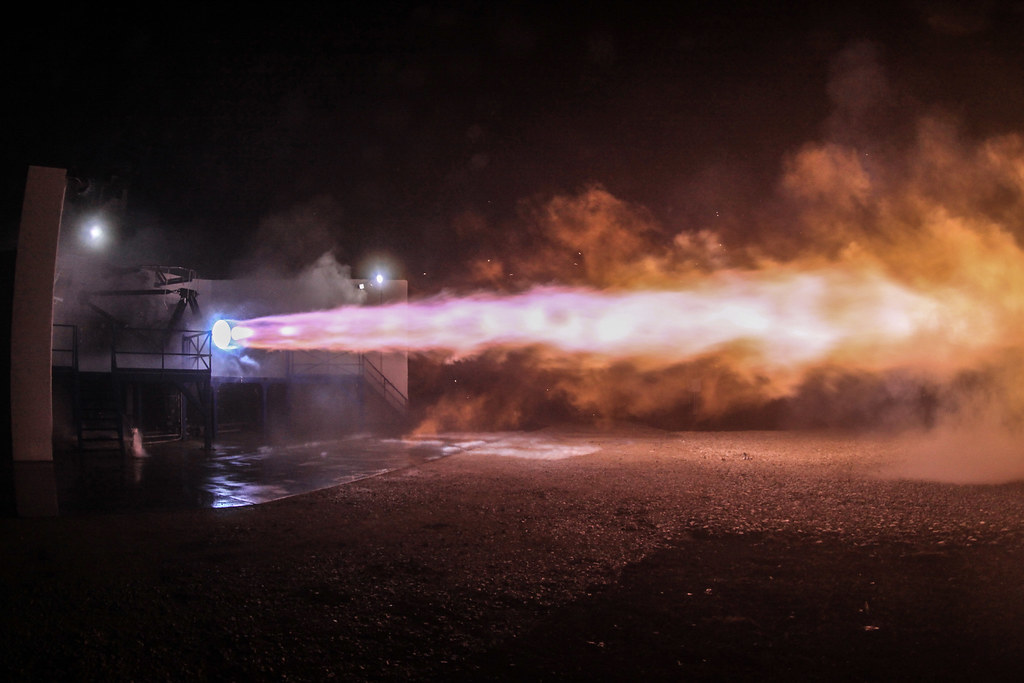
There’s one thing I’ve always wondered while watching Starship launch videos.
It’s how the flames erupting from the 33 engines under the Super Heavy booster are uniquely clear and have a transparent orange glow.
I remember the flames from the Falcon 9 or Saturn V engines appearing cloudier and more yellowish. Upon looking into it, I found that whenever the Raptor engine is mentioned, terms like “mixture ratio” and the unfamiliar “full-flow engine” keep popping up.
At first, I thought, “Wouldn’t adding more oxygen just increase the firepower?” But as I dug deeper, I realized this isn’t just a simple fuel blending issue; it’s a variable that dictates the entire structure of the engine.
Why Does the Mixture Ratio (O/F Ratio) Influence Engine Design?
The mixture ratio is the value obtained by dividing the oxidizer flow rate by the fuel flow rate.
If you use 1 unit of oxygen and burn enough fuel to match it, the mixture ratio is 1. The problem is that performance doesn’t peak at the stoichiometric point.
In a domestic study, a small bipropellant engine using hydrogen peroxide and kerosene was test-fired with mixture ratios ranging from 3.8 to 11.0. Combustion efficiency was highest in the 5–6 range and tended to drop off outside that zone.
Another experiment involving a methane/liquid oxygen engine injector showed slightly different results, maintaining a high combustion efficiency of over 90% across the entire tested mixture ratio range.
This suggests that the sensitivity of performance to the mixture ratio varies depending on the propellant combination.
Looking at this, one might think, “Then why not just run experiments and pick the best point?” But once you move to actual engine design, things get complicated.
The Peak of Specific Impulse vs. the Actual Design Point
Specific impulse (Isp), which represents rocket engine performance, is determined by the product of characteristic velocity and the nozzle thrust coefficient. The factors that most influence characteristic velocity are combustion pressure and the mixture ratio, and the mixture ratio typically shows a peak at a specific value. However, some engines do not use that peak point.
Nuri’s 75-ton engine, used in the first and second stages, is exactly that case.
According to data from the Korea Aerospace Research Institute (KARI), while the maximum specific impulse for this combustor occurs at a mixture ratio of 2.5–2.6, it was set to 2.45 to account for combustion chamber cooling. This engine, which uses liquid oxygen and kerosene, was designed with a propellant flow rate of 243.6 kg/s, a combustion pressure of 6.0 MPa, and a target characteristic velocity of 1730 m/s. They knowingly shifted away from the optimal point. The reason is simple: increasing the mixture ratio raises the combustion gas temperature, which is good for specific impulse, but it also increases the thermal load that the combustion chamber walls must withstand. In fact, other analysis of domestic 75-ton combustors explains that as the mixture ratio increases, the gas temperature also rises, which is disadvantageous for cooling. Because some of the fuel flow is used for film cooling, the nominal mixture ratio that produces the maximum specific impulse is actually set to a lower value.
It’s a constant trade-off between performance and survival. I found it fascinating that this isn’t just a matter of adjusting a number, but a critical point that determines how many times an engine can endure and be reused.
The Mixture Ratio Also Causes Trouble When Adjusting Thrust
Fixing the mixture ratio at the design point isn’t the end of it.
If you move the thrust control valve during launch to increase or decrease engine output, the mixture ratio inside the gas generator also fluctuates.
According to research by the Propulsion Control Group at KARI, when the thrust control valve operates and the engine thrust level changes, the propellant mixture ratio in the gas generator changes as well. This change leads to fluctuations in gas temperature, which can cause damage to turbine blades or a decrease in specific impulse. As a result, they had to develop a separate “mixture ratio stabilizer” to manage these fluctuations. You end up with a structure where adding one component to control thrust causes the mixture ratio to jump, and then adding another component just to stabilize it. At this point, I started to understand why developing a full-flow engine is particularly difficult.
While a gas generator only needs one stabilizer to catch mixture ratio jitters, a full-flow engine must independently manage two pre-burners, each fluctuating with different mixture ratios every time thrust is adjusted. Since there are two turbopumps and two mixture ratio control loops, it makes sense that even a simple throttle adjustment would require much more precise real-time control.
The Mixture Ratio Dictates the Engine Cycle Itself
Going one step further, the mixture ratio problem doesn’t end inside the combustion chamber; it determines the very method of driving the turbopump.
the simplest method is the gas generator cycle. A portion of the fuel and oxidizer is diverted and burned in a separate combustion chamber (gas generator), and the resulting gas drives the turbine to power the pump before being exhausted into the atmosphere.
Nuri’s 75-ton engine and SpaceX’s Merlin engine use this method. While the structure is simple and development is fast, you lose specific impulse because the propellant used to turn the turbine doesn’t enter the main combustion chamber.
To reduce this loss, the staged combustion cycle was developed. In this method, the exhaust gas from the turbine is not discarded but pushed back into the main combustion chamber. The problem is that a single pre-burner can only reliably create either a “fuel-rich” state or an “oxidizer-rich” state.
Interestingly, during the Cold War, the U.S. and the Soviet Union each pushed these in different directions.
The U.S. focused on the fuel-rich side, as seen in the Space Shuttle Main Engine (SSME).
The Soviet Union, starting in the 1970s, deployed oxidizer-rich staged combustion engines for ICBMs, such as the RD-263 or RD-0233.
The Soviets had already secured the materials technology to prevent turbine blades from burning in the high-temperature, high-pressure environment where excess oxidizer exists, a path the U.S. is known to have avoided for a long time.
Full-Flow Engine — The Idea of Burning Everything
What happens if you use both fuel-rich and oxidizer-rich states simultaneously? This is the starting point of the full-flow staged combustion cycle (FFSC). By using two pre-burners, one burns most of the oxidizer and a portion of the fuel to drive the oxidizer turbopump with oxidizer-rich gas, while the other burns most of the fuel and a portion of the oxidizer to drive the fuel turbopump with fuel-rich gas. No propellant is wasted; all of it performs turbine work before entering the main combustion chamber.
Why is this good? Because it allows for lower gas temperatures to achieve the same turbine output.
According to NASA’s full-flow engine demonstration program data, because the entire propellant mass is burned in the pre-burners, there is a higher mass flow rate available to drive the turbines. This excess power allows for lower turbine temperatures, which increases the turbine life—a key factor in the longevity of reusable engines.
Furthermore, if you ensure that oxidizer-rich gas only contacts the oxidizer turbine and fuel-rich gas only contacts the fuel turbine, you eliminate the need for complex propellant sealing devices between the pump and turbine. Structurally, the risk of mixing fluids of different phases is reduced.
The Concept Is 60 Years Old, So Why Did It Only Fly Now?
Actually, the idea of a full-flow engine isn’t new.
The RD-270, developed by Valentin Glushko’s team in the Soviet Union starting in 1962, was already a full-flow staged combustion engine. It used nitrogen tetroxide and UDMH as propellants and reached a vacuum thrust of 6,713 kN, a vacuum specific impulse of 322 seconds, and a combustion pressure of 26.1 MPa. It was developed for the Soviet Union’s planned large launch vehicle, the UR-700. However, after the U.S. reached the moon first in 1969, the Soviet rocket program was cancelled, and development of the RD-270 ceased as well. It wasn’t due to a lack of technology, but because the rocket it was intended for no longer existed.
In the U.S., NASA and the Air Force Research Laboratory conducted the joint Integrated Powerhead Demonstrator (IPD) program in the 1990s.
This demonstration engine, which used liquid hydrogen and liquid oxygen and featured dual oxygen-rich and hydrogen-rich pre-burners, aimed to keep the engine cool during flight and increase system efficiency. It was designed to produce about 250,000 pounds of thrust and be reusable up to 200 times. By July 2006, it had completed 21 out of 26 planned tests, reaching 100% power output. However, subsequent funding required to develop a full engine was not allocated by policymakers, so the overall engine design was never completed. Technology was verified and tests were successful, but it stopped because the money ran out.
Ultimately, the title of the first full-flow engine to actually fly went to SpaceX’s Raptor engine.
Through Starship test flights, it holds the record as the world’s first full-flow staged combustion cycle engine to successfully fly. It uses cryogenic liquid methane and liquid oxygen, and for the Raptor V2, it produces a sea-level thrust of 2.26 MN (specific impulse 327s) and a vacuum thrust of 2.53 MN (specific impulse 380s). Since the concept was first designed for practical use in 1962, it took over 60 years to actually fly.
Ultimately, the core of this delay seems to have been materials and precision control.
Preventing metals from burning in an ultra-high-temperature environment with excess oxidizer, ensuring durability without soot in a fuel-rich environment, and making these two independent pre-burner/turbopump loops run while precisely matching flow rates in milliseconds—it could be said that it took half a century to combine what the Soviets and Americans each solved for their respective halves.
Below is a summary of full-flow staged combustion, gas generator, and oxidizer-rich staged combustion cycles based on actual engine figures.
Comparison of Representative Rocket Engine Cycle Specs
| Engine | Cycle | Mixture Ratio | Vacuum Specific Impulse | Development Status |
| — | — | — | — | — |
| Nuri 75-ton engine | Gas Generator | 2.45 | - | In operational use |
| RD-263 (USSR) | Oxidizer-rich Staged Combustion | 2.67 | 318s | Deployed (Retired) |
| IPD (USA) | Full-flow Staged Combustion | - | - | Development stopped after demo |
| RD-270 (USSR) | Full-flow Staged Combustion | - | 322s | Development cancelled |
| Raptor V2 (SpaceX) | Full-flow Staged Combustion | - | 380s | In active flight |
I’m Starting to Think Full-Flow Isn’t Always the Answer
After summarizing all this, the full-flow engine might seem like the ultimate solution, but that doesn’t necessarily seem to be the case.
Because it requires two sets of pre-burners and turbopumps that must be precisely synchronized, the development difficulty and the number of parts increase accordingly. The fact that there has been only one successful example from the RD-270 to the Raptor seems to demonstrate this complexity.
Looking at the development of the Nuri rocket, it’s understandable why not every launch vehicle aims for full-flow.
KARI produced 17 of the 75-ton engines, conducting 152 tests totaling 15,091 seconds of combustion. For medium-sized launch vehicle development with fixed budgets and schedules, building reliability through the proven gas generator cycle was the rational choice. On the other hand, SpaceX had the goal of clustering dozens of engines like the Starship and reusing them hundreds of times, so they had the incentive to accept 60 years’ worth of risk to eliminate the turbine life and sealing issues at the source.
I’m not sure if all large reusable engines will converge toward full-flow or if cycles will continue to diverge based on purpose.
However, knowing that the single number of the “mixture ratio” is tied to everything from combustion chamber cooling to turbine materials and the choice of the entire engine cycle, I think my perspective on the color of the flames will be quite different the next time I watch a launch video.
References
- Korean Society of Propulsion Engineers Conference Proceedings — Combustion Characteristics of O/F Ratio for Eco-friendly Low-Thrust Liquid Rocket Engines
- Transactions of the Korean Society of Mechanical Engineers B — Mixture Ratio Experiment for Methane/Liquid Oxygen Single Injector
- Korea Aerospace Research Institute — Analytical Study on the Combustor Design of KSLV Liquid Rocket Engines
- koreascience.kr — Current Status of Development Test of 75 tonf Engine System for KSLV-II
- koreascience.kr — 75-ton LRE Combustion Chamber TDM Design Specifications
- koreascience.kr — Study on Characteristics of Mixture Ratio Stabilizer for Liquid Rocket Engine Gas Generator
- Wikipedia — Raptor rocket engine
- Namuwiki — Raptor engine
- Namuwiki — Starship (SpaceX)
- Wikipedia — RD-270
- Wikipedia — RD-263 / RD-0233 / RD-0255 / RD-193 / RD-58
- Hackaday — The Impossible Tech Behind SpaceX's New Engine
- Everyday Astronaut — Soviet Rocket Engines
- NASA — New Rocket Engine Combustion Cycle Technology Testing Reaches 100% Power Level
- Wikipedia — Integrated Powerhead Demonstrator
- spacedaily.com — USAF-NASA Technology Demonstrator Engine Successfully Test Fired
- MoneyToday / Asia Economy / Newsis — Reports on Nuri 75-ton engine development tests