
When a rocket takes off, people usually think of the fuel: kerosene, methane, hydrogen. Yet, in those massive tanks, what actually occupies the majority of the volume isn’t the fuel. A SpaceX Starship holds about 1,278 tons of methane, while it carries far more liquid oxygen—approximately 4,500 tons. In terms of weight, a rocket’s fuselage is closer to an oxygen tank than a fuel tank.
It is a strange situation. Oxygen is a gas we inhale every moment, making up one-fifth of Earth’s atmosphere. It doesn’t seem rare or expensive. Yet, when tracing the causes of rocket launch delays, we often run into supply issues with this common gas, rather than the fuel.
Everywhere in the atmosphere, but not available just anywhere
The answer lies not in oxygen itself, but in the process of freezing it to extract it in a pure state. Air is a mixture consisting of 78% nitrogen, 21% oxygen, and trace gases like argon. What a rocket engine wants is at least 99% pure oxygen, and not as a gas, but in a liquid state with its volume reduced to 1/600th. The problem is that the boiling points of nitrogen and oxygen are -196°C and -183°C, respectively—a difference of only 13 degrees.
The German engineer Carl von Linde was the first to master the technology to separate these two gases by exploiting this narrow gap. In May 1895, in his Munich laboratory, Linde invented the first continuous air liquefaction process using the Joule-Thomson cooling effect and counter-current heat exchange principles. At first, one could only obtain ‘Linde air,’ a mixture of nitrogen and oxygen. Extracting pure oxygen and nitrogen separately required a rectification stage, which he solved by allowing separated oxygen vapor to slowly rise through a column where liquid air trickled down. The first oxygen production plant began operation in 1903 in Höllriegelskreuth near Munich, and by 1910, the double-column process that produces both oxygen and nitrogen was perfected.
This process is structured exactly like the principle used to make soju or whiskey in a distillery. Just as alcohol evaporates before water when fermenting liquid is boiled, nitrogen, which has a lower boiling point, escapes as a gas before oxygen when compressed air is slowly warmed. Much like how liquid flows down and vapor rises in a distillery column, meeting repeatedly, liquid air and gas constantly brush past each other in the rectification column of an air separation unit, gradually increasing purity. The only difference is that while a distillery separates alcohol and water at room temperature, this facility separates nitrogen and oxygen at near -190°C. The temperature is different, but the logic of stripping away mixed substances by their boiling point differences is identical.
Liquid oxygen produced this way is about 1.14 kilograms per liter, compressed 861 times more than its gaseous state. This is why rockets insist on using liquid oxygen. If you were to fill the same tank with gaseous oxygen, the volume would become unmanageably large.
Rockets are not ‘machines that burn fuel,’ but ‘machines that consume oxygen’
This clears up a common misunderstanding about rocket propulsion. People think rockets fly by burning fuel, but they actually fly by burning fuel and an oxidizer together. A car engine on the ground sucks in oxygen from the atmosphere as it goes, so it only needs to carry fuel. However, there is no oxygen to burn in the near-vacuum of high altitude and space. Therefore, a rocket must carry all the oxygen it needs from the start.
SpaceX’s Raptor engine is designed to burn liquid oxygen and methane at a mass ratio of 3.6 to 1. This means oxygen is needed 3.6 times more than methane. Out of about 650 kilograms of propellant consumed by one engine per second, 510 kilograms is oxygen, while methane accounts for only 140 kilograms. A Starship first stage (Super Heavy) is equipped with 33 such Raptor engines. At the moment of launch, this rocket burns through an amount of oxygen equivalent to a city’s daily supply in just a few minutes.
This fact changes the entire framework for viewing the rocket industry. Half of this industry, known for its competition in fuel technology, is actually a competition over how quickly one can freeze oxygen and how reliably one can supply it.
Pure oxygen is not gentle
The second reason handling liquid oxygen is difficult lies in its chemical properties. Oxygen itself does not explode. However, its power to burn other things—its oxidizing power—is overwhelmingly strong. In a pure oxygen environment, even metal parts or oil residue that wouldn’t normally catch fire can spontaneously ignite. The first rule in facilities handling this gas is that even materials known to be non-flammable can catch fire when exposed to pure oxygen.
Adding to this is the temperature issue. The boiling point of liquid oxygen is -182.9°C, and the moment it exceeds this temperature, the pressure inside a sealed container or pipe can skyrocket to dangerous levels. Therefore, every piece of equipment holding liquid oxygen is designed not just as a storage container, but as a thermos meant to block heat that is constantly trying to leak in. If the insulation is breached even slightly, the liquid expands into gas, creating pressure, and if that pressure exceeds safety limits, it leads to an accident.
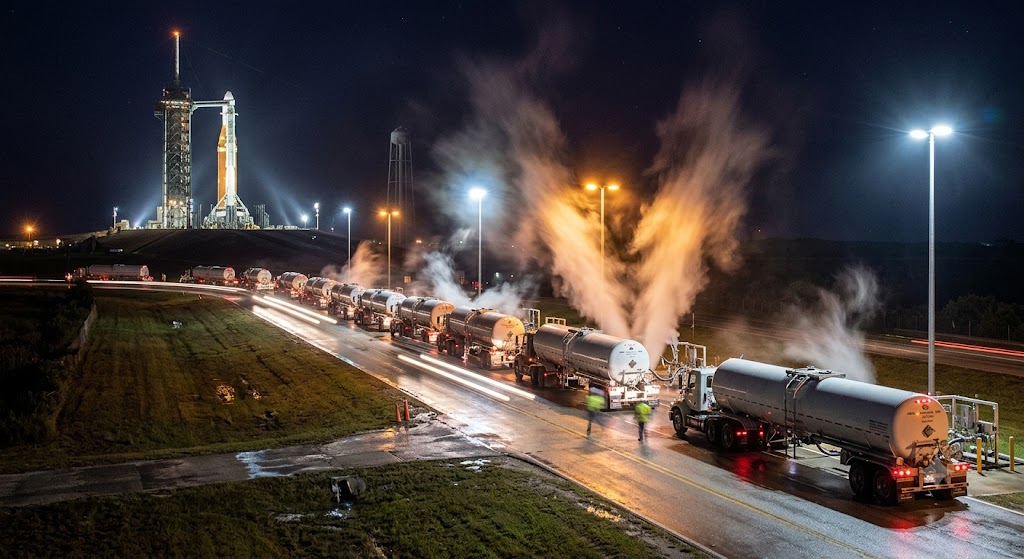
The bottleneck is in the parade of trucks, not the rocket
When all these constraints combine, an unexpected result emerges. Methane, or natural gas, is already a massive industry connected by pipelines worldwide. However, the industry that requires pure oxygen is much smaller, and the system to supply the grade of liquid oxygen required by launch sites is a tiny fraction of that. The cooling process itself is slow and energy-intensive, so unlike methane, it must be produced in specialized off-site plants rather than on-site. As a result, most liquid oxygen is transported by road in insulated trucks rather than by pipeline.
Looking at the numbers, this imbalance becomes even clearer. A typical US tanker truck can carry about 18.1 tons of liquid oxygen. To fill the 4,500 tons of liquid oxygen required for a single Starship launch, about 250 trucks must line up to enter the launch site. To launch one rocket, a logistics operation equivalent to the fleet of vehicles moving in and out of a city must first be completed.
If the launch frequency were once every few weeks as it is now, this level of logistics might be manageable. But once we move to the multi-launch-per-day system that SpaceX is aiming for, the story changes. A method where 250 trucks arrive over several days simply won’t work. This means the only path forward is to build new air separation units right next to the launch site. Even if rocket reusability lowers launch costs, what ultimately determines the launch frequency is not the rocket itself, but whether there is a facility standing next to it capable of freezing oxygen fast enough.
The speed of space exploration is determined by logistics, not chemistry
The history of rocket engineering is usually described through the evolution of thrust, specific impulse, and engine cycles. However, half of that story owes a debt to a much less glamorous technology that began in a Munich laboratory 130 years ago. The method of freezing air and separating two gases by a 13-degree difference in boiling points is still being repeated today inside the cooling facilities next to launch pads.
The next bottleneck on the road to space might not be more powerful engines, but the ability to freeze air faster. How often a rocket lifts off ultimately depends on how large a cooling plant is standing next to it.
References
- SpaceX Raptor engine specifications, Wikipedia
- SpaceX Starship, Wikipedia
- Falcon 9 Block 5, Wikipedia
- Linde Engineering, 'Air separation plants: History and technological progress'
- Science History Institute, 'Carl von Linde'
- Encyclopaedia Britannica, 'Carl von Linde'
- The Chemical Engineer, 'Carl von Linde and William Hampson – Cool inventions'
- Cold Facts Digital, 'Air Separation and Liquefaction'
- Cargo Handbook, 'Oxygen'
- planetearthandbeyond.co, 'Starship Has A Huge Fuelling Dilemma'
- Mobius Market Research, 'Fueling Starships'
- briantimar.com, 'A rapid launch site'