
How the New Glenn Explosion Reshaped Space Hegemony
At 9:00 PM on May 28, 2026, night turned to day without warning over Cape Canaveral, Florida.
A blinding flash erupted at Launch Complex 36 (LC-36). The rocket had not even left the ground. Just moments before—or immediately upon—engine ignition, the 98-meter steel monolith consumed itself. A massive lightning tower collapsed. The lower pad infrastructure took the full brunt of the blast wave. The flames were not brought under control until dawn.
There were no casualties. The 48 Amazon satellites slated to ride the rocket had also not yet been loaded.
People took comfort in that fact. It took only hours to realize how hollow that relief was.
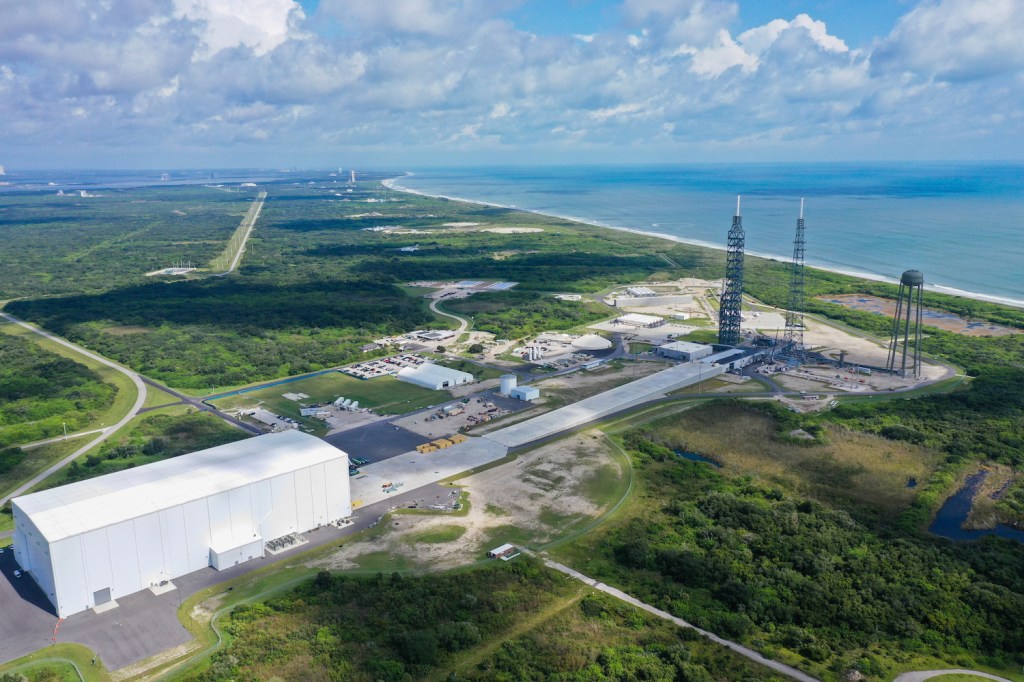
One Launch Pad Was Everything
To someone unfamiliar with American rocketry, this might look like an ordinary corporate setback. A wealthy man’s rocket blew up, and it can be rebuilt. Such setbacks have repeated throughout the history of space exploration.
Yet this incident is different because of a single number.
Currently, there is only one launch pad in the entire world from which New Glenn can lift off: Cape Canaveral LC-36. That is it. Blue Origin poured more than a billion dollars into building that facility. Taking over the historic grounds once home to Atlas rockets, they erected booster recovery assets, propellant feed lines, an upper-stage integration facility, and umbilical systems one by one. A decade of effort went into that single pad.
That pad is now in ruins.
When SpaceX suffered the AMOS-6 launch pad explosion in September 2016, it took 13 months before Cape Canaveral’s SLC-40 could host another rocket. And that was a project to repair and upgrade an existing site. The damage at LC-36 is not something that can be resolved with simple repairs. A lightning tower collapsed, umbilical arms suffered severe thermal shock, and the subsurface pad infrastructure absorbed the shockwave of a massive explosion. A conservative estimate is 12 months—and realistically, it could take far longer.
During those 12 months, New Glenn cannot fly. No lunar landers, no Amazon satellites, no military payloads—nothing will reach orbit.
How We Got Here: A Cascade of Failures
To understand this explosion, one must rewind a month and a half.
On April 9, 2026, an anomaly occurred at Blue Origin’s Second Stage Cleaning and Testing Facility (2CAT) in Exploration Park. During a cryogenic tank proof test, the facility’s roof was completely blown off. It was an explosive structural failure. Fortunately, no one was injured, but only later did it become clear that this was merely a prelude.
Ten days later, on April 19, New Glenn Flight 3 (NG-3) lifted off. The first-stage booster successfully landed downrange on the recovery barge. So far, so good. But high in the atmosphere, a cryogenic hydrogen leak developed in the second stage. Liquid hydrogen crept into hydraulic lines, freezing them solid. The BE-3U engines could not generate sufficient thrust. The customer’s satellites failed to achieve their intended orbit. A mission worth hundreds of millions of dollars ended in failure.
The Federal Aviation Administration (FAA) opened an investigation. The probe dragged on for weeks. On May 25, the FAA finally cleared Blue Origin to resume flights. Blue Origin immediately prepared for its next launch.
Just three days later, the pad exploded.
Lining up these three incidents reveals a clear pattern: the tank failure at the 2CAT facility, the upper-stage engine failure on NG-3, and now this ground explosion. The exact same substance appears in all three accidents: liquid hydrogen.
Liquid hydrogen is notoriously known in aerospace history as the most unforgiving propellant to handle. With a density seven times lower than water, it seeps effortlessly through microscopic fissures no larger than a virus. A mere 5% concentration in the air can ignite with an invisible static spark. Its storage temperature is minus 253 degrees Celsius—barely 20 degrees above absolute zero. Mastering the materials engineering to withstand that extreme thermal delta and designing systems that flawlessly route such a volatile fluid through plumbing is precisely where Blue Origin has repeatedly stumbled.
New Glenn’s architecture pairs seven BE-4 engines burning liquid methane and liquid oxygen on the first stage with two BE-3U engines burning liquid hydrogen and liquid oxygen on the upper stage. The upper-stage liquid hydrogen system proved to be the rocket’s weakest link—a vulnerability proven three times in succession.
The Door to the Moon Has Closed
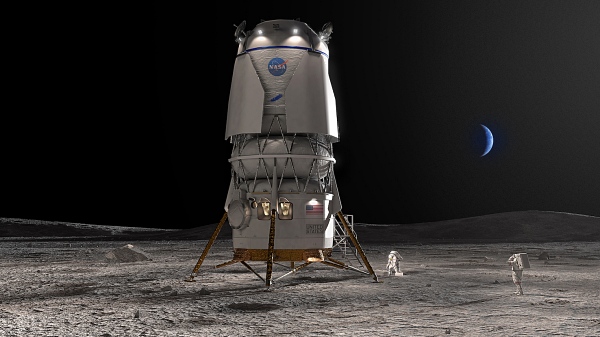
Two days before the explosion, on May 26, NASA announced a major contract award.
Blue Origin was selected to lead the first mission of a $20 billion lunar south pole infrastructure initiative, securing a $468 million contract. The mission was concrete: launch the “Blue Moon Mk1 Endurance” lander to the lunar south pole aboard a New Glenn rocket in the autumn of 2026. The lander was designed to touch down in the Shackleton-de Gerlache ridge area to deploy scientific payloads and characterize surface properties.
NASA chose Blue Origin over SpaceX. Two days later, the very rocket underpinning that decision was engulfed in flames on the pad.
The lunar south pole is far more than just a destination for scientific curiosity. Evidence of water ice has steadily accumulated—billions of years old, frozen inside permanently shadowed craters. That ice can provide drinking water for lunar habitats, and when split via electrolysis into hydrogen and oxygen, it becomes rocket propellant. A high-stakes race is underway to establish the first fueling station on the stepping stone to Mars.
The Blue Moon Mk1 mission was meant to take the inaugural step.
That pad is now a ruin. For at least 12 months, that corridor to the Moon is closed.
The implications for Blue Moon Mk2 are even more tangled. This is the human landing system designed to ferry astronauts to the lunar surface for the Artemis V mission in 2030. The Mk2 architecture relies on docking multiple times in low Earth orbit with dedicated cryogenic tankers to transfer liquid hydrogen. The prerequisite for that entire architecture is that New Glenn’s upper stage can manage liquid hydrogen with absolute reliability.
Now, that very premise has collapsed.
Until investigation results are published, no one can be certain whether the NG-3 hydrogen leak was a systemic defect or whether this pad explosion stemmed from the same plumbing flaws. That uncertainty casts a deep shadow over the entire Artemis timeline.
Military Certification Vanished
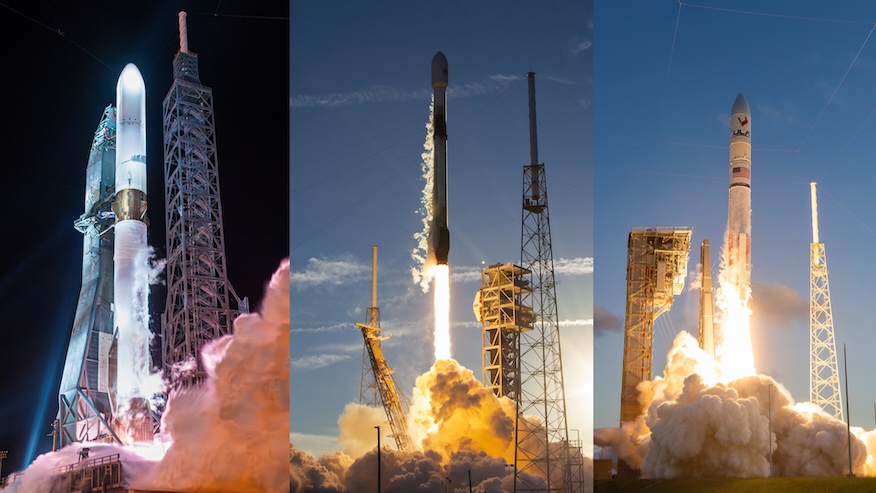
NASA’s lunar ambitions are not the only casualty.
Consider the US Space Force’s National Security Space Launch (NSSL) Phase 3 Lane 2 program—a contract vehicle encompassing the nation’s most critical and sensitive reconnaissance and high-orbit communications payloads. Competing for this work came with a hard condition: pass all specified flight qualification requirements by October 1, 2026.
To achieve certification, Blue Origin needed to complete four consecutive successful flights with New Glenn. Having passed two initial qualification gates in 2025, they were halfway there.
However, with the NG-3 failure on April 19, the consecutive success counter reset to zero. They had to start from scratch. With the pad explosion grounding flights for at least a year, achieving four successful flights before the October deadline has become mathematically impossible.
The financial ramifications of this disqualification are stark. Blue Origin stands to lose roughly $350 million across seven assigned military communications and reconnaissance launch missions for Fiscal Year 2026. That volume will now be absorbed by SpaceX and ULA. The national security launch market contracts once more into a rigid duopoly.
Amazon’s Clock Has Stopped
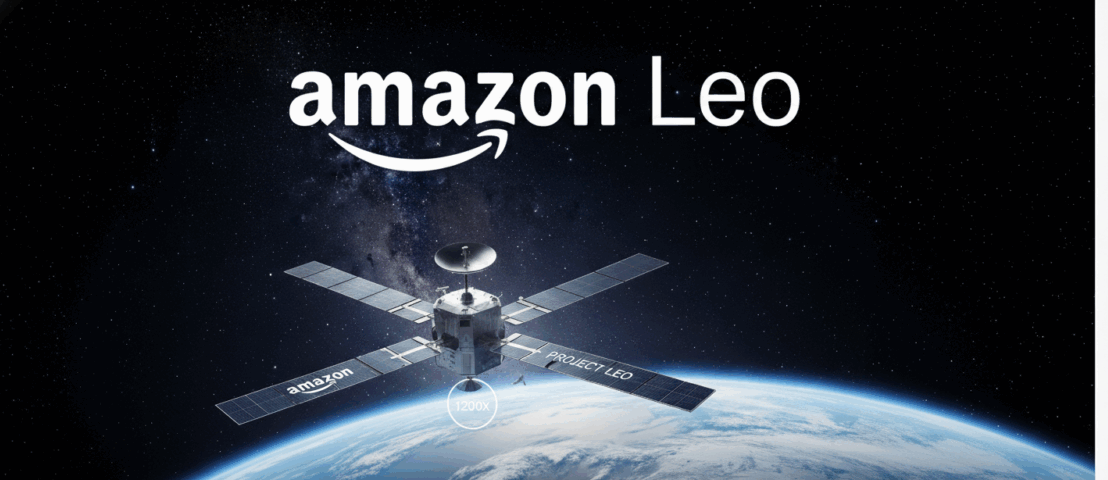
Until the day before the blast, 48 Amazon Leo satellites were slated to be integrated onto New Glenn Flight 4 (NG-4). They escaped the explosion simply because they had not yet been mounted atop the stack.
Yet for Amazon, this sparing produced an even more brutal dilemma.
Amazon Leo (formerly Project Kuiper) is bound by a strict FCC regulatory mandate: it must deploy and operationalize half of its first-generation 3,236-satellite constellation—1,618 satellites—in orbit by July 30, 2026. Missing this deadline by even a single day empowers the FCC to cap the authorized constellation size strictly to the number of satellites already in orbit and forfeit hundreds of millions in performance bonds.
As of late April 2026, Amazon Leo had only 231 satellites in orbit—1,387 short of the 1,618 target. Launching 1,387 satellites in roughly two months would require more than 40 additional launches given average payload capacities. It was already a near-impossible feat.
Now, the launch vehicles Amazon counted on are collapsing one after another. New Glenn’s pad is in ruins. Ariane 6 is plagued by its own production bottlenecks. Vulcan Centaur’s military flights are on hold. Atlas V is nearing retirement with strictly limited remaining slots.
July 30 is rapidly approaching. FCC Chairman Brendan Carr has previously hinted that extension requests could be denied, noting that Amazon has spent more time lobbying against competitor filings than diligently launching satellites.
Between now and the deadline, Amazon has very few options left.
The Shared Vulnerability of BE-4
There is a deeper, more insidious threat lurking beneath this failure.
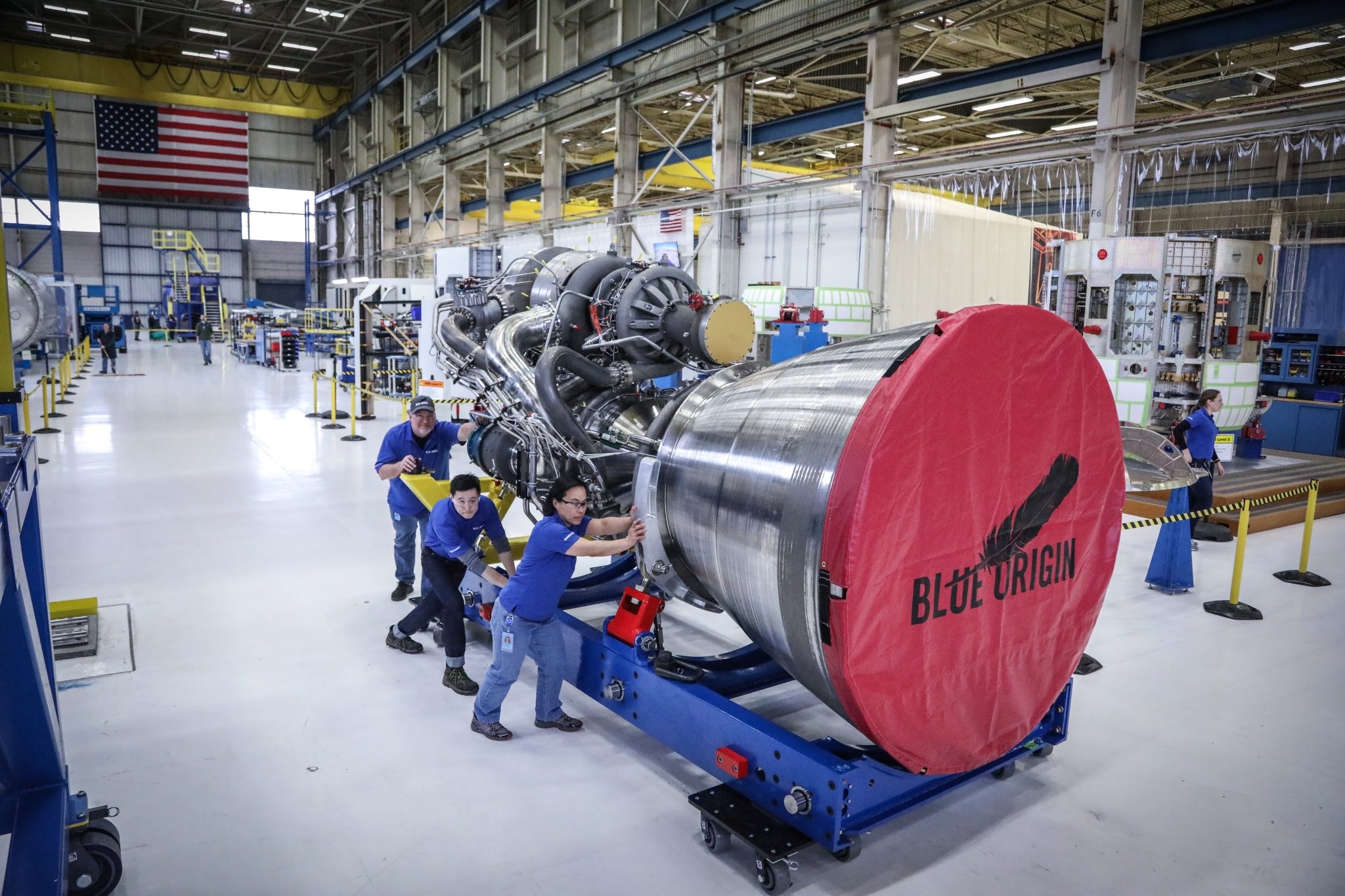
Blue Origin’s BE-4 engine does not power New Glenn alone. It is also the booster engine for United Launch Alliance’s (ULA) next-generation Vulcan Centaur rocket. Two fierce competitors rely on the exact same engine. Two of the most crucial players in the US medium-to-heavy launch market are tethered to the production line of a single company.
Vulcan is already under scrutiny. During the USSF-87 national security launch in February 2026, a solid rocket motor nozzle failed, accompanied by uneven combustion. The Space Force placed Vulcan’s military manifest on indefinite hold. If the root cause of the New Glenn pad explosion points to a hardware defect within the BE-4 engine itself, Vulcan could be dragged into an engine safety recertification process as well.
Should that scenario unfold, virtually every medium-to-heavy launch platform in the United States outside of SpaceX would be rendered simultaneously inoperable. A world where only Falcon 9 and Falcon Heavy fly is no longer just a monopoly—it is complete solitariness.
China Moved in Silence
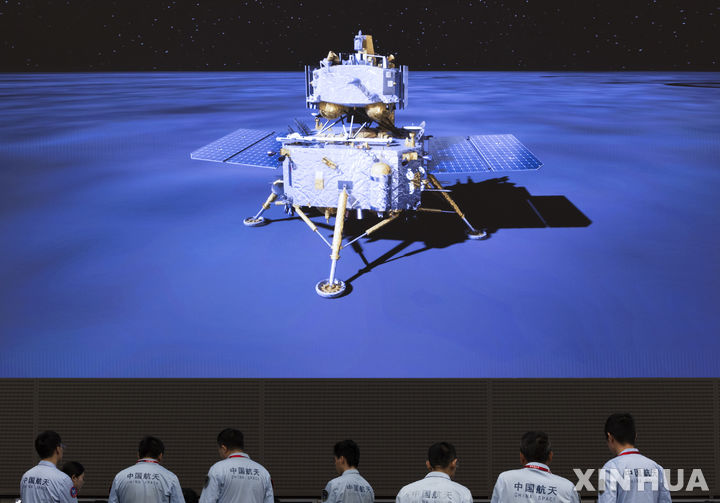
On May 25, 2026, China sent three taikonauts into orbit—three days before New Glenn exploded.
This is not merely a coincidental juxtaposition; it illustrates the collision of two fundamentally different operational rhythms. The US lunar program relies heavily on the technological maturity and launch cadence of commercial enterprises. When those companies stumble, national roadmaps falter. China’s lunar exploration program operates under unified state command and state-owned enterprises. Structurally, commercial failures cannot derail the national timeline.
China’s lunar roadmap remains unyielding. Chang’e 7 is on track to launch late in 2026 to explore the lunar south pole. Chang’e 8, tasked with testing in-situ 3D printing of construction bricks using lunar regolith, is slated for 2028. Integrated flight tests of the new-generation crewed spacecraft Mengzhou, capable of carrying up to seven astronauts directly toward the Moon, will take place within 2026. The maiden launch of the Long March 10A heavy reusable booster, designed to provide translunar thrust, has also been confirmed for mid-2026.
Chinese engineers likely monitored New Glenn’s pad explosion without external frenzy. They calculated what it meant. And the next morning, they simply returned to work.
If New Glenn’s pad restoration takes two years and SpaceX’s orbital refueling technology encounters prolonged delays, the Artemis coalition may not be the first to establish a permanent human outpost at the lunar south pole in the early 2030s. The prospect of the Sino-Russian International Lunar Research Station (ILRS) consortium planting its flag first has suddenly become far more plausible.
First-mover advantage on the Moon is not a matter of diplomatic negotiation. Access to prime water ice reserves, prime communication line-of-sight relays, and corridors for future Mars exploration will largely be dictated by whoever lands first. The nations that grasp this reality are running at full speed.
The Myth of Redundancy Strategy
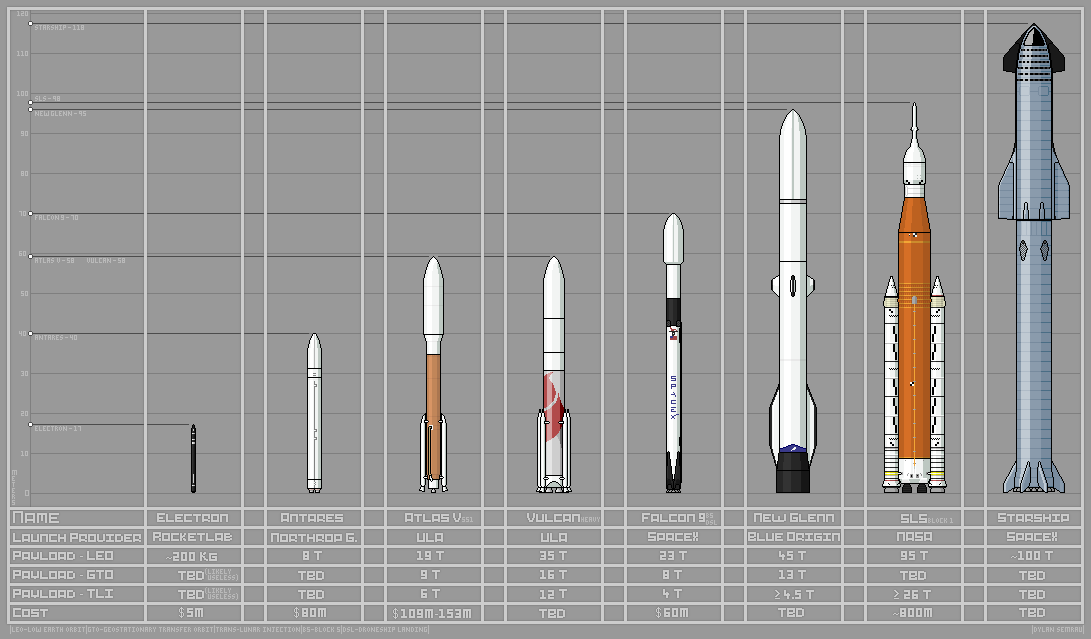
For years, the US government has sought to reduce its reliance on SpaceX across launch markets. It was a rational objective: sole-source dependence is an inherent national security risk. Consequently, contracts were distributed to Blue Origin and ULA, and lunar south pole lander missions were awarded to New Glenn before its flight heritage was fully proven.
The strategic intent was sound, but the execution suffered a fatal flaw.
True diversification requires distributing risk across proven platforms. Awarding a flagship lunar south pole landing mission to a rocket with only three flights under its belt—one of which failed to reach orbit—and only a single operational launch pad in the entire world was not diversification; it was a gamble. Prioritizing the optics of checking SpaceX’s dominance over rigorous validation of mission readiness directly led to this catastrophic blast.
Paradoxically, this disaster only accelerates SpaceX’s market hegemony. Falcon Heavy continues uninterrupted operations at LC-39A. With New Glenn and Vulcan faltering simultaneously, commercial manifests gravitate back to SpaceX. Pricing leverage tilts entirely in SpaceX’s favor. When competition evaporates from the market, launch costs rise. Rising costs compress launch frequencies, further slowing down the lunar exploration timeline.
It is a bitter irony: the measures taken to foster diversification have ultimately entrenched a monopoly.
The Crossroads of Vertical Integration and Outsourcing
One of the most consequential structural shifts sparked by this incident will concern rocket development methodology.
Vulcan Centaur procures its core propulsion externally, purchasing the BE-4 from Blue Origin. Such an architecture looks efficient on paper during early development since it avoids sinking billions into in-house engine programs. Yet when the supplier stumbles, the shockwave directly compromises the customer’s operations. The engine vendor’s setbacks effectively dictate the prime contractor’s launch schedule.
SpaceX approached the problem from an entirely different philosophy from day one. From engines to launch pads, software to launch operations, everything is built and controlled internally. That is vertical integration. While the upfront capital requirements are immense, external supplier failures can never halt their cadence.
In the wake of this disaster, emerging space companies will heed this lesson carefully. The vulnerability of outsourcing critical propulsion plumbing, specialized cryogenic valves, turbopumps, and hot gas control systems has been demonstrated in visceral fashion. Industry design philosophy is likely to pivot away from short-term cost efficiency toward long-term operational autonomy.
The Unanswered Questions
The explosion on May 28 is not an ending; it is a beginning. Ahead lies a grueling process of investigations, root-cause determinations, pad reconstruction plans, and manifest reallocations. Yet regardless of how that process unfolds, foundational realities have already shifted.
No one knows how long it will take for Blue Origin to fly New Glenn again. But the Moon will not wait. The FCC deadline, the NSSL qualification window, and the Chang’e 7 launch schedule will not pause.
What this explosion revealed most starkly is not merely an engineering failure. It is the failure of a structural architecture that staked critical national missions on a single launch pad. It is the failure of a planning model that loaded military satellites, lunar landers, and mega-constellations onto an unvalidated platform. It is the failure of allowing the political objective of curbing a competitor to outrun technical reality.
A single launch pad collapsed. But that pad did not stand alone. America’s path to the Moon, a global satellite internet network, critical national security payloads, and the delicate balance of US-China space dominance were all leaning on that single pillar.
The real question now is: in the crater left behind, what stands in its place?
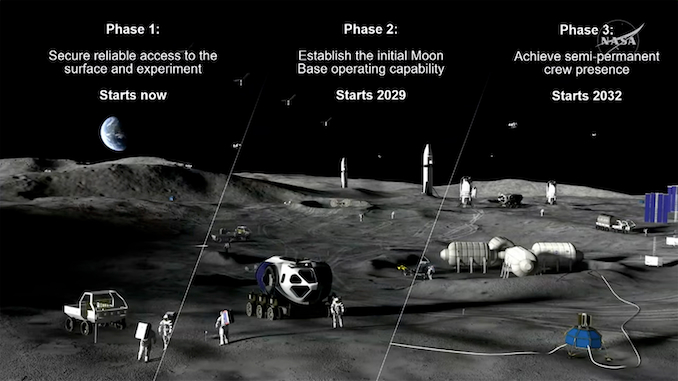
Within a few short years, we will find out whose boots leave the first footprints at the lunar south pole. On that day, some may remember LC-36—and how a single pad explosion quietly rewrote history.
References
(Sorted by citation frequency)
- Blue Origin’s New Glenn rocket explodes on pad, topples lightning tower [Update: No injuries] — Space Explored (2026.05.29) https://spaceexplored.com/2026/05/28/blue-origins-new-glenn-rocket-explodes-on-pad-topples-lightning-tower/
- Blue Origin rocket explosion: Videos show fiery blast during launch — Hindustan Times (2026.05.29) https://www.hindustantimes.com/world-news/us-news/blue-origin-rocket-explosion-videos-show-fiery-blast-during-launch-from-florida-cape-canaveral-watch-elon-musk-reacts-101780019344695.html
- mplex 36 — Wikipedia https://en.wikipedia.org/wiki/CapeCape Canaveral Launch CoCanaveralLaunchComplex36
- Blue Origin’s New Glenn Rocket Cleared For Launch After Suffering Malfunction — Gizmodo (2026.05.29) https://gizmodo.com/blue-origins-new-glenn-rocket-cleared-for-launch-after-suffering-malfunction-2000763199
- FAA Grounds Blue Origin Following New Glenn Upper Stage Failure — SatNews (2026.04.30) https://satnews.com/2026/04/30/faa-grounds-blue-origin-following-new-glenn-upper-stage-failure-and-facility-anomaly/
- New Glenn — Wikipedia https://en.wikipedia.org/wiki/New*Glenn
- NASA selects Jeff Bezos’s Blue Origin for first of three uncrewed lunar missions — The Guardian (2026.05.29) https://www.theguardian.com/science/2026/may/26/nasa-jeff-bezos-blue-origin
- Blue Origin rocket, owned by Jeff Bezos, explodes during test in Florida — The Guardian (2026.05.29) https://www.theguardian.com/science/2026/may/29/blue-origin-rocket-explodes
- Jeff Bezos’s Blue Origin secures $468mn in Nasa Moon Base contracts — Financial Times (2026.05.29) https://www.ft.com/content/2f764093-9413-4945-91f5-19ec8802f1b0
- Space Systems Command Releases National Security Space Launch Phase 3 Lane 2 FY26 Mission Assignments — Space Systems Command Newsroom https://www.ssc.spaceforce.mil/Newsroom/Article/4348694/space-systems-command-releases-national-security-space-launch-phase-3-lane-2-fy
- Amazon Leo | 231 Satellites, 90 Days, and a Deadline That Will Not Wait — KeepTrack Space https://keeptrack.space/deep-dive/amazon-leo-progress-2026
- BE-4 — Wikipedia https://en.wikipedia.org/wiki/BE-4
- Demand Outweighs Supply as Heavy-Lift Launch Needs Skyrocket — National Defense Magazine (2026.04.17) https://www.nationaldefensemagazine.org/articles/2026/4/17/demand-outweighs-supply-as-heavylift-launch-needs-skyrocket
- How is the NG-3 mishap going to potentially impact New Glenn’s path towards NSSL certification? — Reddit r/BlueOrigin https://www.reddit.com/r/BlueOrigin/comments/1sr9q9m/
- US-China space race shifts into a higher lunar gear — Asia Times (2026.04) https://asiatimes.com/2026/04/us-china-space-race-shifts-into-a-higher-lunar-gear/
- Blue Moon (spacecraft) — Wikipedia https://en.wikipedia.org/wiki/BlueMoon(spacecraft)
- Amazon Leo Launch Delayed Again as FCC Deployment Deadline Looms — Broadband Breakfast https://broadbandbreakfast.com/amazon-leo-launch-delayed-again-as-fcc-deployment-deadline-looms/
- Space Force Reassigns Final GPS III Mission to SpaceX Following Vulcan Anomaly — SatNews (2026.03.24) https://satnews.com/2026/03/24/space-force-reassigns-final-gps-iii-mission-to-spacex-following-vulcan-anomaly/
- Blue Origin Files Documents To Kick Off Building A Second Launch Pad At Cape Canaveral — Talk of Titusville (2026.04.09) https://talkoftitusville.com/2026/04/09/blue-origin-files-documents-to-kick-off-building-a-second-launch-pad-at-cape-canaveral/
- Blue Origin readies New Glenn rocket to launch 48 Amazon Leo satellites after FAA clearance — GeekWire (2026.05.29) https://www.geekwire.com/2026/blue-origin-new-glenn-rocket-amazon-leo-satellites/