
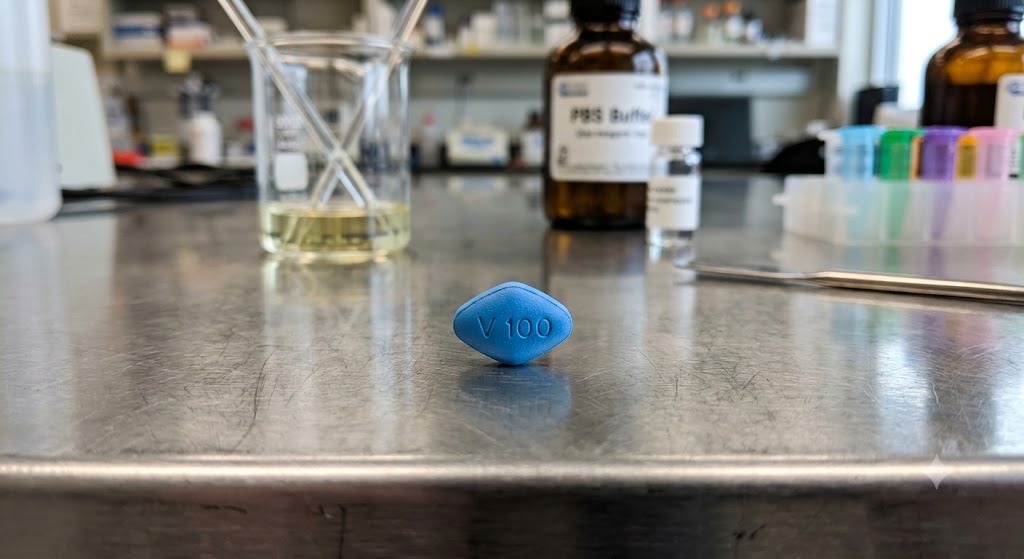
While tidying my medicine cabinet, I found a blue diamond-shaped pill. It was Palpal-jeong (a sildenafil generic). It belonged to my father, and it wasn’t exactly a surprise; in Korea, sildenafil is as common as cold medicine.
However, a headline in my feed a few days later looked a bit strange: “Viagra prevents cancer metastasis.”
Such headlines usually fall into one of two categories.
Either they are exaggerating findings from a petri dish, or they are true but come with so many conditions that you shouldn’t just read the headline. This one was closer to the latter. However, the conditions were much more interesting than I expected.
The original paper was published in the July 2026 issue of Cancer Research, a journal of the American Association for Cancer Research (AACR).
It was led by Dr. Yarden Ariav from the lab of Professor Ayelet Erez at the Weizmann Institute of Science in Israel, with researchers from the U.S. National Cancer Institute (NCI) as co-authors. The title is quite long: “PDE5a Inhibition Restricts Cancer Metastasis by Disrupting NPC1-Mediated Cholesterol Trafficking through a Noncanonical cGMP-Dependent Pathway.”
Even just looking at the title, you can tell that the core of this study has nothing to do with erectile function.
Why is cancer metastasis so difficult, and why is it the cause of death?
Before getting into the mechanism, I need to establish a premise: Most people who die of cancer do not die because of the primary tumor.
A lump in the breast is usually not fatal on its own. It can be removed. The problem arises when cells that break away from that lump settle in the lungs, liver, bones, or brain. It has long been cited that roughly 90% of solid tumor deaths are related to metastasis. A significant portion of cancer treatment is actually focused on preventing or delaying metastasis.
However, metastasis is a very difficult feat even for cancer cells. To leave the primary tumor, they must penetrate surrounding tissue, squeeze through blood vessel walls, survive the harsh environment of the bloodstream, and then exit somewhere else to settle in a foreign tissue. Only a tiny fraction of cells pass through all these checkpoints. It is a well-established theory that even if millions of cells break away daily, only a very few actually form metastatic colonies.
There is one common requirement for every checkpoint: The ability to continuously create new cell membranes and change shape. Rigid cells cannot pass through narrow gaps. To maintain a flexible membrane, materials are needed, and the core of those materials is cholesterol.
This is exactly where this study aimed. Instead of trying to kill the cancer cells, it cuts off the supply of materials needed for movement. In fact, in a mouse model of breast cancer, sildenafil had almost no effect on the size of the primary tumor. Instead, it significantly reduced the number of metastatic colonies that spread to the lungs. It’s more like a drug that keeps the tumor contained rather than one that eliminates it.
What does it mean that sildenafil traps cholesterol in cancer cells?
The starting point of this study was taking sildenafil’s original mechanism of action one step further.
sildenafil inhibits an enzyme called PDE5 (phosphodiesterase type 5). PDE5’s job is to break down a signaling molecule called cGMP; by inhibiting it, cGMP accumulates within the cell. When cGMP builds up in the vascular smooth muscle of the corpus cavernosum, the blood vessels relax, increasing blood flow. That one sentence is the reason why this drug has been sold since 1998.
The Erez team discovered another job for cGMP.
Inside cells, there are organelles called lysosomes. They are commonly called “the cell’s trash compactor,” but in reality, they are more like recycling plants.
They break down old proteins and lipids and send usable parts back out to the cell. One of those parts is cholesterol, and a protein called NPC1 is the transporter that carries it out of the lysosome.
Accumulated cGMP binds to this NPC1. This results in a state where the delivery truck is stuck in the parking lot and cannot leave.
Cholesterol remains trapped inside the lysosome, but the cell has no cholesterol to use. It’s like a situation where the warehouse is full of inventory, but nothing can be shipped out.
Why is this a problem? Because cholesterol is a key material for cell membranes. In particular, cancer cells trying to break away from the primary tumor and move to other organs must constantly create new membranes and change their shape. The entire process of squeezing through narrow gaps, passing through blood vessel walls, and settling in foreign tissue involves restructuring membranes. If there is a lack of materials, that work doesn’t go well.
According to the paper, cancer cells starved of cholesterol saw their lipid raft structures in the cell membrane disrupted, and mitochondrial energy production also fell. Movement capacity, invasive ability, and the ability to form metastatic colonies all decreased.
The research team described this state as mimicking Niemann-Pick type C disease. Niemann-Pick type C is a rare genetic disorder where cholesterol is trapped in lysosomes due to an NPC1 gene defect. They essentially reproduced that pathology temporarily and partially with a drug.
Why does sildenafil leave normal cells alone and specifically target cancer cells?
The part of this paper worth dwelling on the longest is not the mechanism itself, but the selectivity.
Blocking cholesterol transport theoretically applies to all cells. However, in the experiment, only cancer cells were significantly affected. In the same experiment, normal cells were almost unaffected.
The explanation provided by the research team is lysosomal gene expression.
Cancer cells have relatively low expression of lysosome-related genes. They are running their recycling plants with a skeleton crew. Usually, that isn’t a problem. It might even be an efficient strategy to divert resources elsewhere.
But when that one and only shipping route is blocked, there is no detour to replace it.
Normal cells have a cushion. They keep more lysosome-related genes turned on, and other pathways for procuring cholesterol are also functioning relatively well. They can hold out even if one side is blocked.
The response cancer cells take here is also interesting. Since they are short on cholesterol, they turn on a transcription factor called SREBP2 and start making it themselves. If they can’t get it from outside, they will synthesize it inside. Indeed, genes related to de novo cholesterol synthesis were upregulated.
However, this compensatory response was insufficient. The usable cholesterol remained scarce, and stored cholesterol continued to pile up. It’s like a warehouse where goods keep coming in while the traffic jam never clears.
The research team verified in several ways that this was not a coincidence. The same results were produced with vardenafil, another PDE5 inhibitor, and directly turning off the PDE5a gene itself also reduced metastasis. The effect was maintained even in severely immunocompromised mice, which can be read as an indication that it acts directly on cancer cells rather than an indirect effect via the immune response.
In the observational study, papaverine, an unrelated vasodilator, was used as a negative control. Similar benefits did not appear in papaverine users. This result supports the idea that the effect is specific to this class of drugs, rather than due to some common characteristic of the people taking the medication.
This is the part of the paper’s experimental design that was the most painstaking, and personally, it felt the most convincing.
Research results when Viagra and statins are prescribed together
Once the SREBP2 topic comes up, the next step is automatic.
If cancer cells survive by making their own cholesterol, why not block that synthesis pathway as well? And one of the most widely prescribed drugs in the world already does that: Statins.
Statins inhibit HMG-CoA reductase in the mevalonate pathway, reducing cholesterol synthesis at the source. Sildenafil blocks the lysosome’s shipping, and statins block the factory’s operation. It’s a structure that cuts off both import and production.
The experimental results pointed in that direction as well. When lovastatin was added along with sildenafil, the movement and colony formation of cancer cells decreased more than when either was used alone, and the number of dying cells increased. In the same experiment, normal cells were almost untouched. The aforementioned lysosomal vulnerability seems to have functioned as a safety margin here as well. The combination was also better than the monotherapy in mouse models of breast and prostate cancer.
Next comes the human data.
They used medical records from Clalit Health Services, the largest insurer in Israel. About 5 million people, 20 years of data. They selected about 40,000 male cancer patients and compared the 5-year survival of those who had been prescribed sildenafil three or more times in the 6 months before their cancer diagnosis versus those who had not.
The group that took both sildenafil and statins had a roughly 31% lower risk of death within 5 years compared to the group that took neither. The research team adjusted for income level, weight, comorbidities, and cancer type.
31% or 26% — Why the Viagra cancer survival rate numbers differ across reports
We need to stop here.
If you read several English-language articles covering this study, the numbers are slightly different. Some outlets wrote that the 5-year mortality risk for men who filled three or more sildenafil prescriptions was 26% lower, and that the difference widened to 32% when statins were also used. Other media reported that the combination group was 31% lower. Still others just wrote “significantly improved survival” without any numbers.
It is hard to say that all three are incorrect reports. It is because the comparison groups are different.
“Sildenafil users vs. non-users” and “Sildenafil+statin users vs. those who used neither” are different calculations. The latter excludes statin users from the control group, so the difference appears larger. Depending on how you slice the subgroups and what adjustment variables you include, the digit before the decimal point changes.
I think this is the point where people most often stumble when reading reports on observational studies. If you just pull one number and slap it on a headline, the accuracy drops dramatically. The phrase “31% reduction” means nothing on its own; it only becomes information when “compared to what” is attached.
One more thing to point out is that this is relative risk reduction. It is not absolute risk. If the 5-year mortality risk is originally 40% in a group, a 31% reduction brings it to 27.6%, but if it is 4% in a group, a 31% reduction brings it to 2.8%. In the former case, 12 out of 100 people live; in the latter, it’s barely 1 person. It’s the same percentage, but the feeling is completely different. The Clalit cohort in the paper is an analysis that bundles several cancer types together, so it is virtually impossible to know how this number applies to an individual patient.
Co-author Dr. Sama Hayek of the Clalit Research Institute also mentioned this in an interview. She said that this analysis could not conclude whether the effect is stronger in specific cancer types. If you break it down by cancer type, the sample size becomes smaller, widening the confidence interval, and if you perform multiple comparisons, the probability of getting a significant result by chance also increases. That seems to be why only the integrated analysis was presented.
It is also worth noting the limitations revealed by the paper’s authors themselves. First, the cancer stage at the time of diagnosis was not in the data. Stage is the variable that most significantly influences survival, and it was adjusted for without that information. Second, people who obtained sildenafil outside the formal medical system were not counted. In this case, people who actually used the drug are classified as ’non-users,’ which actually works to blur the difference between the two groups. Third, the animal experiments were done in female mice using breast and colon cancer models, but the human data is a male cohort. The directions are misaligned.
What happened to the research suggesting PDE5 inhibitors increase melanoma risk?
This section is the least known and most strange part of this topic.
This is not the first study to deal with the relationship between PDE5 inhibitors and cancer. However, 10 years ago, the direction was the exact opposite.
It started with a study published in Cancer Cell in 2011. It stated that when the BRAF mutation, commonly found in melanoma, is activated, PDE5A expression is lowered, and melanoma cells with lowered PDE5A have increased invasiveness. The logical conclusion is uncomfortable: couldn’t inhibiting PDE5A with a drug have the same effect?
In 2014, an analysis of a U.S. male cohort was published in JAMA Internal Medicine. The result was that there was an association between sildenafil use and an increased risk of developing melanoma. In 2016, an experimental study published in Cell Reports showed that sildenafil promotes melanoma growth via a cGMP-dependent pathway. That same year, the U.S. FDA added PDE5 inhibitors to its safety monitoring list.
Several meta-analyses followed. In an analysis of over 1 million people, the risk of melanoma in PDE5 inhibitor users was roughly 10–12% higher, and if you look at sildenafil alone, it was 26% higher.
However, a meta-analysis published in JNCI in 2017 put the brakes on this trend. The association itself appeared, but there was no dose-response relationship. It was significant in people who used the drug less, but not significant in those who used it a lot. It only appeared in low-stage melanoma and not in advanced-stage melanoma. Furthermore, the risk of basal cell carcinoma was similarly elevated in the same people, and basal cell carcinoma has nothing to do with this mechanism.
This pattern points to one thing: It’s the person, not the drug. Men who are prescribed erectile dysfunction medication are likely to have higher incomes, go to the hospital frequently, get more dermatological screenings, and enjoy leisure activities with high UV exposure. Consequently, skin cancer is ‘discovered’ more often. It is discovery, not incidence. Researchers call this detection bias.
So, the claim that PDE5 inhibitors cause melanoma is now practically dismissed. However, it is cautious to say that it has been completely resolved.
What is truly interesting is the contradiction at the mechanism level. The 2016 paper said that if cGMP goes up, melanoma grows well, while the 2026 paper says that if cGMP goes up, metastasis is inhibited. Same molecule, same direction of change, opposite conclusions.
Both could be right. cGMP interacts with different downstream pathways depending on the cell type and context. In the specific genetic background of BRAF-mutant melanoma, it may act as a growth signal, while in other cancer types, it may act to block cholesterol transport. Assigning a “good/bad” sign to the effect of a signaling molecule is something that usually doesn’t work well.
The cancer-preventive effect of statins, where observational studies and clinical trials diverge
One must also look at the evidence for statins to get a proper grasp of this picture.
The claim that “statins reduce cancer” is a very old topic. Signals consistently emerge in observational studies. In an analysis of about 140,000 people from the Women’s Health Initiative (WHI), the cancer mortality risk for statin users was 22% lower. Similar results have been repeatedly reported in individual cancer type cohorts, such as breast, colon, and head and neck cancers.
However, the signal disappears when moving to randomized controlled trials (RCTs).
A meta-analysis published in JAMA in 2006 collected 26 RCTs and 86,936 people. The cancer incidence odds ratio was 1.02, and the cancer mortality odds ratio was 1.01. There was no reduction in any of the breast, colon, gastrointestinal, prostate, respiratory, or skin cancers. A meta-analysis that collected 35 RCTs in 2023 reached the same conclusion. Incidence 0.99, mortality 0.99.
An umbrella review in 2019 scanned 18 cancer types and summarized it as follows: Based on conventional p-value criteria, significant preventive effects appear in 10 cancer types, but when grading the strength of evidence, there was not a single cancer type that showed conclusive evidence.
There are several reasons why observational studies and RCTs diverge like this.
Healthy user bias is the representative one. People who take statins consistently get regular check-ups, take good care of other medications, and have good access to healthcare. These people live long lives even without statins. There is also immortal time bias. To be classified as someone who has taken the drug for a long time, you must be alive during that period. The classification itself filters out survivors.
This Clalit analysis is also an observational study. It is in a better situation than previous statin studies in that it has biological backing like the papaverine negative control and animal experiments. Still, in terms of type, it is the same grade of evidence.
If history teaches one lesson, it might be that there are quite a few precedents where a 30% reduction from observational studies converged to 0% in RCTs. Beta-carotene and lung cancer, hormone replacement therapy and cardiovascular disease. The list is long.
Sildenafil is already a common drug in Korea — The asset called Palpal-jeong prescription data
What kept coming to mind while reading this study was the situation in Korea.
Viagra’s domestic patent expired in May 2012. Immediately after, 53 pharmaceutical companies poured out 105 generic products, and among them, Hanmi Pharm’s Palpal-jeong took the market. Just one month after its release in June 2012, it recorded 265,192 prescriptions, overtaking both Viagra (104,657) and Cialis (209,093) simultaneously. It has maintained the #1 spot in prescriptions for the same ingredient for over 10 years, and in 2023, it recorded 42.5 billion KRW in sales, with cumulative sales exceeding 400 billion KRW.
There were even years when the annual prescription volume exceeded 7 million tablets. The erectile dysfunction treatment market size is in the 100 billion KRW range.
Here, an interesting point emerges. Korea has a database called the Health Insurance Review and Assessment Service (HIRA), which accumulates claims data for the entire population in a unified manner. If Clalit is 5 million people over 20 years, HIRA is on the scale of 50 million. Since sildenafil is a prescription drug, records remain, and it can be linked to cancer registry data.
In other words, the domestic data conditions are actually better for performing a replication verification of this Israeli study.
Of course, there are hurdles. A significant portion of erectile dysfunction treatment prescriptions are non-covered, and the volume that goes out that way is not captured in claims data. It is also difficult to ignore the volume distributed through online or unofficial channels. It is highly likely that the exposure misclassification problem pointed out by the Clalit study will be worse in Korea.
There are also plenty of confounding variables to adjust for. Men prescribed sildenafil are usually middle-aged or older, and many already have high blood pressure, diabetes, or hyperlipidemia. That means the probability of statin use is also high. If the use of the two drugs is strongly intertwined from the start, it becomes difficult to separate the contribution of each. That is likely why the Clalit study divided subgroups by combining the two drugs.
Still, I don’t think that’s a reason not to do it. Unlike new drug development, this kind of drug repurposing research can start as long as you have the data. The time and cost required to synthesize new molecules and pass toxicity tests are completely skipped. Sildenafil already has an established safety profile, hundreds of products are distributed in Korea alone, and it is inexpensive. If the effect is confirmed, it is an almost ideal condition in terms of accessibility.
However, that “if” is still big. And there is a structural problem that there is no entity with commercial motivation to sponsor a large-scale clinical trial for a cheap, off-patent generic. I think that is one of the reasons why drug repurposing research often fails to reach phase 3 clinical trials even after producing promising results. Without public research funds or academic consortiums stepping up, such hypotheses often end with a few papers.

*
*So should you take Viagra for cancer prevention?
The answer to this question was given directly by the paper’s author.
Professor Erez stated that these results are “still far from daily clinical practice,” warning patients against arbitrarily obtaining and taking this drug. The NCI also added the caveat that further research is needed on whether it can safely and effectively prevent metastasis in humans.
As of the time of the paper’s publication, no large-scale randomized controlled trial has been completed that verifies sildenafil for the purpose of cancer metastasis prevention or treatment.
There are also practical reasons. Sildenafil is a drug with nearly 30 years of accumulated safety data, but it is not a harmless drug.
It is absolutely contraindicated to take it with nitrate-based angina medication. Blood pressure can drop rapidly.
It also interacts with alpha-blockers, some antifungals, and anti-HIV drugs. Cancer patients are usually taking multiple drugs simultaneously, and interactions with anticancer drugs were not covered in this study.
The timing of administration is also worth considering. The group where benefits were observed in the Clalit analysis were those who were prescribed sildenafil during the 6 months before cancer diagnosis.
In other words, it is a case where they were already using the drug at a time when they didn’t even know they had cancer. It suggests the possibility that the drug acted in the early stage when micrometastasis was just beginning, but conversely, this data cannot tell us if the same effect would occur if one started taking it after metastasis had already progressed.
The dosage issue also remains. What was captured in the Clalit data is the erectile dysfunction treatment dosage. Whether the concentration that inhibited metastasis in cell and animal experiments actually reaches human tissue at that dosage is a separate question. This is where drug repurposing research often stumbles.
To summarize, this is about as much as we can say at this point:
A mechanism has been newly discovered, that mechanism worked in animals, and a signal consistent with that direction appeared in human medical records.
The fact that the three layers support each other makes this study difficult to just pass by. At the same time, none of the three layers proves causality.
There is no reason for someone already taking statins to switch medications based on this study, and there appears to be no reason for someone prescribed sildenafil to be scared and stop taking it. The melanoma controversy has already been largely resolved, and the direction the new research is talking about is on the opposite side.
There was a sentence in an interview with Erez that kept bothering me.
The biology of cancer is not determined solely by the mutations of tumor cells, but is also shaped by the patient’s metabolic state and the medications they are already taking for other illnesses.
If that’s the case, at this very moment, an unintended combination is being created inside someone’s medicine cabinet. One cholesterol drug, one erectile dysfunction drug. Neither was prescribed with cancer in mind, yet here we are.