
A few days ago, I stumbled upon a piece of local news from Texas.
It reported that SpaceX would pay up to $220 million—nearly 300 billion KRW—to the city of Brownsville in the name of water infrastructure.
At first, I brushed it off as just another large corporation being generous to its local community.
However, after reading further, I realized this wasn’t a donation. The city gets the money, but in exchange, SpaceX gets to remove 445 acres of land—roughly half the size of Yeouido—from the city’s jurisdiction.
And this deal was pushed through during a six-hour special weekend session, even as protesters were being dragged out by police. Intrigued by why they would endure such a commotion just to secure land and water simultaneously, I dug deeper.
$220 Million and 445 Acres: The Terms of the Trade
Here is how the deal is structured.
Within 30 days of signing, SpaceX will deposit $40 million into an escrow account, followed by six quarterly payments of $30 million, totaling $220 million.
This money is strictly earmarked for water and sewage treatment projects, released in stages based on construction progress.
The recipients are the Brownsville Public Utilities Board and the Southmost Regional Water Authority (SRWA).
Phase 1 involves increasing daily water treatment capacity from 7.5 million gallons to 10 million gallons at a cost of about $46.8 million. Expanding this to 20 million gallons per day will bring the total to $202 million, meaning SpaceX is essentially footing the bill for the entire expansion.
In return, the city of Brownsville agreed to the ‘deannexation’ of 445 acres of land near the port, removing it from city limits.
SpaceX Vice President Sheila McCorkle argued that since the area lacks city services like water and sewage, it would be faster and cheaper to develop infrastructure by working with the City of Starbase rather than the city of Brownsville.
They also stated that this land would not be used for rocket launches or testing. However, the fact that they specifically demanded a location adjacent to port facilities signals their intent to expand logistics or manufacturing operations.
Does Starship Really Need That Much Water?
This made me wonder: why is SpaceX so serious about water? The answer turned out to be quite simple.
When 33 rocket engines ignite at once, the launch pad cannot withstand the heat and vibration. During Starship’s first orbital test flight in April 2023, they launched without any water suppression, resulting in a 7.6-meter-deep crater under the pad, with debris and dust flying for kilometers.
Since then, SpaceX has built a so-called ‘deluge’ system, which involves punching holes in a steel plate under the launch pad to shoot water upward.
This water isn’t there to cool the rocket. Upon contact with the flame, it instantly turns into steam, absorbing the explosive acoustic energy.
According to analysis from the SpaceX community, without this water, the shockwaves from 33 Raptor engines could render the launch pad unusable for months.
FAA environmental impact reports state that each launch uses up to 350,000 gallons (about 1.32 million liters) of water.
A test conducted at the second launch pad in July 2026 reportedly pumped water at 650,000 gallons per minute—emptying an Olympic-sized swimming pool every minute—which is a staggering figure.
For reference, the sound suppression deluge system NASA built for the SLS rocket at the Kennedy Space Center uses 450,000 gallons.
SpaceX is building systems of this scale, and with plans to increase launch frequency, they are standardizing this setup across multiple launch pads.
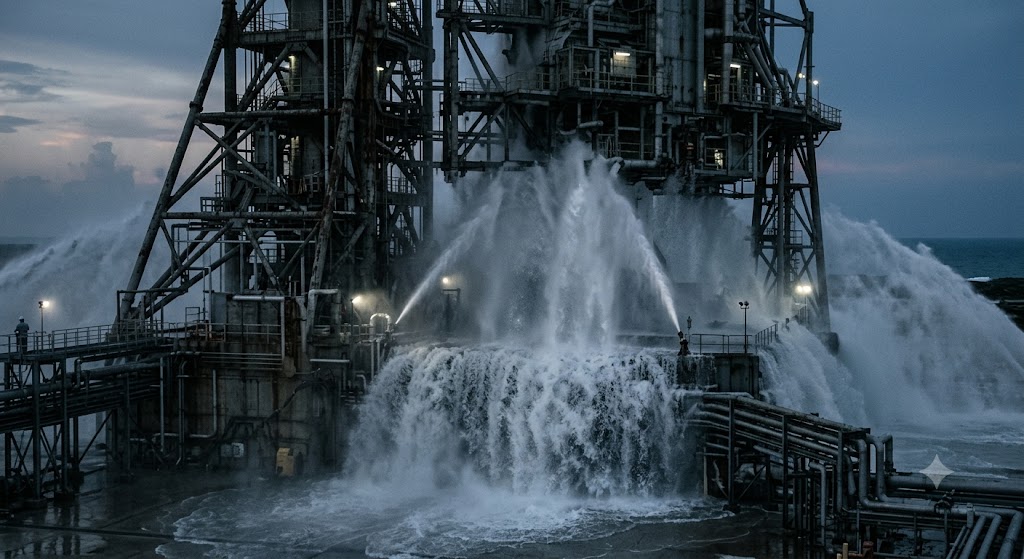
*What makes this worth pondering is that this isn’t just a story about a ‘water-hungry factory.’ It means that the launch frequency itself could be held back by water supply capacity.
According to Starbase community analysis, the bottleneck for Starship launch cycles is shifting toward ground infrastructure.
The key is how quickly the launch pad can be refurbished, how reliably the water deluge protects the hardware, and how fast this system can be scaled across multiple pads.
If that’s the case, securing water is not a peripheral issue separate from rocket development, but rather a core variable determining launch frequency.
## Why in a Water-Scarce Region?
The problem is that the Rio Grande Valley is not exactly flush with water. Cameron County, where Brownsville is located, has faced repeated drought emergencies and water usage restrictions in recent years. The 2026 Rio Grande Regional Water Plan report estimated that if water needs aren’t met during the next drought, the region could lose $2.82 billion and 11,500 jobs in a single year.
The Texas Water Development Board projects a massive water shortfall of 924,400 acre-feet in this region by 2030, a gap that won’t close by 2070.
The city of Brownsville itself relies on the Rio Grande for 70% of its 21 million gallons of daily water usage, with the remainder coming from a desalination plant.
With a rocket company that uses 350,000 gallons per launch sitting in such a town, SpaceX understands that if they don’t secure their own water, their launches could eventually be deprioritized in the local water distribution hierarchy.
For the city, a deep-pocketed partner willing to fund massive infrastructure projects that the city budget couldn’t otherwise afford is a welcome prospect.
So, it might be more accurate to view this $220 million contract not as a pure act of community contribution, but as a transaction born from a mutual, desperate need for water.
## The Pattern is More Concerning
This dynamic felt strangely familiar.
In May 2025, SpaceX already incorporated the land surrounding its facility as an independent city called ‘Starbase.’
The vote passed with 212 out of 212 voters in favor (with 6 against), and most voters were SpaceX employees.
The newly elected mayor and two city council members are also current or former SpaceX employees.
County Judge Eddie Treviño called it a “company town,” noting that it’s no different from the steel and coal companies of the 19th and early 20th centuries that owned everything from worker housing to stores.
With Starbase becoming a city, control over road closures, taxes, and beach access fell into the hands of a company-led government.
Nearby Brownsville residents feel this is an encroachment on their community. Local activist Dennise Palacios criticized it, saying, “With the creation of this company town, the company has more say in what the Rio Grande Valley should look like.”
This recent Brownsville water-land deal is a continuation of that trend. The only difference is that instead of creating a new city like Starbase, they used money to buy and excise part of an existing city’s jurisdiction. The methods differ, but the direction is the same — the company solves its physical needs (water, land, port access) through contracts and incentives rather than standard local political processes.
I was curious why the Brownsville City Council rushed this contract through; the fact that SpaceX rejected requests for more review time says a lot.
It perfectly illustrates where the leverage lies in this negotiation.
The Brownsville Economic Development Council estimates that SpaceX has invested over $3.2 billion since 2014 and created 21,400 direct and indirect jobs.
When a company with that much weight in the local economy says it needs water, it’s not easy for the city to push back on deadlines.
Moreover, this deal is bundled under ‘Project Quantum,’ which implies it’s not a one-off, but part of a continuous expansion program.
Around the same time, SpaceX announced the construction of ‘TeraFab,’ an AI semiconductor factory, in Texas alongside Tesla.
Looking at just the rocket, it’s a water issue; looking at just the semiconductor factory, it’s a separate project. But when you put them together, you see the company building its own entire infrastructure—manufacturing, launch, power, and water—in one region of South Texas.
Instead of relying on local government, they are funding the infrastructure themselves and receiving jurisdictional control or land in return. This feels like an approach being applied not just to Starbase, but to the region as a whole.
The Lingering Question
If you ask whether this is a bad deal for Brownsville, it’s hard to give a simple answer.
It is clearly beneficial to have funding for water treatment expansion in a chronically water-scarce area, and the project might be completed much faster with SpaceX’s money than the city could ever manage on its own.
However, viewing this money solely as ‘corporate social responsibility’ is only seeing half the picture.
SpaceX is securing a tangible stake in water infrastructure, the flexibility to ensure their launch schedule isn’t hampered by local water shortages, and, as a bonus, administrative freedom over land near the port.
Seeing a single company’s engineering needs—starting from a desire to increase launch frequency—lead to the redrawing of local government jurisdictional maps makes it hard to shake the feeling that we will see this pattern repeated in other towns across the Rio Grande Valley in the coming years.
References
- https://www.texastribune.org/2026/08/31/spacex-brownsville-deannex-land-water-projects/
- https://www.krgv.com/news/spacex-to-fund-up-to-220m-in-brownsville-water-projects-in-exchange-for-land
- https://www.krgv.com/news/brownsville-commissioners-approve-444-acre-disannexation-and-spacex-water-agreement/
- https://www.rgvbusinessjournal.com/news/30/08/2026/spacex-brownsville-220m-water-projects-444-acres-starbase/
- https://www.valleycentral.com/news/local-news/city-of-brownsville-approves-220m-water-infrastructure-deal-444-acre-disannex/
- https://www.billionaires.africa/2026/08/31/elon-musks-spacex-backs-220-million-water-infrastructure-deal-in-brownsville-as-city-disannexes-444-acres-for-expansion/
- https://builtin.com/articles/starbase-spacex-elon-musk
- https://www.cnn.com/2025/05/02/us/spacex-starbase-boca-chica-texas
- https://techcrunch.com/2025/05/04/residents-of-spacexs-starbase-launch-site-vote-to-incorporate-as-a-city
- https://www.satellitetoday.com/government-military/2024/12/13/spacex-wants-to-incorporate-starbase-as-a-new-city-in-texas/
- https://gizmodo.com/spacex-tests-overdue-starship-water-deluge-system-1850651605
- https://www.basenor.com/blogs/news/spacex-tests-starship-pad-2-flame-deflector-at-650-000-gpm
- https://www.basenor.com/blogs/news/inside-starships-deluge-farm-the-engineering-behind-the-flood
- https://www.rgvbusinessjournal.com/news/01/03/2026/south-texas-drought-2-8b-11500-jobs-impact/
- https://www.rgvbusinessjournal.com/news/16/04/2026/rio-grande-valley-water-shortage-agriculture-growth/