
The dark factories and robots discussed in Part 2 need a brain.
The companies building those brains all gathered in Shanghai last summer for the World Artificial Intelligence Conference (WAIC) 2026.
However, one scene at this event stood out above all others.
A company that had created a top-tier AI model was giving the model away for free, in its entirety.
If they had won the performance race, they could have sold it for a premium—so why give it away?
Releasing 2.8 Trillion Parameters for Free: Kimi K3
On July 16, Moonshot AI unveiled ‘Kimi K3’, an AI model with 2.8 trillion parameters.
In the Artificial Analysis intelligence index, it ranked 3rd with 57 points, following Anthropic’s Claude Fable 5 (60 points) and OpenAI’s GPT-5.6 Sol (59 points). While a report by Stanford University in March noted that the performance gap between leading US and Chinese models had narrowed to 2.7 percentage points, this announcement led the industry to conclude that the gap had effectively vanished.
Up to this point, it looks like the typical “Chinese AI has caught up with the US” news. The real story comes next.
Starting July 27, Moonshot AI transitioned Kimi K3 to unlimited public downloads of its full weights (the billions to trillions of numeric parameters obtained during training—in short, the model’s brain itself). Developers can use this model for free without per-token costs, and since data doesn’t leave Chinese servers, it also eliminates security concerns.
The catch is that the weights weigh in at 1.4 terabytes, meaning you need supernode-level infrastructure with 64+ accelerators to run it yourself.
It is also worth noting the internal structure of Kimi K3.
The model is designed using a Mixture of Experts (MoE) architecture, where only 16 of the 896 ’expert’ modules are activated per token. This means an activation rate of just 1.8%; while it is a 3-trillion parameter class model, the actual inference cost is designed to be much lighter—an attempt to achieve both scale and efficiency.
In Moonshot’s own evaluation, while it falls slightly short of Claude Fable 5 and GPT 5.6 Sol, it consistently outperformed other models. The context window (the amount of text it can process at once) also supports up to 1 million tokens, enough to ingest and query an entire book.
Alibaba Follows Suit: Qwen 3.8-Max
Moonshot AI isn’t alone.
On August 3, Alibaba unveiled its largest model yet, ‘Qwen 3.8-Max’. With 2.4 trillion parameters, it is in the same weight class as Kimi K3. Alibaba explains that the model is structured to activate only about 95 billion parameters during inference to reduce costs and latency, and it has recorded 5th place on the Text Arena and 2nd on the Vision Arena.
What is more striking than the performance figures is what this model has actually done.
Alibaba revealed that Qwen 3.8-Max autonomously managed a software engineering project for 16 days, repeating code generation, testing, and log analysis to evolve itself, eventually completing an agent framework called ‘oh-my-cli’. It wasn’t a human giving instructions; the AI worked alone for 16 days to create its own tools. The result is available as open source on GitHub.
Alibaba’s examples didn’t stop there.
Qwen 3.8-Max didn’t just replicate existing research experiments; it reportedly designed new methodologies that exceeded the results presented in original papers. It has expanded its range to include application design, legal document review, financial research, sports analysis, and 3D architectural modeling, while also possessing native multimodal capabilities to process text, images, video, and documents simultaneously.
When a single model can handle everything from coding to legal review, it signifies a shift from ‘domain-specific AI’ to the pursuit of an ‘all-purpose AI employee’. However, it is worth noting that most of these results are based on Alibaba’s own announcements and have not yet been verified by independent institutions.
DeepSeek Isn’t Selling Models, It’s Selling the ‘Harness’
If Kimi K3 and Qwen 3.8-Max represent a competition in model weight class, DeepSeek has gone a step further.
DeepSeek recently formalized its ‘DeepSeek Harness’ team and initiated large-scale hiring.
A harness is a software layer that connects an AI model to an execution environment, allowing it to execute code composed of multiple stages, reason through complex tasks, and use external tools autonomously.
If the model is the brain, the harness is the equipment (harness) that gives that brain hands and feet.
What makes DeepSeek’s strategy particularly interesting is its pricing policy.
DeepSeek increased its model API fees while simultaneously releasing the harness under an MIT license for free. It is an asymmetric strategy: sell the model at a premium, but distribute the standard specification that wraps around it for free. The industry interprets this as DeepSeek stepping back from the model performance race to preemptively claim the standard and blueprints of the agent era.
They even published a separate paper on the ‘Cordis’ engine, which sits at the heart of the DeepSeek Harness. Titled ‘Programming Paradigm for Spatio-Temporal Composability’, the paper mathematically proves the design principles of the harness.
By distributing tools for free and publishing the theoretical foundations in academic papers, this move appears to be more than just an open-source project—it looks like a more ambitious attempt to set industry standards. Analysts suggest it is a move aimed directly at Anthropic’s ‘Claude Code’.
Why Open-Weights and Free?
There is a reason why these three companies have chosen an open-weights strategy as if by agreement.
The fundamental difference between the closed-source models led by the US and the open-weights models led by China is accessibility.
Because developers can download the weights of an open-weights model and modify or run them on their own servers, they become an alternative that doesn’t rely on closed APIs. Until now, using frontier-level AI essentially required paid subscriptions to US Big Tech. Once open models start threatening the top tier of commercial offerings, Chinese models can fill the role of the ‘cheap model’ in the strategy of “using high-end paid models for critical decisions and cheap models for repetitive tasks.”
I believe there is also a colder calculation at play.
To go head-to-head with US Big Tech using closed APIs, you need overwhelming brand power and a developer ecosystem, which is difficult for latecomer Chinese firms to overturn in a short time.
Conversely, by releasing weights for free and letting developers worldwide build services on top of their models, they can expand the ecosystem itself, even if their performance lags slightly. As smart routing (mixing multiple models based on the nature of the task) becomes the industry standard, open-weights models are positioning themselves not as a ‘second-best option’, but as an ’essential, cost-reducing component’.
Furthermore, there is the practical benefit of attracting developers.
When you release a model with open weights, startups and researchers around the world build new services based on it, and the improvements or application cases derived from that process flow back to the original creator.
It is a calculation to secure greater long-term influence by growing the entire ecosystem instead of charging for sales.
While US Big Tech prioritizes profit through closed APIs, Chinese companies are prioritizing market share and standard-setting. It is closer to a gamble that chooses long-term ecosystem dominance over short-term revenue.
Nowhere to Run These Models: Huawei Atlas 950
The problem is that running these massive models requires immense computing infrastructure.
Huawei unveiled the next-generation AI computing system, ‘Atlas 950 SuperPoD’, at WAIC 2026 for the first time.
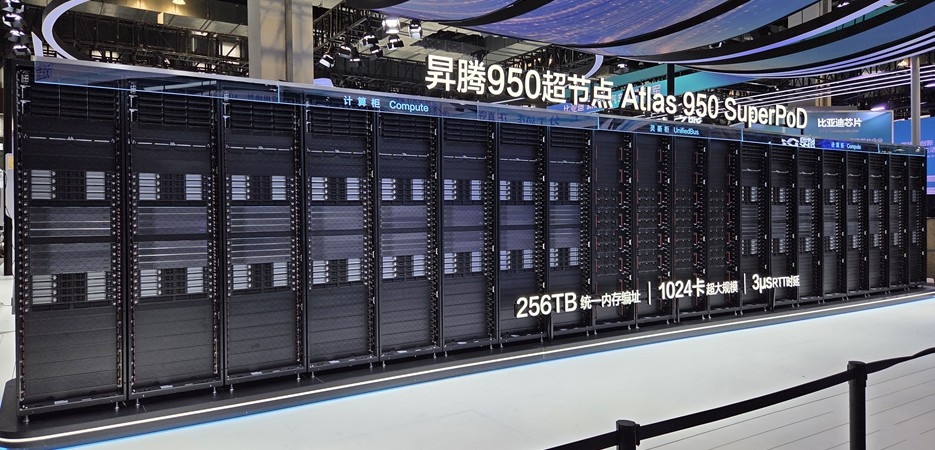
A SuperNode is a technology that links thousands of AI chips into a single compute pool using high-speed interconnect technology. The Atlas 950 integrates up to 8,192 Neural Processing Units (NPUs) to achieve 1 exaflop of computing power. According to Huawei, this system boasts 6.7 times the computing power and 15 times the memory capacity compared to next-generation Nvidia products.
Crucially, Huawei acknowledges this strategy itself.
Xu Zhijun, Huawei’s rotating chairman, stated, “We may be behind (the US) in terms of individual chips, but we can continuously provide sufficient computing resources for the Chinese AI industry through SuperNode and computing cluster technology.”
-> In a situation where it is difficult to obtain cutting-edge individual chips due to US semiconductor export controls, they intend to close the gap through system design that links them, rather than relying on individual performance. Huatai Securities even called this year the ‘first year of Chinese SuperNodes’.
This trend isn’t just Huawei’s alone.
Huawei showcased the ‘Taishan 950 SuperPoD’, a general-purpose computing cluster, alongside the Atlas 950 SuperPoD, and has already taken them to the MWC stage in Barcelona to target the international market.
Even if they fall behind in the competition of individual chips, their strategy of winning through system engineering that tightly weaves them together is extending beyond the domestic market to the international stage. In fact, both the Atlas 950 and Taishan 950 were first introduced in China last September before moving to the international stage.
Linking 100,000 Chips: Sugon 8000
It’s not just Huawei.
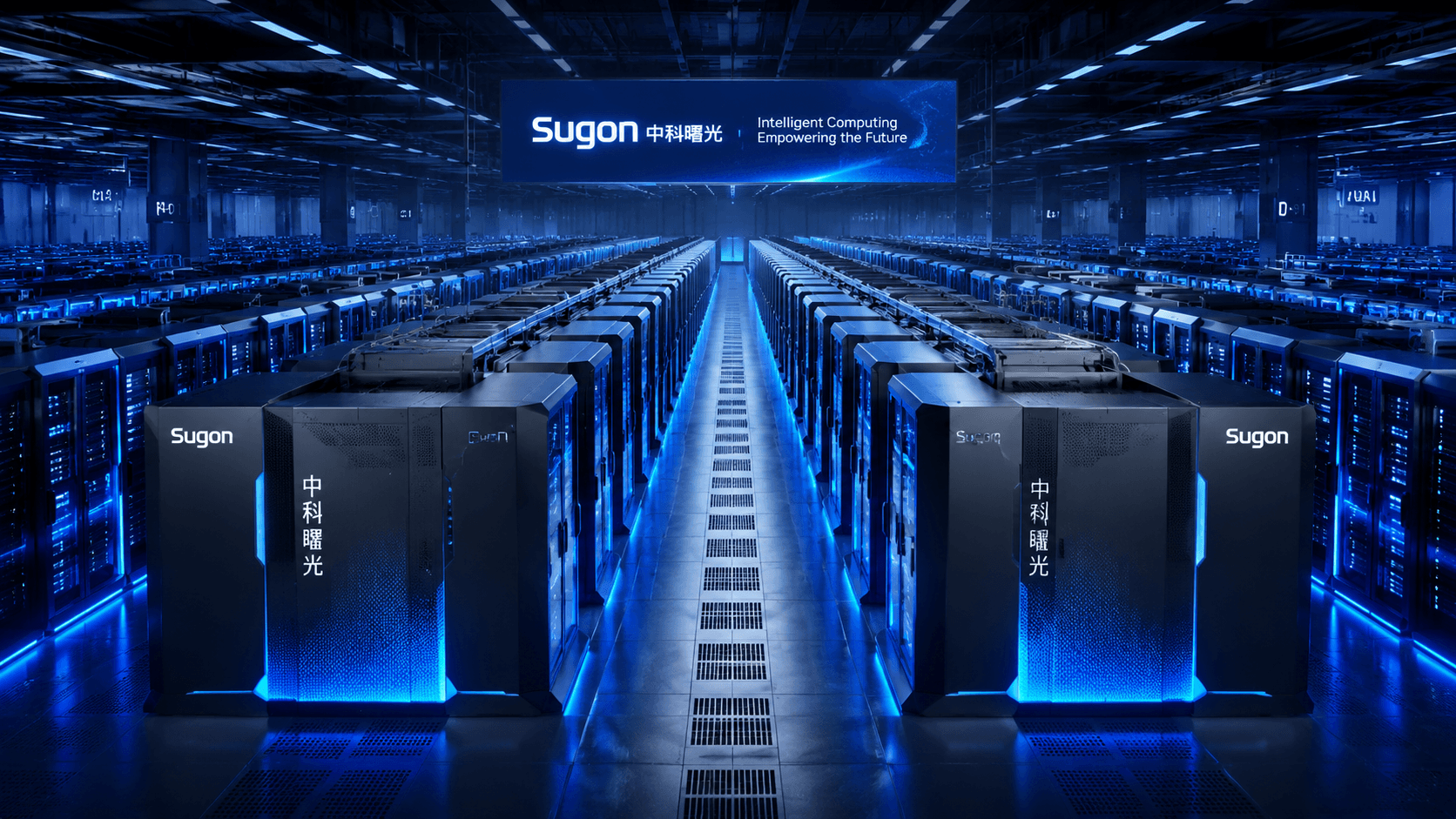
The ‘Sugon 8000 (Dengfeng)’, developed by Chinese IT firm Sugon, is a fully localized AI super-cluster with a scale of 100,000 chips. It was selected as the ‘Zhenguanzhibao’ (the signature exhibit) at WAIC 2026.
With Chinese-designed components applied to everything from chips and computing systems to storage and networking, it is used not only for training and inference of 1-trillion parameter AI models but also for scientific research such as climate simulation, bio-pharmaceuticals, and industrial simulation. Reports suggest it was already fully loaded in its first week of operation.
Sugon 8000’s technical bragging point is density.
They claim the computing density of a single unit is 20 times higher than other supernodes, meaning they have packed more computing power into a smaller space.
It links 100,000 chips stably using proprietary high-speed interconnect technology and employs immersion liquid cooling to withstand megawatt-level high-power deployment per cabinet. Data from the early stages of operation shows the daily average number of processed tasks exceeds 150,000, with a maximum daily throughput of over 500,000. It is not just a display piece, but infrastructure that is actually running.
Recalling that the weights of models like Kimi K3 reach 1.4 terabytes and require over 64 accelerators for self-hosting, it is easy to understand why China is pouring so much effort into SuperNodes.
No matter how good a model you release for free, if you don’t have the domestic infrastructure to run it, you remain dependent on Nvidia chips.
Release models for free, localize the infrastructure: these are the two pillars of China’s current AI strategy.
It is a contrasting approach: opening up software to encourage diffusion, while closing off hardware to protect it.
The Low-Altitude Economy and Human-Car-Home: Where Agents Become Tangible
So, where are these models and infrastructure used?
The answer appears simultaneously in the sky and in the living room.
The ’low-altitude economy’ (the drone, eVTOL, and urban air mobility industry utilizing airspace below 1,000 meters) that China is fostering reached a market size of approximately 1.5 trillion yuan (about 285 trillion KRW) as of 2025, and Shanghai has already designated 46% of its administrative district as a drone free-flight zone. For drones to judge routes and process logistics autonomously, they need the support of the AI models and computing infrastructure we have seen so far.
The background of pushing the low-altitude economy is also worth noting.
With the electric vehicle and solar energy industries now on a stable trajectory, China has marked drones, eVTOLs, and low-altitude logistics as its next growth engine. China accounts for 70% and 50% of the global consumer and industrial drone markets, respectively. The Chinese authorities believe the spillover effect is significant, as it can be linked to logistics, tourism, emergency medicine, agriculture, and public services beyond manufacturing. In Shanghai alone, there are 220,000 registered drones and 800 operating companies.
For the living room, there is Xiaomi.
Xiaomi is promoting the ‘Human-Car-Home’ (Ren-Che-Jia) ecosystem strategy, which bundles smartphones, electric vehicles, and home appliances into one.
Using its proprietary OS, HyperOS, and the on-device AI assistant ‘Super Xiaoai’, the system understands the user’s location, time, and weather to adjust lighting and air conditioning in advance.
The electric vehicles and smartphones produced by the Yizhuang and Changping dark factories mentioned in Part 2 are bundled into a single AI within this ‘Human-Car-Home’ ecosystem. It is said that over 175 million people worldwide are already within this ecosystem.
Xiaomi’s ambition does not stop there.
The number of connected AIoT platform devices, excluding smartphones and laptops, has surpassed 1.1 billion, and by releasing its own large language model series ‘MiMo’ as open source, it is binding its models, OS, and semiconductors into a single technological foundation.
They even announced separate hand-control technology for their self-developed humanoid robot ‘CyberOne’, having recruited talent from the former Tesla Optimus development team. A company that started as a smartphone maker is now attempting to weave cars, homes, and robots together with a single AI.
It was fascinating to see the same company that was building dark factories in Part 2, by Part 3, re-bundling the products from those factories into a single AI ecosystem.
The Era of ‘1 Person, 1 Agent’: What Does It Really Mean?
‘1 person, 1 agent’ is a phrase heard everywhere these days.
It means an era where one person uses multiple personal assistant-type AI agents simultaneously. When you piece together what we have explored so far, it becomes clear why this slogan has emerged: frontier-level models released for free (Kimi K3, Qwen 3.8-Max), harnesses that give those models hands and feet (DeepSeek), domestic SuperNodes to run them (Atlas 950, Sugon 8000), and the actual sites where these results are applied (low-altitude economy, Human-Car-Home)—all these pieces are interlocking to put an agent into everyone’s hands.
What is particularly impressive about this flow is the speed.
Kimi K3 was released on July 16, and its weights were released just 11 days later; Qwen 3.8-Max appeared a week after that.
Huawei’s Atlas 950 and Sugon’s 100,000-chip cluster also revealed themselves physically at the same WAIC event.
I got the impression that models and infrastructure didn’t develop separately and then merge at some point, but have been moving at the same speed like a single team from the beginning.
The fact that such a density of announcements poured out within a few months feels like a signal of how urgently this competition is moving.
In Part 1, we saw the government pouring money into semiconductors, AI, and robots.
In Part 2, we saw that money manifesting as robots on the factory floor.
What we saw in Part 3 is how the brains that give those robots judgment are being created, released for free, and operated.
These brains all had fast execution speeds, broad release scopes, and the infrastructure to run them was being equipped within the same country. In the next part, I plan to look into another pillar of this infrastructure competition: the more covert realm of quantum security.
References
- Moonshot AI (China) switches Kimi K3 to public weight download [Global AI Briefing]
- China's open model 'Kimi K3' enters Frontier AI... A major shift in the token economy
- Doesn't fit on 8 H200s: 2.8T parameter open model Kimi K3
- Alibaba unveils 'Qwen 3.8-Max'... Head-to-head with Kimi K3
- [AI Now] "1/105th the price"... DeepSeek shakes up the AI agent market with Harness
- DeepSeek launches AI coding tool team targeting 'Claude Code'
- Chinese companies promote SuperNodes linking thousands of AI chips... "A new leap" (Summary)
- Huawei, the vanguard of US-China competition, unveils Atlas 950, linking thousands of AI chips, for the first time
- China launches '100,000 AI accelerator' super-cluster
- Drones, flying cars, helicopters... China boosts 'low-altitude economy'
- Xiaomi's first IFA appearance... Unveils 'Human-Car-Home' AI ecosystem with over 380 products
- Connecting 380 products into one via AI... Xiaomi links smartphones, cars, and homes