
At this very moment, some of the encrypted data traveling across the internet may already be secretly copied and stored on servers by someone. It doesn’t matter if they can’t decrypt it now. The calculation is that once quantum computers are commercialized in about 10 years, they can simply decrypt it all at once.
This is called a ‘harvest now, decrypt later’ attack. Information that retains its value for a long time, such as payment data, is the most vulnerable target.
China appears to be the first country to react most significantly to this threat.
The new economic assets explored in parts 1–3—namely AI models, robotic factories, and data generated by supernodes—are ultimately not free from this threat.
Ciphers That Don’t Need Opening: One-Time Pad
The concept China has latched onto is the ‘One-Time Pad’ (OTP) encryption method. It uses a completely new random key for every message sent, which is then discarded after a single use. Theoretically, it is known to be unbreakable by even the most powerful computers. The problem has always been how to ‘share’ this key safely. If the key is intercepted while being transmitted, it becomes useless. This means that no matter how perfect the cipher is, it is futile if the key is leaked during the transfer process.
This is where Quantum Key Distribution (QKD) comes in. QKD transmits information via photons, the smallest units of light. If someone tries to secretly observe the transmission, the quantum state of the photons changes. This means the receiver can immediately detect that an eavesdropping attempt occurred. It is not a technology that encrypts data directly, but rather a technology that distributes encryption keys in a way that makes them impossible to steal without notice.
To summarize: the One-Time Pad is the theory of a ‘perfect cipher that you use once and discard,’ and QKD is the actual technology that allows you to distribute the keys for that perfect cipher without anyone being able to intercept them. It is a structure that only works in practice when theory and technology are paired together.
A 10-Year Project Starting with Micius
In 2016, China launched ‘Micius’ (Mozi), the world’s first quantum communication experimental satellite.
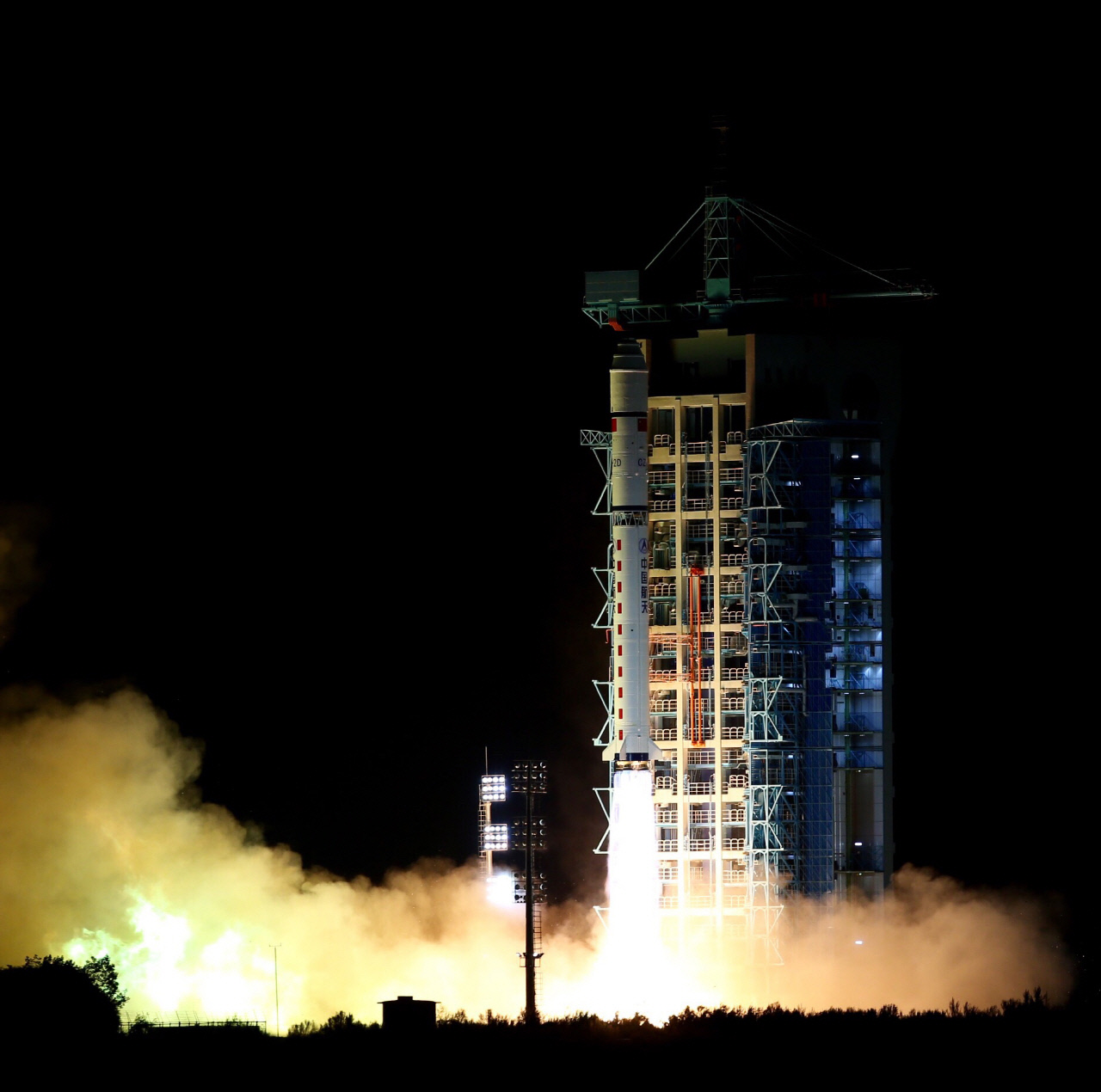
The following year, it completed a 2,000-kilometer quantum communication line connecting Beijing and Shanghai, which uses 32 ’trusted nodes’ as relay stations to re-generate and transmit keys for each segment.
Because photons are absorbed or scattered after traveling long distances through fiber optics, this structure was a necessary choice for long-distance communication. From the start, this line was used to connect government agencies and banks.
However, this trusted node structure has its weaknesses.
Each relay station must convert the quantum key into a standard (non-quantum) signal to pass it to the next segment, which critics point out theoretically leaves a possibility for someone to intercept data at these relay points. It is more of a practical compromise to overcome distance limitations rather than perfect security.
In 2018, using Micius, China successfully conducted intercontinental quantum encrypted communication between Beijing and Vienna, Austria, which is 7,600 kilometers away, exchanging 2 gigabytes of data during a 75-minute video conference. Researchers from the Chinese Academy of Sciences, the University of Science and Technology of China, and the Austrian Academy of Sciences participated in this experiment.
Recently, the technology has been evolving toward lowering costs. The ultra-small satellite ‘Jinan-1,’ unveiled last year, is 10 times lighter and 45 times cheaper than Micius. It successfully transmitted quantum encryption keys from Beijing to Stellenbosch University in South Africa. This confirmed that a single satellite could carry keys to the other side of the globe. Because the satellite method does not require passing through multiple trusted nodes, it is gaining attention as an alternative that addresses the weaknesses of fiber-optic-based lines.
One Step Ahead in Computing Speed: Zuchongzhi 3.0
It is not just in communication; progress has also been made in computation.
The 105-qubit superconducting quantum computer ‘Zuchongzhi 3.0,’ developed by the University of Science and Technology of China, is reported to be 1,000 trillion times faster than existing top-tier supercomputers in specific operations. This March, systems based on this chip moved out of the laboratory and into actual commercial service. It was jointly deployed by China Telecom Quantum Group and QuantumCTek, both based in Hefei.
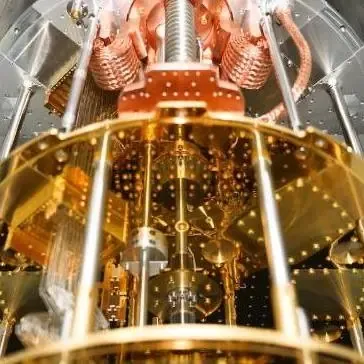
An interesting point here is that this announcement signals that communication infrastructure (QKD) and computing infrastructure (quantum computers) are simultaneously moving into the commercialization stage in the same country.
It is a scene where the technology to block eavesdropping and the technology that might break encryption in the future are maturing side-by-side. It is natural for the side holding both the spear and the shield to gain an advantage over time. Viewing it as a sequence of laying the shield (QKD) first and then growing the spear (quantum computer), it looks like a strategy of first protecting oneself before developing the power to pierce the opponent’s defenses.
The Quantum Signal from Shanghai
A recent case in Shanghai shows how this infrastructure is actually being used.
In September, the Shanghai Financial Regulatory Bureau announced measures to improve the efficiency of tech finance in the banking and insurance industries, explicitly mentioning quantum computing as an area for utilizing advanced computational technology. It is a structured approach that divides roles: blockchain for data sharing and transaction record management, IoT for on-site information collection, and quantum computing for financial tasks requiring complex calculations.
While this is not a measure allowing the trading of specific cryptocurrencies and is still in the pilot stage, the fact that financial authorities mentioned quantum computing in an official document is significant.
This is because financial data that maintains its value over a long period, such as payment data or account information, is the primary target for ‘harvest now, decrypt later’ attacks. The underlying reasoning is that if a way to protect this data is not established now, it could cost much more in a few years.
It is also worth noting the timing of this announcement. The fact that quantum computing was mentioned alongside blockchain and IoT suggests that Chinese financial authorities are already treating this technology not as a ‘future technology to be used someday,’ but as ‘infrastructure that needs to be assigned a role right now.’
Why is China Rushing Quantum Security Now?
In part 1, we saw the government pouring funding into New Quality Productive Forces,
In part 2, we saw the results appear in factory robots,
And in part 3, we saw them manifest in AI models and supernodes.
The quantum infrastructure seen in part 4 is essentially the security layer that underlies all of this. The final puzzle piece that runs through this entire series is that no matter how good your AI models and robotic factories are, it is meaningless if the data powering them is completely compromised at some point in the future.
Given that China has been consistently investing in this field for nearly 10 years, from Micius to Jinan-1, Zuchongzhi 3.0, and the Shanghai financial pilot programs, this seems like a long-term investment rather than chasing a trend. They are betting on ensuring that the data moving today remains safe even 10 years from now, rather than focusing solely on immediate results.
The picture seen through the first four parts of this series eventually connects into one.
The government provided the funding (Part 1), that money appeared as robots in factories (Part 2), then as AI models and supernodes (Part 3), and they are even laying down the security layer (Part 4) to keep all of this safe for a long time in advance.
In the next part, we will take a look at the other side of this flashy growth—the shadows of the Chinese economy, such as balance sheet recessions and youth unemployment.
References
- 'Dream Communication' That Can't Be Hacked… China Succeeds in Intercontinental Quantum Communication
- China’s 2,000-km Quantum Link Is Almost Complete
- China Records 13,000km Quantum Communication with Ultra-small Satellite
- China Unveils 105-Qubit Quantum Computer 'Zuchongzhi 3.0'… 1 Trillion Times Faster Than Supercomputers
- "China Has Done It"… Developed Quantum Computer '1,000 Trillion Times' Faster Than Supercomputers
- Shanghai Expands Financial Use of Blockchain and Quantum Computing
- Applying Post-Quantum Cryptography to Prepare for the Quantum Computer Era: Why Implement It 10 Years Early?