
From parts 1 to 4, we followed how New Productive Forces policies move money, and how that capital manifests in dark factories, AI models, and quantum security networks. It was a story of splendor.
This episode covers the exact opposite side of that story. If you break down the numbers of the Chinese economy during the same period, you see a picture entirely different from the dazzling growth of the new economy.
Keywords like New Productive Forces, dark factories, open-weight AI, and quantum security covered in this series so far have all been about the bright side. However, when looking beyond policy documents and news headlines at actual statistics, numbers with vastly different temperatures appear within the same country.
In this episode, I intend to examine those opposing numbers one by one.
The Real Report Card Told by Total Factor Productivity
A representative indicator of how efficiently an economy is running is Total Factor Productivity (TFP).
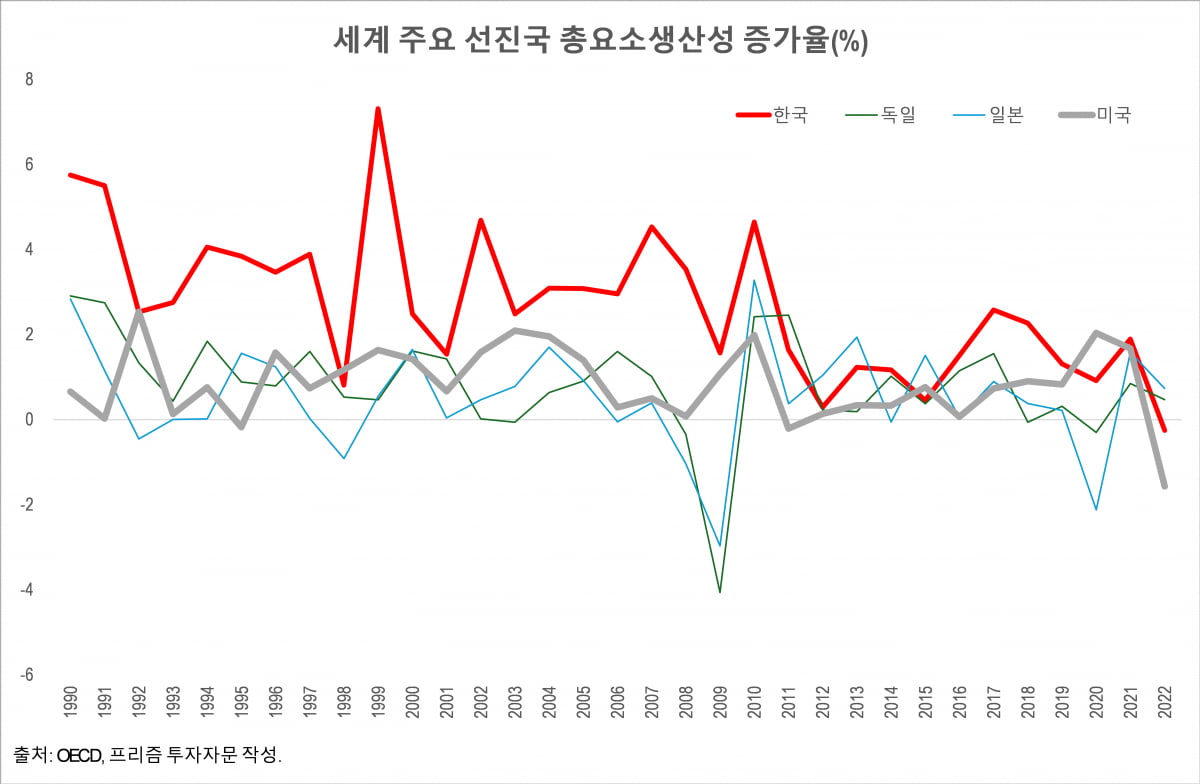
This figure represents how much more is produced purely through technological innovation or efficiency improvements without additional inputs of labor and capital. China’s average annual TFP growth rate has continuously fallen from the 4% range in the 2000s to 2.3% in the 2010s, and to 1.7% between 2020 and 2023.
According to a presentation by an expert who has analyzed the Chinese economy using the same model for 30 years at the Korea Institute for International Economic Policy (KIEP), the potential growth rate during the 15th Five-Year Plan period is estimated at about 4.7%, following a path that drops by 0.1 percentage points each year.
The contribution of TFP to growth is now hovering at just a little over 2 percent.
Two factors overlap in the background of the declining potential growth rate.
One is population. As the population ages rapidly, the working-age population itself is shrinking.
The other is TFP, and the common diagnosis of various research institutions is that this indicator, which has been falling continuously since 2008, shows no signs of recovery.
This means that one of the two engines of growth (population) has already broken down, and the other (productivity) is also faltering.
A research report points to structural problems such as the urban-rural divide, a mismatch in the supply and demand of science and engineering talent, and the burden of social spending due to rapid aging. The strange situation where youth unemployment and a shortage of talent in high-tech industries occur simultaneously is one facet of this mismatch.
It was interesting to note that there is a separate reason why these numbers are so painful.
Some analyses point out that the growth of China’s high-tech industry is not the result of efficiency improvements, but rather the result of capital that lost its place in existing industries flocking to new ones.
It means that instead of developing new technologies to produce more with the same resources, money that exited real estate or traditional manufacturing simply flocked to industries with fancy names like semiconductors, AI, and robots.
It is in this same context that Morgan Stanley recently pointed to the proliferation of over 140 robot companies in China and warned of out-of-control overproduction. In a sense, these shadows were already mixed into the spectacular robot boom we saw in part 2.
It also means that being a “new industry” does not automatically guarantee that capital will be used efficiently.
Balance Sheet Recession, Richard Koo’s Warning
Richard Koo, Chief Economist at the Nomura Research Institute, who became famous for analyzing Japan’s long-term stagnation in the 1990s with the concept of a ‘balance sheet recession’(a phenomenon where the overall demand of an economy shrinks for a long period as companies and households prioritize debt repayment over investment and consumption after asset prices collapse), has recently brought this term back up in relation to China.
He pointed out, “Given the difficulties Chinese companies are facing, the 5% growth rate figure is overly optimistic,” noting that while it might be correct from a production perspective, consumption and spending are insufficient.
What was particularly notable was the policy prescription.
Economist Koo said, “Even if the government cuts taxes or provides cash, that money mostly goes to debt repayment rather than consumption or investment,” arguing that tax cuts are also not an appropriate policy. Instead, his prescription is that the government should directly execute any project as long as its social rate of return is higher than the government bond yield (about 1.7%). The logic is that such projects can recover their costs on their own, are sustainable, and do not remain a burden on taxpayers.
However, not all experts agree with this diagnosis.
Some counter that it is too early to conclude that the entire Chinese corporate sector has entered a long-term deleveraging phase.
There is criticism that the ’three red lines’ regulation for real estate developers introduced since 2021 and the tight management of commercial bank loans were too strict, so it should also be noted that the Chinese government has recently started adjusting to relax these regulations.
Plans are also being discussed for local governments to purchase unsold commercial housing using a cost-plus method and convert them into low-income rental housing or public rental housing. The explanation is that this can clear inventory while simultaneously resolving the housing demand of migrant workers and young people entering cities.
According to one survey, about 70 percent of Chinese household assets are concentrated in real estate.
This means that a decline in housing prices leads directly to a decrease in household assets, which in turn leads to a vicious cycle of shrinking consumer sentiment.
Household debt also reached 63.5 percent of GDP as of the end of 2023, nearly double what it was 10 years ago, with mortgage loans accounting for over 70 percent of this. It is a structure where household financial stability is immediately shaken if housing prices falter. There are also diagnoses that the real estate crisis, which began in earnest after the Evergrande Group incident in 2021, continues to spread across the entire real estate-related industry, which accounts for 25–30 percent of GDP.
Neijuan, Cannibalistic Competition
A term frequently seen in Chinese economic news lately is ‘Neijuan’ (内卷).
Originally a term used in anthropology and sociology, it is now used to refer to a phenomenon where companies engage in cutthroat competition, lowering prices to the point where they cannot make a profit.
China’s Producer Price Index (PPI) has recorded negative year-on-year growth for over 35 consecutive months since October 2022.
In the first quarter of 2025, the national industrial capacity utilization rate fell to 74.1 percent, back to 2015 levels.
The situation with the Consumer Price Index (CPI) is similar; the annual inflation rate as of May 2026 stood at only 1.2 percent and has remained at a moderate level since. This means that while goods continue to pour out, there are not enough people to buy them, effectively cementing chronic oversupply and weak demand simultaneously.
This is particularly severe in core industries such as steel, solar power, and electric vehicle batteries.
Looking at the solar industry alone, China holds an overwhelming position, producing 93 percent of the world’s polysilicon, 97 percent of wafers, and 92 percent of solar cells. Yet, within the industry, price competition and deteriorating profitability have led major companies like Jinko Solar, Trina Solar, and JA Solar to cut their workforce by over 30 percent in 2024, and over 40 small and medium-sized solar companies have gone bankrupt or exited the market.
This is not the first time the solar industry has undergone restructuring.
Between 2009 and 2010, Chinese companies rapidly expanded production capacity with massive debt to meet rising demand in Europe and the US. Then, as the Eurozone crisis in 2011 reduced European subsidies and anti-dumping investigations from the US and EU followed, major companies went bankrupt one after another in 2013. In a sense, an entire industry went through a cycle of boom and bankruptcy, was revived by government support to reach world No. 1, and is now stuck in the same bottleneck again. Subsequently, the government increased domestic installation targets and poured in policy support to reorganize the industry, and the result is the current overwhelming global market share. The problem is that the production capacity created in that process has once again swelled to a level that far exceeds global demand.
Against this backdrop, the Chinese government has been pushing for restructuring since the second half of last year under ‘Anti-Neijuan’ policies.
An integrated acquisition platform for polysilicon raw materials was created, leading some to call it the birth of the ‘Solar OPEC’. Major companies such as Tongwei, GCL Tech, Daqo, and Xinte are reported to have participated in this platform with equity.
The fact that the title of the document containing this policy direction was ‘Deeply Recognize and Comprehensively Rectify Neijuan-style Competition’ speaks volumes about the severity of the situation. It means that the problem of low-price competition has risen to an agenda that must be addressed at the party level, to the point where such a title appeared in a Communist Party theoretical journal.
Youth Unemployment, Why the Numbers Disappeared
China’s youth unemployment rate (ages 16–24) soared to 21.3 percent in June 2023. Consequently, the National Bureau of Statistics of China abruptly stopped announcing the youth unemployment rate starting in August of that year.
Even after resuming the announcement, they changed the counting method, such as excluding students, and as of June 2026, it recorded 14.9 percent. This is a slight improvement from the previous month’s 15.6 percent and is reportedly the lowest level in 12 months.
Local media explains that the improvement trend that continued after last September reversed once in March this year but has improved for three consecutive months since.
Despite the announcement that the numbers are improving, it still means that one in seven young people cannot find a job. The fact that the statistics themselves were suspended was also a problem. Regarding the reason for deciding not to announce the statistics, a spokesperson for the National Bureau of Statistics explained, “There is a need to further optimize labor statistics due to economic and social development,” but suspicions grew in the market that they were hiding them because the performance was poor.
The Wall Street Journal also pointed out that such concealment of statistics actually lowers market transparency and trust.
During this period, neologisms became popular among Chinese youth, such as ‘Tangping’ (躺平), which means ’lying flat and doing nothing,’ and ‘Bailan’ (摆烂), which means giving up in the face of worsening situations.
It is said that an increasing number of young people are mocking themselves, comparing their refusal to look at low-wage jobs despite being highly educated college graduates to ‘Kong Yiji,’ a failed scholar in a novel by Lu Xun.
There was also a cynical reaction to the government’s campaign, involving celebrities, telling ‘Youth, become farmers,’ with people comparing it to the ‘Down to the Countryside Movement’ during the Cultural Revolution, which forcibly sent intellectuals and students to rural areas.

In a sense, the flashy slogans of the ‘one agent per person’ era we saw in part 3 and the self-mocking youth who cannot find jobs are coexisting in the same country at the same time.
Hukou System, The Structural Reason Consumption Doesn’t Rise
China still retains the Hukou (household registration) system, which restricts the freedom of movement to a significant extent.
Since the Hukou Registration Regulations were enacted in 1958, a structure has been maintained where even if a person with a rural Hukou goes to a city to work, if they cannot obtain the Hukou of that city, they are discriminated against in public services such as education, healthcare, and housing.
During the planned economy era, rural areas took on the role of supporting cities, and as this population movement control continued for a long time, the separation between urban and rural areas became solidified.
Several relaxation measures have been introduced since the Reform and Opening-up.
In 2014, the State Council introduced a reform plan to effectively abolish the Hukou registration system in cities other than super-large cities with over 5 million people, and allow migrant workers to apply for a residence permit to receive basic public services after living there for more than six months.
However, the threshold for obtaining a Hukou remains high in super-large cities like Beijing and Shanghai, which have the highest influx of migrant workers.
A recent study explains this with the concept of ‘selective citizenship,’ meaning that the larger the city, the more it accepts migrant workers as low-wage labor while rarely granting them full citizenship.
The analysis is that if the Hu Jintao era protected labor rights partially while limiting the granting of citizenship, the Xi Jinping era has been reorganized into a selective citizenship system centered on a point-based system.
This structure is directly linked to the consumption problem.
Since the 300 million migrant workers working in cities cannot rely on the city’s social safety net for their children’s education, old age, or medical care, they have no choice but to save the money they earn to prepare for themselves rather than spend it. Even the problem of ‘second-generation migrant workers,’ whose children who moved to the city inherit their parents’ rural Hukou, is overlapping.
While it is a slightly different nuance from households focusing on debt repayment instead of consumption in a balance sheet recession, it points in the same direction in that it creates a structure where ’they don’t spend even if they earn.’
It means that no matter how much the urbanization rate is increased, if that urbanization does not lead to full citizenship, the effect of boosting domestic demand is bound to be halved.
EUV Lithography, Filling the Bottleneck with Substitutes
Extreme Ultraviolet (EUV) lithography equipment, considered a core bottleneck technology in semiconductor manufacturing, is virtually exclusively supplied by ASML of the Netherlands.
EUV is considered essential for implementing ultra-fine processes of 7 nanometers or less, and the US has pressured the Dutch government since 2019, during the first Trump administration, to completely block ASML’s EUV exports to China. As a result, China is bypassing the limits by combining multi-patterning technology with existing Deep Ultraviolet (DUV) equipment.
KIEP estimates that China’s DUV equipment technology is about 3–5 years behind global leaders, and about 15 years behind in EUV independent development.
Industry insiders’ assessments are cautious.
They point out that while one can respond to some extent up to the 1a level with their own DUV equipment and multi-patterning technology, as generations progress, it will likely be difficult to secure yields if implementing fine processes without EUV, leading to a loss of competitiveness. The fact that the price of one EUV unit exceeds $200 million, while immersion DUV is around $90 million, is a number that also shows the gap.
Still, there is clear progress.
At the end of July, when news broke that Shanghai-based state-owned enterprise SMEE had begun mass production of its own immersion DUV lithography equipment, ASML’s stock price plummeted for two consecutive days. They plan to produce 5 units this year and increase it to 20 by 2027, so while the scale is not yet large, there are forecasts that when combined with SMIC’s multi-patterning technology, it could support the production of some advanced semiconductors without EUV.
Reuters reported in December last year that China had even completed an EUV prototype at a high-security research facility in Shenzhen, which is said to have been made by reverse-engineering by former ASML engineers. The gap is still large, but the speed at which that gap is closing is worth noting.
How Do These Shadows Intertwine with New Productive Forces?
In part 1, this series already foreshadowed this structure under the name of K-shaped divergence.
The lower stroke of that graph, where the new economy heads up and the old economy heads down, is exactly what we covered in this episode. TFP decline, balance sheet recession warnings, Neijuan, youth unemployment, consumption shrinkage due to the Hukou system, and EUV bottlenecks—all of these are happening at the same time, within the same country, alongside spectacular new economy growth.
What is interesting is the government’s attitude.
While directly intervening and tidying up the problems of the old economy, such as the Anti-Neijuan policy, it is simultaneously putting its weight behind the new economy by mobilizing fiscal, bank loans, and capital markets.
It is a method of artificially shrinking the old economy while pouring resources into the new economy, and it is not yet known whether this reorganization will end smoothly or whether it will incur greater social costs in the process.
If we look at the numbers in this episode one by one, we can see that it is difficult to interpret any of them in isolation.
TFP decline is intertwined with population problems, balance sheet recession concerns overlap with real estate and household debt problems, youth unemployment is not unrelated to industrial restructuring, and consumption shrinkage due to the Hukou system leads to the result of sluggish domestic demand. Since all these threads are tangled together, it does not seem easy to solve everything with one policy prescription.
No matter how much the government pours fiscal resources into the new economy, if the tangled threads of the old economy are not untied, the K-shaped gap is likely to remain wide in terms of real-life experience even if it is mitigated in terms of numbers.
In the next episode, I plan to examine how all these flows connect to the international status of the yuan, or in other words, the financial hegemony strategy.
References
- Current Status of China's Macroeconomy and 2026 Outlook
- The Chinese Economy Trapped in the Illusion of Innovation
- Stop the Cannibalistic Competition… China's 'Anti-Neijuan' Drive in Solar and EV Industries
- China's June Youth Unemployment Rate at 14.9%, Lowest in a Year… "Improving for 3 Consecutive Months"
- Companies and Households Not Borrowing Money… China Falls into Japanese-style 'Balance Sheet Recession'
- Chinese Economy, Too Early to Conclude Balance Sheet Recession
- Can Make DRAM Even Without EUV… China Accelerating Equipment Self-Reliance
- Chinese State-Owned Enterprise Produces Own DUV Lithography Equipment… Cracking ASML's 'EUV Fortress'?
- China Begins Mass Production of Own DUV Lithography Equipment… Speeding Up Semiconductor Equipment Self-Reliance