
When the waters rise, West Asian myths put one person on a boat to escape. Yet, in the same era, stories from the Yellow River basin ask a completely different question. It is not the one who fled, but the one who passed his own door three times in 13 years without entering who becomes king. It is not the one who avoided the water who survives, but the one who mastered it.
This is not a simple difference in storytelling. When we hear “flood myth,” we naturally think of arks, survivors, and divine judgment; that is the specific sensibility left behind by West Asian and Mediterranean traditions. Many Asian flood myths answer an entirely different question: not who survives, but who has proven their qualification to rule the waters.
Gun Died, and Yu Became King
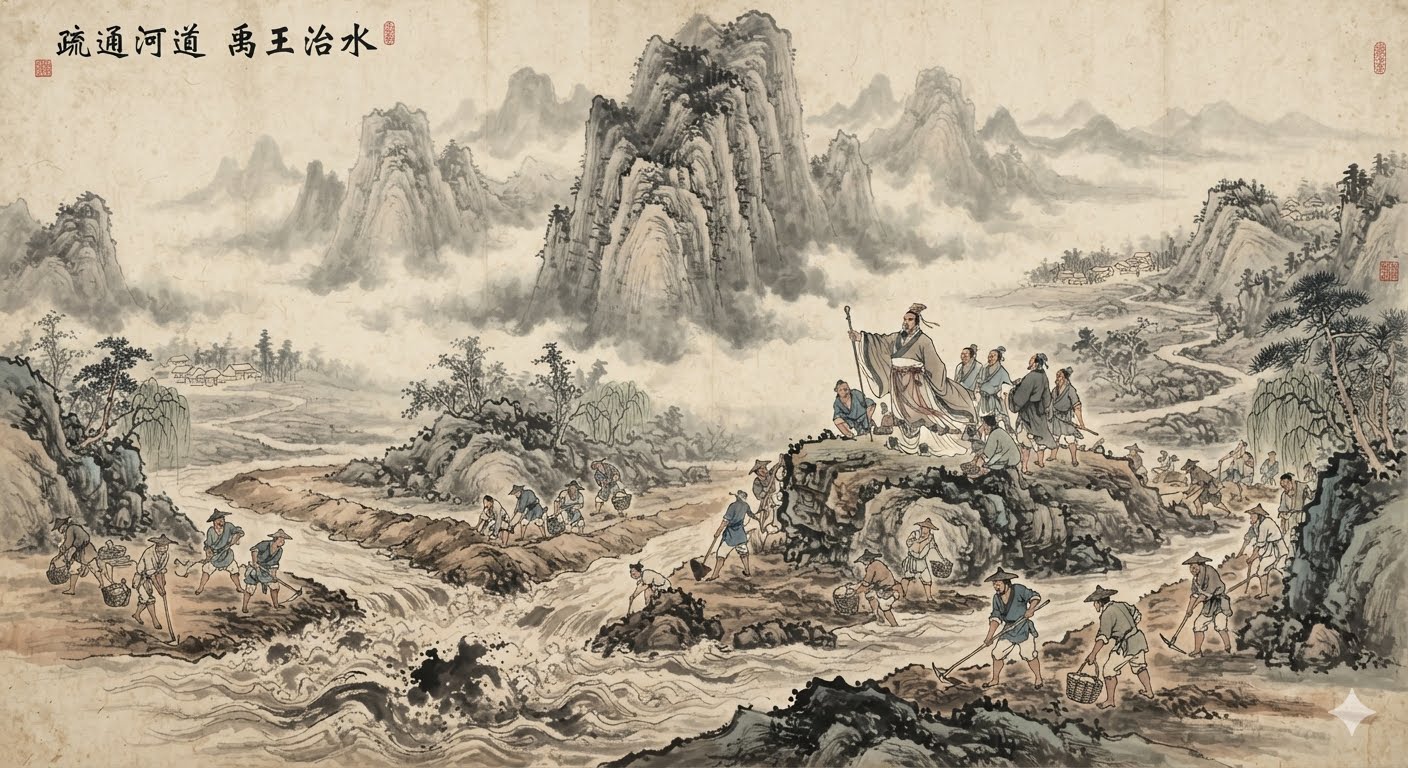
In the late 3rd millennium BCE, Chinese mythology recounts a catastrophic flood during the reign of Emperor Yao. Yao entrusted the task of flood control to a man named Gun. Gun chose to build dikes to block the water. According to the Classic of Mountains and Seas, he stole “breathing soil” (xirang)—a self-expanding earth cherished by the Heavenly Emperor—to build his barriers. He struggled for nearly nine years, but the water could not be tamed. In the end, he was executed, either for the crime of stealing from the heavens or for his failure to control the flood.
His successor, Emperor Shun, entrusted the same mission to Gun’s son, Yu. Yu’s method was the polar opposite of his father’s: instead of blocking, he channeled. He opened waterways to let the water flow, dividing it into nine great rivers to lead into the sea. Legend says that for 13 years, he wandered the sites and passed his own house three times, yet never once stepped inside. After successfully controlling the flood, he divided the world into nine provinces and established a tribute system. When Emperor Shun died, Yu, having gained the trust of the people, inherited the throne and founded the Xia Dynasty. From this point on, royal succession shifted from abdication to heredity.
In this myth, the flood is not a punishment, but a test. The gods are not trying to judge humanity; rather, natural disaster serves as a stage to verify the qualifications of a ruler. The one who tried to block the water died; the one who let it flow became king. Traditions also exist where Gun and Yu transform into fish or bears, reflecting the imagination that those who master water must share in its attributes.
How Disasters Create Dynasties
What makes this story interesting is not just the difference in subject matter. Political scientist Karl Wittfogel once proposed the theory that large-scale civil engineering projects, such as irrigation and flood control, give birth to powerful centralized states—the so-called ‘hydraulic society’ hypothesis. The logic is that organizing and controlling the massive labor force required to build dikes and open waterways necessitates a power structure, and those who hold that power become the rulers of the state. While this hypothesis has faced various counterarguments in academia, the narrative structure of the Gun-Yu flood myth follows this logic perfectly. The person who successfully organizes flood control infrastructure gains political legitimacy, and that legitimacy marks the beginning of a dynasty.
Even with the same disaster, geography changes how the story is reconstructed. The Euphrates was unpredictable and destructive, whereas the Yellow River, while prone to frequent flooding, was a river that could be managed through irrigation—its basin was wide and flat enough that new riverbeds could actually be carved out. Faced with a river they believed could be managed, people imagined shovels to carve paths rather than arks to escape.
A Life Gained in Exchange for Saving a Fish
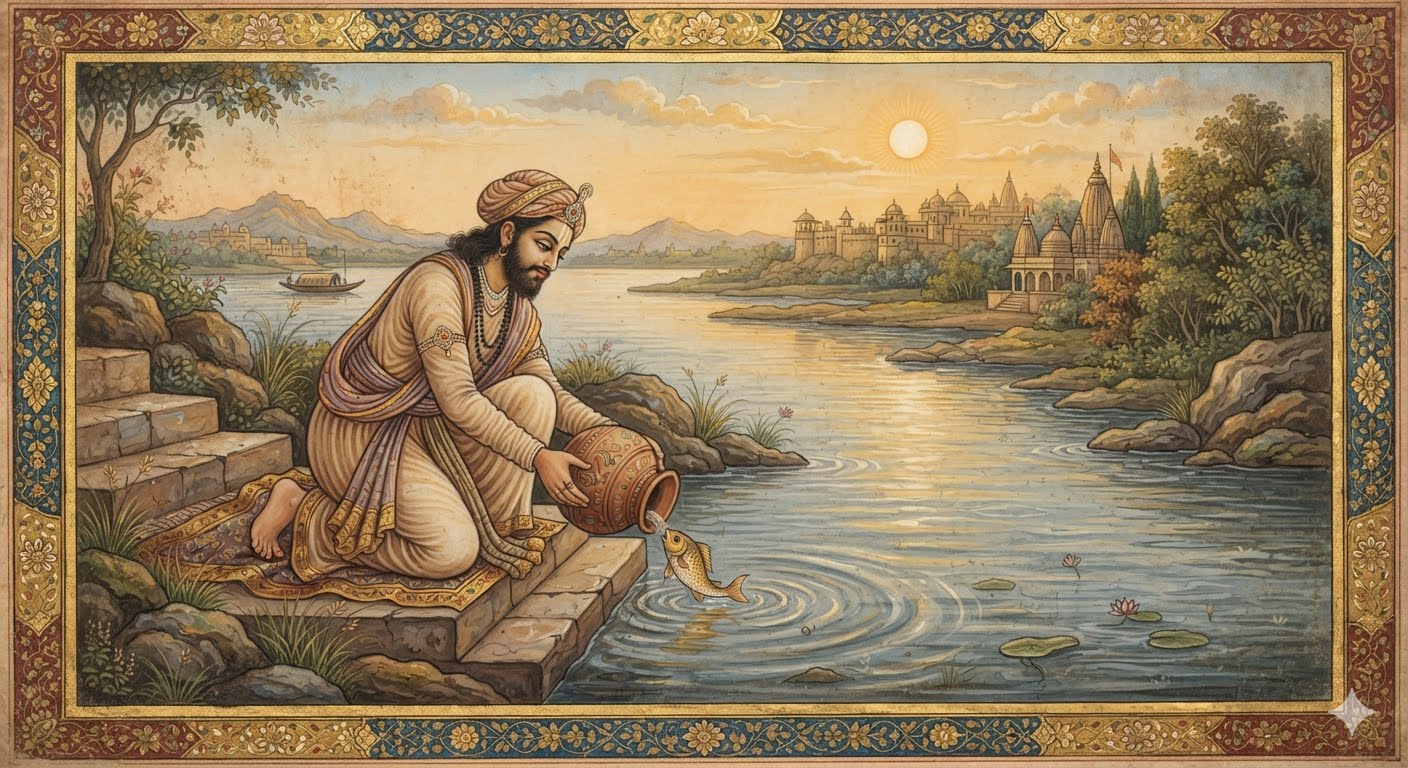
Indian stories show another angle. The story of Manu and Matsya is recorded in the Shatapatha Brahmana, a prose text of the Yajurveda, which scholars date to around the 6th century BCE. While Manu is drawing water to wash his hands, he finds a small fish. The fish begs to be saved, fearing it will be eaten by larger fish. Manu raises the fish in a jar. As it grows and the jar becomes too small, he moves it to a ditch, then to a river, and finally to the ocean.
In return, the fish warns Manu that a great flood is coming to swallow all life. Manu builds a ship, and when the flood begins, this fish—later identified in texts as Matsya, an avatar of Vishnu—ties the ship to its horn and pulls it to a mountaintop. After the waters recede, Manu remains as the sole human and becomes the progenitor of humanity.
The framework is similar to the West Asian version: warning, ship, survival, reconstruction. But there is a crucial difference. In West Asian myths, the survivor is chosen by God. Manu was not chosen; he paid a price. The act of caring for a small life came first, and that care was returned. The logic is closer to cause and effect than to judgment. It is not a story of God punishing human sin, but a story of one human’s good deed circulating and returning.
The Rainbow Serpent Created the World, Not an Ark
Australian Aboriginal mythology starts from a completely different question. For them, the beginning, the ‘Dreamtime,’ was a process of formless spirits gaining shape. One of the central beings is the Rainbow Serpent. Living at the bottom of rivers and lakes, this being governs water and rain; it is both a god who created the earth and a destructive force that sweeps through everything when angered.
Here, water is neither a tool for judgment nor a material for reconstruction. It is part of creation itself. While West Asian myths have a linear temporal structure where the world begins anew after a single catastrophe, the worldview of the Dreamtime is more like a continuum where the past, present, and future are connected. The waterways and terrain created by the Rainbow Serpent are still there, and the myth continues without end. The flood is not an ’event that happened in the past,’ but something that ‘still exists in the form of the land.’
This difference seems trivial but is profound. West Asian and East Asian myths share at least one premise: the flood is an event with a beginning and an end, and the world is reorganized after that event. The Aboriginal worldview sidesteps this premise entirely. Disaster does not pass; it is something carved into the landscape that continues to speak.
Why Didn’t the East Run Away?
Looking at the three myths side-by-side, a pattern emerges. In West Asia, nature was a divine realm beyond human control, and the only way to survive was to be chosen by God. For the people of the Yellow River basin, however, nature was a subject to be managed—if you failed to manage it, you died; if you succeeded, you became king. The Indian story sits somewhere in the middle: there is divine intervention, but it is human goodness that draws that intervention. And the Aboriginal worldview does not place the dichotomy of ‘management’ between humans and nature in the first place.
Whether the conclusion of a flood myth is the start of a dynasty, the reconstruction of humanity, or simply a part of the terrain—the answer to this question reveals how that civilization connects disaster and power.
This is why the myth of Gun and Yu is still discussed today. China’s flood control policies and its long-standing obsession with water management systems are often traced back to this myth. The logic that a failed flood controller loses power and a successful one gains it has survived as political rhetoric even after the dynasties changed many times.
The Belief in Control vs. The Belief in Lack Thereof
Ultimately, the question remains: what kind of stories do we choose in the face of disaster? Do we imagine an ark to escape, a shovel to carve a path, or do we accept that the water is a part of the world from the start? The three myths do not provide an answer. They only show how differently humans have negotiated with their own helplessness in the face of the same disaster.
As we now face a new form of ‘great flood’ called the climate crisis, what kind of ancient story framework are we unconsciously pulling out to use again?
References
- Wikipedia - Gun-Yu Flood Control
- Wikipedia - Manu
- Wikipedia - Matsya
- Wikipedia - Great Flood Myths
- Namuwiki - Great Flood Myths
- Namuwiki - Gun (Chinese Mythology)
- Namuwiki - Rainbow Serpent
- Kyeongin Ilbo - Great Yu's Flood Control
- JejuNuri - Remaking Nature, Great Yu's Flood Control
- Oral Literature Research - Ecological Philosophical Perception in Chinese 'Gun-Yu' Myths
- Opinion News - Great Flood During China's Xia Dynasty, Scientifically Proven
- Atlas News - Australian Mythology, Dreamtime Beyond Space and Time