
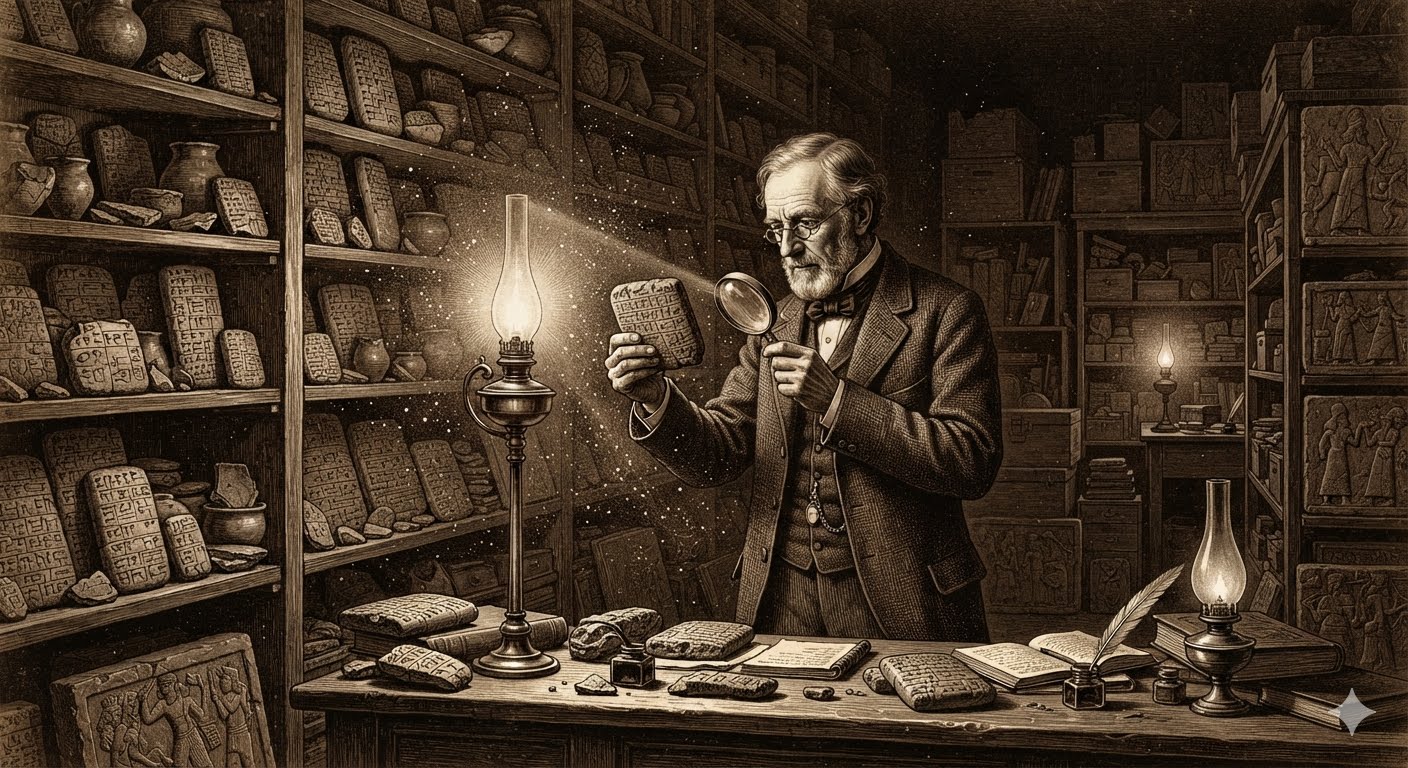
On December 3, 1872, at a lecture hall of the Society of Biblical Archaeology in London, a British Museum employee named George Smith stood at the podium and began to read from a fragment of a clay tablet he held in his hand. It was one of thousands of shards unearthed from the ruins of Nineveh. A divine command to build a boat, instructions on its width and length, orders to build a roof, and a request to load the seeds of all living things. The audience must have felt as if they were listening to Genesis chapter 6. However, this clay tablet was created long before Genesis.
Legend has it that Smith could not hide his excitement and began taking off his clothes right there on the spot. Whether that is true or an exaggeration, it is not hard to imagine the atmosphere in that lecture hall. The story we had been taught as the first revelation of humanity was, in fact, a continuation of a story someone had written down long before. And this was not a matter of faith, but a matter of philology.
The Illusion of an “Original”
Everyone remembers their first encounter with Noah’s Ark differently. It might have been in Sunday school or a picture book. The common thread is that most were taught it as the first flood story in human history. A story where God decides to punish fallen humanity, chooses one person to build an ark, and loads all the life in the world into it. But this structure—the divine decision, the chosen individual, the instructions for boat construction, the preservation of flora and fauna, and the scene of releasing birds to find land—was inscribed on Mesopotamian clay tablets long before the story of Noah was set down in writing.
This is not about questioning the authenticity of religion. It is about the realization that the sense of an “original” may itself be an illusion. Whether it is the Bible or a meme seen on social media this morning, the point we believe to be the first is usually just the point where we first encountered it. We cannot see how many layers of versions are stacked behind it.
Copying Was Editing, Not Creation
Scholars who have long studied Mesopotamian literature repeatedly point out one thing: scribes in this region valued collecting and stitching together old stories far more than creating new ones. Even within the Epic of Gilgamesh, the name of the flood hero is mixed up, appearing as Utnapishtim in one section and Atrahasis in another. The consensus is that this is evidence of an editor stitching together two different source texts without unifying the names.
This is surprisingly similar to modern software development. There is an original code, someone copies (forks) it, fixes a few lines to suit their needs (commits), and then someone else takes it and works on it again. Looking only at the final version, it is easy to be confused about who the original author is. The Mesopotamian flood story was the same. A story first told orally in Sumerian was edited as it was translated into Akkadian, passed through the hands of Hebrew biblical editors, and reassembled into a different framework in the Greek-speaking world. In an era without the concept of copyright, stories were no one’s property.
Five Versions, One Skeleton
Known as the oldest layer, the Ziusudra story is in Sumerian. When the god Enlil decides to bring a flood because he cannot stand the noise of humanity, only Ziusudra survives thanks to a tip-off from the god Enki. The storm sweeps the land for seven days and seven nights, and when the sun rises again, he bores a hole in the boat to look out. The story ends with a scene where he sacrifices animals to the gods.
The Atrahasis Epic, recorded in Akkadian, depicts the motive for the flood more explicitly. The gods do not want to punish humans for their sins, but for the noise. When the growing human population becomes too loud, the god Enlil becomes annoyed. Enki secretly warns Atrahasis, whom he favors, to build a boat and load it with his property and livestock. The clay tablet containing this epic dates back to the 18th century BCE—the oldest written record of a flood story verified by academia.
In the 11th tablet of the Epic of Gilgamesh, Utnapishtim tells the same story to Gilgamesh. The boat is built in a shape close to a cube, and the storm lasts for six days and seven nights. As the water begins to recede, Utnapishtim releases a dove, a swallow, and a raven in sequence. The dove and swallow return unable to find a place to land, but the raven does not return—signifying that the water has receded.
Almost the same scene appears in the Genesis story of Noah. A raven is sent out first, then a dove is released three times. On the second time, it returns with an olive leaf, and on the third, it does not return. While the order and details differ, the skeleton is the same. Today, many scholars suggest that the Noah story was not a direct copy of Mesopotamian mythology, but that a famine narrative originally unique to this region may have been combined with flood motifs during later editing. However, it is difficult to deny the fact that the Mesopotamian flood narrative was already widespread at the time of that combination.
There is also a Greek version: the story of Deucalion and Pyrrha. When Zeus, angry at human corruption, decides to send a flood, Prometheus tips off his son Deucalion to build an ark. After nine days and nights, the waters recede and the ark lands on Mount Parnassus. The couple, having received an oracle, throws stones behind their backs to create a new humanity. Plato mentioned this story in Timaeus around the 4th century BCE.
The Real Flood Left in the Mud
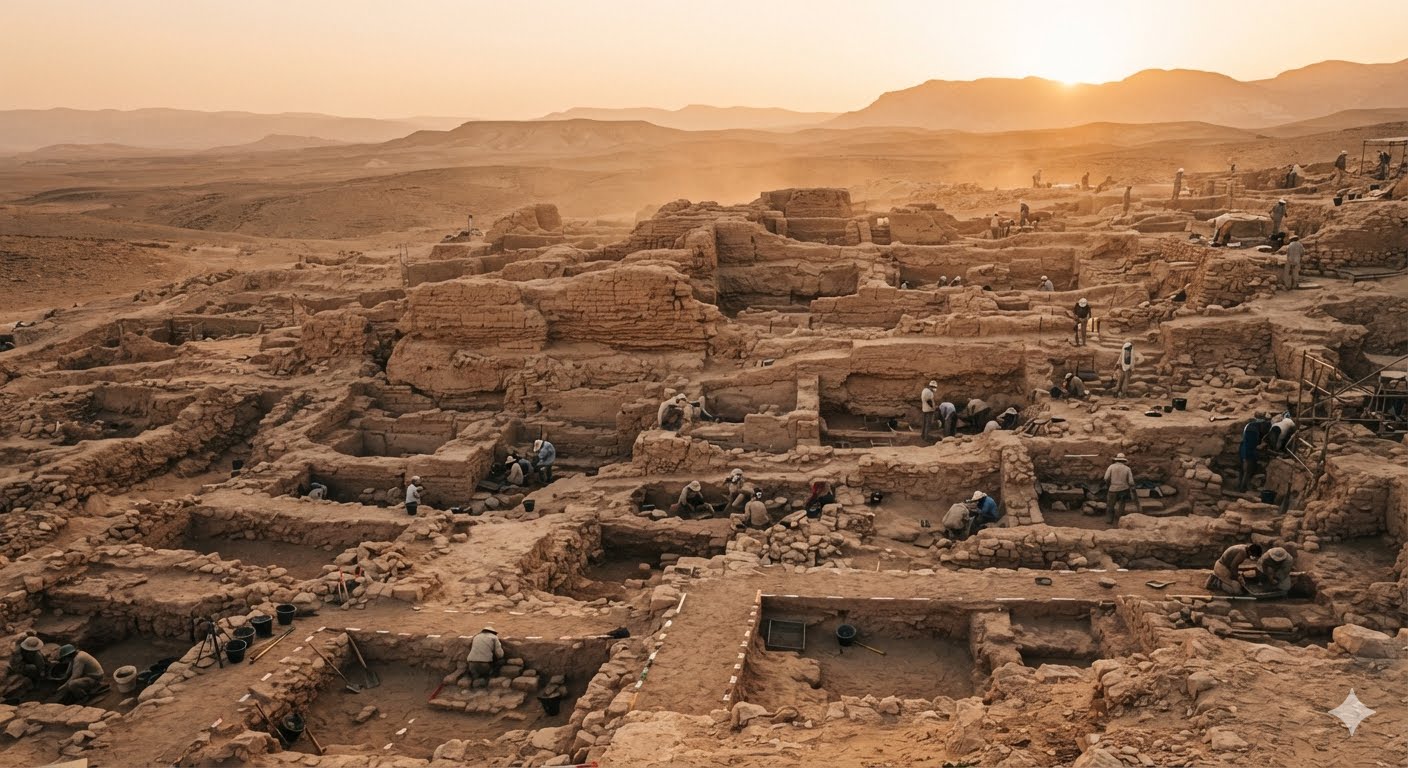
If we stop here, this ends as just a story of literary transmission. But the issue goes a bit deeper. In the early 20th century, archaeologist Leonard Woolley discovered a strange layer while excavating the Ur region in southern Iraq. It was a thick layer of mud sediment with no artifacts whatsoever. The thickness far exceeded the height of a person. Below and above it, there were traces of pottery and daily life from different eras. A deposit of such scale, which could only be created by a river, was wedged in as if it had interrupted the continuity of civilization.
Mesopotamia was different from the Nile. The flooding of the Nile was a predictable event that repeated every year and was even considered a blessing that brought fertile soil—which is why there are almost no flood stories in Egyptian mythology that destroy the world. On the other hand, the Tigris and Euphrates rivers would instantly overflow their banks when melting snow and heavy rain coincided. It was water that was unpredictable, destructive, and capable of erasing an entire city. To survive in this river basin, it was more natural to understand the water as divine judgment.
In other words, the real question is not “who copied whom,” but “why did the people of this region repeatedly tell stories of disaster in the same way?” The answer lies not in literature, but in geography. An unpredictable river, the feeling of helplessness in not being able to tame it, and people who needed a god to explain that helplessness. The story was rewritten over generations to fill that need.
The very act of looking for an “original” might have been a question that did not fit the logic of this region. To these people, a story was not the property of an author, but a tool that the community refined together to understand disaster.
What Smith Held in His Hand Was Not the Beginning
George Smith must have believed that he had discovered the first story of humanity in that lecture hall. But even the clay tablet he held was a fragment of a version that had already been edited over several generations. The versions before that have either turned back into mud or are still buried under the desert. Perhaps even at this moment, an older version than we ever knew is waiting for its next discovery under the dirt at some excavation site.
How many of the stories we encounter every day are the first version? Probably not many. If so, this sentence I am writing right now will also, at some point, remain as just another old version to someone else.
References
- Wikipedia - Epic of Gilgamesh
- Wikipedia - Flood myth
- Namuwiki - Epic of Gilgamesh
- Namuwiki - Gilgamesh
- Atlas News - Noah's Ark Combined with Mesopotamian Flood Myth
- Shinang Sinbo - On the Epic of Gilgamesh and the Bible
- Jo Cheol-su, 『Sumerian Mythology』, Seohaemunjip, 2003
- Andrew George (trans.), Gong Gyeong-hee (trans.), 『Epic of Gilgamesh』, Hyundai Jisung, 2021