
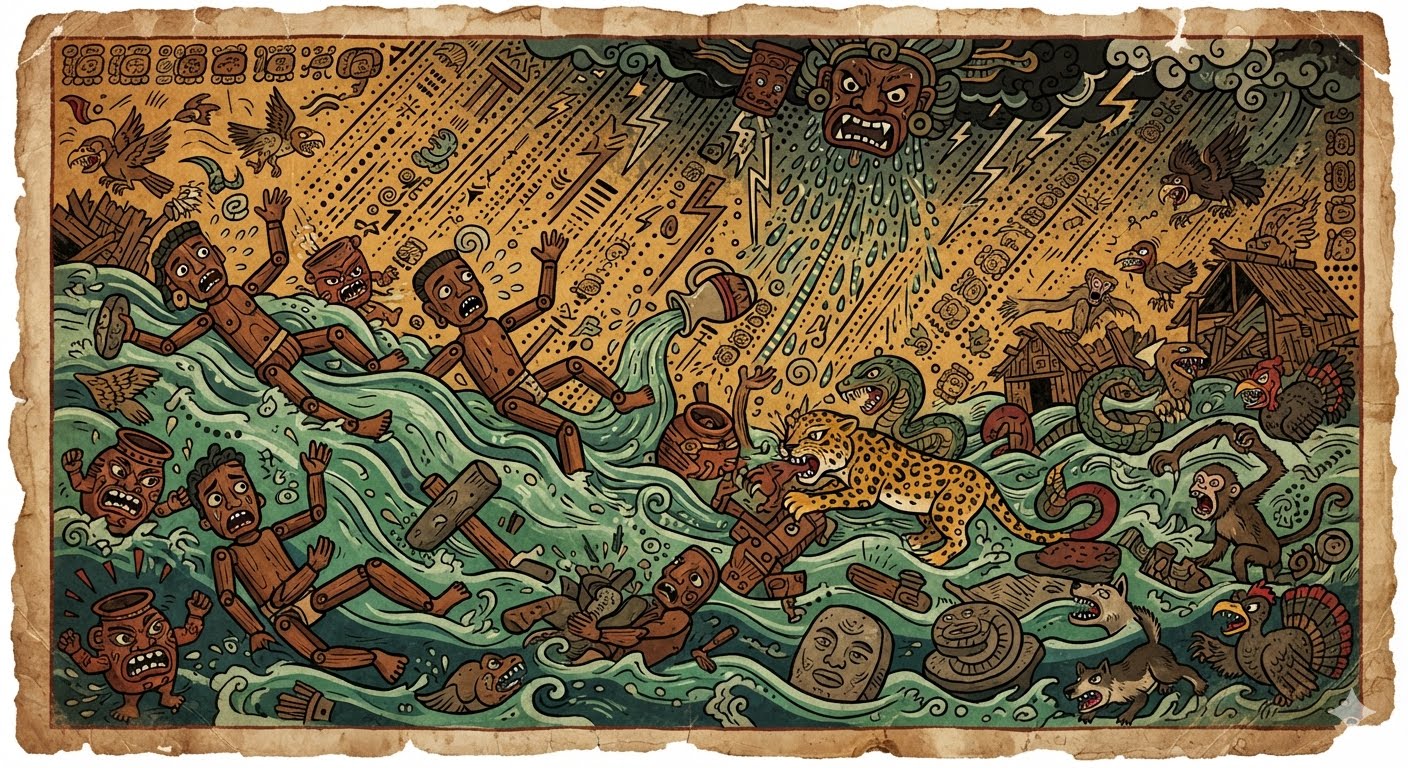
Somewhere in the highlands of Guatemala, the Kʼicheʼ people before the Spanish conquest believed that the world we live in is actually the gods’ third attempt. The first humans were molded from mud but crumbled easily. The second were carved from wood. They could walk and talk, but they had no emotions and could not remember their creator. The gods were disappointed. And so, they poured water from the sky to erase the wooden humans.
At first glance, this story feels similar to Genesis. It follows a structure where a disappointed god wipes out humanity with water. But look closer, and the texture is different. The biblical flood is a judgment for sin. The Mayan flood is a rework of a failed product. It isn’t that the god is angry, but rather that even the creator goes through trial and error.
What the Wooden Humans Witnessed
According to the Popol Vuh, the critical flaw of the wooden humans was their lack of memory and gratitude toward their creator. While their appearance was human, they were hollow inside. To eliminate them, the gods sent a rain of resin from the sky, and it is said that even the tools and animals the humans had mistreated rose up to attack them. A few survivors are said to have fled into the forest, becoming monkeys.
What stands out is the intensity of this flood. The biblical flood is an absolute catastrophe, described as rising “fifteen cubits above the highest mountains.” In contrast, the Mayan flood is portrayed as a cleanup of a specific failed prototype. It is not an event that resets the entire world, but rather a process of discarding one prototype to move on to the next—the current humans, molded from corn dough. A worldview where creation is not completed in one go, and where even gods fail and try again, lies at the foundation of this flood story.
The Couple Who Became Fish, The Couple Who Became Dogs
Aztec mythology shows a different side. Tlaloc, the rain god who ruled the fourth of the five ‘Suns’ (eras), destroyed humanity with a great flood (or rain of fire). Only the righteous couple Tata and Nena survived, but there was a condition: they were to eat only corn as ordained by the gods. The couple could not bear the hunger and ate fish. Upon discovering this, Tlaloc grew angry and turned them into dogs. Thus, the fourth era ended, and the fifth, our current age of the sun, began.
What is striking here is that survival itself is not a complete salvation. They survived, but they broke the rules and lost their human form as a result. In West Asian mythology, the survivor is often a blessed ancestor of the new humanity, but in Aztec mythology, the survivor is tested once more and ultimately punished. The story does not conclude after the flood; it continues to slide into the next failure and the next era. The cyclical concept of time, represented by the five suns, seems to have shaped this narrative structure—the idea that the world is not completed at once, but is built, destroyed, and rebuilt time and again.
Floods of the Great Plains: Water Rising to the Mountain Peaks
In Native American traditions, the flood is also a familiar motif. The Cheyenne of the Great Plains hold a flood tradition believed to have occurred in the Missouri River basin, stating that this event altered the tribe’s history. Among the Blackfeet, there is an ‘origin of language’ story where an old god gathered people on a mountain after the flood and had them drink water of different colors, resulting in different languages for different tribes. Many Pueblo peoples, including the Hopi in the American Southwest, share a tradition that water rose nearly to the mountaintops.
What these regional myths have in common is that the flood is used as a device to explain the origins of a specific tribe or linguistic group, rather than the end of all humanity. It is less an event that rewrites the world, and more a story explaining why we are scattered and speak different languages today.
What We See When We Compare the Tables
If we collect the myths we have examined across parts 1, 2, and 3, an interesting pattern emerges. Civilizations that had no way to interact, separated by geography and language, repeatedly created strikingly similar frameworks.
Three elements appear almost without exception. First, a transcendental being who decides to organize the world. Second, a few humans who know of the decision in advance and prepare. Third, a sense of reconstruction where the world begins anew after the water recedes. The meaning attached to these elements varies completely by culture—whether it is judgment, a test, trial and error, or an explanation of origins. However, the fact that the frameworks overlap this much makes it difficult to dismiss as mere coincidence.
It May Not Be Mythology, But Sea Levels That Are the Real Evidence
This is where we must shift our perspective. Since the late 20th century, some geologists have begun to find the answer to this global similarity in Earth’s history rather than mythology. The most widely known is the Black Sea deluge hypothesis proposed by geologists William Ryan and Walter Pitman in 1997. They argued that about 7,600 years ago, Mediterranean seawater catastrophically poured over the Bosporus Strait into the Black Sea, which was a freshwater lake at the time. The maximum depths of the Bosporus and Dardanelles straits are 110 meters and 103 meters, respectively, and the sea level at the peak of the last glacial period was about 125 meters lower than it is now. This means that in those days, these straits could have been land exposed above sea level. The core of this hypothesis is that as glaciers melted and Mediterranean levels rose, the entire Black Sea basin might have been submerged in an instant.
This hypothesis caused a great stir when it was announced, leading to speculation that Neolithic farmers living on the Black Sea coast spread memories of the flood throughout the Near East as they fled. However, within academia, this hypothesis remains controversial. Some researchers counter it with evidence that the Black Sea filled much more gradually rather than catastrophically. There is also caution regarding direct links between the Black Sea deluge and the Flood of Noah, noting that evidence is insufficient.
Whether the Black Sea hypothesis is correct or not, there is a more certain background. From about 14,000 years ago, as the last ice age was ending, there were several instances where massive ice sheets covering the continents melted, causing global sea levels to rise rapidly in a short period. The coastline during this period looked completely different from today, and the water receded slowly over thousands of years, yet sometimes fast enough for humans to feel it within a few generations. About 8,200 years ago, the so-called ‘8.2ka event,’ where the climate in the Northern Hemisphere fluctuated rapidly, was recorded—it is attributed to the sudden collapse of a massive glacial lake in northern Canada, which caused vast amounts of freshwater to pour into the ocean.
The exact date of the flood in mythology cannot be pinpointed. However, during the very period when humanity was settling in river basins, the Earth was indeed going through a time when sea levels were rising and falling rapidly enough to be felt within a human lifespan.
Because They Were River Basins, And Because the Water Truly Rose
Thus, there are two theories explaining why global flood myths are similar. One is that civilizations mostly began in river basins and coastal lowlands, and since large rivers periodically flood, each civilization independently created similar stories. The other is that the rapid sea-level rise and local disasters that actually occurred at the end of the ice age (Black Sea inflow, 8.2ka event, etc.) were passed down through generations and solidified into myth. These two explanations are not mutually exclusive. It is highly likely that actual events served as the seeds, and the recurring living conditions of river basins kept those seeds growing.
We can add a psychological explanation here. Water is a source of life for humanity, but at the same time, it is an uncontrollable threat of death. This ambiguity itself likely made water a material easily molded into a symbol of divine judgment or re-creation in any culture. The memory of actual events, recurring geographical conditions, and the universal ambiguity of water as a symbol—these three elements overlapped, causing civilizations that had never met to write strikingly similar stories in their own ways.
The Flood Story We Are Writing Now
In Part 1, we started from the moment George Smith held the Nineveh clay tablets. In Part 2, we saw that Eastern cultures asked completely different questions in the face of the same disaster. And now, by placing American myths and Earth-historical evidence side by side, a single picture is completed. Global flood myths are not stories where one copied another. They are independent records written by different civilizations to cope with similar geographical conditions and, perhaps, actual disasters experienced during similar periods, each in their own way.
We might be the generation witnessing yet another ‘great flood.’ Sea levels are rising again, and low-lying cities are already redesigning their disaster prevention facilities. If someone digs up the records of this era thousands of years from now, whose place in that story will we occupy—the one building a boat to escape the water, the one cutting new channels for the water, or the one who simply accepted that the water is part of the world?

References
- Wikipedia - Flood Myth
- Wikipedia - Black Sea deluge hypothesis
- Namuwiki - Flood Myth
- Namuwiki - Popol Vuh
- Namuwiki - Mayan Mythology
- Monthly JoongAng - The First Humans Made of Corn Dough
- Kookmin News - What is the Message in Flood Myths Found Around the World
- IPCC AR4 Glossary - 8.2ka Event
- References regarding Gun-u (flood control), Manu-Matsya, and Utnapishtim (Refer to Part 1 & 2)