
I recently saw a headline on a portal site that read, “Fitch praises South Korea’s fiscal improvement,” and I was about to scroll past it.
I thought, “It’s good news, so why bother looking into it?” However, upon reading another article that quoted the original headline, the nuance felt different.
“South Korea’s 2027 budget improves fiscal indicators, but the effect may be temporary” — it’s an ambiguous sentence that feels like both a compliment and a warning. Because I have a personality that gets curious about the original source when headlines seem slightly inconsistent, I ended up searching for and reading several articles related to the Fitch report.
A Summary of Fitch’s 2027 Budget Assessment: Starting with Key Figures
In a report released on September 9th, Fitch predicted that South Korea’s fiscal performance under the 2027 budget would be significantly better than previously projected.
The core of their assessment is that the managed fiscal deficit ratio will shrink from 3.9% of GDP in 2026 to 0.1% in 2027, and the consolidated fiscal balance will turn into a surplus of 1.9% of GDP. They also projected the national debt ratio to hit 48.3%, a much lower trajectory than their previous estimate of 51.7%.
Looking at the numbers alone, it is certainly dramatic. Just a year or two ago, fiscal authorities were worrying about tax shortfalls; now they are discussing a surplus. For the concerned ministries, this is a reversal that might feel like a different era.
Since the managed fiscal balance is an indicator of the government’s actual financial health, narrowing the deficit from 3% to a near-balanced 0.1% is a welcome figure that fiscal managers haven’t heard in years.
Earlier on the 3rd, Moody’s reportedly issued a similar assessment, meaning two of the world’s top three credit rating agencies have delivered the same diagnosis. Moody’s noted that fiscal conditions would improve due to AI-driven semiconductor demand and the resulting increase in tax revenue, and that the method of using part of the Future Response Fund to reduce net government bond issuance is positive for credit ratings by curbing government leverage.
If the Managed Fiscal Balance is Improving, Why is National Debt Still Rising?
There is one confusing point here.
One might think that if the fiscal balance is improving, national debt would decrease, but that’s not the case.
The 2027 budget scale itself is 820.9 trillion KRW, an all-time high expansionary budget that is 93 trillion KRW (12.8%) larger than this year’s original budget. This is the first time the total expenditure growth rate has exceeded double digits and the first time total expenditure has surpassed 800 trillion KRW. Yet, the fact that a budget has been drafted where total revenue exceeds total expenditure—the first time since the 2019 original budget—means that tax revenue has grown explosively.
Next year’s national tax revenue is projected at 584.4 trillion KRW, which is 194.2 trillion KRW (nearly 50%) higher than this year’s original budget (390.2 trillion KRW). This is a much larger figure than the approximately 550 trillion KRW the market expected.
The problem is that even with such an expansionary budget, the national debt itself does not decrease. Next year’s national debt is expected to reach 1,519.8 trillion KRW, an increase of 106 trillion KRW from this year’s original budget. The ratio (relative to GDP) is decreasing, but the absolute amount continues to swell—the denominator (GDP and tax revenue) is growing quickly, making the ratio look better, but the debt itself hasn’t shrunk. A university professor pointed out that even if the managed fiscal balance nears equilibrium, if the total debt keeps increasing, it’s hard to say fiscal health has fundamentally improved. Looking at the numbers, I can see why such a comment was made.
The 162 Trillion KRW Future Response Fund: Why Separate the Tax Revenue Surge?
Another notable aspect of this budget is the creation of a ‘Future Response Fund’ worth 162.3 trillion KRW.
The plan is to set the average annual growth rate of internal taxes over the last 10 years (2015-2025) at 6.2% as a baseline, and separately accumulate the surplus tax revenue that exceeds that trend line. The idea is to avoid spending all the increased tax money on consumption-based expenditures in a single year and instead allocate it to mid-to-long-term areas like youth, growth engines, regional development, and education.
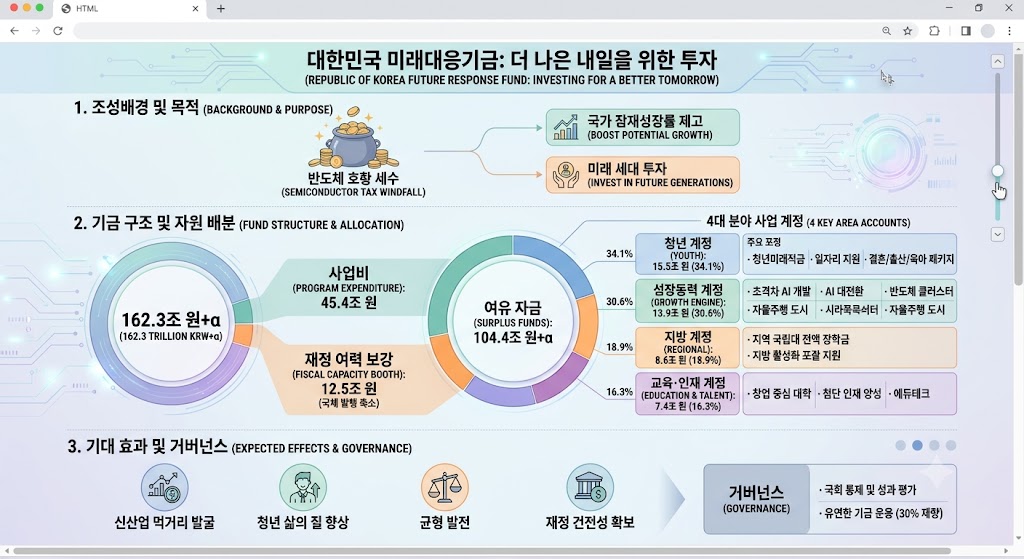
Of the fund’s resources, 45.4 trillion KRW will be invested in these four major areas, and 12.5 trillion KRW will be used to reduce new government bond issuance. The remaining 104.4 trillion KRW will be kept as reserve capital for fiscal stabilization purposes rather than being spent immediately. It is, in a sense, a fiscal reservoir—money tucked away in the warehouse when tax revenue is good, to be drawn upon later when revenue drops or unexpected expenses arise.
However, concerns surrounding this fund are significant.
Critics point out that the amount of money the government can operate at its discretion without prior parliamentary control has increased. Many of the projects in the four major areas, such as tuition support for regional national universities or youth support, are programs that require continuous fiscal input once started. If the actual operational period of the fund ends in just 4-5 years, there is an analysis that the timing of when resources dwindle might overlap with the need to shift these continuous projects into the general budget, potentially creating a future burden.
How Other Countries Handle Tax Revenue Booms
This dilemma is not unique to South Korea. Countries around the world reportedly face similar crossroad decisions when unexpected tax booms or fiscal surpluses occur.
Broadly speaking, there are two paths:
One is to accumulate it as a buffer against economic downturns,
and the other is to manage it as long-term assets, like a sovereign wealth fund for future generations.
‘Rainy Day Funds’ operated by several U.S. states are closer to the former, while Norway’s sovereign wealth fund is closer to the latter.
The Future Response Fund is a mix of both—nearly half is invested immediately in the four major areas, and a significant portion is kept like a reservoir. The direction itself doesn’t seem bad, but as always, the problem lies in the detailed operational rules.
After searching for more articles on the debate surrounding the fund, there are recurring questions:
Who manages this money, when can it be withdrawn, how much can be spent, and will the same principles be maintained even if the government changes?
The fact that the 162 trillion KRW itself could be largely operated outside the framework of the National Assembly’s annual budget review raises concerns about weakened fiscal control. While the Ministry of Economy and Finance might see this as a golden opportunity to link the semiconductor boom to structural investment, politically, the debate over who holds the “key to the warehouse” is likely to continue for some time.
The Semiconductor Supercycle: How Long Will It Actually Last?
The reason Fitch attached the qualifier “temporary” while viewing this budget positively is that the source of the tax revenue increase is essentially concentrated on semiconductors alone. Since the recent tax revenue increase relies on the AI/semiconductor boom, Fitch’s diagnosis is that if the semiconductor industry normalizes, the fiscal deficit could gradually expand again.
Then the question becomes how long this boom will last, and industry outlooks are generally optimistic.
Reports have flooded in about DRAM and NAND prices jumping by double-digit percentages in just a few months during the first half of this year, and as AI server memory demand grows faster than expected, market research firms are successively upwardly adjusting their forecasts.
Korea Ratings predicted that the expansion of AI memory demand would spread to general-purpose DRAM and NAND, leading to a favorable trend until 2027, and many in the securities industry similarly analyze that earnings growth will continue at least until 2027.
The logic is that while Samsung Electronics and SK Hynix are accelerating capacity expansion, the new production capacity is not expected to be fully operational until after the second half of 2027, so supply shortages and strong prices will be maintained until then.
However, opinions within the industry are divided on whether to view this cycle as a typical rise-and-fall curve like in the past, or as a long, gentle trend based on the structural demand of AI. What is certain is that from some point in 2027-2028, expansion volume will begin to hit the market, and no one can guarantee how prices will move after that.
Semiconductor Downcycle and Tax Shortfalls: A Pattern Experienced in 2017-2020
Actually, this configuration is not unfamiliar.
During 2017 and 2018, when we experienced the semiconductor supercycle, surplus tax revenues of 23.1 trillion KRW and 25.5 trillion KRW were generated, respectively. However, in 2019, when the semiconductor downcycle arrived, tax revenue was short by 1.3 trillion KRW, and in 2020, when the COVID-19 shock overlapped, the shortfall grew to 6.5 trillion KRW. This is proof that tax revenue that overflowed during the boom can quickly flip into a deficit during a downturn.
It is said that the Minister of Economy and Finance also mentioned in a recent briefing that no one knows whether the semiconductor super-boom will last until next year, the year after, or beyond, and thus such tax revenue cannot all be spent on consumption in the same year.
The background for creating the Future Response Fund seems to have come from this learning effect from 2017-2020.
However, no matter how well a reservoir is built, if the speed of filling it (the duration of the semiconductor boom) and the speed of draining it (the fiscal demand of the continuous 4 major area projects) are mismatched, the reservoir can bottom out at any time.
Looking more closely at the 2018 case, the pattern is quite clear.
In March of that year, Samsung Electronics and SK Hynix stock prices hit a peak and began to fall, but semiconductor exports hit a new monthly all-time high 6 months later in October. And 9 months later, in December, semiconductor exports plummeted 8.3% year-on-year, and the real economy froze rapidly. Stock prices, export performance, and the real economy declined in sequence with a time lag.
The semiconductor boom that led the COVID-19 recovery in 2020 also entered a downcycle in the second half of 2021, repeating a similar flow. While many analyses suggest this AI-driven supercycle is based on different structural demand than in the past, as long as it bears the name “cycle,” it seems impossible to completely erase the premise that it will eventually decline.
What is the Relationship Between Korea’s Credit Rating by Fitch and This Assessment?
This report does not immediately lead to a national credit rating upgrade.
In its regular evaluation at the end of January this year, Fitch maintained South Korea’s national credit rating at ‘AA-, Stable’, citing the mitigation of geopolitical risks and the maintenance of a medium-term downward path for the government debt-to-GDP ratio as factors for an upgrade, and damage to the effectiveness of fiscal policy due to political deadlock and the possibility of a spike in the national debt ratio as factors for a downgrade.
This 2027 budget assessment can be seen as acting as a basis for somewhat alleviating one of those downward factors, the ‘risk of a spike in the national debt ratio.’ At the same time, the downward pressure of structural growth slowdown due to aging, which Fitch has already pointed out, is repeated throughout this report.
While the rating itself remains the same, one of the two pillars supporting the rating (fiscal soundness, growth potential) is improving in the short term, while the other remains a homework assignment.
Isn’t What Fitch is Really Worried About South Korea’s Potential Growth Rate?
As I kept looking at the numbers, I wondered if the weight of Fitch’s message is actually on the growth rate rather than the fiscal situation itself. In this report, Fitch emphasized the importance of connecting temporary tax increases to improvements in productivity and potential growth. In other words, the current fiscal improvement is just a number riding on the performance of a few semiconductor companies, and it should not be read as a sign that the entire Korean economy’s strength has improved.
In fact, South Korea’s potential growth rate was around 5% in the early 2000s, fell to the mid-3% range in the 2010s, then to the mid-2% range from 2016-2020, and has recently dropped to around 2% based on Bank of Korea estimates. The OECD views it even lower, estimating it fell from 1.92% in 2023 to 1.71% in 2024, and will drop to the mid-1.5% range next year. The Bank of Korea predicts that if this trend continues, entering the 0% range in the 2040s is inevitable.
No matter how well one industry like semiconductors does, if structural problems such as demographic changes and productivity stagnation remain, the potential growth rate curve itself has no choice but to continue heading downward.
National Debt Ratio of 48.3%: How Does It Compare to Other Countries?
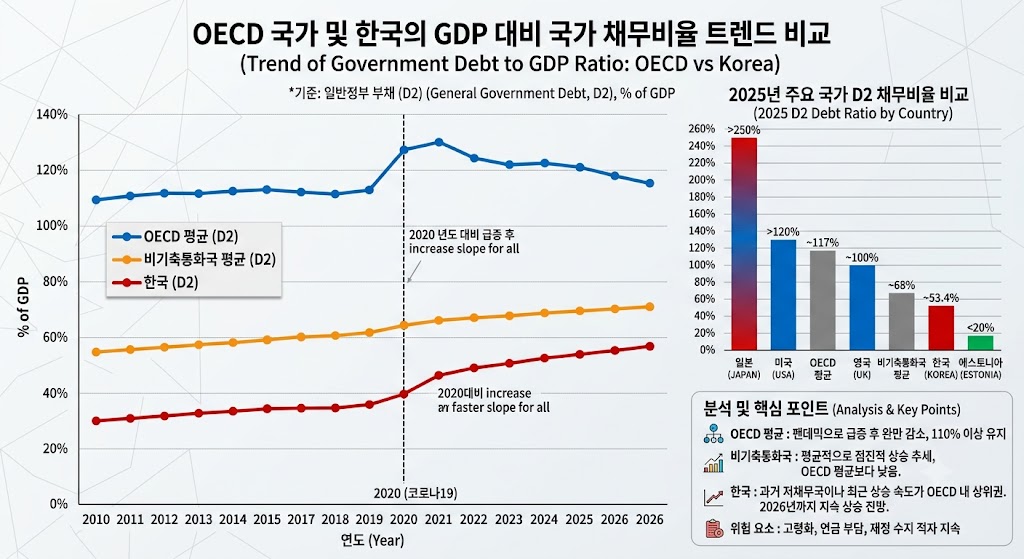
Looking at a single number absolutely can cause you to miss things, so I made some comparisons. As of 2024, the OECD average general government debt ratio is around 74%, while Japan is at 237%, the U.S. at 121%, and France at 113%. Based on this standard, South Korea’s national debt ratio is still in the lower-middle tier of the OECD, and the absolute level itself is indeed low. This is also a logic the government often uses when talking about fiscal soundness.
The problem is the speed. The IMF Fiscal Monitor report noted that from 2020 to 2026, the increase in the debt-to-GDP ratio for 35 developed countries averaged about 1 percentage point, whereas South Korea jumped 21 percentage points during the same period, ranking 2nd in growth speed after Estonia. Given that there is no precedent for a country whose debt-to-GDP ratio has risen by over 20 percentage points in 5 years to maintain its credit rating, this combination of ‘low level but rapid speed’ is ultimately the point that credit rating agencies are most sensitive to. The fact that this Fitch report positively noted the national debt ratio improvement path is, in reverse, proof that this speed itself has been continuously raised as a downward factor.
The Key Point to Watch: Will the Future Response Fund Actually Boost the Growth Rate?
To summarize, I think Fitch’s perspective can be summarized as follows.
The 2027 budget itself is an attempt to strike a balance between fiscal soundness and investment in future growth engines, and in the short term, fiscal indicators are noticeably improving. However, the source of that improvement is concentrated on a single external variable: the semiconductor supercycle. The moment that cycle breaks, the current good numbers could largely revert.
The key will ultimately be whether the 45.4 trillion KRW in the Future Response Fund actually moves the needle on productivity or potential growth in a few years, which is impossible to confirm at this point.
For youth, AI, and regional investments to bear fruit, time is needed, and the possibility that the semiconductor industry could turn down before then cannot be ruled out. Whether this budget, which received high marks from both Fitch and Moody’s, will remain as an example of ‘South Korea using the semiconductor boom well as a primer for structural reform’ when looked back upon in a few years, or remain as another data point that fluctuated with the semiconductor cycle like in 2017-2020, is still an open question.
Reading several articles together, I felt that while credit rating agency reports are usually cold documents, this one felt particularly ambivalent.
In one sentence, they praise it as a much stronger fiscal performance than previous projections, while
in the very next sentence, they put a question mark on the sustainability of that performance.
This dual tone itself seems to show exactly where the Korean economy stands right now.
One industry, semiconductors, is earning so well that the short-term numbers look better than ever, but once you strip those numbers away, slower and heavier problems like demographic structure and productivity remain exactly where they were.
It is unlikely that a single budget will suddenly solve those problems, and Fitch likely didn’t add that extra sentence because they didn’t know that.
References
- Fitch and Moody's praise government budget but say, "It must lead to actual productivity and growth rate improvements" | Source: Asia Economy | https://www.asiae.co.kr/article/2026090914182161451
- Fitch gives positive evaluation to Korea's budget for next year... "Fiscal balance improvement and national debt stable"
- Fitch: "Concerns over fiscal deficit expansion when Korea's semiconductor cycle ends"
- Fitch, positive on Korea's budget for next year... 'Warning' on semiconductor reliance
- Fitch: "Possibility of fiscal deficit expansion upon normalization of Korea's semiconductor industry"
- Fitch projects managed fiscal deficit at 0.1% of GDP for next year
- Fitch: "Concerns over fiscal deficit expansion when Korea's semiconductor cycle ends"
- 'Government warehouse' Future Response Fund launches with 162 trillion KRW... 45 trillion KRW to be spent on youth, AI, and regions
- 821 trillion KRW super budget riding the semiconductor boom... Fiscal shake-up if tax revenue hits a wall
- What happens to the 162 trillion KRW Future Response Fund in 5 years?... The warehouse runs dry
- 'All-time bonus' brought by semiconductors... Where does the 'surplus tax revenue' go? [Source] - Kookmin Ilbo [Original Link] - https://www.kmib.co.kr/article/view.asp?arcid=0030003566