
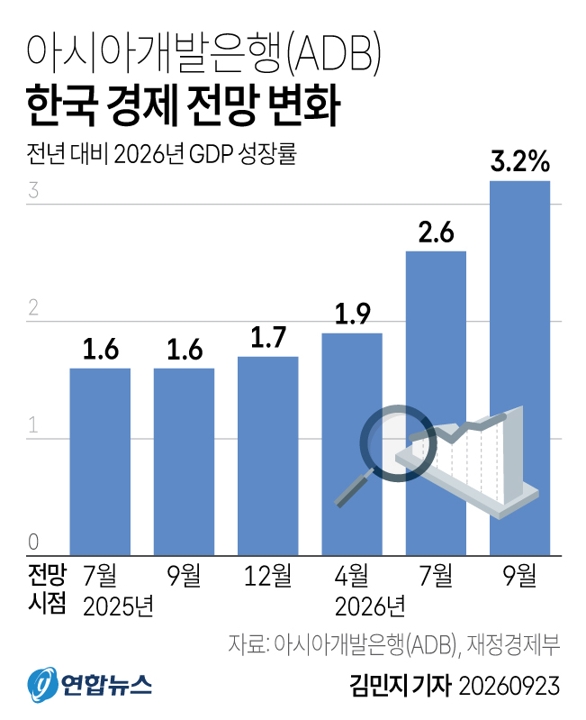
It is rare for a growth forecast to shift by as much as 1.3 percentage points in just five months.
Released on September 23, the ADB’s growth forecast for South Korea in 2026 stands at 3.2%, marking two consecutive upgrades following the 1.9% forecast in April and 2.6% in July.
At the core of this upward revision is the export of AI semiconductors.
How much has the ADB’s growth forecast for South Korea increased since April?
It is 1.3%p higher than in April and 0.6%p higher than in July. The ADB issues its annual outlook in April, a supplementary outlook in July, and a revised outlook in September; this year, the figures for South Korea were different each time.
Next year’s figures followed the same trend.
Only inflation remains stagnant. The forecast for this year (2.7%) and next year (2.2%) was kept unchanged from July, as the ADB concluded that government price stabilization policies would offset the inflationary pressure from energy prices and strong domestic demand.
Usually, if the economy is hotter than expected, inflation forecasts are raised accordingly. While the ADB acknowledged the upward pressure, it did not adjust the figures, and actually lowered the inflation forecast for developing Asia-Pacific countries from 4.3% to 4.2% for this year.
3.2% is not an outlier. The Bank of Korea projected 3.3%, while the KDI projected 3.2%(), which is 0.2%p higher than the government’s 3.0% forecast from July. Considering last year’s actual growth rate was 1.1%, the country is looking at nearly triple the growth in a single year.
Countries that also saw upward revisions in the ADB growth table
Between July and September, the countries with the largest upward revisions were Singapore, Taiwan, and Hong Kong, with South Korea coming in fourth.
The most interesting part of this announcement was not the line about South Korea, but the Asia-Pacific growth table attached to the back of the press release.
If you look only at the line for South Korea, it reads like “the Korean economy performed well,” but the picture changes when you look at the entire table.
Singapore’s forecast rose from 3.2% to 5.0% (a 1.8%p increase), Taiwan’s from 9.5% to 11.0% (1.5%p), and Hong Kong’s from 3.0% to 4.2% (1.2%p).
Other developed nations like Japan (0.7%), Australia (2.0%), and New Zealand (1.6%) did not move at all. The group average rose by 0.5%p to 3.1%, suggesting that a few specific countries are driving the average upward.
All the economies that moved upward are deeply integrated into the semiconductor supply chain. Two of them are also major buyers of Korean chips. According to Data News’ analysis of Korea Customs Service data, Hong Kong and Taiwan accounted for 16.5% and 11.1% of South Korea’s semiconductor exports in August, respectively.
How much did semiconductor exports boost the ADB’s growth forecast for South Korea?
While the ADB provided four reasons, the weight is clearly on semiconductors.
The July-August Manufacturing Purchasing Managers’ Index (PMI) and Business Survey Index (BSI) were robust.
Exports increased due to AI semiconductor demand.
Fiscal policy was expansionary.
Private consumption recovered moderately thanks to corporate earnings.
The second reason is confirmed by the numbers.
According to the Ministry of Trade, Industry and Energy’s August export and import trends, semiconductor exports in August reached $46.65 billion, a 209% increase from a year ago, setting a new monthly record and surpassing the $40 billion mark for three consecutive months. Looking at the fixed prices for memory in the same report, the price of a DDR5 16Gb chip rose from $35.0 in April to $46.5 in August. Between the ADB’s April and September forecasts, chip prices jumped by more than 30%.
The skew is best realized through percentages.
From January to August, semiconductors accounted for 40.5% of total exports, and 73.7% of the total export growth during the same period came from semiconductors.
If we look only at the month of August, semiconductors accounted for 78.8% of the total export growth.
It would be incorrect to say that everything except semiconductors has cooled down.
Exports of non-semiconductor items also increased by 20% in August. However, within that category, automobiles fell by 29.8% and ships by 45.9%. The Ministry of Trade, Industry and Energy attributed this to temporary factors such as holiday shifts, partial strikes, and a decrease in delivery volume to India.
Honestly, I stared at this percentage longer than I did at the 3.2% headline.
Why are the ADB’s growth forecasts fluctuating so much?
It is because the forecasts are chasing actual data.
At first, I thought it might be a base effect, given that last year’s growth rate was as low as 1.1%.
That is only half true. It was already known in April that 2025 was a sluggish year, and the number released at that time was 1.9%. The base effect only lowered the starting line and cannot explain the 1.3%p added afterward.
The rest comes from the way the forecasts are constructed.
Growth forecasts are calculations based on assumptions made at the time. They estimate GDP by assuming export volumes and chip prices.
In April, it was difficult to assume that monthly semiconductor exports would exceed $40 billion for three months in a row. Once the actual figures were recorded, the assumptions were adjusted, and economies with a high reliance on semiconductors saw their results fluctuate significantly.
The fact that the ADB is not alone in this supports this explanation.
Taiwan’s statistical authority, the DGBAS, also raised its national growth forecast three times in a row: 7.71% in February, 9.64% in May, and 11.05% in August. As data came in, everyone followed the same upward trend.
This structure works in reverse as well. If a variable causes a significant increase, it will cause a significant decrease when it turns downward. This is why we must look at what is driving the forecast before how quickly the figures have risen.
The same chip boom, but different results: Why Taiwan’s 11% and South Korea’s 3.2% growth forecasts diverge
It comes down to whether chip exports translate into consumption.
Taiwanese authorities explained that demand for AI infrastructure is boosting not only exports but also private consumption and private investment.
In contrast, the KDI observed that while South Korea’s semiconductor boom is evident in exports and facility investment, the income gains are concentrated in the semiconductor sector and only slowly spreading to consumption.
This difference in intensity is reflected in the word choices in the ADB press release.
“Increase” is used for exports and “robust” for manufacturing indicators, but “moderate recovery” is used for private consumption. It is as if they are describing different speeds within the same sentence.
One cannot explain the 7.8%p gap between the two countries solely by consumption. Taiwan started from a different place, having grown by 8.76% even last year. Nevertheless, the picture for South Korea is clear: The average has risen, but the body that created that average is narrower than expected.
Downside risks identified by the ADB and the 2027 South Korea growth outlook
The ADB lists three risks.
Geopolitical tensions, global financial market volatility, and a contraction in exports and investment due to additional U.S. tariff hikes.
All three can directly affect the semiconductor export route.
Tariffs are not just about direct exports to the U.S.
In August, the U.S. accounted for only 9.1% of South Korea’s semiconductor exports, but if chips sent to China (35.8%), Hong Kong, Vietnam (11.5%), and Taiwan are intermediate goods, they are not free from the tariffs imposed on the final products. The fact that 84.0% of exports are concentrated in the top five regions is a burden in the same vein.
The 2.3% forecast for next year is nearly 1%p lower than this year. The calculation is that the additional growth on top of the high level set by the chip boom will diminish. Developing Asia-Pacific countries as a whole are charting a much flatter path, with 5.0% for this year and 5.1% for next year.
The ADB’s next figures may or may not be released in December. The December supplementary outlook on the schedule comes with the caveat “if necessary.” Before then, the Ministry of Trade, Industry and Energy’s export and import trends will be released at the beginning of every month. Ultimately, it was that single line for semiconductors in those reports that drove this forecast.