
Why are people handed tofu when they are released from prison? Following this question leads us to a thousand years of tofu history.
Tofu arrived from China and left its mark in Korean literature by the late Goryeo period in the poems of Yi Saek. The Joseon Royal Court even designated specific temples, known as Joposa, solely for the purpose of making tofu for royal ancestral rites.
You likely remember the scene in the movie ‘Lady Vengeance,’ where a preacher hands a block of pure white tofu to Geum-ja as she exits prison. While the common explanation—that it signifies “living a clean, new life without sin, like tofu”—is familiar, the deeper you dig, the more layers you find hidden within that single block.
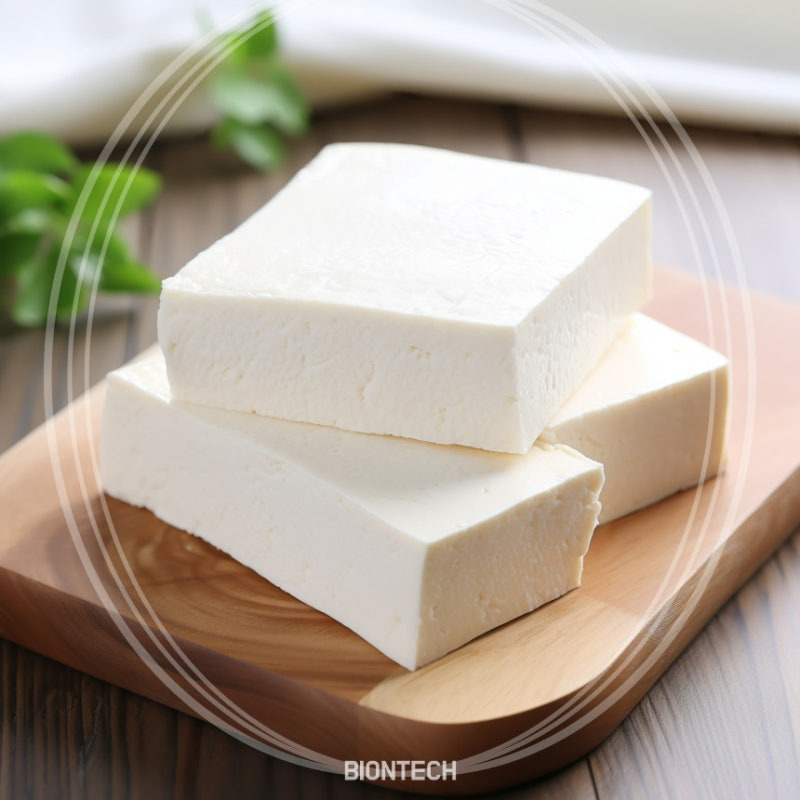
Who First Made Tofu: The Gaps in the Liu An Legend
It is often said that tofu was discovered by accident about 2,000 years ago by Liu An, the Prince of Huainan during the Western Han Dynasty, while he was attempting to create an elixir of life. The problem is that there are almost no records of tofu for about 1,000 years after that. Since tofu only appears clearly in literature around the Song Dynasty, many view the Liu An story as a later legend created to attach a famous name to a great invention.
Regardless of the inventor, the principle of grinding soybeans, boiling them, and curdling them with a coagulant is clear. Because it uses a method similar to cheesemaking to coagulate proteins, some interpret it as being inspired by the dairy techniques of nomadic peoples.
When Did It Arrive on the Korean Peninsula?
The most widely accepted theory is that it was introduced in the late 13th to 14th century during the late Goryeo period, when exchanges with the Yuan Dynasty were active. It is presumed that the manufacturing method was brought over by envoys, merchants, and monks. While there are theories about its arrival during the Three Kingdoms period, there are no records to support them.
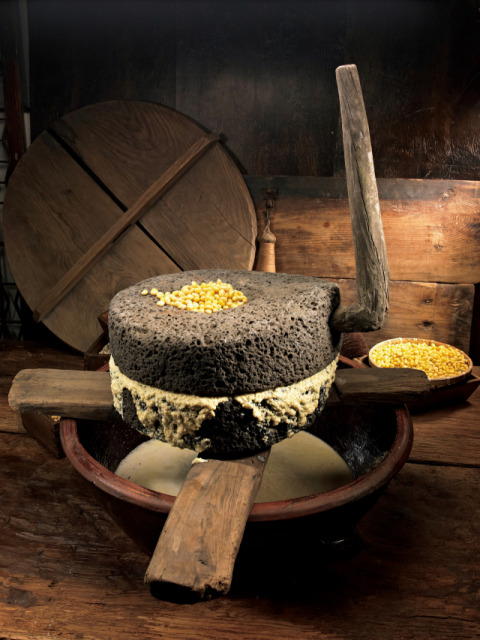
What is certain is what we find in literature.
This is because the first confirmed mention of tofu in our records comes from a poem by the late Goryeo scholar Mogeun Yi Saek.
The First Korean Record of Tofu in Yi Saek’s Poetry
“Daesaguduburaehyang” (大舍求豆腐來餉), included in the Mogeun Sigo, is a poem describing a monk (Daesa) who brought tofu and offered it as a meal. The frequently cited lines are as follows:
菜羹無味久 豆腐截肪新 — Long tired of bland vegetable soup, the tofu, sliced like fat, is a fresh delight. 便見宜疏齒 眞堪養老身 — Easy to eat with thinning teeth, it is truly perfect for nourishing an aging body.
‘截肪 (Jeolbang)’ means ‘sliced fat,’ a metaphor for the white, smooth appearance of tofu.
For an elderly scholar who had been eating only vegetable soup, tofu provided a meat-like richness while being a food that could be eaten even with weak teeth. I find it quite interesting that the view of tofu as a ‘health food for the elderly’ existed even back then.
Joseon Tofu, Recognized by the Ming Emperor
In the Joseon Dynasty, tofu even made its way onto the diplomatic stage.
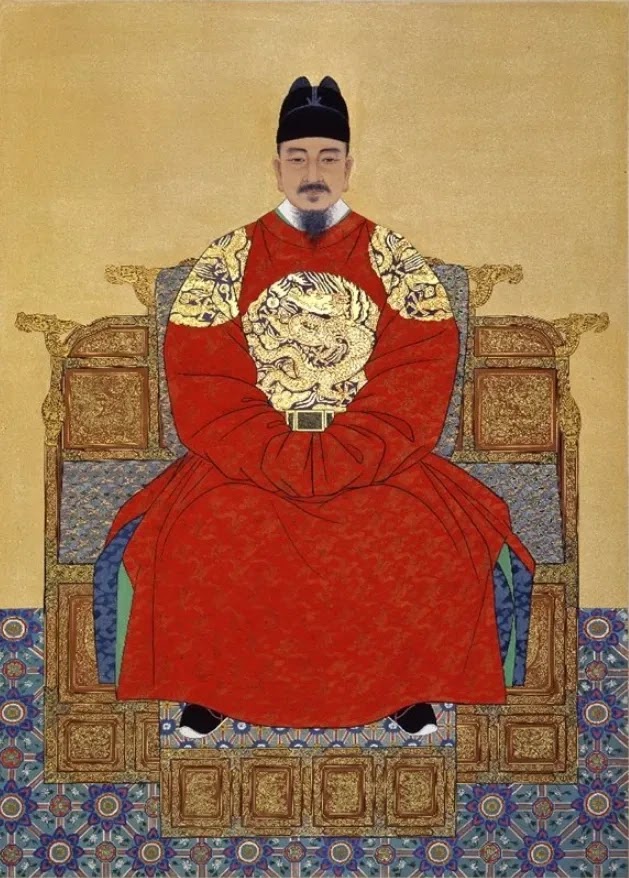
In the Veritable Records of the Joseon Dynasty (Sejong Sillok), it is recorded that in 1434 (the 16th year of King Sejong’s reign), the Xuande Emperor of the Ming Dynasty praised the women sent from Joseon for their food preparation, stating, “Among them, the method of making tofu is exceptionally refined (其造豆腐之法, 尤為精妙).” Given that China is the origin of the dish, being praised by the Chinese imperial court speaks volumes about the quality of Joseon tofu.
There are also stories that Ming soldiers dispatched during the Imjin War (Japanese invasions of Korea) searched for Joseon tofu. However, as this cannot be verified through primary sources, I share it only as an anecdote.
Tofu for Royal Rites Was Made in Temples: Joposa
If I were to point to the reason behind that skill, I would cite the Joposa (造泡寺).
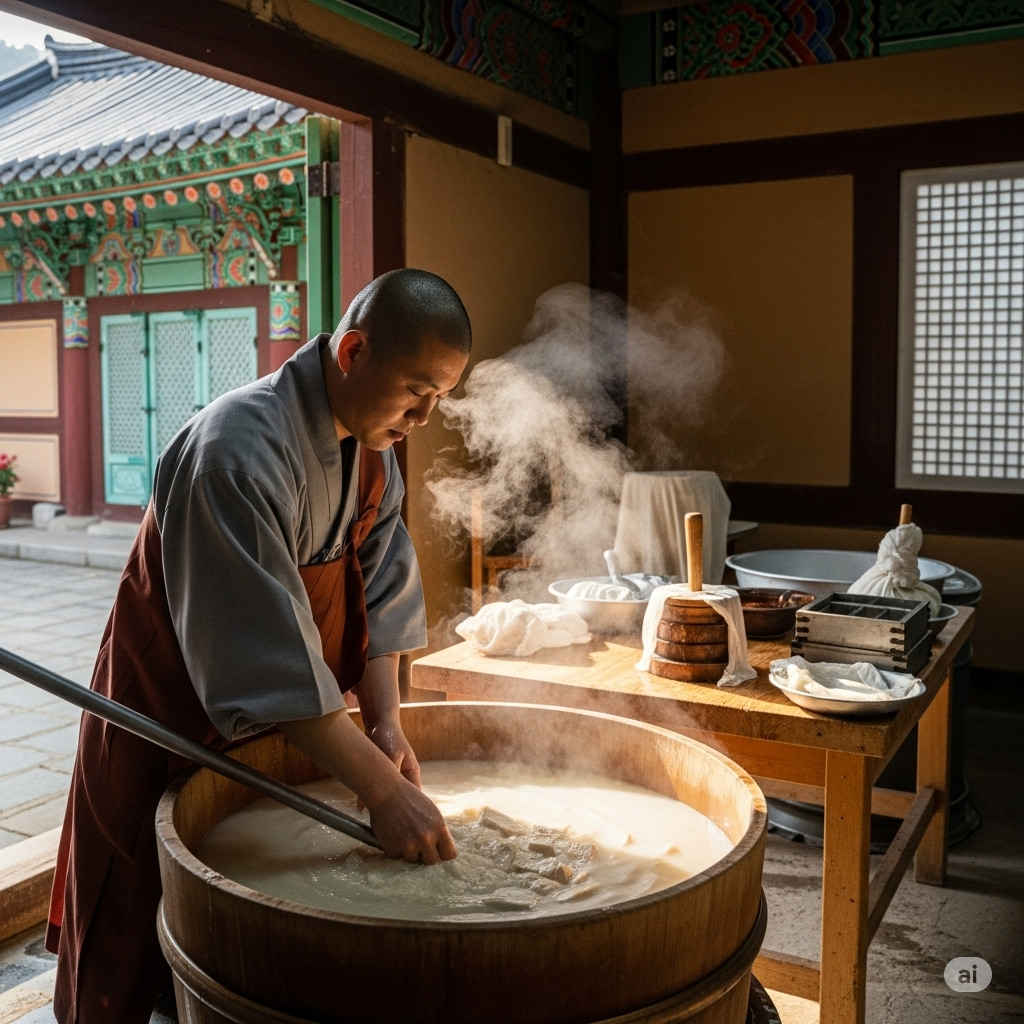
Joposa were temples designated to make and offer tofu for royal ancestral rites. ‘Po (泡)’ refers to tofu.
Royal rites sometimes required vegetarian offerings without meat, and white, clean tofu was an essential sacrificial food. Since tofu spoils easily, it was logical for temples near the royal tombs to take charge. The monks’ familiarity with bean-based foods and the temple’s labor force were also contributing factors.
Why did this system lead to tofu quality?
Royal offerings had to pass strict standards, and the same temples repeated the same task for generations. It was a structure where techniques were accumulated in one place, accompanied by rigorous inspection. The fact that temples like Jingwansa in Seoul still maintain a connection with tofu and temple food today is a remnant of this history.
Heo Gyun’s Praise for Tofu and Yeonpotang
Tofu was also an object of refined taste for the nobility. In his food critique Domundaejak, Heo Gyun wrote of tofu: “People outside Janguimun Gate make it well. Its softness and smoothness are beyond words.” This means that even then, people had a palate for seeking out tofu from specific neighborhoods.
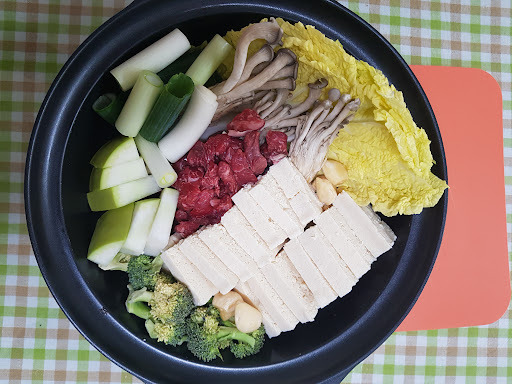
Yeonpotang (軟泡湯), which scholars enjoyed gathering together to eat, was originally a tofu dish. The name itself means ‘soft tofu soup,’ and it was made by pan-frying tofu and boiling it in chicken broth. It is quite different from the octopus yeonpotang of today.
Why We Eat Tofu After Release from Prison
Tofu has even permeated our proverbs.
“If you like someone’s words, you’ll even buy tofu when you went out to buy bean dregs,” refers to the power of kind words.
“Losing a tooth while eating tofu,” refers to being caught off guard.
“I wouldn’t believe it even if they said they made tofu out of beans,” refers to deep distrust.
There are usually three explanations for the custom of eating tofu after release from prison:
- Symbol of Whiteness: It means to start fresh and clean, like tofu.
- Contrast with ‘Bean Rice’: It signifies not returning to the ‘bean rice’ (a derogatory term for prison meals) of incarceration. Some interpret it as tofu being unable to turn back into beans.
- Nutrition: A practical reason to replenish easily digestible protein in a body that has been confined for a long time.
Rather than one being the sole ‘correct’ answer, it seems more natural to view the custom as having solidified through the overlapping of these three explanations.
From LA to the World: Sundubu-jjigae
Tofu crossed borders again in the 1990s through the sundubu-jjigae (soft tofu stew) of the Korean-American community in LA. BCD Tofu House, opened by Hee Sook Lee in LA in 1996, is the representative example.
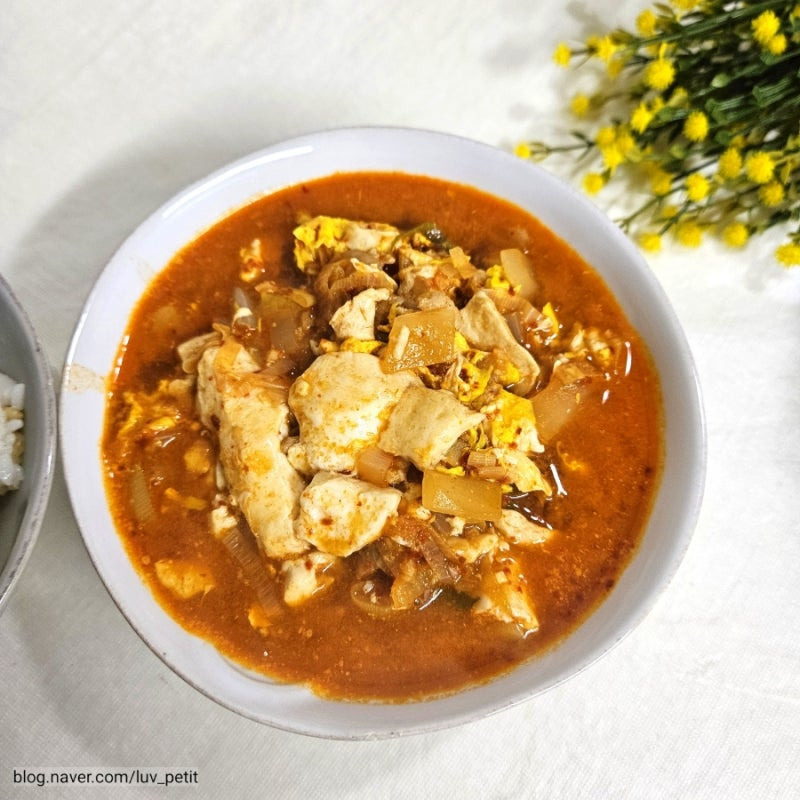
By pairing it with stone-pot rice and grilled fish to complete a meal, and allowing customers to choose their spice level, the restaurant lowered the threshold for local diners. Interestingly, this LA-style composition returned to Korea and established itself as a common format for soft tofu specialty restaurants.
How Do Korean, Chinese, and Japanese Tofu Cultures Differ?
| Country | Typical Tofu and Dishes | Cultural Position |
|---|---|---|
| Korea | Firm tofu, soft tofu; dishes like stews and braised tofu that blend with other ingredients | Strong symbolism in ritual food, post-prison customs, etc. |
| China | Varies from firm to soft by region; fermented tofu like stinky tofu, Mapo tofu | A wide-ranging daily ingredient, even used in street food |
| Japan | Silken tofu (kinugoshi), yuba, chilled tofu; cooking that highlights the ingredient’s natural flavor | An object of delicate appreciation, as seen in the 18th-century cookbook ‘Tofu Hyakuchin’ |
To put it roughly, Chinese tofu is an ingredient that transforms, Japanese tofu is an object to be savored, and Korean tofu is a food shared together around a stew pot.
Next time you slice a block of tofu, you might want to recall that white glow that Yi Saek welcomed, likening it to ‘fat.’
References
- Health Chosun, Feeding 'Tofu' to Those Released from Prison... Is It for 'Health'?
- Hankyung, [Why is this?] The reason people eat tofu when released from prison
- Encyclopedia of Korean Culture, Tofu (豆腐)
- YouTube, "Tofu was made by people who used to make cheese"
- The Heart of Korean Food
- Korea Soybean Research Association, The Origin of Tofu Manufacturing
- Mogeungo
- YouTube, Why Tofu Was Included in the Ming Army's Diet During the Imjin War / History of Soybeans and Tofu
- Academy of Korean Studies, Dictionary of the Veritable Records of the Joseon Dynasty, Joposa (造泡寺)