
Which restaurant would you book: one with 100 reviews averaging 4.5 stars, or one with only 3 reviews that are all 5.0 stars?
Our inclination toward the “seemingly certain” option over the one with a higher expected value is driven by three cognitive biases: the certainty effect, loss aversion, and confirmation bias.
Why do cognitive biases make us choose the ‘seemingly certain’ option over expected value?
Let’s say you are booking a dinner for an anniversary.
Option A has 100 reviews with a 4.5 average, while Option B has 3 reviews, all of which are 5.0.
Even though A is safer in terms of failure probability, there are moments when we are drawn to the ‘perfect’ number in B.

Interestingly, actual experiments show the opposite trend.
In a study on choosing phone cases (Powell et al., 2017, Psychological Science), participants tended to choose options with more reviews, even if the average star rating was lower.
Regardless of the choice, the commonality is the same: instead of weighing averages and sample sizes, we try to finalize our decision based on a single noticeable cue.
These three biases are the representative concepts that explain that very moment.
The Certainty Effect: Why we choose 100% even when the expected value is lower
The certainty effect is a cognitive bias where we place excessive weight on certain outcomes over probabilistic ones.
Kahneman and Tversky demonstrated this through an experiment in their 1979 prospect theory paper.
One option offered a 80% chance to win 4,000, while the other offered a guaranteed 3,000. Even though the expected value of the first (4,000 × 0.8 = 3,200) was higher, the majority of participants chose the certain 3,000.
If we scale these numbers up (a hypothetical conversion), it’s like choosing between an 80% chance at 40 million won and a guaranteed 30 million won. By choosing the certain option, you are giving up 2 million won in expected value—that 2 million won is essentially the price you pay for the “feeling of certainty.”
Why does this happen?
Prospect theory explains that humans do not perceive probabilities as mere numbers. As expressed in the paper’s abstract, probabilistic results are undervalued compared to certain ones. While 80% and 100% are only 20 percentage points apart, 100% is perceived as the line where uncertainty disappears, making the psychological gap feel much larger than the numerical one. This is why the same 20 percentage point difference feels completely different than moving from 20% to 40%.
How prospect theory challenged the assumption of the rational human is discussed in How Behavioral Economics Shattered the Myth of the Rational Human.
Loss Aversion: The coefficient where the pain of losing is about twice the joy of gaining
At the deeper root of our preference for certainty lies loss aversion.
It is the concept that we feel the pain of a loss more intensely than the joy of an equivalent gain, first proposed in the 1979 prospect theory.
Follow-up research in 1992 estimated this ratio (the loss aversion coefficient) to be about 2.25, often summarized as “about 2 times.” The value varies significantly depending on the individual and the situation. For reference, Kahneman received the Nobel Prize in Economics (2002) for this research; Tversky passed away in 1996 and was not among the recipients.
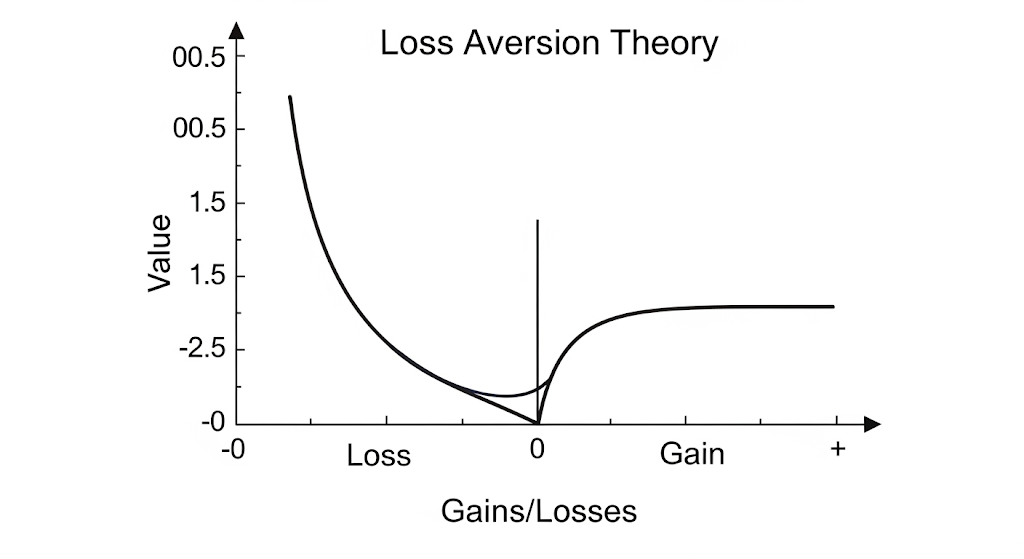
Let’s calculate this with a coin flip.
Would you participate in a game where you win 150,000 won for heads and lose 100,000 won for tails?
The expected value is 0.5 × 150,000 - 0.5 × 100,000 = +25,000 won, which is a gain.
If you still hesitate, apply the coefficient. The 100,000 won you might lose feels like 100,000 × 2.25 = 225,000 won, which is larger than the 150,000 won you stand to gain. For this game to feel attractive, the gain would need to be well over double the loss (this is a simple application; actual perception varies from person to person).
Loss aversion is most commonly seen in investing.
Think of an investor who cannot sell a losing stock, holding on while saying, “It will go up someday” (a hypothetical case). The unrealized loss before selling is just a number, but once sold, it becomes a realized loss, so the mind leans toward delaying that pain. This also leads to the status quo bias, where feeling change itself like a loss keeps us in the familiar present. Why the mindset of protecting money differs from growing it is worth reading alongside The Psychology of Money: Two Paths.
Confirmation Bias: Why we only gather evidence for what we believe
Confirmation bias is the tendency to search for information that aligns with our existing beliefs and to overlook or interpret opposing information differently.
Nickerson’s (1998) review concludes that this phenomenon appears widely in many forms. If loss aversion makes us “seek” certainty, confirmation bias makes us “protect” the certainty we have already obtained.

It is often said that social media filter bubbles and echo chambers fuel confirmation bias.
However, if you look at reviews summarizing related research (Media Technology & Democracy), the picture isn’t that simple. Evidence supporting filter bubbles is weak, and evidence for echo chambers is mixed. Even when they appear, they tend to be concentrated among a small group of the most politically extreme users. Research also cites that people prefer agreeable information but do not necessarily go out of their way to avoid opposing information.
Therefore, I believe it is more realistic to look at what information we pick up first rather than just blaming the “algorithms.”
Where do these 3 cognitive biases appear in daily life?
Rather than moving independently, these three biases often support each other to create “certainty.” The table below simplifies the tendencies seen in investing, information consumption, and career choices.
Comparison of how 3 cognitive biases manifest in investing, information consumption, and career choices
| Domain | Rational Approach | When Bias Intervenes (Relevant Bias) |
|---|---|---|
| Investing | Choose the option with higher risk-adjusted expected value | Prefer low-yield “principal-guaranteed” products; cannot sell losing stocks due to “break-even” mentality (Certainty effect, Loss aversion) |
| Info Consumption | Cross-check conflicting perspectives and sources | Find and read news/feeds that align with my perspective first (Confirmation bias) |
| Career | Compare new opportunities despite the risk | Stay in a familiar position due to fear of the uncertainty of change (Loss aversion, Status quo bias) |
Examples of how these biases lead to significant losses in investing are summarized in Why Smart Investors Failed in LTCM and 2008.
2 ways to reduce cognitive bias: Listen to opposing opinions and write down reasons why you might be wrong
If you only chase certainty, you are likely to miss better opportunities. While you cannot eliminate bias entirely, there are mechanisms you can insert before making a decision.

- Listen to the opinions of people who truly think differently. Playing “devil’s advocate” in team meetings is a frequently recommended method. However, psychologist Charlan Nemeth argues that opposition from someone who actually holds a different belief is more effective at making people rethink than role-playing (Behavioral Scientist, 2018 interview). It is better to seek out people with different perspectives than to assign roles.
- Write down in advance why your decision might be wrong. The same interview introduces an investment firm that requires decision-makers to write in detail over several days about “why this decision is wrong.” Nemeth sees this as a method closer to genuine opposing opinion. If you are doing this individually, adding one more line about the “maximum amount you can afford to lose” provides a benchmark for when you feel shaken by loss. This part is my suggestion, not research.
There is one thing you can do today: find one piece of writing that opposes the decision you are currently pondering, read it to the end, and write down in three lines what would change if that article were correct.
Notice: This article is general information based on public data at the time of writing and does not recommend the purchase or sale of specific stocks/assets or the subscription to financial products. Figures and research results may change in the future. (Last checked: 2026-10-28)
References
- Prospect Theory: An Analysis of Decision under Risk
- Advances in Prospect Theory: Cumulative Representation of Uncertainty
- Confirmation Bias: A Ubiquitous Phenomenon in Many Guises
- Powell, D., Yu, J., DeWolf, M. & Holyoak, K. J. (2017). The Love of Large Numbers: A Popularity Bias in Consumer Choice. Psychological Science. Press Release: https://www.psychologicalscience.org/news/releases/people-favor-highly-reviewed-products-even-when-they-shouldnt.html
- Behavioral Scientist (2018). Stop Playing Devil's Advocate, and Other Advice for Better Decision Making (Charlan Nemeth Interview). https://behavioralscientist.org/stop-playing-devils-advocate-and-other-advice-for-better-decision-making/
- Media Technology & Democracy. Echo chambers and filter bubbles don't reflect our media environment. https://mediatechdemocracy.com/all-work/echo-chambers-and-filter-bubbles-dont-reflect-our-media-environment