
The Secret Map of Great Navigators
Have you ever felt your heart race at the stories of legendary explorers? Like Columbus, who crossed unknown seas to discover a new continent, or Magellan, who successfully circumnavigated the globe. We admire their genius in navigation and indomitable courage in the face of their great achievements.
Of course, their exceptional skills are a given. But what if there had never been a favorable wind during their journeys? Or if an unpredictable storm had swallowed their ships?
Strangely, when we navigate the vast ocean of ‘money’, we often try to ignore the existence of these favorable winds and storms—’luck’ and ‘risk’. When someone emerges as a navigator who has amassed tremendous wealth, we strive to find the inevitable formula for success in every entry of their logbook. Conversely, when someone crashes into the reef of bankruptcy, we blame their recklessness and greed, vowing that we will not follow in their footsteps. We want to believe that success is 100% skill and failure is 100% incompetence, as it makes this turbulent sea feel predictable and fair.
But is that really the case? Today, even if it feels a bit uncomfortable, we will discuss the secret map that every navigator must unfold. It is the story of the two great currents—’luck’ and ‘risk’—that determine the course of our lives and money. At the end of this journey, you will likely view the sea of money with entirely different eyes. So, let’s raise the anchor and set sail together!

First Voyage: The Invisible Forces of Luck and Risk
The Boy Who Met a Million-to-One Favorable Wind, Bill Gates
Our first exploration examines how the legendary captain known as ‘Bill Gates’ was born. If, in 1968, young Bill Gates had not docked at a very special harbor (high school) called ‘Lakeside’, could the massive ship known as ‘Microsoft’ have ever set sail?

At that time, among the countless harbors around the world, there were very few places where students could freely touch the latest navigation equipment called ‘computers’ and learn how to operate them (programming). To borrow Morgan Housel’s expression, Bill Gates was indeed a boy who encountered a ‘million-to-one’ powerful favorable wind.
Of course, he honed his navigation skills by staying up all night and was a sailor with a passion hotter than anyone else. We usually focus only on his ’effort’ as the sail. But let’s pause for a moment and think. If he had never been given the ‘opportunity’ to board a ship and venture into the sea, where could his great talent and passion have blossomed?
This is the terrifying power of ’luck’. Luck is not merely a seasoning that slightly increases sailing speed. Sometimes, it becomes the ‘starting point’ from which the voyage can begin. For Bill Gates, Lakeside High School was like a vast ocean where he could set his talent afloat.
The Genius Who Perished in an Unforeseen Storm, Kent Evans
If Bill Gates’ story is a record of favorable winds, then there is a storm story that must be recorded alongside every navigation log. It is the story of ‘Kent Evans’, another genius navigator whom we do not remember.
Kent Evans was Bill Gates’ closest friend. Bill Gates himself recalled him as “the smartest kid I know.” They promised to explore the future seas together, and perhaps the Microsoft fleet would have set sail under the name ‘Gates, Allen & Evans’.
However, before Kent Evans could even begin his voyage, he was swept away by an unexpected storm in a climbing accident. His tragedy had nothing to do with his skill or effort. It was pure ‘bad luck’—in other words, ‘risk’.
We remember Bill Gates, who successfully completed his voyage, but we forget Kent Evans, who tragically vanished. This is due to ‘survivorship bias’, where we only hear the stories of those who survived and generalize the secrets of success. Kent Evans’ story warns us that in the sea of life and money, there are always reefs of ‘risk’ that cannot be controlled by your effort alone.
Another Voyage Shaped by Waves of Chance
- Case 1: A Failed Map Opens a New Continent (3M’s Post-it)
3M Post-it
In 1968, 3M researcher Spencer Silver set sail towards the destination of ‘strong adhesive’, but repeatedly failed and arrived at the unexpected island of ‘very weak adhesive’. His voyage was officially a failure. Years later, his colleague Arthur Fry, experiencing personal inconvenience with bookmarks falling out of hymnals, suddenly recalled the record of the failed voyage (weak adhesive). This ‘serendipitous encounter’ led to the discovery of a new continent called ‘Post-it’. - Case 2: The Sinking of the Greatest Fleet (Nokia’s Failure)
Nokia's Decline
In the mid-2000s, ‘Nokia’ was an invincible fleet in the mobile phone market. Their technology, or navigation skills, were beyond doubt. However, in 2007, a new type of ship called the ‘iPhone’ appeared, which had never existed before. Nokia dismissed it as just a ’toy ship targeting a small niche market’. By stubbornly adhering to their successful navigation method of ‘hardware’, they failed to read the massive current of change in the ‘software ecosystem’. Ultimately, their past great successes became an ‘inherent risk’ that blinded them to the future and sank their invincible fleet.


Second Voyage: The Mental Compass That Leads Us Astray
Now, we have confirmed the existence of the two great forces, luck and risk, that govern the flow of the sea. But why do we often fail to feel these obvious forces and even try to ignore them? The reason lies in the ‘cognitive bias’—a malfunctioning compass—installed in our minds.
My Voyage is Skill, Your Voyage is Thanks to Favorable Winds: Fundamental Attribution Error
It is easy to think this way: “My success in investing is due to my excellent navigation skills (analytical ability).” But when a friend succeeds, we think, “That friend was lucky to have met favorable winds.” Conversely, when I fail, I blame it on “unexpected storms (market conditions)” but when a friend fails, I say, “See, I told you that reckless sailing (aggressive investing) would lead to this.”
This psychological tendency to attribute one’s own success to skill and failure to bad luck, while attributing others’ success to luck and failure to incompetence, is known as ‘self-serving bias’ and ‘fundamental attribution error’. It serves as an instinctive defense mechanism to maintain the self-esteem of ‘I am a great navigator’. However, this defense mechanism prevents us from properly learning from our own successes and failures.
Arriving at the Destination Means Everything Was Right: Outcome Bias
Let’s say a captain recklessly steers his ship into a storm and miraculously arrives at a treasure island. From the outcome alone, he appears to be a ‘great navigator’. People would praise his decisiveness.
However, the process was a foolish gamble that had a 99% chance of shipwreck. Nevertheless, the outcome of ‘arriving at the treasure island’ transforms his reckless journey into a ‘wise decision’. This is ‘outcome bias’, where everything is judged solely based on the ‘result’, rather than the rationality of the process. Following the navigation skills of a lucky gambler only increases the probability of meeting the gambler’s tragic end.
The Heroic Ballad of a Pleasing Narrative: Narrative Bias
The human brain has an instinct to weave complex and random events into a ‘plausible story’. It is much easier and more enjoyable to understand Bill Gates’ success as a smooth heroic narrative—‘a genius boy who loved computers overcame adversity and changed the world’—rather than as a dry list of facts like ‘genius + effort + luck + …’.
In this process, the crucial element of ’luck’ in his success is often minimized to ‘his insight in not missing opportunities’ or completely omitted. The more we become accustomed to such heroic tales, the more we fall into the illusion that the world is predictable and develop unrealistic expectations that, like the protagonist, we can achieve everything just by trying.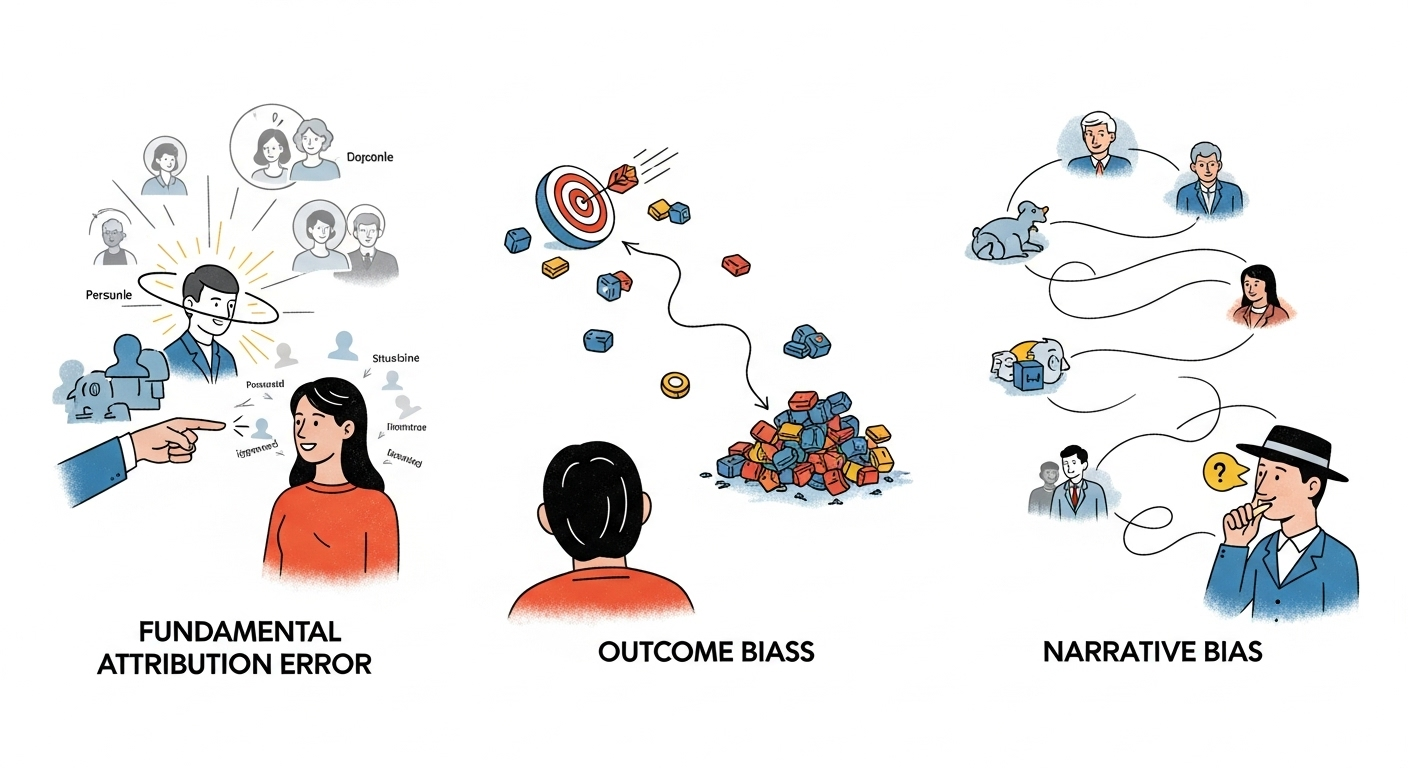
Third Voyage: How to Build a Ship That Doesn’t Sink in Storms
So, what should we do? Should we fall into nihilism, thinking, ‘If everything is just luck, there’s no need to row’? Absolutely not. Rather, acknowledging the existence of luck and risk is the true first step in building a wiser and sturdier ship. The key is to focus on the ‘sails and rudder we can control’ instead of getting frustrated by the uncontrollable waves.
Don’t Covet the Hero’s Secret Map, Learn Universal Navigation Skills
No one can follow Bill Gates’ course exactly. The special favorable wind he needed—‘Lakeside High School in 1968’—will never blow again. Mimicking the extreme success of a specific hero is akin to trying to replicate their luck, which carries a high probability of failure.
Instead, we should focus on the ‘universal principles’ that have been proven effective by countless captains over time.
- Consistently saving and investing a portion of income (regularly maintaining the ship and stockpiling food)
- Looking at long-term destinations without being swayed by short-term waves
- Not carrying the heavy burden of unmanageable debt
- Diversifying cargo (assets) instead of putting everything on one load
While these principles may not be shortcuts to a massive treasure island, they are the most reliable navigation skills to help most of us safely reach the peaceful harbor of ‘financial freedom’.
It’s More Important to Not Sink Than to Go Fast: Securing a Margin of Safety
To survive in the sea of investing, the most important thing is not to become ’the fastest ship’ but rather to become ’the ship that never sinks’. A single catastrophic shipwreck can take everything away from you.

Therefore, we must always prepare for unexpected reefs (risks). This is the concept of ‘margin of safety’.
- Emergency rations (cash reserves): Extra funds prepared for sudden storms or calms.
- Distributed cargo (diversified investments): Ensuring that even if one cargo hold takes on water, the entire ship does not sink.
- Conservative route planning (conservative forecasts): Always planning routes with the worst weather in mind.
- Manageable weight (affordable investments): Not loading the ship with an unmanageable weight.
A strong margin of safety is the most reliable shield that allows you to continue sailing without being thrown out of the sea when faced with unpredictable attacks.
Leave Room for ‘What If’ in Your Voyage Plans
We often tend to plan our future voyages too tightly. However, the sea of life never flows according to our plans.
Acknowledging the existence of luck and risk means leaving a spacious margin in our voyage plans for the question ‘What if…?’. A little more flexible goals, a route that can be adjusted, and mental preparedness to cope with unexpected changes in life. These are the essential wisdoms for navigating the uncertain sea.
The Conditions of the Greatest Captain
We have navigated the sea of ‘money’, examining records of dazzling favorable winds and tragic storms. The conclusion we reach at the end of this long journey is singular: ‘humility’.
The humility that does not boast that my success is solely due to my excellent navigation skills. The humility that does not excuse my failures by blaming the rough waves, but acknowledges my misjudgments. And above all, the humility to recognize the immense power of luck and risk that surpasses my map.
This humility is the most powerful driving force that makes us more cautious, allows us to see further, and helps us build sturdier ships.
Ultimately, the true winners in the world of money are not the smartest people, but rather the ones who survive the longest. And those who survive the longest are the ones who can be grateful in the face of favorable winds and humble in the face of storms.
So, where does your ship stand between luck and risk? The journey to find the answer to this question will itself be the greatest voyage that leads you to a new continent of financial freedom.